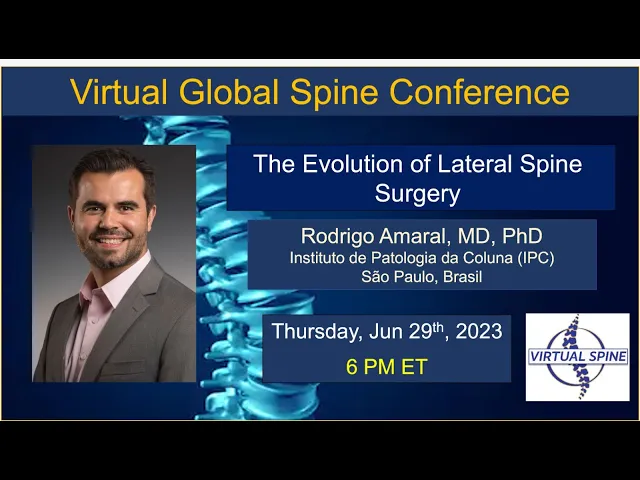
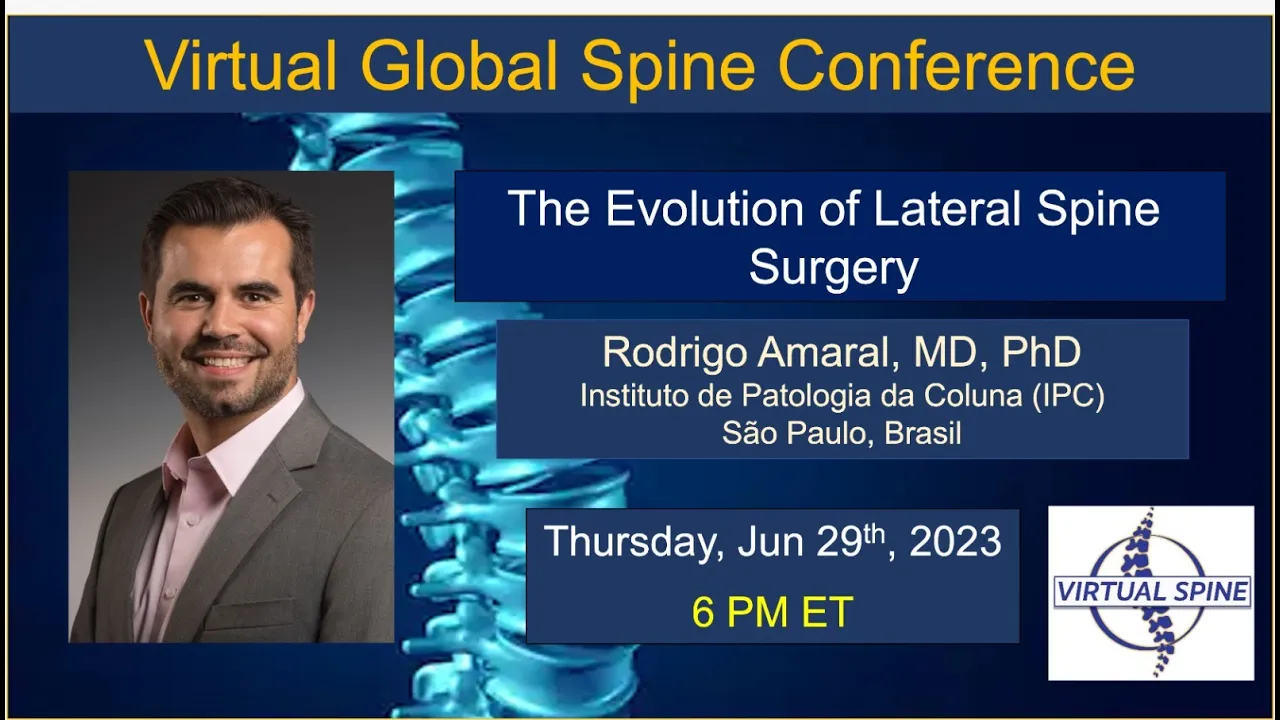
All right welcome everybody we're starting on our weekly session on bridge to a global spine conference this week we have a friend of mine Rodrigo Amaral he's a spine surgeon from Sao Paulo Brazil uh he's a distinguished leader I'm Pioneer in the field of spine surgery Brazil particularly in the development of techniques focus on lateral surgery so uh he will be talking about the History or the evolution of lateral spine techniques from the beginning uh to the uh the more carbon thingies so welcome Rodrigo I'm very happy to have you thank you very much Alfredo
it's very nice to be here thank you for your kind invitation uh let's talk a little bit about the it's impossible to talk about the evolution and the the the new Perspective of lateral surgery without uh going to through the history itself so I will give a brief uh introduction on the history and all you know the achievements that we get uh with the technique over time and it's a big pleasure to be part of this initiative the virtual spine conference and it's very good to be among friends and you as my friend for many
years uh very kind friends for many years uh invite me to to be in this position and I'm very grateful thank you very much I'm since here a lot of uh friends some friends some fellows uh I want you to make clear that anybody have any questions during the presentation just feel free to to ask the questions and I will try to be a little brief so we have some time for uh later on discussions if anybody wants so let's start sharing my screen is okay Great yes no perfect now okay so um orthopedic surgeon
from Sao Paulo Brazil I'm now director of the IPC Institute of the pathology of De colon at Sao Paulo I'm also part of the spine department at the Vita orthopedic Orthopedic Group in Sao Paulo founder of the Brazilian spiny study group and mujakura where we change the Curve is a outreach program that help people with scoliosis waiting list waiting on the waiting list for scoliosis surgery in the public health system in Brazil and I'm very glad to be here talking about the history history of my life in spine surgery what is the lateral spine surgery
the lateral Fusion for spine surgery working for many years with Professor pimenta here in Sao Paulo as my partner And also my mentor and lateral surgery is being part of my my whole history in spine surgery so I want to start with this quote Dean gaming is the inventor of the Segway the the the the vehicle uh the wheels that moves with the body the balance and he said that every once in a while a new technology an old problem and a big idea turned into an innovation and this is exactly what we face when
we we look at the excellent Evolution is an innovation and it's not easy to innovate innovate is a creative creation development and implementation of a new product product process or service that aims to improve the efficiency Effectiveness and competitive advances of uh old procedure compared to our old procedure Innovation also needs to be we need to be able to test and measure The frequency uh of this Innovation so what we cannot measure we cannot manage the only way to learn is from what we we measure so is innovation is our is always a a win-win
situation we never lose when we Innovation because we either learn with the failures or uh we succeed so uh every time we we have a failure we have to bring come back to the basis and and ask questions so why is wrong what I did wrong what could could I could then to Make it better uh every time we succeed we have also to to come back to the basis and ask the right questions uh what I did to make this right you know and how can I apply this type of learning to other projects
and how can I improve this even better so it's a continuous process is not a only idea it's a combination of idea with uh uh persistent uh working that have to come back to the basis every time So talking about the the evolution of the lateral approach is absolutely necessary to understand the basis of this procedure and everything starts in the late 1990s when John Reagan come with a paper about a new approach to the latter of to the lumbar spine and he's using at that time uh video assisted uh thoracoscope laparoscopic video assisted retro
peritoneal approach for the lumbar spine and early in 2000 in 1999 Dr pimente Started to do this type of approach here in Brazil um and get some experience with the three portal doing the dissection of the retropolitanuary space with CO2 balloon and trying to use the endoscope for reaching the lumbar spine and crossing the solos Moscow and that and that time he's uh using the BAC cage for those who knows uh what the Dak cage used to be a cylindrical cage that traded into the Disk space and uh back in the the 80s and 90s
this will be a standard procedure for the inter body fusion and most of the the complications at that time was related to the stability of that implants and also the complications with how hard was to manage a camera inside of the retropolitanoid space with a tree portal triangulating instruments inside of the the belly of the patient and trying to Cross the muscle with uh Steve uh working channel so very fast Dr Perimeter realized that the video assistant and the three portal access to the lumbar spine to the retropolitanoid space was not very easy and was
not very affected effective and then he came with the the early days of the lateral approach what he calls lateral endoscopic trespoagic retro uh peritoneal approach and and that was kind of a sustained uh Endoscopic procedure but with just one uh portal and guided to uh through the with the finger so the dissection of the the right repetitive space was done with the finger inside of the retropolitanoid space creating the space and then using guideline guide wire and dilators to cross the Moscow with the the video assistance of the endoscope and he can he can
reach the spine he could uh implant good size good size inner body spacers as you can see here In the the examples most of the spacers the titanium spacers at that time and most of the spacers they settle down and the subsidence rate was almost 100 with this procedure at that time but he couldn't he could uh learn with his experience and and understand that was possible to grow inside of the retipility space in which they spent from that type of approach so the key idea at that time will be how to avoid critical structures
like the Retropolitano content ureter also the how to manage the psoas Moscow and the lumbar plexus inside of the Moscow trying to keep this as minimally invasive as possible and that time he's using endoscopic view to to to do this type of approach the advantage the possible advantage of uh using this approach will be allowing large larger implants and less morbidity for the surgery avoiding posterior open approach and trying to keep this as Minimized as possible what is the problem that he have to face at that time so it's not easy to cross the lumber
the The Source muscle without damaging the Lumar plexus because as we know from Anatomy the lumbar plexus is seated inside of the muscular and is almost impossible to to Define exactly what is the point of Crossing this muscle without damaging the nerve uh doesn't have the the industry doesn't have any good size Implants to cover from cortical bone to cortical bone and he's using at that time a 2d visualization endoscopic assistant so that's the scenario that he he faces uh for creating this lateral technique so the old problem we would be assessing the lumbar spine
small implants and 2D visualization the new technology merging at that time would be the es self-monitoring self-assessment EMG trigger EMG that can be used uh integrated with this this type of Procedure and as many companies was were going to less invasive surgery a lot of different types of retractors retractor system was being developed to to addressing spine problems so the big idea was we was integrating those two new technologies EMG and retractor system to uh full uh planet and and comprehensive procedures so the plexus monitoring at that time could be done using this triggered triggered
EMG increasing safety for crossing the soils Moscow custom-made uh large implants that can cover from cortical bond to cortical bone also integrate the platform of x-leaf and he moves from a 2G visualization endoscopic assistant to a direct visualization we've integrated lights into the retractor system so in 2003 the x-leaf comes to the market with the combination of this tree uh different features a big Pro old problem a new two new technologies and the big idea of Crossing uh unusual corridor To the lumbar spine and being able to reach the the lumbar disc from lateral to
lateral orthogonal in a safe Manner and being able to to put the the larger implants that we can use in the the lumbar spine so actually we've come together as a combination of out of the Shelf uh three blade retractor a piece of plastic and uh integrated light with directional mirror monitor so it wasn't a very uh big Uh development itself but it was a very good Innovation for the future very basic uh uh uh development at that time but very big innovation so the first publication in English language of the x-leaf technique was in
2006 but the first publication of early experience happens in Brazil in 2003 so three years after we start our cases here we did the first he did the first publication on on the technique itself and even in 2006 he was expanding the Indications for more complex applicabilities like we can see here in the publication of uh charity revision retrieval or partiality this artificial disk through a lateral minimum invisible technique and over time this these indications evolve a lot and we're going to talk about this later so the rise of X Leaf over this 20 years
of History so far from 2003 to 2023 passed through many different uh challenges and face a lot of controversy In the market and also bring many many answers to all of the criticisms and over 20 years we can see we can say that this is a very well established technique and and have a space for grow and also stands as a standard technique for many of the surgeries across the world so the three bases of the technique itself is using the largest footprint implant that you can use in the spine is even bigger than an
airlift because because cross from Lateral cortex to lateral cortex so this large footprint increase not even the the exposure of the display space increasing Fusion rates but also provides a very stable biomechanical construction that helps with Fusion uh actually if also increase the the height of the disk space and keeps this height over time so uh creates the ligamental taxes uh correlated with the indirect compression and this is one of the phenomenons that we can see uh in The the this technique that mimics the same concept that we can use that we use for many
many years in the cervical spine applying indirect view compression to the forami uh distraction the ligamental flavor the posterior analysts reposition the disk space in the previous position and this can provide indirect compression to to the neural elements and all of this can be done to a minimal invasive approach sparing muscle damaging and Speeding the process of Rehabilitation so one of the concepts the key concepts of the technique is the indirect decompression the first paper on the indirectly completion decompression was published about by our group in 2010 and after this publication many authors uh uh
try uh the the same the same methodology and they also proved the efficacy of the indirect compression in the practice and now we can say that Indirect compression is not it's not a debatable uh concept anymore and most of the surgeons they really accept the concept of indirect decompression in the lumbar spine as a standard technique the Publications on the the this technique evolve over time and you can see exponential number of publication uh over time and we reach almost 400 Publications uh last year as you can see in this in this graphic and this
Continues evolving especially now with the the new technologies integrated to the lateral technique the first paper the original paper the description of the technique itself was quoted as the most cited uh paper on 2017 for The Spine Journal uh on the section of minimal invasive surgery for the spinal journal and also the spinal Journal um publish a specific issue only focus on Lateral spine in 2017 showing the importance of this technique for uh the scientific community indications of this this procedure is very variable and can start with very simple cases like degenerative disc disease uh
recurrent disc herniation it's patients with spinal stenosis with no deformity and you can see here that this this can be handled in a very a minimal invasive fashion uh very stable construction with or without posterior Fixation and supplementation then this can be this can achieve very good results in a very minimally invasive fashion also a very good indication for this technique first is for adjacent level disease adjacent level disease is a heart uh condition to treat because it's not only correlated with transitional uh level over a previous Fusion but it's also correlated with such some
imbalance issues and being able to use a light Invasive technique for restoring this high and also creating those this is a is important to uh to help this type of patient most of the time if we're dealing with adjacent level disease with and we we're facing a patient with a such time imbalance we can use more lodiotic implants and most of the time we need to supplement this with particle screws but it's also possible to treat simple adjacent level diseases Standalone fashion special especially With larger implants and integrated with a lot of later lateral fixation
systems so this is also a very very unique and very interesting indication for the surgery spondylolisthesis one is definitely one of my favorite indications for this procedure responsibility this is a is a very hard problem to deal with is a common problem for many uh of you know for all of the surgeons uh uh is uh it's a common Problem in the office for many of the spinal surgeons and sometimes it's hard to deal with the these cases because we have uh the significant narrowing of the disk space we have uh a very uh compressed
condition in the the neuro elements and being able to restore this height and also to uh translate the vertebra to the the original position allows you to create a very stable construction restore low Doses and also indirectly Compression the neuro elements with a true Mis procedure and you can see here that they can achieve a significant amount of low doses correction and also translation and the concept of in directory compression helps you to allow uh to preserve posterior elements and uh uh be not not being necessary to do open uh laminectomy and exposing this patient
to risks of inflection and blood loss and more trauma to this contraction so you Can see that it's possible to achieve very good results only with indirect to compression as the MRI show in the bottom this is a true Mis procedure and you can achieve a significant amount of indirect compression and patient satisfaction over time uh as we expand the technique for more complex case we also expand the use of the lateral technique for uh the four mini patients and we start to do constructions with patients uh With the span deformity in general but we
start to do uh actually for patients with adult spine deformity degenerative scoliosis and we realize that the use of multiple antibody spacers in the Apex options deformity not only uh allows us to reconstruct uh such to alignment because we can restore this kite and also lumbar doses but helps the control of coronal uh uh bow alignment and also axial G rotation so a lot of papers uh a lot of authors and surgeons start to use This technique for uh as a Mis procedure or combine it with posterior approach for treating uh degenerative scoliosis and we
can see the applications for this even for mild or moderate scoliosis cases like like you can see here in the examples or more complex cases when we have a significant maw alignment spondylolisthesis lateral prosthesis and a significant need of low dosage restoration so is the very versatile technique that can be applied not only For mild and and moderate degenerative cases but also can be applied for more complex cases combine it with open posterior approach achieving a very significant restoration of Lumbar Doses and amazing ability to flexibilize the spine and control scoliosis correction and also coronal
alignment as we expand this technique for low for upper levels we expanded the the lateral approach not only for the lumbar spine But also for the thoracic spine and many applications for the this technique of the thoracic spine is possible one of the the beautiful applications of the the lateral technique is for the thoracic juice herniation especially for the gigantic calcified thoracic discrimination and the literature risk is full of papers on this topic especially the papers come from Dr uribi Center most of you know Professor Juan Uribe and have a Special interesting on this topic
and a lot of experience and he put together a very diabetic paper on how to approach the thoracic spine how to do a retroplotal approach and how to reach the spine through a uh less invasive minimal uh mini mini thoracotomy dissecting with the finger and releasing the pleura from the chest cavity and creating a retroplator approach what allows you to reach in the spot to reach The spine without having the the to the the problem of uh dealing with the lung uh selective intubation reducing the risk of uh complications in the chest cavity and being
able to address the most of the anterior pathologies on the thoracic spine through a direct as fast under direct visualization and with a very uh effective way in a less invasive fashion so it's possible to do that open uh thoracotomy with all the benefits of the direct visualization to the thoracic Spine with a less invasive approach and this can be applied not only for or thoracic classified or acid disc herniation but also can be applied to tumors and traumas so here you can see another the same indication but also for a larger decompressions as you
can see in this case a huge complete a huge compression this patient had a severe myelopathy and I decided to do a full corpectomy at the level of the the compression with the Total release of the disk space with no remaining compression and no significant complications for this approach but you can also use for a trauma acute or chronic trauma and you can perform a very strong fixation anterior fixation because you can use long end plates that settles on the the holds on the uh a quartz called bone and can achieve very good results on
reduction without facing a lot of subsidence and this can Be done combining an interior approach and a perptiness fixation with a very efficient results most of the time uh here you can see a different application of the ACR technique this is a heel compression fracture causing acute kyphosis of the thoracolumbar junction and we did a ACR here uh hyperlodoric interbody spacer to compensate the kyphosis of the disk space and a segment of fixation restoring uh the the perfect Anatomy of the thoracolumbur junction with a very small um less invasive procedure much much less invasive than
a three column of the army at that level so another application a beautiful application elegant application for this technique is for revision surgery and you can consider revision surgery uh pseudotrosis for posted a lot of fusion also tea leaves and plips posture fixation that uh doesn't heal so you can Remove very easily any type of antibody space from a lateral approach but it's also possible to revise a total disk Replacements especially because the risk of a total disk replacement the revision risk of a total digital replacement for this from from the same approach is to
face all the the adhesions of the great vessels into this space so using alternative approach is always a benefit to the patient and also decrease the risk of Complication so here I bring some some of our cases actual level total disk replacement that fail in l45 and start to develop a progressive spondylolisthesis with the breakage of the core of the charity disc replacement at that level and we did a revision from a lot though approach using a hypoallergotic e-plench at that time fixating with a integrated screw and this patient could you know find a good
amount of fluidosis Correction Because this patient have a hypoallergotic spine and we we mimic the the lower doses of the spine in a beautiful way and we could revise this without facing all the the scarcission and the addition of the great vessels and the the ensure part of the l45 also this the second case is uh silver trousers of posterior fixation a tea lift that doesn't heals with adjacent segment disease and we are able to do a revision of the the Lose lose e-plane the previous losing plan and also treat the adjacent segment disease with
only one minimum invasive simple approach with good results uh with the uh when we start to do uh deformity we start to face patients with severe malalignments severe uh kyphonic lumbar spine and then we start to to wandering how we can manage uh lumbar kyphosis with a less invasive approach from anterior elongation and then we came up with the idea of uh what the of The ACR what is the hyperlodoric interbody spacer that can create low doses without having to compress and without having to shortening the posterior spine and the ACR becomes very popular for
many of the the the the deformity patients because most of the time you can reach a significant amount of low doses if you combining this ACR this anterior elongation with posterior shortening and we can reach 20 and 30 Degrees of low doses with this technique uh without uh having to to expose the patient to the risks of posterior uh three column osteotomy so the literature shows if you have the ability to plan your ACR and put the the apex of the lordosis in the right spot and use this as a combined procedure you can actually
achieve very good results even for severe such low imbalance patient using this hyperlodoric implants at the anterior spine so there's a lot of data And the literature showing the capability of this technique to to restore low Doses and this can be done in a minimum invasive fashion or combine it with a posterior hybrid hybrid approach um we also use combination of the lateral technique with a lifts so we can handle very hard uh deformity yatrogenic deformity if you combine the anterior approach with the lateral approach it's definitely not not possible to reach L5s1 to through
a lateral approach because of the anatomy itself the the position of the Ilia Crest the position of the vessels the enterization of the source but if you can combine an entry approach with a good lot of approach and good planning you can achieve very good results with the the anterior elongation techniques and we can apply also for a very severe deformity as we can see here a patient with multiple previous surgeries with a Collapsed cathodic Circle lumbar spine unable to walk uh cerebral palsy a previous Walker so this patient is a very severe and sick
patient and we are able to combine into your approach with a posterior a fixation with multiple rods and extension to the helium with a very good results restoring standing and also capability of walking up the station uh what we have to expect in terms of Complication with the latter approach so the most common complications comes with the the plexus the the lumbar plexus is important to understand the correlation of the lumbar plexus and this technique is important to understand the lower the lumbar plexus stays inside of the sovas Moscow and we're crossing the service Moscow
so we need to handle the lumbar plexus without seeing the lumbar plexus so we can use the monitoring you can use EMG you can use saps you can use MEPS if You're doing a multimodal approach a multimodo neural monitoring but it's very important to understand where the the the the the lumbar plexus cross the soil Moscow and the correlation of the lumbar plexus with different levels so many authors publish experienced and papers and and and caterparic Analysis and clinical experience uh trying to understand in a good manner the position of the plexus regarding the Disk
space on different levels and over time we kind of establish a safe working zone for many levels especially uh important for four five five level most of the time the four or five level the the working Zone will be right in the center of the disk space and usually you are able to expand your your dissection through the anterior cortex of the the disk space and and place a good size implant Crossing from side by side and stabilizing the spine and it's Very important to understand this to prevent uh complication uh sensory and motor complications
on this level this paper doing a review on anatomy and after uh the full understanding of the anatomy we can see a significant increase on the the adoption rates of this technique for many of the surgeons all over the world a lot of people talk about uh complex neurological complications with the lateral approach but in fact when you go To the the literature and see the systematic review and the meta-analysis the the real deficits the incidence of real deaths is very low usually around 2.8 to 3 percent of uh femoral nerve pulses and quads weakness
uh but of course we cross uh Moscow and we have to expect it by just by crossing a Moscow we have some side effects and even now 20 years after the the publication of the first experience is not a is not a It's not well uh established in the the literature what is a complication for this technique and what is only a side effect of crossing a Moscow because most of the people say that so was weakness will be a complication but you know if this happened right after the surgery and solves within three weeks
to 12 weeks this is actually just uh side effects of dealing with a very important Basco for the gate because the psoas muscle is important for the Hip Flex Flexion and we have a lot of inhibition of this muscle muscle after we cross this muscle so uh after a full understanding of uh what we do what are we dealing with and understanding what is what is a real neurological deficit we face with a very low instance of complication real neurological complication with this technique uh what about major complication we Crossing we're dealing with uh uh
Abdominal uh wall so we're dealing with uh like an anchor-like approach so we have to be able to manage uh major complications like power injury like vascular injury and as you can see here's in this timeline uh since the beginning the lateral adopters they they decide to put together a community to uh honestly debate on the educations the evolution of the technique and also collecting data on the complication and for many years uh uh the solar Society Stay stand together as uh as a community of lateral surgeons specialists and in 2010 one of the Publications
in the literature showed one power injury over eight cases uh with a 12 in that series of bowel injury and in 2014 a fatal vascular injury was published and until that time the the reports of severe major complications was just anodogical reports in the literature but that fatal vascular publication put Together a red flag on this topic and then we decided to stop all the the the the the the experts who put together all the experts and collect real data on on major complication and then in 2015 Dr Uribe put together a survey with 77
experts on the on the technique with more than 100 cases experience collection 13 000 cases uh showing that the incident of a bowel injury was 0.08 and the incidence of a vascular injury was 0.1 percent so probably is lower than uh the risk of a vascular injury through a posterior approach itself and we know that we can damage a vessel through a chillif approach uh we did this uh we collected not a major company we call major complication vascular visceral complication but but also good infection and uh as we do dealing with a minimal invasive
Technique we can see that uh infection Isn't a big problem for uh this type of surgery because we're not damaging the muscle we're not uh doing a very uh aggressive uh uh work with uh for for the disk space and we not denervating the posterior muscular preserving uh vasculature and innervation and the complicated the overall rate of major complication stands in 0.5 percent or to 0.7 percent so it's a is a relatively low uh uh rate of complication and we can say that this is a safe procedure in General uh the country education for lateral
procedure will be definitely five one five one is a is a no-go they are not be on on the L5 S1 level doesn't allow the surgeon to reach this the spine in this position not just because of the iliac crest it stays in the way but also the the vessels uh they position more lateral and also the source muscles The Source muscular and the black suit goes more anterior uh blocking uh the the lateral uh access to The the L5 S1 space but also if you're dealing with a four or five transitional Anatomy you can
face the same problem as you you face in this l5s1 so enterization of the soa's enterization of the uh lumbar plexus lateralization of the vessels can be a contra education for sure also patients then have uh extensive abdominal retroperitino approach they can have Scar Tissue uh in that in their position and this doesn't Allow you to create a safe recapitino space and some abnormal distribution of the the vessels can also be uh relatively contrain for a lateral approach so but but for uh over L4 uh l45 is usually uh East technique and a feasible technique
in a very safe manner the evolution of the implant itself uh we came from from uh from side by side uh coverage from 50 to 60 45 millimeters lateral to 60 millimeters lateral lateral to lateral and we start With the 18 millimeter anterior posterior uh increasing to 22 millimeter anchor posterior and also to 26 millimeter anterior posterior and these three sizes pretty much fits 99 of the the the population the the body sizes so uh when we move from 18 millimeter cages to 22 or 26 millimeter cage we realized that the incidence of subsidence in
a standalone fashion drops drama dramatically in our series from 30 To 10 percent so we understand the importance of the the biomechanical construction that this this large footprint can provide you so it's important to understand that the benefits of the technique relies on the the biomechanical uh but we also expand uh the the the the type of implants that we use not only for the generative cases as I mentioned the ACR for the forming cases with 20 And 30 percent we also expand the use of the the lateral access for corpectomies in the thoraxis thoracic
spine in the lumbar spine in the past we we did a FK trial uh on tdrs lateral tgrs that doesn't go through because of the metal metal uh surface but was a very good experience at that time and and we have some patience is still uh with no problems with this technique and right now uh with the evolution of the the technology itself we can see Like 3D printing and also horos uh surface of the implants and also expandable technology the retractor itself evolves over time starting with a specular uh three blades uh altogether open
altogether retractor and then we move to a three blade retractor with uh integrated four blade uh four blade optional uh retractor integrated lights uh some companies use four blade retractor some companies use Integrated lights in the blades some some people want to use the microscope there's a many different types of doing the the approach itself but most recently we're using a solid two blade retractor for stability that provides us a rectangular opening of the disk space more limited access to the source Moscow reducing the the the damage of the Moscow and also uh in increasing
the stiffness of the retracted and and stability especially for for prone Position uh the neural monitor the the neural monitoring system also evolve over time and we start in 2003 with the trigger EMG now we have integrated self-assess self-assessed sscps and we start to talk integrated self-assessed MEPS as well for the future so neural monitor also evolved bringing more safety and more reproducibility for this technique with more options for neural monitoring So the name of the technique and the description of the technique also evolve over time so we start in 2003 2006 with the first
publication with the name axlev and then some companies came with the direct latido what the literature used to call dileth that evolves to a oblique entry anterior tube so as approach what we all know right now as a olive technique but in the late uh 2000s 17 2018 the scientific Community you start to talk about single position Surgery and they start to discuss about how much time we used to lose you know surgery just by positioning the patient in a different position taking the patient from the latter position and put in the prone position for
the screws and then all the scientific Community with the advantage of the the navigation they start to talk about single position lateral surgery so single position lateral surgery stands as a viable and good option for degenerative cases but Uh analyzing the data on on the lateral access itself we can see that almost 75 of the U.S surgeons they was trained on lateral technique but only 20 percent of U.S surgeons they adopt a lateral surgery as a gold standard for for lateral fusion and then the the scientific Community starts to question uh if the real problem
was the position of the patient itself in the lateral later lateral position and not uh only the flips so we start to consider doing Single position surgery not in the lateral the cubitus but also putting the Basin in Prime positions so in 2020 uh LA marchina and berciano they published the first experience with the prone position for lateral antibody Fusion what they call Pro xlif with the preliminar results and at that time they face a lot of complications handling the the weight of the retractor itself the mobility of the retractor and how to stabilize the
triplet retractor in the Prone position because the gravity was was etching against you and then in the same year pimenta and co-authors they came together with the prone transfer technique what is the evolution of the prone the pro the pro uh axlev with a special design two blade retractor patient positioning and trying to solve all the the GIF codes that the preview previous authors face with the the experience so more recently we adopt the prone Position as a standard for our lateral surgery and we're not doing lateral access to the lower spine in lateral decoctus
anymore just for very selected and specific patient but we using the pro Insurance Service as a standard technique for our our lateral axis for four years now so we realized that turning the patient to prone brings a lot of benefits not only for for the workflow but also for The the surgery itself uh prone position is a very large attic friendly position uh is a very familiar workflow for many of the spine surgeons we can also combine your uh um lateral or your your anterior spine work with posterior decompression osteotomies and you can also use
combine it with deformity correction and this is becoming a very powerful and strong tool for for many indications over here so I can I can put some some benefits here Here is one of the surgeries that I did live broadcasting to us and you can see here that actually the uh deformity correction with open posterior approach with a lateral access after position positioning my screws doing my fast attack dummies doing my posterior release and then coming back right away to the posterior approach to finalize final tuning my lower Doses and doing my final construction with
the rod so I can Say that this position is is very orthodic friendly and also uh position the patient in a Jackson table with extended or neutral hips can brings the psoas muscle more posterior and also the lumbar Praxis more posterior using special boasters with coronal Benzene allows you to reach your l45 level and also l12 level in a more efficient way is a a very good technique for spondylolis this is reduction because the gravity helps you to to reduce the The spongy and also allows you to grow posterior and anterior at the same time
and you can do of course you can do any type of posterior approach uh the same time and as you do in your lateral access you can even work with two surgeons one doing one part of the surgery at the same time so uh this is some of the studies that we did uh trying to understand that the effect of patient the patient positioning on the The Source muscular and the lumbar Plexus and here you can see one of the papers that I I wrote uh uh proving that the source Moscow moves more anterior in
lateros De cubito exposing the flexure to a more dangerous situation and here on the right side you can see aludi and Shira Qureshi papers that they did a karaveliki dissection and put in some some markers into the lumbar plexus proving the extending the legs in front position can bring the soils Moscow and the lumbar Plexus more posterior allowing you to reach l45 level in a safer way with a better working Zone uh also the lumbar dose is not only theoretically you can prove this uh with the the clinical experience our early experience with this technique
and comparing our data uh with the previous data that we achieved with the lateral position we can we can see that we can improve segmental doses from uh mean 1.9 degrees to six punches 6 degrees Also a multi-centrical experience show the improvement improvement of segmental of those it can can reach uh 10 degrees or more what is is a very good number for uh average degenerative cases for the lumbar spine uh here you can see the effect of the prone position for the low doses restoration here the pre-operative Imaging with the patient standing and also
interoperative Imaging with the patient in the Jackson table when Extended legs we go from four degrees of segmental doses in l34 level to 12 degrees and we finish with 17 degrees after the position of the implants and fixation so the gravity and the position itself helps a lot for you to restore segmental or doses for this type of patient using the special boosters that allows you to bend the patient coronally not only provides a better lordotic work frame but also helps you to clear the The iliac Crash from from your way so you can reach
our fourth or four or five level in a safer and more reproducible way and also you can reach one two level in a safer and more reproducible way and and actually the coronal Benzene tools the Coronado bending binging uh boasters positioners they help with scoliosis correction and can be a powerful tool for long and complex cases as well here you can see the effect of the Position on the the spondylolisthesis on the right side just by positioning the patient you can see a very mobile spondylolis this is reducing a hundred percent and create creating allardotic
uh segmental disk space and on the right side you can see a combined posterior and anterior approach when the surgeon decides to do a pack of fixation position the rod partial reduce reducing the spondy with a gentle maneuver then moving to the anterior approach to doing The disk space preparation and positioning the implant and then finishing with a final reduction of the the rods and completely translational reduction a reduction of the spondylolisthesis uh here is a another study comparing lateral position and proposition uh uh data this is a retro multicentric uh uh single Center perspective
uh propensity score matching analysis when they are where John Paulina put together the Group uh took two identical groups and compare uh the the amount of low dose's restoration and you can see from 0.5 degrees in average to 9.9 degrees in average comparing these two techniques so uh we can say that this is a very powerful technique for uh low dose's resolution and a good option and viable option for lumber Fusion uh of course it's a familiar workflow everybody is trained to do posterior surgery for for the lumbar spine so it's a very familiar Workflow
workflow not only for the surgeon but also for um the script tags for the the X-ray uh we know that position pedicure screws in a lateral position can be done but it's not a fun surgery it's usually a lot of uh work for position the bottom screws because the angle of the screws is going up and the patient is close to the table sometimes you have to deal uh with the the pillows of the table sometimes the convergency of the Pedicure screws is not so easy then even when you're doing this under navigation is not
a fun technique and also position particle screws in a lateral position increase the risk of medical violation and increasing the risk of neurological deficits so in my experience I did this many many times in later of the cubitus but it's definitely my preference to do this in a pro on the cubitus and with The patient standing in a in a Jackson table as we know most of the doses that we can achieve in the lumbar spine especially when we're correcting a spine deformity comes from the posterior work having the patient in a prone position helps
you to do your PCOS and final tuning or lordosis to a more effective lordotic construction especially considering the apex of the lumbar doses it can bring the apex of the luminal doses to the right spot Preventing Superior correction and increase using the risk of pjk uh as you can see here uh if you have the patient in front position and you can use also navigation you can start you with your posterior access to your fast attacked I mean doing your posterior release position your pedicure screws uh doing your laptop exposure position or implants and then
coming back to the posterior surgery and doing Rods and and final compression so it's a very effective way of doing a lateral surgery and in my hands uh is a is being a standard technique for for the last few years um we study also the risk of complications with this uh I will call new new type of lateral approach and the risk of complications sounds to be exactly the same risk of complications as the regular Latino body Fusion uh the Average neurological uh symptoms goes from anything from three percent to 30 percent but if you
look at the the risk of uh persistence in the femoral nerve policy will be around two to three percent and super silence rate would be around three percent wood infection also very low uh 87 percent of the patient was discharged in day one uh in in post uptake one and with 1.9 percent of readmission in 90 days so I can say that This is a very predictable and very safe way of for meal over Fusion what to expect for the future actually is not really the future is actually the present of this technique itself so
we start to talk about surface technology not only 3D printing but also uh uh Nano engineering for uh different types of surface the surface of the implant that can induce bone growth to different size sporos or also the porosity of the the The 3D printing also the the integration of Biologicals with drug delivery with uh anti-inflammatory peptides that can reduce the the edema and the bone formation induced by the bmt2 we can also use the stem cells or uh uh biological engineering for inducing bone growth this is the future not only only for the lateral
technique but this is the future for all the the diffusion uh the lumber The the spine fusions itself but I would say that the the fusion for the lateral technique is the full integration of a platform that can use spinal navigation and also spinal robotics reducing the gaps between surgical surgeons skills and delivering to the patient a more reproducible and more predictable results so we are using uh some type of navigation and we start using uh first experience with with robotics here in my Country I know this is a reality for many of the US
uh uh hospitals for for a lot of U.S hospitals but this is definitely not a reality uh overall the word and I think the future for this technique will be a full integration of uh uh specific design tools integrated with pre-operative planning interoperative navigation and robotic and the post-operative post-operative reconciliation so what really makes an invention is When someone decides not to change the solution to a known problem but to change the question and what what uh lateral lumbar interbody Fusion did and the student doing is to change the the question every day so thank
you very much for the invitation I'm number four questions uh it was a big pleasure to be here thanks Rodrigo was an outstanding uh review of the population of wildlife surgery Um we're gonna go straight to the comments in order to respect the time I know it's Alex there you have any question please tune up um there's a comment there's a question about the use of pins for L4 and Pius Pony to do destruction of the space uh particularly for the risk of uh femoral injury injury do you have any comment about that Use of
white beans beans like shrimps that goes like like small screws that go through the uh to the bodies to do destruction okay yeah yeah so I history of the the lateral the lateral surgery and we try pretty much you know everything for many years so the evolution of the technique passed through many many challenges and we have the opportunity of using uh small screws Or or uh wires go into the disk space and what you realize is is that uh using a screw that goes into this space can also can can provides a better stability
can increase the stability because it holds the retracted into the disk space but also increase a little bit the risk of a small bleeding on the of the bone and uh solos hematoma so if it's not something really necessary for increased stability I will not recommend you to to use a pin into The disk space routinely because this can increase a little bit the risk of uh psoas hematoma and the most of the retractors in the mark markets they doesn't have the the enough strength to increase this space I think this space uh uh restoration
is a process that is based on full disk space release and also sequential dilation sequential trialing so it's much more reliable to use uh broad discectomy and using trials sequential sequential Trials four millimeter six millimeter eight millimeter 10 millimeter trial to restore this height then try to do this with the distractor because you can even break osteophyte or creating a bone defect that can uh results in a in a hematoma yeah awesome thank you may I ask you questions um do you do you switch totally Completely to prom or do you still do some lateral
logical which is um surgery what is your percentage how much do you prone and how much lateral I would say right now I'm doing 90 prone uh because of the benefits that I show in the in the presentation right now I still saving later of the cubitals for uh Standalone I I don't know it's just my preference I don't I don't think make a lot of sense to put the patient in Front position for a standalone but it can be done uh and also if you have uh like a crepectomy or you have some more
work to do I think lateral position can be a little bit more stable sometimes if I have like a four five five one I do my own alif exposures so sometimes I do my a-lift exposures in lateral de cubitus I do my four or five and lateral decubitus and I do my posterior fixation In lateros De cubitos so I do a 360 Construction in only one position what I think is is uh time saving but also this is just for specific patients that not requires a lot of Lumbar segmental doses so if I don't doesn't
need a lot of fluid Doses and the patient doesn't have a lot of deformity and I do it you know four five four five and five one construction sometimes I uh decide to do this in a lateral decorative Oh thank you am I ask you how many laterals do you do in a year is it like 100 to two per week so just just the Curious for for my learning curve I didn't start with prone um what is the amount we we have to do to do it regularly to to get into the the flow
um what is the number you recommend uh it's hard to see it's hard to tell because you know first if you have previews lateral uh uh uh experience With the patient in lateral position is very easy and a straightforward technique probably within like five to ten cases you're probably managing most of the the situations but if you have no experience with lateral surgery at all uh the learning curve will be a little larger will be a little longer because you have to understand the anatomy you have to understand how to manage the retractor you have
to understand how to manage the Neural monitoring uh you have to understand how is the indication the culture education for addressing especially four or five because of the transitional Anatomy position of the Solas vascular Anatomy so I would say a good number would be like 30 cases and starting with easy cases and going uh through more complex case as you get more experience but there's not a magic answer depends on your background and Your your uh how comfortable you are with the lateral technique itself thank you it was great presentation thank you very much oh
thank you thank you thank you again Rodrigo um was an extraordinary review of 20 years of experience in a pretty specific technique so um I really appreciate what you've done and um we'll see everyone next Thursday Night for another weekly session thank you bye-bye very nice Alfredo thank you very much I really appreciate appreciate the opportunity and uh I put some some compliments on the initiative of the virtual spine it's a big pleasure to be to be here thank you thank you awesome thank you bye thank you bye