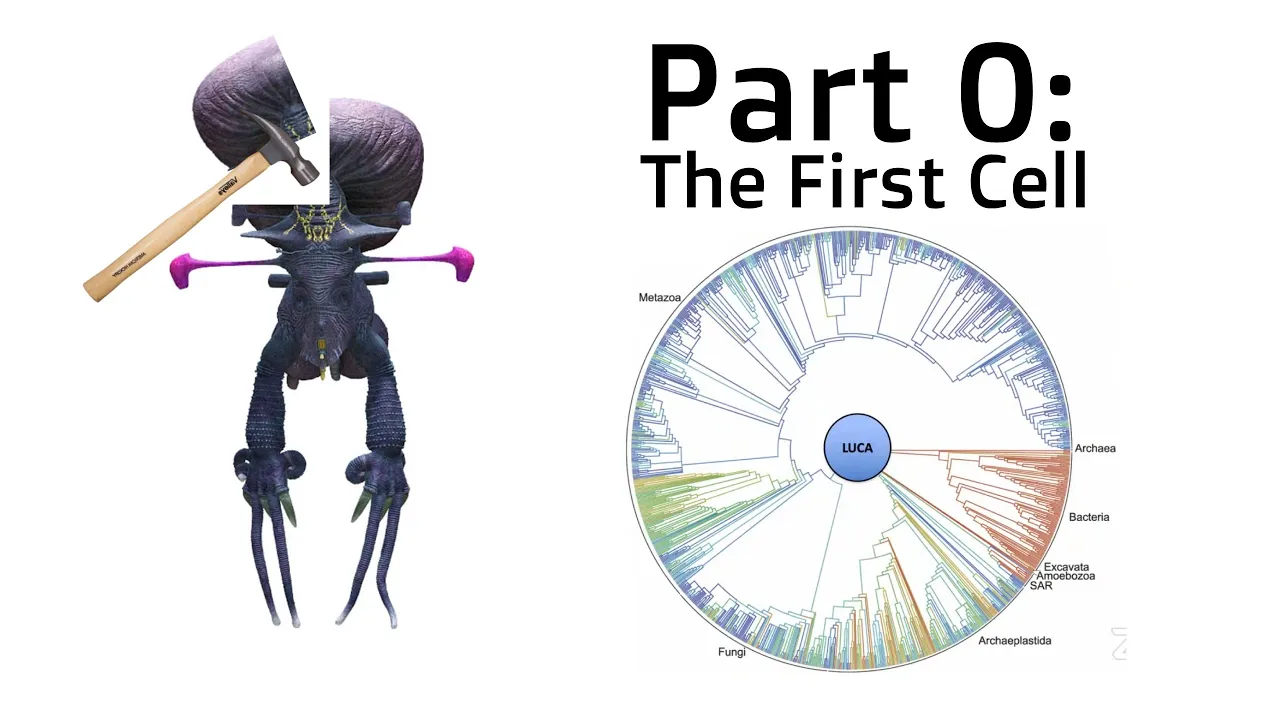
have you ever looked at what Hollywood passes for aliens and found yourself a little disappointed of course the practicality of special effects necessitates that they look pretty much like weird humans but if you consider the billions of years of evolution and the many coincidences that it took for us to look like this it starts to feel a little bit unbelievable I think it's a real shame that even when alien ecosystems are presented in media they always rely on the same familiar tropes like insect aliens or squid aliens or other kinds of spiced up Earth life
I think we can do better than that welcome to the first episode of this new series where we're going to be following the evolution of an alien biosphere all the way until the development of intelligent life and if we've done our job correctly it should look bizarre and miraculous I also want this series to be a One-Stop shop for all of your alien life world building needs so I'm going to be covering the biological principles that I'm using at every step of the process and hopefully you can follow along one thing I'm not going to
be covering is the planet building process uh it's really not my cup of tea and so I would probably be making a lot of mistakes and doing everyone a disservice but I can't recommend enough channels like artifexian who has great tutorials on anything from building your stars to building your planets to the geological features on those planets it's TR incredible he'll be linked in the description and with that let's begin and where better to begin than at the very start of our alien biospheres natural history with the evolution of the first ever life on our
planet now before we can create life on our alien planet we should probably know how it happened on Earth on Earth the prevailing theory is something called abiogenesis in which life capable of evolution comes from inorganic or dead matter the processes for how exactly this happened are a little bit shrouded in mystery but I'm going to be giving you my best interpretation of what I understand the science to be fundamentally all life requires three basic things in order to be able to do what life does the first of these is some kind of storage of
information this is going to be DNA in our case but it could be anything else and all that this really allows is for evolution to happen in the first place because if information can be passed on it can mutate and so natural selection can take place assuming of course that that information can affect the rest of the cell and now this is where the second part of life comes in the second fundamental building block and that is some kind of chemical activity where the life is capable of taking one chemical and turning it into another
or taking a chemical and using it for some purpose of self-replication that is the second component and the third fundamental building block of life is some kind of membrane that allows all of these chemical reactions to be contained within a manageable space so how did these three fundamental building blocks of life come about on Earth starting from just dead chemicals well uh amino acids and simple RNA can come about very easily in the conditions of ancient Earth this this was proved for example in the Miller Yuri experiment where they electrified a bunch of boiling water
and ammonia and resulted in a bunch of amino acids this is a very interesting experiment you can read about it on Wikipedia so the theory that I personally subscribe to is something called RNA World in RNA world the early primordial ocean was filled with these folded rnas which were capable of uh performing self-replication through some kind of uh chemical process and this in a way combines the second and First Fundamental building blocks of life into one molecule which is a very good start and so these folded rnas which were capable of producing more of themselves
uh would have been the first kind of self-replicating organism these folded rnas could become more efficient if they bundled up together in a kind of production line to create more of themselves faster in a way this already is enough to be considered some kind of life and to undergo darwinian Evolution but it's still very simple and it has the fundamental flaw that it is incapable of controlling its chemical environment and this is where the membrane comes in so along with the amino acids and RNA that already exists in the water there are also these chemicals
called phospholipids and phospholipids have a hydrophobic tail and a hydrophilic head and what that means is that they are prone to spontaneously organizing into the kinds of bubbles that enclose spaces of water and forming a kind of spontaneous membrane essentially one of the most versatile versions of this is something called a lipid Bayer lipid Bayers are truly incredible without any additional cellular Machinery they have been observed to grow divide and even Aid polymerization reactions so these things by themselves are already capable of some of the processes of life even with with no extra machinery and
so now we have something that is capable of enclosing space and something that needs an enclosed space and they exist within the same primordial ocean of course RNA that was able to find itself in these phospholipid by layer bubbles was more successful because it had more control over its chemical environment and over time it would have evolved to expand its own lipid by layer and grow more of these little bubbles that contain only itself this is by all definitions life but you'll notice that so far we've only been talking about RNA the RNA to DNA
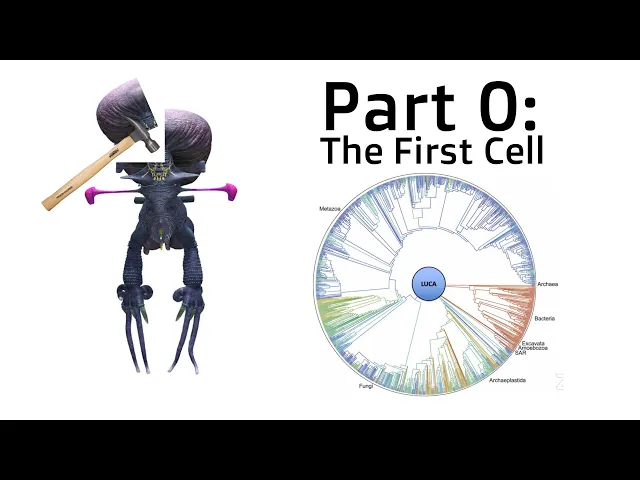
transition is a little bit more hazy I have not been able to find any good explanations on this but it is most probable that DNA is just a better storage method than RNA RNA is just a single strand it's a little bit unstable DNA forms these very kind of uh solid structures that then can store information more permanently and with that we've created Luca the last Universal common ancestor on Earth the Luca is expected to have lived about 3.7 billion years ago some push it back to 4.4 but essentially it would have come about almost
immediately after the first more permanent bodies of water settled down on the planet the last Universal common ancestor was extremely simple it was just some DNA in a little membrane that would have contained some small proteins and would have probably fed passively to break down organic molecules in the water around it one of the more complicated features that it probably did have is these structures called phy which help it attach two surfaces but are also used in bacteria for horizontal Gene transfer it's still unclear exactly where the last Universal common ancestor lived or actually what
it metabolized the most popular theory is that this uh last Universal common ancestor lived around geothermal vents which makes a lot of sense these thermal vents have a lot of nutrients going around they have very hot conditions it's a big kind of chemical soup where a lot of reactions can happen and at the early Earth it would have been much more common to see these things around because the Earth was that much more volcanically active at the time so it makes a lot of sense that this is where it could have lived but this is
still up for debate in the scientific community so now that we understand the path that life on Earth took to get to its last Universal common ancestor we can start to speculate what can we change what had to happen the way that it did and what could happen differently in our speculative alien biosphere well for that let's take a look at each of these components step by step starting with membranes membranes will mostly depend on the liquid solvent in which your organisms are living so in water phospholipids are simply just the best option they have
these incredible properties even when they are just on their own without any other kind of chemical support structure like I mentioned before they're able to grow divide it's just the most likely that if you have a water solvent based life form that you will have phospholipid based membranes there are others in methane for example you will not get phospholipid membranes because the solvent is non-polar and so phospholipid don't really have any kind of repulsion or attraction to it but there are equivalent chemicals in most solids so in methane you have a chemical called acry nitr
which is able to form these other chemicals known as zomes that can then form these kinds of layers even in an otherwise non-polar solvent keep in mind that the methane boiling point is minus 160° C and so your life will be very very cold if you choose to set it in a methane solvent but it istically possible that these membranes form now I think this is a great time to say that I am going to only be focusing on water-based life in this series water-based carbon life specifically because anything else is just too theoretical and
it would have no scientific backing and it would be mostly just speculation and while it's super interesting and it's a shame that I can't cover it I think it's best if we stick to something that is more applicable and scientifically grounded but now let's move on to our information storage this is a completely different story than the membranes we have so much room to work with here and almost nothing is set in stone it was mostly created by coincidence on Earth so when we're talking about the information storage systems that we have on Earth we're
mostly talking about RNA and DNA both of these have certain things in common they're both based on a backbone in this case a deoxy ribos backbone which is sugar molecules connected by phosphates and then there are nucleotides which actually encode the information that are attached to this backbone already here there are a ton of possibilities for example the backbone does not necessarily have to be deoxy ribos there can be other sugars or other kinds of structures that are connected as long as they make one long polymer the problem here is that there hasn't been a
lot of research done into what properties exactly these polymers would have and so it's not necessarily going to be as stable or good at its job as DNA is or it's not even necessarily known what shapes it will form for example DNA is in this very iconic double helix shape which might not be the case for other types of backbones one backbone that I found particularly interesting was peptide nucleic acid which has a lot of research done on it and is actually more stable than DNA and it forms very very interesting bonds which are much
stronger it's also a good example of how you're actually able to to mix and match backbones because as it turns out a peptide backbone and a deoxy ribos backbone are also compatible and can create the same double helix shape and be much more stable than DNA currently is so this is interesting it also means that DNA is in some way suboptimal and what that means for us is that we have a lot of leeway when it comes to experimenting with different storage systems for biological information because nature doesn't really look for Perfection it looks for
good enough and if DNA is good enough despite being suboptimal it stands to reason that there are a lot of other structures that would meet the Criterion of good enough now that we've talked about the backbone let's also address the nucleotides in our DNA you have adamine thyine cytosine and guanine as the uh four bases and they form base pairs which is uh essentially the combinations of these two that are capable of bonding together together for example adenine and cytosine will never be able to form a base pair and so adenine can only pair with
thyine here's the interesting thing these do not have to be the way that they are even on Earth in RNA the thyine is actually uracil it's not the same chemical which means that we can technically have any kind of bases or any kind of system of nucleotides so long as they do form these base pairs and are not compatible with the other one that should give you an idea of how arbitrary all of this is now I will say that all of this flexibility does come with a little bit of a caveat RNA is necessary
for a biogenesis to have happened in the first place it's called the RNA World hypothesis so something like RNA which is capable of being both an information storage and a chemical agent is necessary for the initial start of life but it doesn't necessarily mean that your DNA which on Earth is kind of a modified version of RNA it doesn't mean that your version of DNA on your planet has to be in any way related to that RNA because RNA can itself form very complex chemical systems and so it stands to reason that this RNA can
also build very strange organic compounds capable of storing information and so while I don't know enough chemistry to come up with anything super creative I'm sure that there would be a lot of people out there that are capable of coming up with some truly bizarre uh information storage system and all of those would still be valid so we have a lot of options when it comes to the chemical structure of our life forms but before we can really start making our decisions we have to understand a little bit about the planet that all of this
is taking place on so because I want to make this series as applicable as possible I'm setting it on a sister planet to Earth that I'm calling no Terra this planet Planet will have very very similar characteristics to our own planet now this will help to avoid any kind of unexpected geochemical or physical effects on the life that I might not be able to anticipate and so it'll help to keep our life forms more scientifically plausible and with that let's start building our last Universal common ancestor the first thing we're going to want to decide
is what kind of membrane are we using in my case because these are water-based life fors they live in a water solvent lipid layer will be pretty much standard and they'll probably evolve in this lineage as well even on this Alien Planet our first deviation from Earth life will be the DNA structure that this creature has instead of DNA our alien life forms will use GNA or glycon nucleic acid this uses glycol sugars in its backbone instead of the deoxy ribos sugars that are used in Earth's life forms now I'm going to add a feature
to this last Universal common ancestor that might be a little bit bit controversial on Earth both bacteria and ARA have cell walls almost universally but while in bacteria they're made out of peptidoglycan in ARA they are made of other chemicals that are sometimes called pseudo peptidoglycans what that means is that these were evolved independently and the Luca on Earth did not have a cell wall however the cell wall evolved independently twice and so it's fair to say that it will probably emerge in unrelated lineages even on an alien planet and so to simplify things I've
decided to give my last Universal common ancestor a cell wall as well what the cell wall does is it helps the microorganism to maintain its shape it protects it from outside elements and it allows it to osmo regulate more effectively now the cell wall in my microorganism is going to be based on polysaccharides this is very similar to the pseudo pep glycin in ARA and to the cell walls in plant cells but you don't have to adhere so closely to Earth biology you could for example have silica incorporated into this cell wall as in a
kind of composite or you could have some other kind of maybe fatty cell wall that is made to be more waterproof you could also potentially have the wall sandwich between two lipid layers or you could not have a cell wall at all and instead just have more lipid layers there are a lot of different ways that you can take this that don't necessarily comply with what happened on Earth speaking of convergent evolution with Earth my Universal common ancestor will also have py the reason that I think these would evolve very readily in almost all biospheres
is that they are just very useful they help the cell to attach itself to surfaces and they are relatively easy to evolve once you have a membrane that being said it doesn't necessarily have to look like this in your last Universal common ancestor they could for example secrete a kind of adhesive chemical onto their membrane which would have the same function or you could potentially have a rougher cell wall which causes friction with surfaces that it encounters also potentially allowing the cell to grip onto any surfaces so once again a lot of options next we're
going to move on to the ribosomes almost all life anywhere will have some equivalent to ribosomes because what ribosomes do is they convert RNA signals into proteins they are essentially the things that build proteins and so that's a very important function that any cell will have it's converting storage information into active chemical processes and that's critical so there will be an equivalent to a ribosome it won't be structured like a ribosome on Earth but we'll call it a ribosome for Simplicity finally the energy producing structures that are going to be present in my last Universal
common ancestor are not going to be attached to the cell wall like they are in some Earth f for example on Earth in mitochondria the energy producing structures are attached to the membrane in such a way that in order to get more of them the membrane has had to become bent and folded inside the mitochondria in order to increase the surface area on this Alien Planet the energy producing structures of the first microorganisms will float around the cytoplasm freely and will not be attached to the cell wall and now with that we've created our last
Universal common ancestor this is the cell that will serve as a blueprint for all future life on this Alien Planet you might be asking yourself what does this really affect well to be honest not much because we're not focusing on the miniature chemical details for the rest of this series if we were we would see just how very very different this life is because of the the changes that we've made but we want to focus on the evolution of this planet's animal equivalence not necessarily the micro world so this is just going to be the
first step in the journey in the next episode I'm going to be discussing how our cell differentiates into an entire procaryotic ecosystem until then goodbye and see you next time