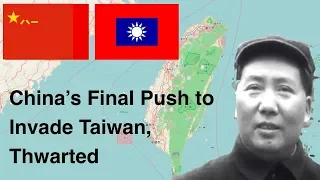
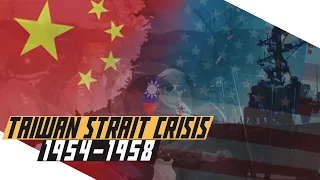
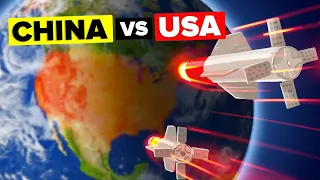
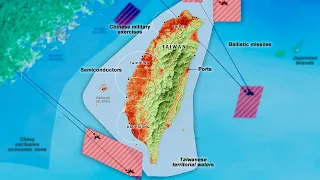
[Music] this I'm sorry in this video we are looking at the developing relationship between China and the USA so first of all when you look at the sino-american confrontation in the 1950s and the 1960s and Taiwan lay at the heart of sino-american antagonism as in 1949 the Americans recognized and supported the Shanghai shek nationalist regime in Taiwan and Taiwan's aim was to vie conquest the mainland now the People's Republic of China were also excluded from the United Nations and the Korea War prompted the u. s. to transform Taiwan into a military base and in 1951 Washington signed a united defense assistant agreement with Taiwan and this provided Taiwan with military materiel for the defense of Taiwan against possible attack so the People's Republic of China responded by bombing some of the offshore islands in 1954 and 1958 and the Beijing authorities remained convinced that the u.
s. sought to undermine the People's Republic so this meant that they remained committed to liberating the island the Chinese opposition to Soviet American attempts to regulate the nuclear arms race also meant that they gained a reputation as irresponsible but China did make sure that they didn't get involved in a war for us and for example in the Vietnam War they would only give moral and material support unless the u. s.
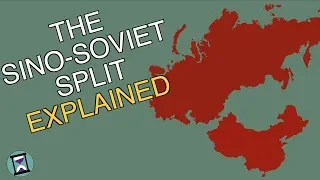
attacked China or invaded North Vietnam so next thing to look at is a sino-american rapprochement and the sino-soviet split of the 1960s remember the Chinese were in international isolation so this meant that they took steps to ease the relationship with the West a Mao did not reject the u. s. as a threat yet he saw the USSR as a larger threat to China and the year of 1968 was a major turning point in terms of a sign of American relationships so firstly President Johnson refused to escalate war in Vietnam after the Tet Offensive and he announced that he wouldn't be going for reelection however on the other hand the Soviets had invaded Czechoslovakia after the Prague Spring and these events meant the mound for that American imperialism was on the defensive and that Soviet imperialism was entering an offensive phase so this meant that he saw the Soviets as more dangerous than the US but President Nixon and Kissinger also recognized a benefit of an improved relationship of China a Nixon realized that China was a developing nuclear power and a major political and strategic force in Asia so this meant that in July in 1969 some trade controls and travel restrictions were relaxed and this was firm to the artichoke approach those restrictions were moved layer by layer bothered than all at once the next development came in 1970 when some diplomatic connections were opened with China in Warsaw and here the American ambassador in Poland Rousseau's tassel met with the Chinese charge lead affair laiyang and in these missiles Tercel informed yang that the u.
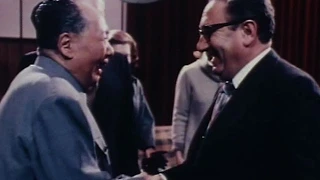
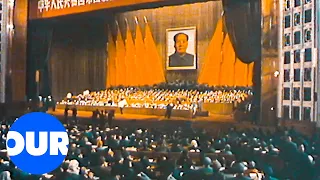
s. were willing to improve relationships with China the Chinese also received a development during the 1970s when the Chinese Prime Minister Zhao Enlai was victorious over those in China who wished to oppose improved relationships of the US and this positive relations with the US would enhance the power of Zhao and lie whilst they would also bring down the downfall of certain people who try to oppose it a for example Lin Biao was killed in a mysterious plane crash when attempting to flee the country in 1972 however rapprochement was delayed when Nixon started his bombing campaign of Cambodia and after Beijing announced the postponement of a sino-american talks in Warsaw Mao issued a statement calling for the people of a world to unite and defeat the US aggressors and their running dogs but the year of 1971 did lead to a further rapport between the two countries and firstly China were admitted to the UN and they gained a permanent seat on the Security Council and secondly Kissinger visited China where he met with Zhou Enlai for a total of 17 hours the meetings went well and here they agreed a presidential visit for the next year a Nixon did visit China in 1972 where the two countries agreed to maintain closed diplomatic contact but yet not formal diplomatic relations both Washington and China also renounced any ambitions to teach hashida me within East Asia which meant complete control now Washington also agreed to a phased patrol of all US forces in Taiwan but when Mao died in 1976 he was succeeded by Deng Xiaoping and he emphasized the centrality of economics over revolutionary theory so this meant that positive relationships with the u. s.
were vital for the Chinese economy so that China had access to the US dominated global markets so the UN's interference in Taiwan was also resolved in December 1978 when the griemann was reached and Deng assured the US but the Taiwan issue would be resolved peacefully so this meant that formal diplomatic relations began between the countries on the 1st of January 1979 Deng would also visit visit the u. s.