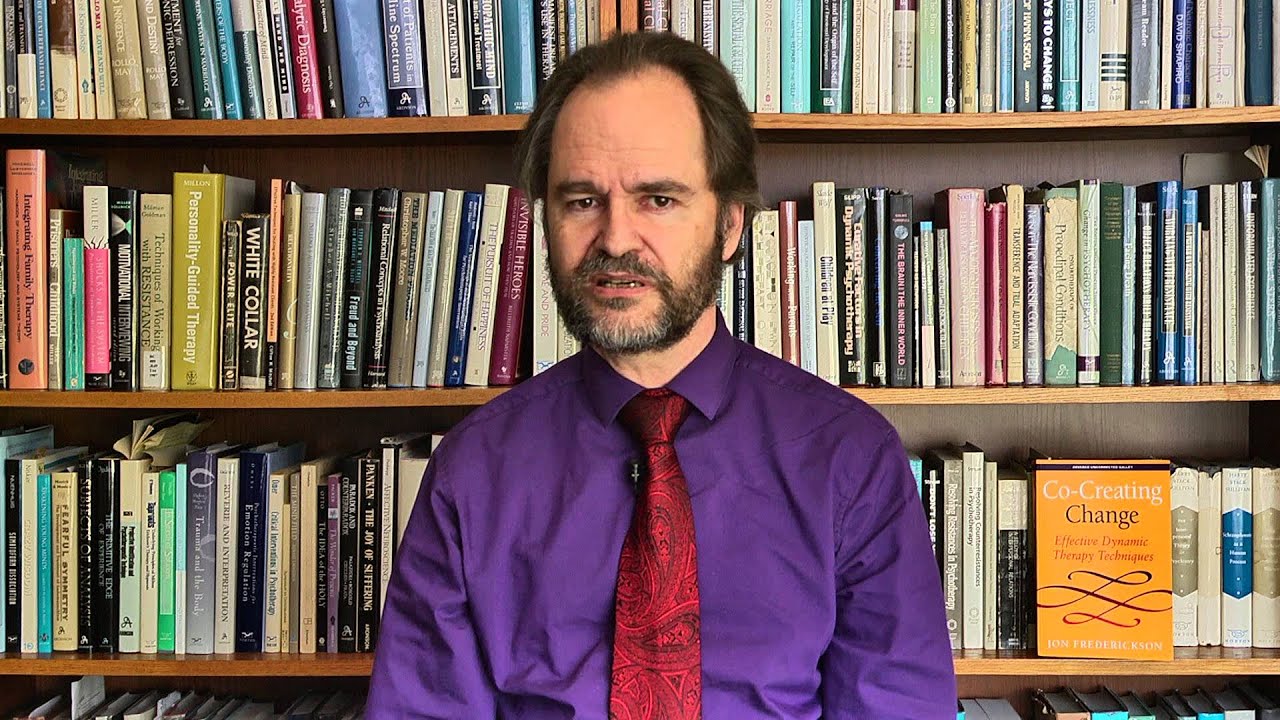
hi I'm John Frederickson and welcome to the istdp institute in this video we're going to talk about how to assess whether your patient's anxiety is too high whenever you explore important issues in therapy the patient's anxiety will rise and that's a good sign it means you're getting close to important feelings however as we talked about in our first video on anxiety we mentioned that anxiety can be discharged into the sematic nervous system or into the parasympathetic nervous system when the patient's anxiety is discharged into the somatic nervous system the patient is tense she sigh and
she clenches her hands those are signs that her anxiety is well regulated and that she can tolerate high levels of feeling when you ask about her feelings she'll get tense she'll often sigh and response to your questions now in contrast when patients experience anxiety discharge into the parasympathetic nervous system anxiety is too high these are patients who experience anxiety symptoms such as nausea EP stanic upset stomach diarrhea dizziness problems thinking ringing in the ears and blurry vision when patients experience these symptoms they have problems thinking and remembering their hippocampus shuts down at this level of
anxiety the brain doesn't function well enough for the patient to do the work of therapy so anytime you see these symptoms anxiety is too high stop exploring feeling start regulating anxiety and keep regulating anxiety until a patient's muscles become tense again then we can explore feeling safely to regulate the patient's anxiety draw her attention to her anxiety ask her are you aware of feeling anxious right now next help her identify the symptoms of excess Ive anxiety you might ask how is your stomach right now oh you have nausea that's a sign your anxiety is too
high so let's pause for a moment and see if we can help you regulate your anxiety keep assessing the patient by asking about other symptoms of parasympathetic nervous system activation you can ask how is your thinking right now is it clear or cloudy how is your vision right now is it clear or blurry how is your hearing right now are your ears ringing all these questions allow you to find out if the patient's anxiety is too high and they help the patient see these signs of excessive anxiety too invite the patient to pay attention to
one anxiety symptom in the body until it disappears then invite the patient to pay attention to another anxiety symptom eventually through attention the symptoms of anxiety will drop then we go to the next step help the patient see the sequence that triggered her anxiety the sequence always follows this pattern a stimulus triggers a feeling the feeling triggers anxiety in the body then the patient uses a defense to ward off her feelings anxiety we point out the sequence for two reasons first of all it explains to the patient why anxiety occurs and second L intellectualizing with
the patient helps to bring anxiety down so you might say something like this so we see that uh when you became angry with your boss when he insulted you and you felt that anger here with me but as soon as you described your anger you became anxious and got sick to your stomach do you see that if the patient can see that then you can continue so we see that you got anger angry rather this triggered anxiety in your body then you turn the anger onto Yourself by criticizing yourself does that make sense keep discussing
that sequence of causality with a patient until the anxiety symptoms disappear then you can explore feelings again however since the patient's anxiety just went too high it's best to explore feelings in another relationship if the anxiety symptoms do not disappear the patient is using defenses which perpetuate anxiety and we have to restructure those defenses first before anxiety will come down that will be the subject of our next video Until Then I'm John Frederickson at the ICB Institute thanks for joining us and feel free to visit us as www.v institute.com and check out our Psychotherapy video
that shows therapists how to address severe anxiety thanks very much for joining us