[Music] let us continue our module 1 discussion in this video lecture we will be focusing on propositional logic so how do we transform a proposition into its equivalent mathematical equation we use small letters to represent one proposition for example b q r and s are used to express a preposition each variable can be true or false we have sentences that are composed of more than one preposition and this sentence we call it compound proposition to connect the different preposition in a sentence we use logical connective or functions like negation conjunction disjunction implication and by conditional
so let us discuss first negation or not function and that operation switches the actual value of the proposition suppose the original proposition is true then if we negate it the statement will be false and vice versa the symbol for not are these two symbols and it should be written before the variables so let's have an example let p today is sunday so when we negate p we negate the predicate or the fact about the subject so the result will be today is not sunday if we want to determine the possible result when we evaluate a
statement we may use a truth table the truth table shows all possible states or values of the proposition and its corresponding status when we evaluate the whole statement like in this truth table the first column shows all possible values of p and in the second column shows the corresponding result when we did gate is implemented when negation is implemented so when p is true when we negate it it becomes false when the original statement is false when we negate it the statement will be true so that's how negation works so now let's move on with
the next operator or operation it is conjunction or ant a conjunction is a compound statement formed by combining two statement using the word and in symbolic logic this is the symbol to be used okay so in symbolic logic the conjunction of b and q is written as this p and q okay so let's have this example p today is sunday q it is sunny so if we have p and q so the equivalent in english today is sunday and it is sunny okay and this is the truth table for and again a conjunction is true
only if both the statement in it are true otherwise the statement is false okay so now let's move on with the third operator which is disjunction a disjunction is a compound statement formed by combining two statements using the word or this is the symbol for war okay so let's have this example so this is how we write or function so p or q let p today is sunday q it is sunny so when we read this in uh this mathematical equation in english it is equivalent as today is sunday or it is sunny okay and
this is the truth table for or as you can see on the truth table as long as there is a true proposition the statement will be true okay the statement will be false if all proposition in the statement is false okay so that's this junction so by the way we have two types of this young or operation okay so we have inclusive or an exclusive or the previous slide discusses the inclusive or where in the statement is true if at least one of the proposition in the statement is true so for example i will eat
chicken or pork this lunch so i'm going to eat chicken or pork or both will make this statement true okay so while the second type of or is exclusive or sore or x or in xor the statement will be true if and only if one of the proposition is is true but not both okay so for example soup or salad comes with the meal so we can get a soup either soup or salad but not both okay if we're going to get both we're going to have uh an additional charge for it but in case
we want to retain the charge or the cost we're just going to choose one of it so that's an example of exclusive wire okay so the symbol for exclusive or is plus inside the circle this is the truth table for xor so one proposition should be true but not both to make the statement true under exclusive or or sore okay so now let's move on with the fourth function or operator which is implication an implication also known as conditional statement if statement is a type of compound statement that is formed by joining two simple statement
with a logical implication connective or operator the symbol that is used to represent a logical implication operator is an arrow pointing to the right thus a rightward arrow so it is denoted that a p implies q p r o q which is read as p implies q so today is sunday implies it is sunny or if it if it is today if today is sunday then it is sunny so that's the meaning of proq okay and also by the way in b implies q p is the hypothesis antecedent or premise okay while q is the
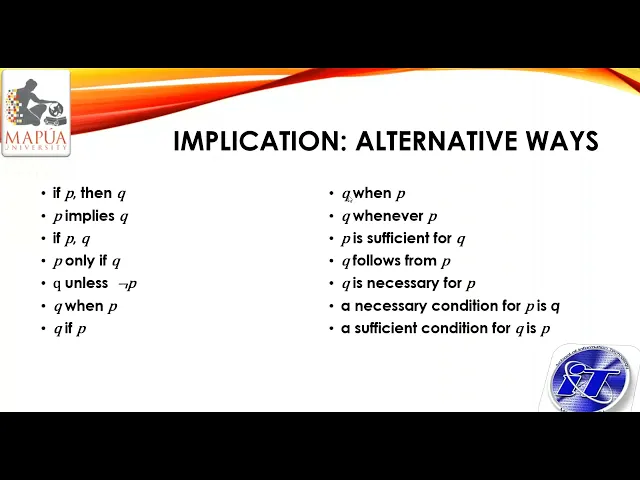
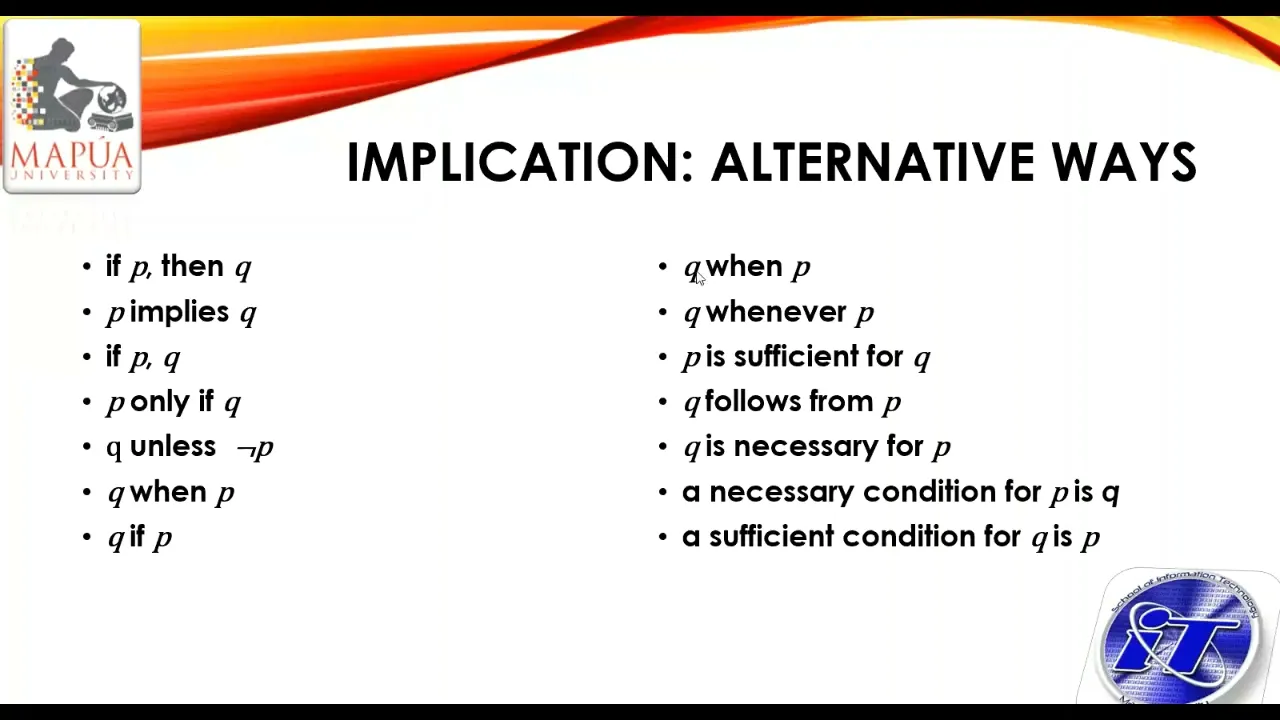
conclusion consequence or the result of the if statement so implication comes in many ways so aside from if then statement if proposition comma proposition we have this alternative ways in writing or reading implication so we have a b then q p implies q if p comma q p only if q q unless not p q when p q a p q when p q whenever p p is sufficient for q q follows from p q is necessary for p a necessary condition for p is q and a sufficient condition for q is p and by
the way as you can see in the different form conclusion can be written first before the consequence like here q when p so kindly memorize these different forms of implications so that uh you will i um correctly identify which is the conclusion and the premise of the statement okay so how do we determine will be the statement true or false in an implication operation under implication operation so based on this truth table as long as the premise and consequence have the same value the statement will be true true true therefore the statement is true false
false the statement is true but if not we need to check the value of consequence just the consequence okay so if the consequence is true like and that on the fourth row falls through so consequence is true so the statement will be true otherwise like on the third column the statement is false okay so again if we have different values for the premise and consequence always check the value of the consequence the consequence value will determine if the statement is true okay if premise and consequence have different values the consequence value will determine if the
statement is true or false okay again true false is false false true is true okay so let's have this example if you get hundred percent on the final then you will get a grade of one so let p you get one hundred percent on the final let q you will get a you will get a grade of one okay so if p is true you get 100 but greece was your instructor didn't give you a one okay so what does it mean the result was not achieved did it happen therefore the statement is false so
regardless if if the premise was achieved but the result was not achieved therefore the whole statement is false and the statement of that instructor is actually a lie okay so therefore that statement is false well if p is false q is true the statement is true because the result happened even though the student did not meet the requirement even the student didn't get 100 percent the professor gave him gave him a grade of one so it happened a statement happened the consequent happened therefore the statement is true so that's the logic behind implication so therefore
as long as the conclusion is met the statement is true even if the premise is not achieved four for the values for the premise for having a different value for the premise and the consequence okay now in case we are changing the premise or the consequence of the statement or introducing negation to our statement the meaning of the statement may change or it could be altered the change could be converse contrapositive or inverse so if you say converse the original statement okay so in the original statement the original premise which is b will become the
new consequence while the original consequence will become the new premise so pro p implies q it will be written as q implies v in converse while in contrapositive we're going to introduce negation on both premise and consequence of converse so we have not q implies not p that's contra positive while inverse we introduce negation on both premise and consequence of the original statement so we have not p implies not q so by changing the premise and consequence by introducing negative what will happen to our original statement will it be will then converse will be the
negation of the original statement or are the are uh will be um will will the meaning of the statement will be the same so let's check using a truth table so based on this truth table when we change the order or when we um change the premise and the consequence okay so from p implies q to q implies p they are not equal okay it doesn't mean that that p implies q and you change the order they will be the same they have they will have the same meaning it's not the same based on this
truth table so for example if you are intelligent then you will pass the course we can say that if you pass this course you are intelligent why because there are different ways in passing this course aside from being intelligent am i right so that's why conditional is not equivalent to converse okay so if you're using this way of thinking in doing logic or using in a critical hour or skeletonizing statement it's a big wrong it's a big x okay it's incorrect okay so you cannot change the order by changing the order means changing the meaning
of that statement it's a big no no if you are using this as your way of proving something it's incorrect conditional is not equivalent to converse okay now let's compare conditional and inverse introducing negation on both premise and con and consequence inverse is not the negation of conditional statement as you can see here in this table okay team fly screw is not the negation of inverse okay but if you can see inverse and converse have the same result therefore inverse and converse are equal based on the truth table okay now let's compare conditional and contrapositive
as you can see in this column and the lumo contrapositive they have the same result same values therefore conditional is equivalent to contrapositive p implies q is the same as not q implies not p so therefore we could write p implies q as not to implies not p or vice versa okay we're going to use these forms when we group something on the next video lectures okay so again conditional contrapositive equivalent inverse converse are equivalent but conditional is not equivalent to hunt first don't forget that okay so now let's move on with the last condition
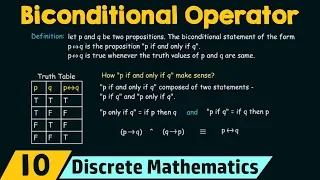
last function last operator logical operator operator which is by conditional the biconditional statement is p if and only if q okay this is the um the symbol for biconditional double-headed arrow so how do we determine if the statement is true in biconditional if both p and q have the same value okay both true but false the statement will be true otherwise the statement is false okay alternative mean uh meaning of by conditional is a p then q and if q then p so it means that we have two implication and and operation for biconditional okay
more discussion about this when we discuss logical equivalence about this statement okay so just accept it first accept it now that p if and only if q is the same as p then q and if you then okay so now these are some of the alternative ways in writing and reading or by conditional statement so p is necessary and sufficient for q if p then q and conversely if p if we double f q that's by conditional alternative ways okay so as a summary negation from true to false from true to false false to true
while conjunction okay as long as there is a false proposition the statement is false while for or as long as there is a true proposition the statement is true while for x or the statement will be true if at least one of the statement if the one of the preposition is true but not both conditional the statement will be false if the premise is true while the conditional is false otherwise it's true well for the biconditional pq should have the same value otherwise it is false okay so again these are the logical operators that we
are using for logical proposition okay so this will be our last slide for this video lecture thank you for listening and see you on the next video lecture thank you [Music] you