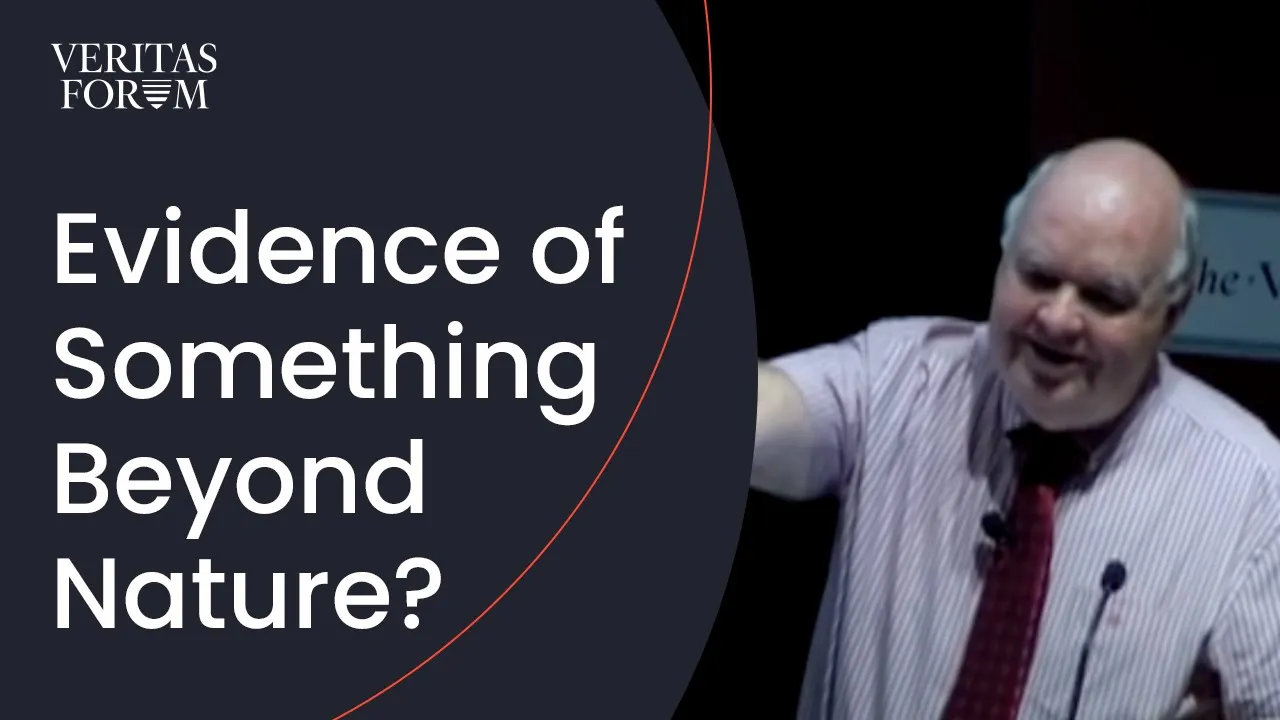
that question of the immateriality of information is very important it means we cannot reduce information to physics and chemistry let me tell you a little story we have a marvelous College in Oxford I'm a fellow of green Templeton college and we put on Lovely dinners and uh unfortunately sometimes the seat arrangements are fixed so you can't adjust where you're sitting so this night I was sitting beside a bio chemist and he asked me what I did and I was foolish enough to reply I said I'm a pure matician he said how dreadfully boring and um
I said oh but but but I tried to make up for it by being interested in the big questions of life he said like what well I said like the status of the universe is it created or not oh dear he said it's far worse than I thought he said listen the bottom line is this I'm an atheist I'm a reductionist we're going to have an awful evening we've nothing to talk about and that's that so what do you do with that well I said to him I said you know it's not all that bad
is it I said I mean I'm fascinated by reductionism I know at least three kinds which kind are you well he wasn't quite sure so uh being a kind man I helped him a little bit and I said U you're a methodological reductionist you take a big problem split it into little problem so all the little problems get insight onto the big problem yes he said I do that good I said we agree in that then so he was warming up called me by my first name so we were getting on famously and then I
said I think you're an ontological reductionist that you believe onos Greek being you believe everything can be reduced to physics and chemistry he said that's right that's my basic principle so I said let's have an experiment then he said what here at the table I said sure So I picked up the menu and he looked at it and it wasn't very interesting it said roast chicken and not even in French in English and uh I I I I he said what's the problem I said you're a reductionist everything in terms of physics and chemistry I
said now look at this thing here R O I said those are marks aren't they but they're Semitic Greek Semion a sign they're marks that carry meaning he said that's right okay I said explain to me the semiotic of those marks in terms of the physics and chemistry of the paper and ink and those asylums and then his wife said a bit loudly get out of that if you can but he didn't try I want to tell you what he said now this is one of the world's top biochemists he said John for 40 years
I've gone into my laboratory thinking that that could be done but it can't I was so amazed I backtracked and I said oh but science has only been going 500 years or so said doesn't matter you cannot explain the semitics bottom up you have to introduce an intelligence and then it dawned on him that I wasn't bright enough to have thought of the argument he said where did you get that [Applause] argument I said I borrowed it from a Nobel Prize winner and I'm glad you laughed ladies and gentlemen it's interesting isn't it just a
few marks and you instantly argue upwards and postulate mind and we sit and look at the human genome 3.7 is it billion letters in exactly the right order in a four-letter chemical alphabet sophisticated because the levels of information are contained not only in the linear sequencing but in the folding and it its relationship to the cell and all kinds of things and we ask about its ultimate origin chance and necessity what chance of the laws of nature we don't say that about print what's the difference semiotics in both cases seems to be something very interesting
is going on and that Semion the evidence of meaning our capacity because you see ladies and gentlemen we are not only containers of text we are producers of text and that to my mind is great evidence that there is a Transcendence Beyond nature the beginnings of supern nature are already to be seen within you for more information about the Veritas Forum including recordings and a calendar of upcoming events please visit our website at veritas.com