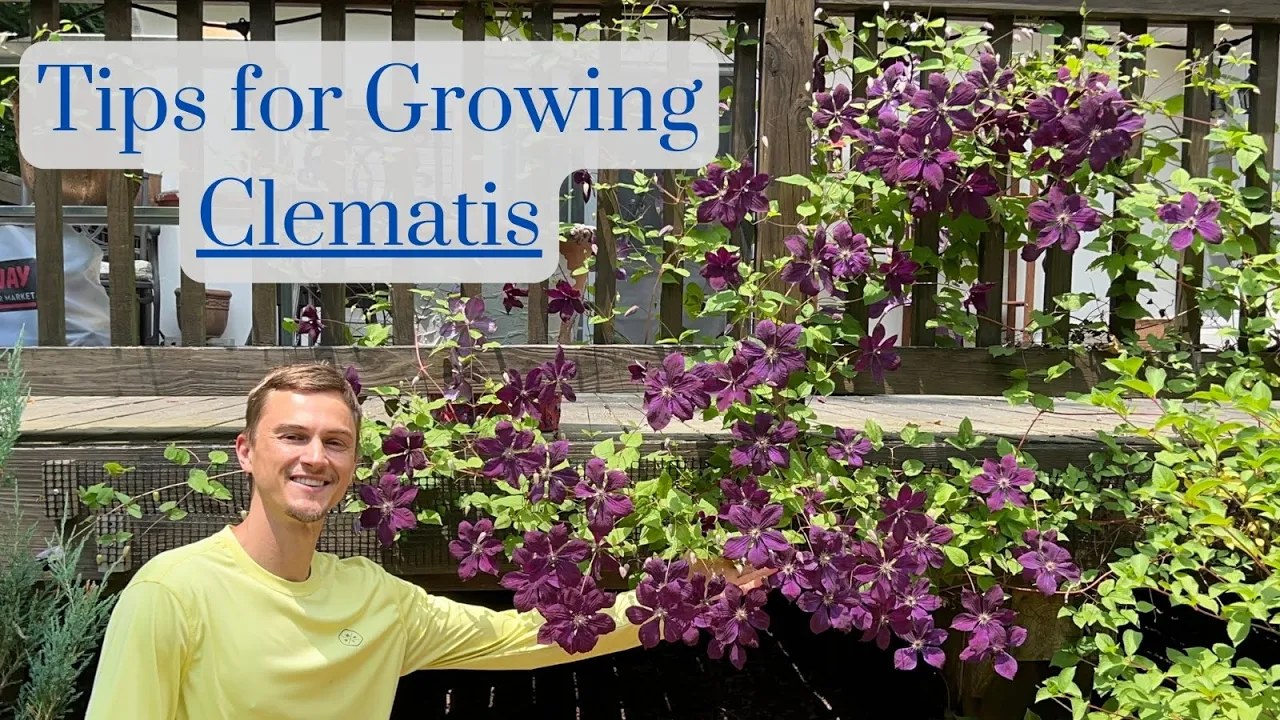
what's up plant lovers I'm Devon Wallen and today we're going to be talking about some tips for growing our cemus or Claus um depending on where you live how you pronounce it doesn't matter um they're one of the most beloved climbing vines and there's a few different kinds of clus that can be grown in particular they are categorized into three different groups based on how they should be pruned we'll talk about pruning towards the end of the video but we'll start the video by just going through some basic tips for growing our clemon to get
our beautiful flowers as prolifically as possible so many of us have heard um that their Roots like to be grown in the shade while their shoots like to be grown in the Sun and that basically means they like their root system to be kept a little bit cooler kept shaded while their actual top growth is um growing in the Sun so some of the ways that I'm actually achieving that is number one I have grown um some hostas around the base of my clus and I've also put a nice layer of mulch and actually I've
put some Stones down here to really just help keep the soil nice and cool and it also helps to lock in the moisture then just in front of it you can see right here I have a panicle hydrangea that is I've just recently pruned it back so it's pretty small but as it grows um throughout the summer season it will definitely provide extra shade for the base of my plant so as you can see I have my clus growing and they're going to be trained along these cables which will look absolutely beautiful and they will
not be um shaded by any plant life they'll be fully exposed to the sun which is exactly what we want to provide for our clus now the next thing that we want to ensure is that we provide them something to twine onto to climb up and this is a part that most gardeners get wrong when they um when their clus is not growing and they don't know why it's not growing it's likely because they don't have it climbing up a suitable structure Clem is Pro produce very small tendrils that can only cling on to something
that's very thin so you need to provide something that has the thickness of a pencil or smaller so we saw the one that I have that I'm going to be training along those cables that is definitely thinner than a pencil and here I have um this structure that I built with some copper uh tubing and some wire that goes across the wire is very thin and it is is exactly what a clus needs in order to cling onto so that it can provide support and continue to grow if it cannot cling onto something then it's
going to Simply stop growing here you can see these Cletus up front that were planted by the previous homeowner I then uh and and they planted it too far away from the wall and it really doesn't cling onto anything so unless I can really train it into the second Cletus that I planted myself um it really does not do anything it just kind of stays at about 18 in tall and that's it so if you you do have a traditional wood type trellis consider adding in some nails with some fishing wire or some just metal
wire that goes across them so that they can actually cling onto or if you don't want to do that you can take some string or floral tape and just tie it to that structure as it grows um but you do need to help train it by providing it something thin and if not actually TI It Up So then it can Propel itself upwards and onwards now the next tip that you really need to ensure is that you will train your plants early and often I'm here um in Westchester Pennsylvania Zone 6B and it is the
middle of April and you can see all of this fresh growth from this season they grow very early and you really need to be on top of training them um as as often as possible I try to look at mine every single day because they will grow a couple inches even um uh daily if you're if they're getting sufficient rainfall um and so that basically means you need to stay on top of them and train them on a regular basis or else you'll find that your plants have fallen um you know just to the ground
or they've just stopped growing uh you may need to even introduce some sort of temporary structure to help propel them onto the permanent structure that you're going to be training them on here you can see I have this sort of metal thing that I just put here um so that it could help reach up to these cables training them can be is very easy can simply just be placing them kind of like this and then they will continue to grow and then I will reloop that back through and you want to do this often because
if you don't they can become a tangled mess before you know it and then it will be very challenging to train them afterwards and they will start to grow into one another they're also very delicate so they can easily break so if they do break while you're training them simply cut down to that next uh healthy bud and they'll just quickly regrow so you can hear see here here is the the growth point that's coming and then they produce these little baby tendrils and these are the tendrils that will start to cling on to um
our structures so placing those tendrils on those wires on those cables is going to be absolutely essential to do on a very regular basis so as you can see I have about four or five nice healthy stems growing from the base of my plant and that is really essential to having a nice full bushy look from your cemus um if you're growing a new plant and it only has one or two stems uh my best recommendation would be to you know let's say you're planting it in the summer this year next spring chop it down
to about 12 in and that's going to help promote new stem formation so that you can get enough stem material um growing from the base of your plant now we red did our deck last winter and in the process of redoing the deck I had to basically chop off the entire mother plant which was like 20 ft in length and basically chop it back to the ground um and while I lost a lot of top growth material it did encourage fresh formation of new stems and as you can see it's full it's really nice and
full and this plant will definitely grow very quickly back to that original uh size that it was last year okay so now on into pruning now as I had mentioned there are three different groups of cemus groups 1 two and three and the saying is um if it blooms before June don't prune if it blooms late June or after you can prune it in the spring so the part of if it blooms before June that basically refers to groups one and two now group one in particular those are going to bloom very early mids spring
is when they're going to be in bloom and those plants are best if you just simply thin them out after flowering but these vigorous Cletus can get quite large and overgrown and it can often lead to a lot of flowering just at the ends of stems rather than a nice bushy plant and when that happens it can be um a good idea to do a reinvigoration pruning U cutting your plant down to about 6 in you can do this once every 3 to four years with those plants but other than that you really don't need
to do any real pruning with groups one that's why it's really important keep your tag of your chus you know along with all of your other plants in your garage in your shed somewhere that you'll know exactly what plant you're growing and then that will help you just do a little search online to find which group you are growing now group two has a lot of the really nice showy Cletus hybrids that a lot of us are growing for me I'm growing two different kinds of group twos here on this uh trellis section right here
and just like group one we're not going to do any sort of heavy pruning in the springtime we'll dead head the flowers after they have bloomed uh around like mid June and then that can actually encourage fresh new flowers towards the end of summer but the one thing you will want to do with your group two clus is to cut back any old dead growth on your plants in the springtime and let me show you what what I mean by that so once our plants start to flush out in the spring like you can see
here we'll find all of the ends of the stems like this right here and we'll travel down on this dead stem to the next section where actual growth is coming from so you can see I'm going to travel down to this Bud right here and I'll just remove this little guy just like that and so we'll REM remove all of this dead growth um in the springtime that'll keep our plants nice and healthy however there are instances where you can see this nice fresh growth is just starting and it is actually Clinging On to this
old stem so when that happens I'll obviously leave that old stem to allow this guy to um hoist onto and then as it grows and finds other support further on then I can remove this if desired but it really is absolutely essential that you do travel down backwards because um you may find some dead growth in the middle that actually does have fresh growth at the end I have definitely accidentally cut out sections that I thought were dead only to discover that it was um still alive and well at the end of that stem so
you really need to be uh very careful about where you are cutting and finally is group three so groups one and two those actually produce their flowers on last year's growth whereas group three blooms later in the season after uh pretty much at the end of June or thereafter and they're actually going to be blooming on this year's growth and those are some of the most vigorous types of clus they can really get tangled really get huge um so it can be a good idea to cut them down in early spring or late winter to
the lowest set of healthy buds so that can be as low down as 10 12 or maybe even 6 in close to the ground and they're still just going to explode with growth as the season um progresses so with that now you know some of the basic tips for growing clitus happily healthy ly and um that will allow you to get the most flowers possible there's definitely a lot more information out there about you know each of those three groups with regards to pring so if you are interested in learning more make sure you subscribe
to our channel uh give this video a like um so that you can stay in the know for each of our weekly plant videos thanks for joining me here on plant vibrations I'll catch you guys soon ciao