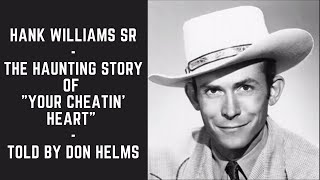
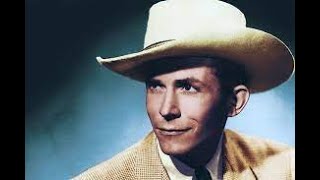
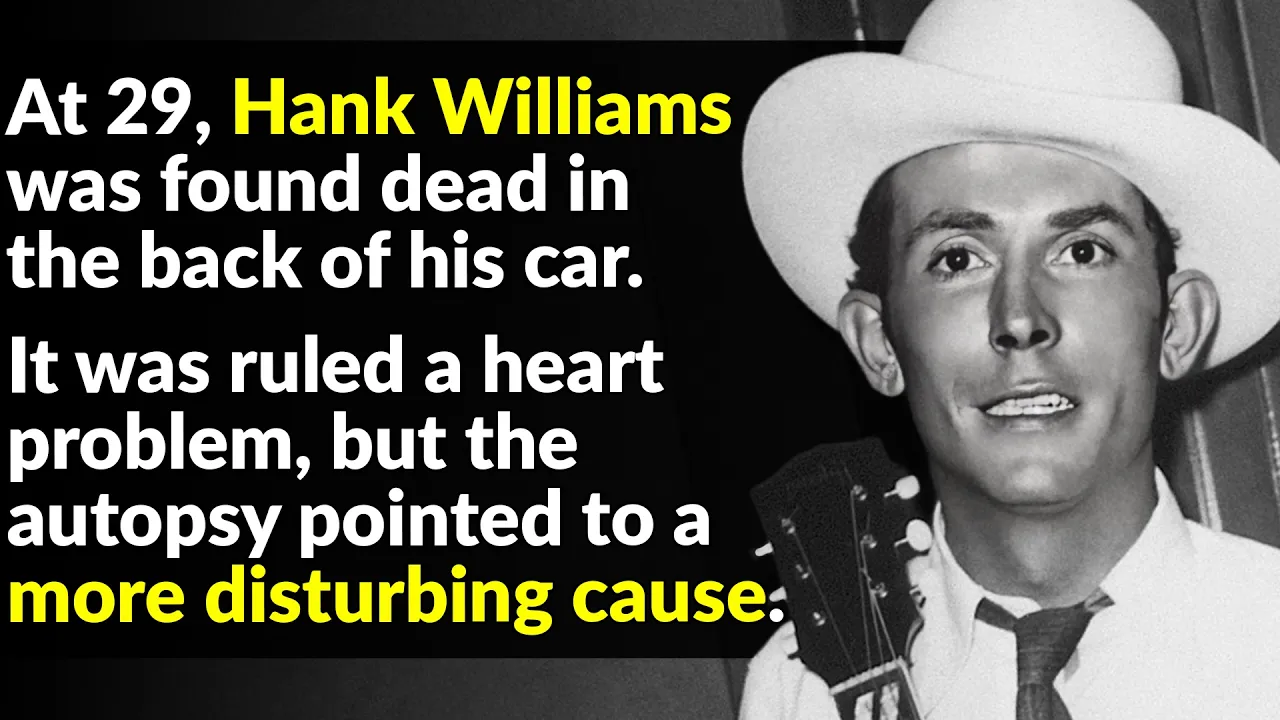
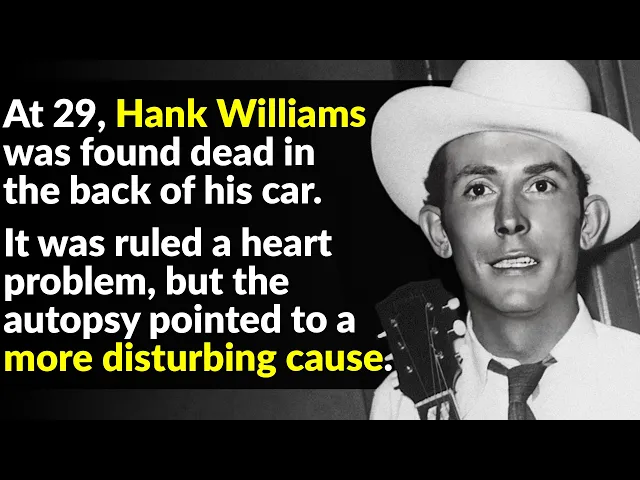
On New Year's Day 1953, Hank Williams was found dead in the back of his car. He was just 29. The cause of death was listed as a heart problem, but strange evidence found in the autopsy pointed to an even more disturbing cause.
Hyram Williams was born on September 17th, 1923 in Mount Olive, Alabama. He was the third child and he was born with spinobipida oulta a birth defect that impacts the spinal column which caused him strife for his entire life. His mother was involved in the musical and religious community and she sang hymns and played the organ at the local church.
This early exposure to music and spirituality would be a major influence on young Hank. At age six, someone gifted him a harmonica, giving him his entry point into the world of music. In late 1933, Hank exchanged places with his cousin for a year.
He lived with his aunt and uncle in Fountain, Alabama. There he learned the basics of guitar and discovered new music at dances and churches in the area. Hank's father was hospitalized for 8 years with a brain aneurysm and his mother had to work multiple jobs to keep the family afloat, moving from town to town.
It was while they lived in Georgiana that Williams met someone who would change his life. He began receiving guitar lessons from a street performer, Rufus Payne, a Greenville icon known primarily by his nickname T-TO. Hank was around eight when he got his first guitar.
It was a gift from his mother who bought it secondhand for $3. 50. In 1937, Williams got into an altercation with a teacher at his school.
And when his mother lodged a complaint and demanded the teacher be fired, the school refused. As a result, the Williams family relocated one more time to Montgomery. Around that same time, Williams began going by Hank rather than Hyram.
While living in Montgomery, Hank signed up for a talent show, winning first place and $15. In an effort to get noticed, he decided to perform on the sidewalk in front of a local radio station. His gamble paid off, and he caught the eye of the station's producers.
They gave him opportunities to play with a band on air. So, by the time he started his own band, he already had a following. Hank Williams and the Drfting Cowboys toured all over southern Alabama, performing at dance halls, clubs, and private gatherings.
He dropped out of high school to pursue his music career full-time. And with his mother as the band's manager, they were able to travel further a field, finding more and more success as they did. Even at this young age, Williams was starting to form a dependency on alcohol.
He was using it to numb the chronic back pain he experienced. For now, it wasn't affecting his performances or his radio show, but it wasn't long until problems started to pop up. When the US entered World War II in 1941, Hank fell on hard times.
The army didn't draft him due to his back injury, but all his band members left to serve overseas. He replaced them, but his addiction was growing too severe for the new members to handle, and they soon abandoned him. Then in 1942, he was fired from his radio show, supposedly due to his habitual drunkenness.
In his time at the station, he'd made a connection with a fellow musician and promoter, Roy [music] Akuff. After losing his radio gig, it looked like life might force Hank to put a lid on his dreams. He took a position at the Alabama Dr Dock and Ship Building Company in 1942 for a year and a half.
After that, he had a brief stint at a shipyard in Oregon, but he couldn't stay away from the South and eventually returned to Mobile, Alabama. It was 1943 when he met someone who would change everything. Hank met Audrey Shepard and their romance blossomed immediately.
The two lived in a hotel while working at the shipyard together. Shepard became a fullhearted supporter of Williams and together they decided to move back to Montgomery to start a band. They married in 1944 at a gas station.
By 1945, WSFA had rehired Williams to his radio show. He was writing original songs, but he still hadn't released an album. The following year, he and his wife pitched their music to Akuff Rose Music, a newly formed label started by Roy Akuff.
The label's co-founder, Fred Rose, brought Williams on for a six song contract, after which he helped him sign with Sterling Records. The success of Williams' new songs was immense. The following year, he released Move It On Over, which was an immediate hit.
His career was starting to really take off. But little did he know, his time was already running out. >> I got a song I wrote just specially for you.
I'm going to sing just for you. >> What is it? >> It's called Hey Goodlook.
>> In the early months of 1948, Hank and his wife Audrey began having marital issues. Tension stemmed from his alcohol addiction. His reliance on booze wasn't new, but the intensity had increased.
Audrey gave him an ultimatum. his addiction or her. After moving to Louisiana, joining a new radio show, and performing across the state and in eastern Texas, Hank Williams released more music that served to earn him more and more fame.
[music] His version of Lovesick Blues topped the Billboard charts for 4 months straight. His manager arranged for him to perform at a grand old opery show, and for that he needed a band. Hank brought back the Drfting Cowboys, this time with a different lineup.
This version of the Cowboys would become the most famous iteration of the band. Their debut performance on June 11th, 1949 received six encors. I was a fool [music] to wonder and straight for straight is the gate and narrows the way.
>> The month before the Grand Old Opry performance, Hank's wife gave birth to their son, Randall Hank Williams. By the time the 1950s rolled around, Hank was earning around $1,000 per show, equivalent to about $13,000 today. He also started recording morally charged songs under the pseudonym Luke the Drfter and often added these sermon-like pieces to his regular set.
At the same time, he was releasing song after song under his real name. Life was moving along at a quick pace, but there was something sinister waiting in the wings. [music] His substance issues were still a constant in his life and they threatened to take over.
In May of 1951, he was sent to the North Louisiana Sanitarium to help with his reliance on alcohol. He was released 3 days after his admission and for a while everything seemed fine. Then in November, things took a turn for the worse.
He was on a hunting trip with his bandmate Jerry Rivers when he tried to jump across a gully. He fell, triggering his chronic spinal condition. Doctors performed a spinal fusion in an attempt to alleviate his symptoms.
Unfortunately, the hospital discharged him early with a back brace and pain medication, which went against his doctor's recommendations. With his existing addiction issues, having access to these drugs was incredibly dangerous. 1952 was a busy year for Hank Williams.
He continued to tour with his band and appear on the Grand Old Opry, but behind the scenes, his personal life was falling apart. [music] He had a fling with dancer Bobby Jet, which resulted in a pregnancy. By spring, Audrey divorced him after a decade of turbulence.
With his health issues getting worse and his reliance on substances following suit, Audrey demanded he leave their shared house in Tennessee. Reportedly, Williams responded with a desperate and ominous plea, telling her, "Audrey, I won't live another year without you. " Hank hastily moved on with Billy Jean Jones, who was 19 at the time of their relationship.
Billy Gene had grown up living near the singer. When they reconnected, she was dating one of his friends. Hank would miss performances to see her, and this came with consequences.
In August, the Grand Old Opry fired him for his inebriation and for consistently skipping concerts. His substance abuse was slowly destroying his career. Williams married Billy Jean Jones in October of 1952.
All the while, he recorded new music and performed on and off. This could have been a positive turn of events if he hadn't started experiencing heart issues as the year wore on. His health problems were so bad that when he met Horus Toby Marshall, who claimed to be a doctor, he asked him for his help.
But Marshall was actually hiding a secret. He had faked and forged his way into being a doctor. He bought his DSC title and he'd already done time at the Oklahoma State Penitentiary for forgery.
Now under the pseudonym Dr CW Lemon, he prescribed Williams amphetamines, chloral hydrate, morphine, and more. In December of 1952, Hank Williams was booked to play in Charleston, West Virginia for New Year's Eve. A snowstorm thwarted his journey, causing all flights to be cancelled.
Williams had to turn to other options to make it on time. He paid a college student, Charles Carr, to be his driver to the concerts. They stopped in two towns before making it to Knoxville, Tennessee, where a plane waited to take Williams the rest of the way to Charleston.
However, the weather remained a problem and the flight had to turn around. At this point, Hank's physical state was worsening and Carr was getting nervous. After arriving at the hotel in Knoxville for a brief reprieve, Carr asked for a doctor to come check on Williams.
When the doctor arrived, he only made matters worse. The doctor prescribed the singer morphine and vitamin B12 to help with pain and indigestion. Then Williams and Carr continued on their journey.
It was almost midnight when they left the hotel with Carr driving and Williams in the back seat under a blanket. They crossed into Virginia as the clock ticked down to January 1st, 1953. Carr was reaching a point of exhaustion after driving for 20 hours, and they stopped in at an all-night restaurant for some refueling.
Williams declined Carr's offer to join him inside for a meal. After stopping at a gas station, Carr checked on Williams in the back seat and found him not only unresponsive, but showing signs of rigger mortise. Hank hadn't been alive for quite some time.
Officers arrived at the scene and pronounced Hank Williams dead. Soon afterward, Dr Ivan Malanin performed an autopsy at a funeral home and he declared heart and neck hemorrhages to be the cause of the singer's death. But there were some suspicious signs on the body that made them investigate further.
Dr Malinan noticed that Williams had evidence of injury in his groin area and had visible signs of a struggle. Reportedly, he'd engaged in a physical altercation along the road, but there were few details about what had really happened. As a result, they couldn't ascertain that the cause of death was anything but the hemorrhages in his heart and neck.
A day after his death was publicized, Williams' remains were transported to Montgomery, Alabama. His devastated mother displayed him for 2 days until his funeral on January 4th. Morning fans flocked to pay their respects from all over the country.
Between 15 and 25,000 people waited outside the auditorium where the funeral was held, there to celebrate Hank Williams' impact on the world. Fellow performers provided the soundtrack to the funeral. The Drfting Cowboys, Roy Auff, Red Foley, and more played songs from the singer's discoraphy as family, friends, and fans passed by the casket.
[music] Tributes to Hank Williams continue to this day. The memory of his life and his music live on in the legacy he left on the genre and the industry. [music] >> While his career wasn't as long as it should have been, he was able to make genre changing strides with his musical talent.
If you enjoyed this Factate video, give it a thumbs up and subscribe for more incredible stories. If you want to say in who we cover next, join our membership program through the link in the description for exclusive [music] perks. Your support means everything to us.
Thanks for watching and we'll see [music] you in the next one.
![Unforgiven: 20 Things You Didn't Know [1992]](https://img.youtube.com/vi/dR4kX8e5sgU/mqdefault.jpg)