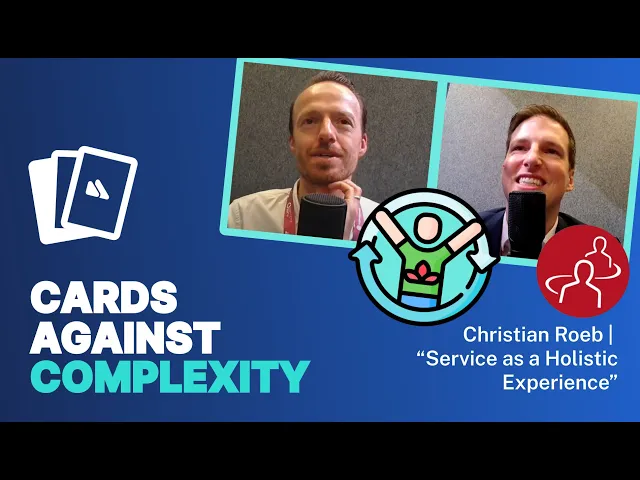
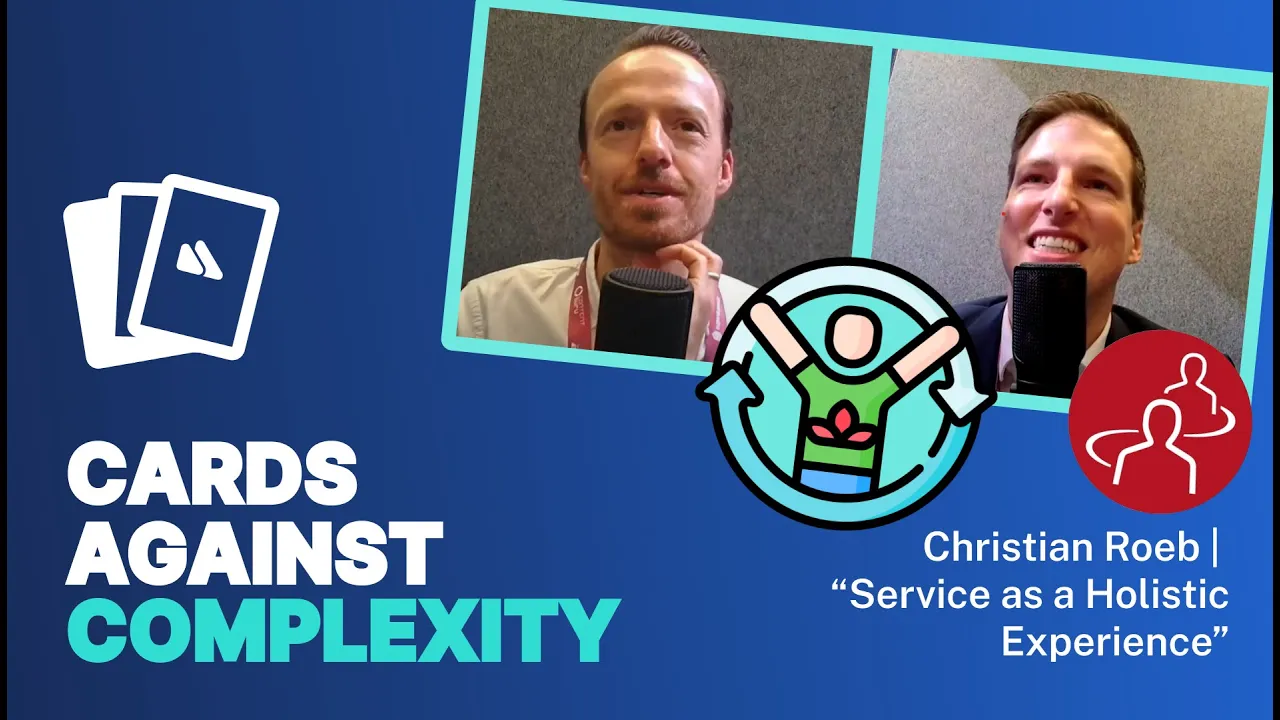
Christian, hi, welcome to Cards Against Complexity. You are the managing director at TOP SERVICE Deutschland. Tell us a little more about what TOP SERVICE does, what is the TOP SERVICE award?
- Sure, TOP SERVICE Deutschland is the award for companies that turn customers into fans or that are developing towards that. - And tell us a little more where can we find the award, who are typical companies that have just won, how long have you been around? - So the award has been around for 20 years and for us this is the topic of analysis moving forward developing in the foreground.
The idea is to give managers valuable management insights and to make the topic of service customer orientation measurable. We all agree that satisfied customers should come back, buy more and bring their friends with them, but we make the whole thing measurable and tradable. We do driver analyses, we give managers insights into how they can actually get there, which is more than a gut feeling, that you can make concrete progress and that you can also find arguments internally in service and in customer orientation, in customer enthusiasm, in investing in employee satisfaction, in customer satisfaction, that's very closely connected.
Since this is a complex task to analyze this topic, to measure the connections and to provide valuable, reliable insights, we have looked for a very strong partner, the University of Mannheim in the person of Professor Christian Homburg, a very renowned professor who has developed this model with us that is based on a lot of science, a lot of studies, which has as a basis these connections between successful companies that are particularly customer-oriented. Really exciting and I mean making customer service measurable, there are always 2 or 3 numbers that you look at. Let's jump straight into what it looks like for a few of your customers.
I would really like to go into it a little deeper because numbers at the end and evaluation make the difference because then only then can I improve my company. Before we do that, let's jump in first a round of Cards Against Complexity and we've just opened the deck of cards, I'll show you that, of course everything is still face down, we have 4 cards in front of us and in principle it's very simple, Cards Against Humanity for everyone who doesn't know the game yet, similar principle: We have a card on the left-hand side with a sentence that needs to be completed. You have three options.
The options aren't quite ideal, but you'll find something. They're written in English. I'll translate them directly.
The award winner probably or one of your customers would like to get a really good idea from you on how to improve their customer satisfaction. You suggest that the self-service help page should be replaced with an all you can eat taco bar where every customer can then order their tacos directly and after delivered to their home, you suggest that there is a wheel of fortune online for the customers so that they can then just get random gifts or thirdly you let the customers play Tetris because what else should you do? - Challenging.
You have to choose. The business executive is waiting, he's also quite impatient and is now happy when your customer satisfaction goes up_ Then I would choose the second. - Wheel of fortune with random gifts.
Why did you pick the wheel? Because it gives the respective customer, while he's waiting, the feeling that he's valued, that he's getting attention, that he has a benefit, that he can be surprised and surprise is a very important driver of satisfaction and success. Yes, and a bit of a surprise, a small gift every now and then, you're actually happy about Christmas coming soon, so we can always use a few surprises and a few presents.
If I'm not lucky enough to be able to install a wheel of fortune and simply give out gifts, which somehow doesn't really have anything to do with customer satisfaction, then what do I do? So, as you said before, you have developed a structured approach. How do you think about customer satisfaction that makes it measurable?
Maybe you'll take me with you. From your experience, regardless of your prize, what are the metrics or areas that you should keep an eye on as a customer service manager? So you're a customer service manager, I think, it's more your area of expertise or other exciting decision-makers who are walking around here at the summit because you already mentioned the NPS and the CSAT.
From our point of view, these are transaction-related metrics that measure the day-to-day business and you can quickly react to, what the current status is and direct the team accordingly. We also see the NPS as a good change instrument to raise this awareness among the workforce about the topic of customer satisfaction and that this is measured, but as consultants we also see limits, yes and the topic "diversity", it's on everyone's lips and all companies like to look at the NPS and it has its justification and it has its advantages. But what happened to me personally, was that I returned a car to the car rental company at the airport.
. . - A few people have already done that before.
Yes unfortunately I was too late, I got stuck in a jam and I just wanted to know how much the bill was the next day and at the airport the return is anonymously with a temporary employment agency so I went up to the car rental office and the counter wanted to know because of the delay how much will be charged on my credit card. The reaction was that they asked me: Did you get clocked in the last hour and a half. That was the answer to my question of how much the bill would be.
I had to briefly think about how the two things could be related to each other and then. . .
The employee clarified and said yes, if you haven't been clocked in the last hour and a half, then you returned the car half an hour ago on time, then you won't be charged at all and in return please give me a nine or a 10 and those are just scenarios that can happen with such a topic NPS and daily measurement. That's why it has its limits and it also has its justification. We think it's good to supplement that with other factors.
On the one hand qualitative interviews in the organization or with customers, so customer focus groups, there are, for example, at Net Cologne, which has been a good customer of ours for a very long time, a customer advisory board, that means that new ideas, new wishes are discussed directly with real customers, yes and those are included on the board, so to speak, and so there are many examples of how you can internalize the topic of customer orientation more strongly. Service is unfortunately often understood as a department, unfortunately that is often the call center of the contact center, the person responsible for service, which, in our opinion, has fewer resources and less budget every year, sometimes fewer staff have to handle a higher volume and are under a lot of pressure and in many of these cases many of these tickets are caused by the fact that internal coordination between marketing sales and other departments may not have gone quite optimally - that's our experience - that's exactly where we start with our analysis. Our analysis is holistic, we analyze top management commitment, corporate culture, human resources management.
When hiring, do simply make sure that you find a Javascript developer and be happy that it worked or, ideally, does this person already have the soft skills that fit your culture because otherwise it can happen that. . .
At a public utility company from our customer base, updates are often made by the IT department on Fridays at 11 a. m. This means that customer service and sales can no longer work, because the IT department is already in running towards overtime and wants want to go home at lunchtime and these are always cases and problems that can arise because you don't work together across the entire organization, yes and I just mentioned a few examples, it might take too long to mention them all, but we'll just go completely through analyzing the supply chain or the value chain of the company and still doing it in a very standardized and lean way with a little effort and if you are interested you can contact us.
Right, you'll find the link here in the description but apart from that you would say: Don't just measure the classic numbers with a focus on the customer service business and the contact center, but also keep an eye on everything and actually look holistically at the entire value chain of the company because service is ultimately the result of the company and not just the customer service center. - You simply take the workforce and the culture, in principle it's about change, about optimization, about understanding customer orientation as an attitude and bringing it into the minds of the employees. Tante Emma was very good at that.
Tante Emma had that internalized and created connections that we would love to have in today's time of large corporations. But you can't take every employee with you into a large corporation. There are people who work 9 to 5 and there are different motives and needs and there are a few tricks how you can internalize the whole topic more.
An example I would like to share. . .
- Super, let's get into the structure a little bit, but customer examples are great, and let's talk a little bit about the industries because that's also holistic, I don't just see it in the organization but service is not just in trade where we see this every day, this can also happen behind the scenes between B2B, for example. A large, well-known car rental company worked with us and asked themselves: What can be done about this internally, to get the topic into the head of the accountant, for example, what did they do? They showed customer feedback, open answers, unfiltered, unedited on flat screens in the headquarters and on the day where, for example, the German train company may have gone on strike, did the staff, the accountant and back office see on the screen what the colleagues at the counter are confronted with, with what load, with what challenge, and what the whole thing was done for and what the customer feedback was.
Other customers then adapted it in other areas and this creates a different feeling. So share feedback, it's a way, maybe a few other examples. You have seen a lot across the companies that work well and we like to have that for our listeners.
Maybe the first two things I can do to think about holistic customer service a little further beyond the NPS or CSAT. - Yes, what people also like to do is, you leave a chair empty in the meeting room, that's where the customer sits and if internal discussions are not in the spirit of that customer, which actually should be the goal of every company then you can always point to the empty chair and say: What does our customer have to say about this internal discussion, and then it's simply important to always talk about this topic of service, customer orientation. The board of one of our customers says, for example, no matter how sales and profits develop, if the topic of customer satisfaction is declining for us, then it was a bad year, so that will simply be anchored in top management and seen there as a KPI for the entire organization.
And then of course you can bring this to the individual employees and so the whole thing can be further thought through and further internalized. - Super exciting. So from your perspective measurability of service is actually an overall company measurement end-to-end along the value chain, take all teams with you and communicate together, of course the NPS comes out in the end on a transaction level but as a company I should actually make service as a company a priority and accordingly bring change with it.
Yes, because in the end we only get praise for our hard work, if we work well as a team, if there is a problem in your department, we will never get the benefit from the customer that we actually want because that is a sum of puzzle which in the end leads to customer satisfaction, customer enthusiasm and recommendations. If individual pieces of the puzzle are missing and the company perhaps doesn't have an overview of where it is then in the long term, this leads to frustration, this leads to you losing good talent in the organization who want to get ahead and want to develop the company further. - Super exciting, Christian.
Thank you very much for your time and for your insights. I think this view across companies is super exciting for our listeners. You gave a few practical tips we also still have the wheel of fortune that we can always bring out if it doesn't work at all, thank you very much for playing a round of Cards Against Complexity and also thank you very much for your insights from your experience with top service companies in Germany.
- Thank you very much, Jan.