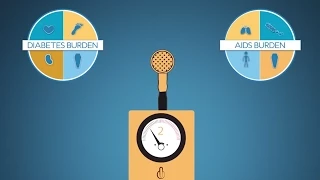
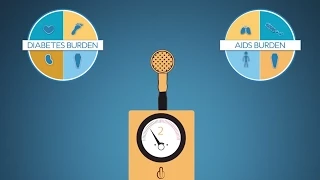
picture this you're the director of chronic disease control in the Ministry of Health you're meeting with your fellow directors discussing health programs when the minister of Health bursts in and announces that the ministry has just been offered $100 million in additional funds you think so many of my programs could benefit from that kind of money however there is a catch the money will be given only to disease intervention strategies which demonstrably offer high value for money or bang for the buck that is the greatest health benefits for the most people with the available funds and
of course there are other agencies within the ministry competing for this funding the minister proposes that you focus on Diabetes a great cause you think as the Director of chronic disease control you know full well just how much diabetes affects people's lives but how do you make that argument in a way that others will understand how do you demonstrate to the donor that diabetes compromises the of many people in important ways as much as a disease like say AIDS after all they're different in just about every aspect populations affected physiology rates and types of complications
mortality risks not to mention strategies to prevent and treat furthermore how do you show that your diabetes intervention strategies and programs offer health benefits similar to or more than those of the competition it's like comparing pineapples bananas and broccoli wouldn't would it be great if there were a single tool to combine the negative effects of early death and morbidity on well-being that is one number to portray the full burden imposed by a disease a universally recognized and respected method to comprehensively quantify disease burden for a specific disease thankfully there is it's called a Del and
it's exactly what you need in technical jargon it's a common metric that solves the pineapple banana broccoli non-comparability problem di are allow direct comparison of the burden of different diseases they also allow summing burden across diseases they permit comparing treated and untreated disease they even make it possible to compare different types of interventions such as treatment expansion versus prevention campaigns di stands for disability adjusted life years simply put a DI is a standardized quantitative measure of the burden of disease it combines mortality the years of life lost due to premature death with with morbidity a
measure of all non-fatal clinical effects such as illness episodes or chronic disability mortality is easy to quantify it's simply the life expectancy of a healthy individual at the time he or she becomes ill minus the Agee at death of an individual with the disease being studied think of this as the ly in di or life years lost due to disease morbidity is a bit more complicated to calculate first each illness effect is given a sever Verity rating called a disability weight ranging from zero which means fully healthy to 0.3 which is common for long-term chronic
illnesses to one which means 100% disabled next because effects can be short or longterm duration of the morbidity is factored in think of this as the da in dially or disability adjustment due to morbidity when both mortality and morbidity contributions are added together you have a full Del score let's look at an example using adult onset diabetes let's say an individual dies at 60 years old instead of his life expectancy without diabetes of 75 years that's 75 minus 60 so 15 di incurred that's the mortality part of the dally let's also say that the morbidity
effects of adult onset diabetes perhaps foot or kidney complications rendered this individual 50% disabled for the final 10 years of his life that's the disability weight so 0.5 * 10 for 10 years results in five more Dales incurred in some for this individual the overall disease burden due to diabetes can be represented as 20 delies 15 for mortality plus five for morbidity usually we adjust dally estimates for timing meaning we treat future events as having less value from today's perspective because we aren't as concerned with the the future as we are with the present this
adjustment is known as discounting keep it in mind because it can significantly reduce the dally burden of early mortality for now we'll stick to exploring undiscounted dies and what if a Diabetes Care intervention extended life by 5 years and reduced the duration of disability from 10 years to four then the ly the life years lost would be 10 instead of 15 the da the disability adjustment would be two instead of five added up that yields 12 di instead of 20 this means using the standard terminology we've averted eight delies through this intervention that is the
health benefit of the intervention delies were invented 30 years ago to combine separate data on disease mortality and morbidity being recorded by the World Health Organization it complements another common metric already in use at the time known as qualies or quality adjusted life years Di and qualis both incorporate disease related reductions in length of life and the negative effects of morbidity but they consider the matter from opposite perspectives qualies quantify health so bigger values are better while di quantify disease burden and thus smaller Del values are better health programs try to avert delies other than
their opposite sign delies and qualies are almost equivalent since their introduction Di have become the accepted way to quantify Global disease burden allowing observers to compare and evaluate disease data as grouped by country and region age and gender type of disease and more for example here you can see the distribution of DIYs by disease and age in newborns most alies are due to neonatal disorders for one-month olds diarrhea lower respiratory illness and other common infectious diseases cause the greatest burden diabetes extracts a steady toll starting in the 20s cardiovascular disease takes off quickly from age
30 similarly in this graph you can see how disease burden varies by geographic region on the left are wealthier countries with the largest burden from cardiovascular disease and cancer and secondarily from muscular skeletal disorders diabetes and mental disorders on the far right are African regions with the highest burden from HIV diarrhea and respiratory infection tropical diseases and neonatal disorders you can find even more dally based Graphics in a special December 2012 issue of Lancet and online at the institute for health metrics and evaluation website let's return to your immediate dilemma using dies you can now
provide your boss the minister of Health with exactly the kind of estimates and information the donor wants to see you can quantify the burden of diabetes and compare that to the burden of other diseases such as AIDS granted you still need to collect data on such items as a number of people who have diabetes how much their lives are shortened on average and how much disability they suffer you also have to gather the same data for individuals with HIV infection in order to make these dally comparisons the good news is that the necessary information is
all generally available through clinical surveys epidemiologic studies and Global burden of disease tables you can even use di to tackle The Minister's other Challenge quantifying and comparing different intervention programs to address diabetes you could calculate the number of d a particular diabetes treatment program averts perhaps by extending life or reducing the length or severity of morbidity you can then compare that result with the number of delies averted by another program perhaps focused on diabetes prevention through nutritional counseling then by factoring in the potential $100 million in new funds and the coverage which those funds allow
for each Intervention Program you can extend your analysis into a basic cost Effectiveness analysis completing this analysis will take some effort in practice but it's simple conceptually you're lowering the dally burden and comparing which options offer the biggest Health improving bang for the buck that's what the donor wants di are a big part of global health planning and evaluation they offer a logical and flexible way to compare disease burden due to both mortality and morbidity from different diseases across populations and with and without interventions with the di concept under your belt you can understand and
contribute to Global Health policy discussions so go forth and use D in good health