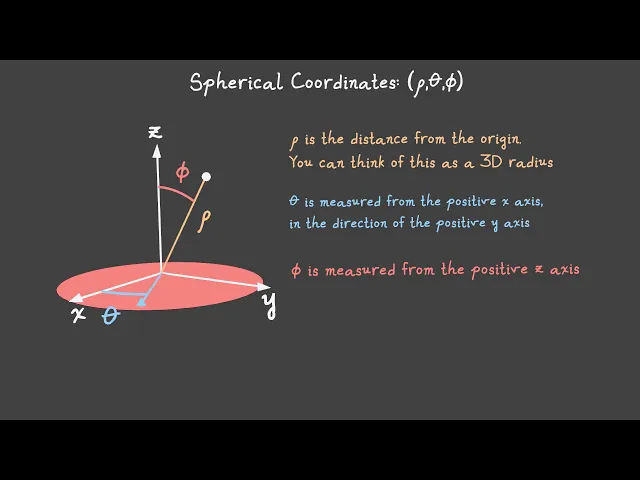
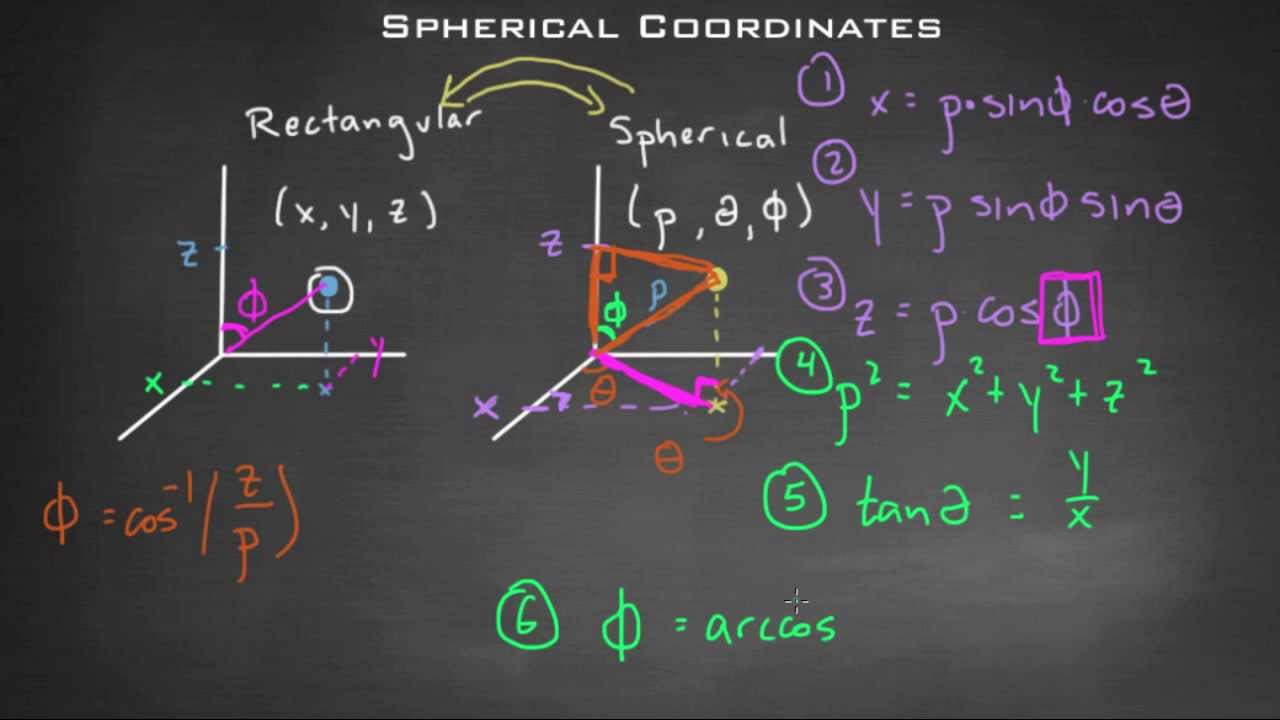
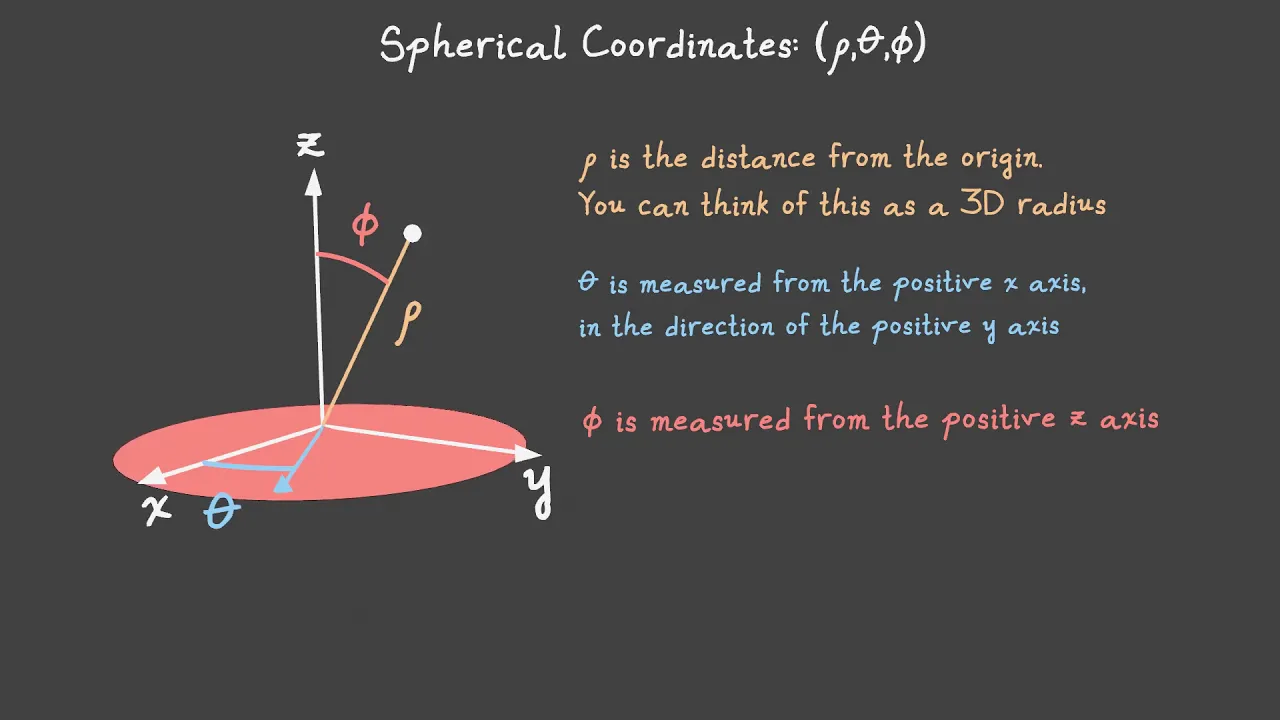
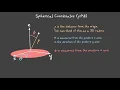
if you're having trouble setting up triple integrals in spherical coordinates this video is intended to help you visualize what those three spherical coordinates Rho theta and fee look like in 3d space we're gonna start by looking at this point in 3d space and the first coordinate we're going to look at is Rho Rho is defined as the distance from the origin and you can think of it like a 3d radius or later when we start making solids this is going to be the radius of our sphere theta is measured the same way that it is
in polar or cylindrical coordinates where we start from the positive x axis and we rotate towards the positive Y axis you're probably more used to seeing this in 2d space so make sure that you're starting it at the right position with the positive x axis and sweeping towards the y axis the last coordinate fee is the angle measured starting from the positive z axis notice that this description doesn't give us any direction for fee to travel like theta does what this means is that the same fee can be measured at many different spots around the
z axis in our example fee is 30 degrees but over on this side fee is also 30 degrees in fact all the points on this cone have the same fee value 30 degrees since the angle they form with the positive z axis is always 30 degrees next let's think about the possible values for our three coordinates starting with Rho we only want to consider positive values for our distance so we're going to say that Rho has to be greater than or equal to zero in the diagram you can see what happens when we let Rho
fluctuate between zero and one next is theta and if we start at theta equals zero and go up to theta equals two pi then what we've done is swept in a complete circle and that circle is going to encompass all of 3d space so theta is in between zero and 2pi the last one is V and this one might be a little bit counterintuitive the first time you see it but it makes sense if you think about the values of B needing to sweep all of 3d space so if we start at y equals zero
and slowly increase it we can see this cone almost blooming out of the z-axis until eventually it reaches PI over 2 and when fee is PI over 2 then we've swept all the way down to the XY plane and so if we then continue to increase fee then we start to get this cone in the negative Z and at the bottom here we've swept all of 3d space but note that fee hasn't gone around in a complete circle fee has started at 0 but the angle of fee down at the negative z-axis here at the
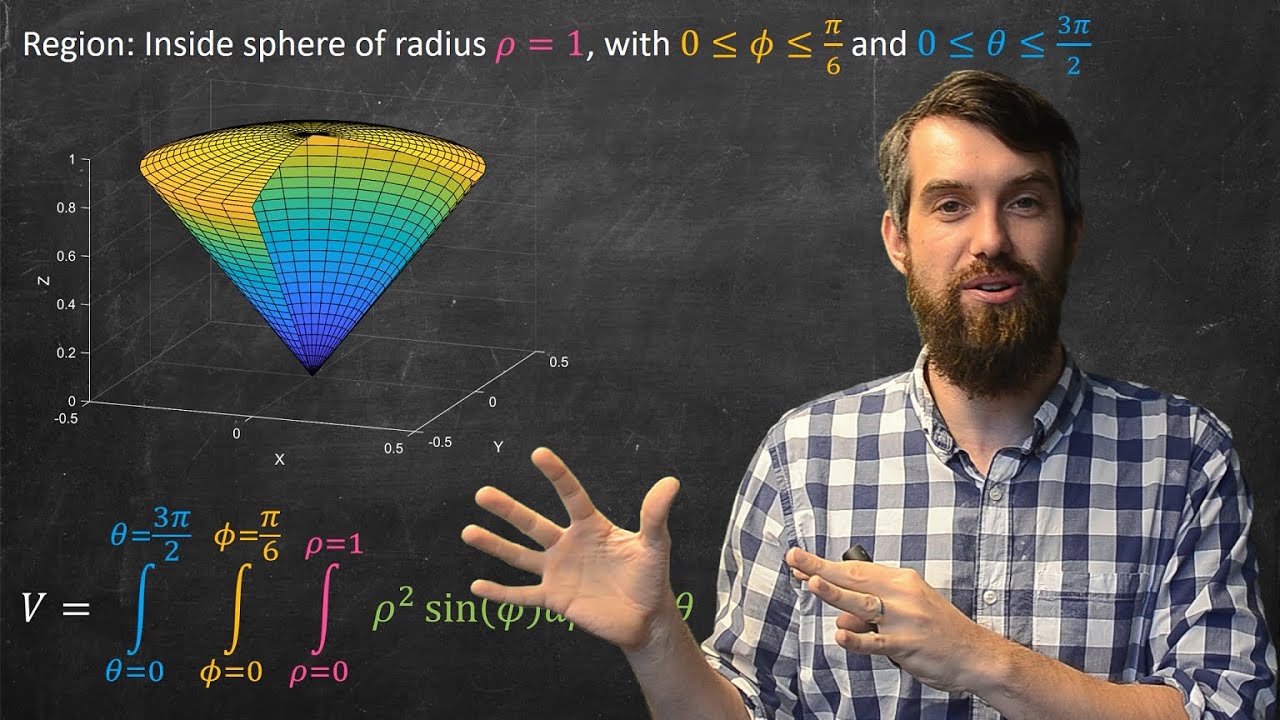
bottom is equal to PI so we say that fee is going to be in between 0 and pi if we put all these together to try and define a solid sphere of radius 1 then we can say that Rho is in between 0 and 1 theta is in between 0 and 2 pi and fee is in between 0 and pi let's look at a few more solids where spherical coordinates would be a good system to use this next one is the portion of a sphere that looks a little bit like an ice-cream cone the sphere
reaches out to a radius of 1 at the edge so we say that Rho is in between 0 and 1 for theta as we sweep around the z-axis we see that the entire circle is present in the solid so we say that theta is in between 0 two pi and lastly for feet since this cone forms a 45-degree angle or a PI over four radians angle with the xy-plane we're going to say that fee starting at the positive z axis is between 0 and PI over 4 these three ranges for rho theta and fee form
the bounds for our triple integral so we can find the volume of the solid by looking at a triple integral that is integrating one the last solid I want to look at is a quarter of a sphere again Rho is going to be between 0 and 1 but I want you to think and see if you can figure out what theta and V are for this solid if we let theta sweep around the z axis we can see that it starts at pi and then finishes at 2 pi v starts below the XY plane so
our starting point or lower bound for feet is going to be PI over 2 at the flat xy-plane and then it's going to extend all the way down to V equals pi well I have this example up I thought I would show you something interesting that can happen with Rho let's say that Rho in this case is between one half and one then we wouldn't start with the origin we would start with Rho equals one half so we get this hollow sphere effect looking back at our quarters fear you may have noticed that this isn't
the easiest way to find the volume of this solid in fact we know that the volume of a full sphere is 4/3 PI R cubed and a quarter of that would end up being the volume of our solid the major benefit of spherical coordinates is that we can introduce a fourth variable our density and we can talk about the mass of a solid for example if I let the density be proportional to 1 over Rho squared then there's no way that I'd be able to find the mass of this object but spherical coordinate says all
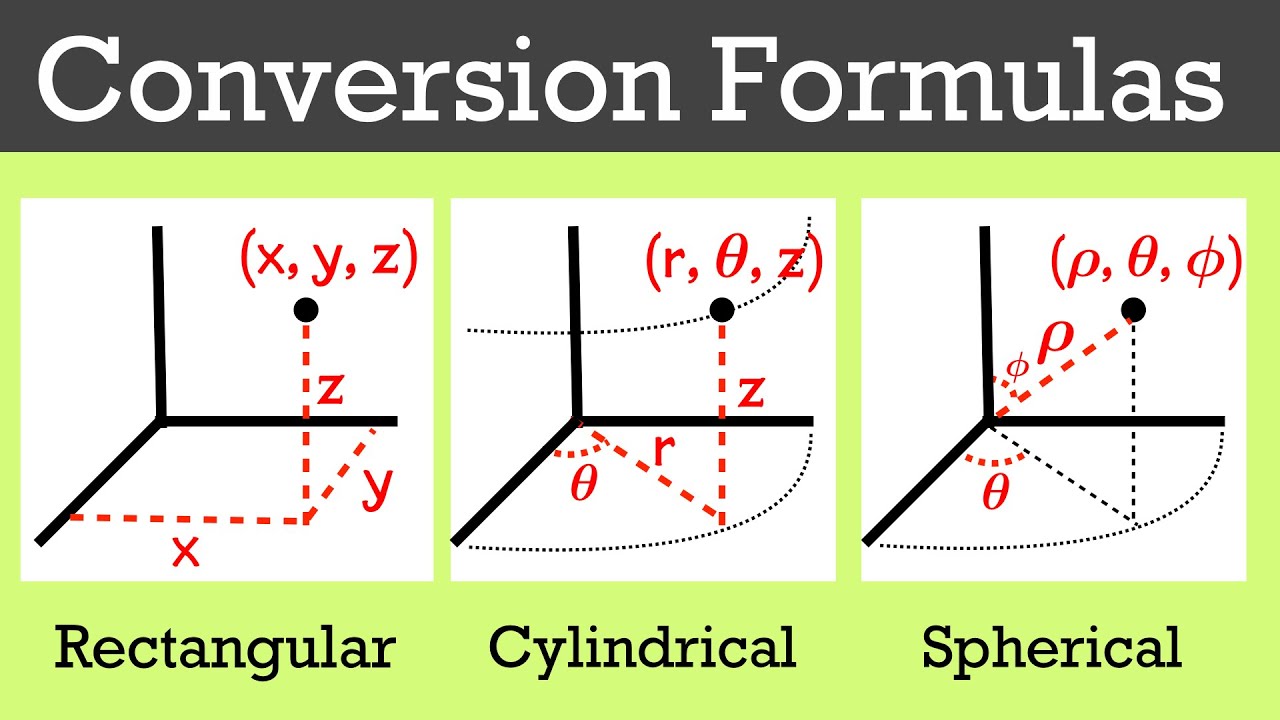
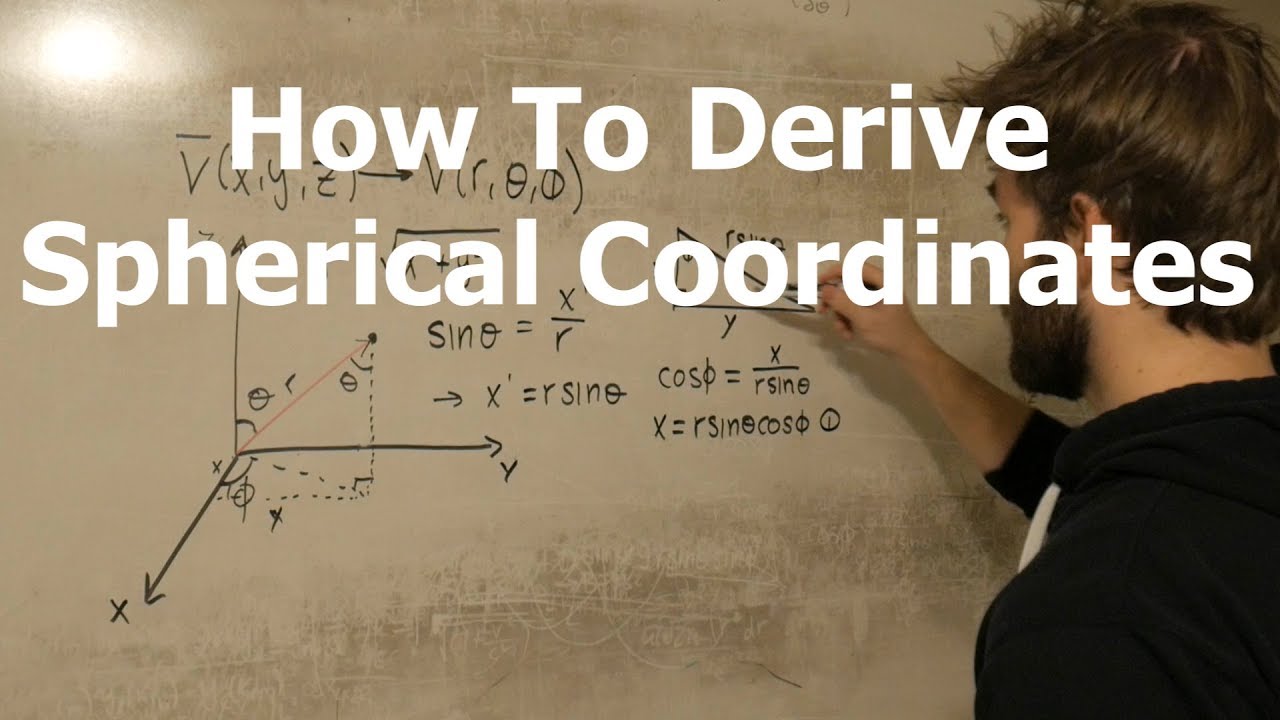
we need to do is change our density formula to be K over Rho squared one more thing to consider before you start trying to tackle these spherical coordinate problems is that when you're converting from Cartesian coordinates XY and Z into spherical coordinates you're going to need quite a few formulas but a lot of these formulas are things you've already seen or they're based on this following right triangle so I'll lead you to the book or the online resources that I'm going to link below in order to see more about these equations but good luck tackling
your spherical coordinates problems