Plato's allegory of the cave is probably the most well-known and at the same time most complex allegory in the history of philosophy. It poses the question of reality, true knowledge, philosophical education and the responsibility of philosophers. In this video you will find out exactly what this famous parable is about and how it can be interpreted .
The allegory of the cave is in the seventh book of the Politeia, after the allegory of the sun and the allegory of the lines. Plato would like to use the parable to explain his theory of ideas in more detail and to illustrate how people can recognize ideas, especially the idea of the good, and what ethical consequences result from this knowledge. According to Plato, in order to attain real knowledge, man must change his entire way of looking at things and with it his life.
This path to true knowledge is hard and arduous. For this, man must first be freed from his previous wrong worldview and then, as an enlightened philosopher, has the duty to free other people from their wrong worldview. In the parable, Plato first describes life in the cave, then the ascent from the cave and finally the return of the philosopher to the cave.
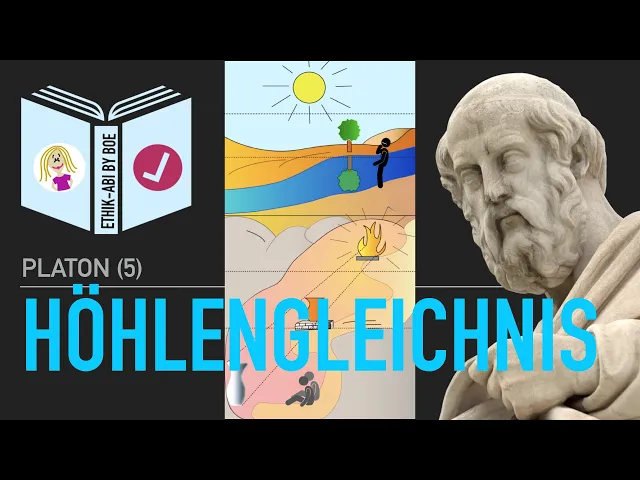
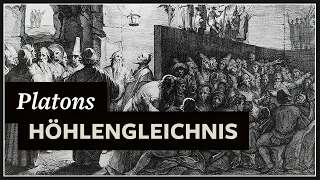
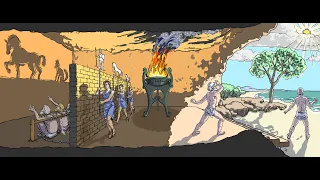
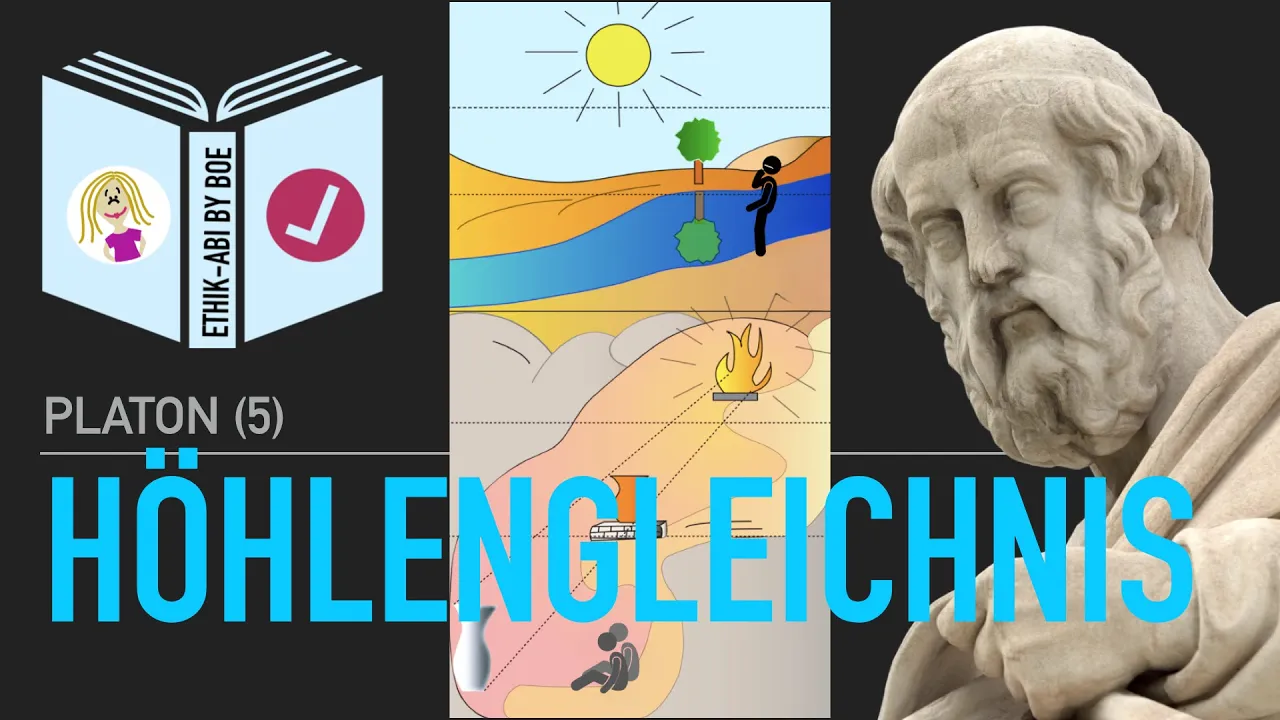
“Imagine people in an underground cave. This has an entrance leading up to daylight which is as big as the whole cave. In this cave, people have been tied by the legs and neck since childhood, so they remain in place and only ever look straight ahead.
Because of their shackles, they cannot turn their heads around. They receive light from a fire that burns high in the distance behind them. Between the fire and the chained is a path above.
A small wall is erected along this path, such as puppeteers build between themselves and their spectators, over which they perform their tricks. Now imagine along the short wall people carrying all kinds of implements so that they project beyond the wall, statues of people and other creatures made of stone and wood and other materials. Some of these carriers talk to each other, others remain silent.
The people in the cave have never seen anything of themselves or each other other than the shadows cast by the fire on the opposite side of the cave. After all, they can't move their heads their entire lives. So you only see the shadows of the things that are carried by.
If they could now talk to each other, they would certainly describe what they see as being . And if the prison also had an echo from the opposite wall, and then if one of the passers-by spoke, they would think the passing shadow was the one speaking. In no case could such people believe anything other than the shadows of those artificial objects to be true.
” At the beginning of the parable, Plato describes the situation of the people in the cave who were bound. From childhood on, they only perceive shadows and the echo of voices and consider these images of reality to be real because they know nothing else. These people represent the ordinary, philosophically uneducated people.
They are ignorant because they are far from the source of knowledge, more precisely the idea of good. In their everyday lives they are surrounded by illusions that they take to be the truth. They don't have real knowledge, only opinions.
Often these opinions are wrong. Ordinary people settle for the mirages, illusions and opinions instead of freeing themselves, turning around, ascending and opening their souls to the world of ideas and therefore to real knowledge. In Plato's theory of ideas there is not only the world of our sense perception, but behind or above it a world of ideas.
The highest idea, which gives all other ideas and thus all things in the sense world their existence and knowability, is the idea of the good. While the senses are elusive and ephemeral and can fool us, ideas are eternal and true. Most people stay in the cave with their wrong opinions because they are comfortable, don't know any different, and are afraid of change.
The process of knowledge is strenuous and demanding. It is arduous to embark on a quest for truth and real knowledge. Many people are therefore satisfied with their situation and do not want to question their everyday understanding of the world.
You'd rather not know. “Now think about what it would be like if these people were freed from their bondage and thereby also cured of their ignorance. Here is what would normally happen to them: If a man were to be freed from his bonds and forced to stand up suddenly, turn his neck, walk and look up at the light, and with all these doings he would feel pain and because of the blinding brilliance those things would not rightly recognize the shadows of which he had previously seen - how do you think he would answer if someone explained to him that before he had only seen trifles, but now he is closer to beings and so, turned towards the actual beings, he sees right?
And if that person then showed him each of the objects passing by and asked and forced him to say what it was? Don't you think he would be embarrassed and think what he saw before was more real than what he is being shown now? And when he was compelled to look at the light himself, his eyes would hurt, and he would turn away and flee to the things he could look at, believing that these were actually clearer than what he was now able to see shows?
But if he were dragged from there by force up the rough and steep slope , and not let go until he had been drawn out into the light of the sun, would he not feel pain and be reluctant to be dragged like that? And if he were to come into the light, wouldn't his eyes be full of brilliance and, at least for the first moment, would he not be able to see anything at all that was now being described to him as the real thing? So he would have to get used to it if he wanted to see things up there.
First he would probably see the shadows most easily, then the reflections of people and other objects in the water, and then himself. And then he could see what is in the sky and the sky itself, and more easily at night , looking up to the light of the stars and the moon as by day to the sun and the light of the sun. Finally, however, he would be able to see the sun, not its reflections in the water or elsewhere, but itself, in itself, in its own place, and behold it as it really is.
And then he would probably make the general reflection about her, that she is the one who brings about the seasons and years and rules over everything in visible space, and that she is also in a certain sense the cause of all that she has seen before is. But if he now thinks back to his first dwelling and to the wisdom that was there and to his fellow prisoners at that time, then he will probably count himself lucky about the change and regret it. But the honors and praise which they bestowed on one another there, and the rewards for him who most keenly discerned the passing shadows, and who best remembered which of them used to pass first, and which afterwards, and which at the same time, and of that the best knew what was to come - do you think he still wants that praise and envies those in honor and power with those over there?
Or will he be, as Homer says, that he would much rather work in the field for a poor man's wages and endure all sorts of things than get caught up in those opinions and live that life again? He would rather endure anything else than that life. ” In this part of the parable, Plato describes the process of knowledge as an arduous climb out of the dark cave.
The prisoner who is freed from the bonds and dragged upstairs must realize that the shadow images are not real and that he has been artificial all his life believed projections to be the truth. In order to recognize the ideas and, above all, the idea of the good, man must leave the world of deceptive sensory perception - the cave - and step by step ascend to the truth - the spiritual world of ideas. This realization does not come suddenly, but in stages.
The soul moves away step by step from the everyday world of mere opinions. The gradual recognition of the truth becomes possible through philosophical education and training - in Greek paideia - which can lead people to the highest idea, the idea of the good. Recognizing the ideas and finally the idea of the good as the principle of everything that exists requires a liberation and turning of the whole soul (periagôgê psychês) - away from the darkness of the world of senses towards the light of the world of ideas.
It is interesting that the cave dweller does not free himself. Someone forces him to climb up, and in the end even violently drags him out into the daylight. According to this parable, philosophical education and knowledge do not seem to be possible without outside help.
According to Plato , in order to lead people step by step from ignorance to true knowledge, philosophers are needed as teachers. The "redirection of the soul" (periagôgê psychês) towards the truth takes place through education, in which a knowledgeable person accompanies and guides an ignorant person. Someone who has already been liberated, left the cave and recognized the ideas, especially the idea of good, must help the remaining cave dwellers in their liberation and ascension.
By the way, for this purpose Plato designs a detailed educational program, which I will explain in more detail in the video about the ideal state. The aim of this education is the true insight into reality, the recognition of the idea of the good. And in which stages exactly does the process of knowledge take place?
Man first recognizes things of which he previously only saw shadows. While the shadows correspond to the images of objects that can be sensed, but also to false ideas - for example of justice - the objects in the cave correspond to the things that can be perceived by the senses. At a further stage of the ascent he then sees the cave fire.
This enables the visibility of the sensually perceptible things in the cave and the creation of the shadows. It is analogous to the sun parable for the sun in the sensually perceptible world. After that, via a steep ascent, he reaches the outside until the light of the sun.
He has now advanced into the realm of the conceivable, the spiritual world of ideas. Here he is initially blinded. He only recognizes shadows and reflections in the water, which he initially believes to be real.
But then he looks up and sees the real landscape and the real sky, first by night and then by day. The real things in the outside world correspond to the ideas. Finally he sees the sun itself and its light.
He recognizes that it is the cause of all that exists and is visible, the very force that gives all things their appearance and their reality. The sun is the idea of good. The process of knowledge described is painful and strenuous: the cave dweller is violently dragged up the path, the bright light of truth blinds and hurts him, he always has to get used to new situations and lighting conditions.
He is initially disturbed and considers the shadow images to be more real than reality. A life in the false reality of the cave is no longer conceivable after realizing the truth. The philosopher can no longer take seriously what the people in the cave believe to be true , because he has recognized it as false.
But he doesn't stay up with the sun, but has to return to the darkness of the cave to help those who are still chained in the cave and trapped in illusions and wrong opinions . As a philosopher, he now has an educational and educational mandate. "If such a person climbed down again and sat down in his old place, then his eyes would be filled with darkness if he came out of the sun so suddenly.
But if he then had to try again to judge those shadows in competition with those who were always tied there, while his eyes are still blinded and have not yet adjusted (and this period of adjustment will probably take a long time), so be it surely he would be laughed at and said that he came back from his ascent with ruined eyes and that it was not worth going up there even to try. But whoever tried to free them and lead them up, they would probably kill him if they could only somehow get their hands on him and kill him. ” The last part of the allegory of the cave describes the philosopher's return to the cave.
According to Plato, whoever has recognized the truth should return to the cave and help those who are still bound. He must try to convince the other prisoners in the cave of the actual reality . After the highest insight, the knowledge of the idea of good, the now philosophically learned must perform his duties of education and government.
He is responsible for the education (paideia) of the philosophically uneducated and should lead them to knowledge and thus to a good and happy life. With Plato, the purpose of the philosophical educational path is to train an elite - so-called philosopher kings - who can then rule because, in contrast to average people, they have recognized the idea of the good and can implement it in the state. Plato's demand for such "political" behavior on the part of philosophers results from his view that knowledge must always be put into practice.
The return of the philosophers is necessary for the state to function as a whole and for the individual to be happy. For this, the citizens of the polis must be educated and freed from their misjudgments and illusions . But those who have returned can only find their way around the cave with difficulty, as it is much darker than outside.
The philosopher seems unworldly, meets with incomprehension and ridicule, is seen as a threat and even puts his life in danger. Furthermore, the ascent to the truth is arduous and most people prefer to be content with the shadow images. Therefore they are not grateful but rather irritated when someone who has seen the sun and with it the idea of the good, true and beautiful descends back into the cave and tells them that their usual world is only an illusion.
The philosopher who wants to move other people to true knowledge therefore runs the risk of being ridiculed, threatened and even killed. This passage in the allegory of the cave is certainly an allusion to the fate of Plato's teacher Socrates, who wanted to free the Athenians from their wrong opinions and was finally sentenced to death. And Plato also had very sobering experiences during his three visits to Syracuse trying to educate the rulers there philosophically.
In order to understand the allegory of the cave, one must relate it to the allegory of the sun and lines previously described. This is associated with a few individual problems in detail, which I do not want to go into detail about. In the parable of the sun at the end of the sixth book, Plato draws an analogy between the sun and the "idea of the good".
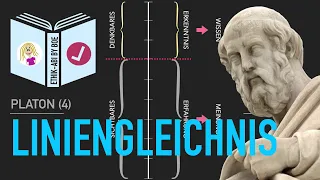
The sun is to the visible as the “idea of the good” is to the conceivable. Just as the sun enables the knowledge and existence of sensually perceptible objects in the realm of the visible , so the “idea of the good” enables the knowledge and existence of ideas in the realm of the conceivable. In the allegory of the lines, Plato assigns different subject areas to different modes of knowledge and determines their relationship to one another.
To do this, a line is divided into four unequal sections. The first division divides the whole object realm into two opposing realms: a sensible realm accessible to perception, and an intelligible realm only mentally knowable. The resulting four subsections represent the empirical objects and their images as well as the mathematical objects and the ideas.
They correspond to the four modes of knowledge eikasía, pístis, dianoia and noésis. Noésis reaches the unconditional real beginning and thus the foundation of knowledge: the idea of the good. In the visible realm only opinion (dóxa) is possible, in the conceivable realm real knowledge (epistêmê).
Now let's put the three parables in relation to each other. The cave corresponds to the area of the visible (sensual world) in the sun and the lower section in the line equation. The ascent out of the cave illustrates the different possibilities of knowledge on the different levels of being that are described in the parable of the lines.
The dialectic serves as a method to grasp the ideas and the idea of the good (noésis). The outer area of the cave corresponds to the realm of the conceivable - i. e.
the world of ideas in the allegory of the sun and the two upper sections in the allegory of lines. In all three parables, Plato describes a path of knowledge that takes place in four stages of knowledge, is based on ontologically different types of objects and ends in the knowledge of the truth. The allegory of the cave presents some difficulties in interpretation because it is very complex and Plato himself only interpreted it incompletely.
In addition, Plato deliberately avoided using a fixed terminology. Researchers are also discussing the details of the assignment of the elements from the parable of the sun and of the lines that has just been presented . Due to these difficulties, the German philologist and philosopher Thomas Alexander Szlezák proposes not to concentrate on individual details but on the main statements of the parable and distinguishes five basic intentions of the cave allegory: The everyday attitude of knowledge must be abandoned in favor of a philosophical attitude.
(1) The "turning of the whole soul" (periagogé) does not lead directly to the highest possibility of knowledge, but only via a graded sequence of different ways of knowing. Philosophical education thus corresponds to gradual habituation, not sudden knowledge. (2) From an ontological point of view, Plato assigns unequal object types to the various graded modes of cognition.
"Shadows of something" are less "being" than the perceptible things, than the ideas, than the "idea of the good". (3) The way to show the "idea of the good" costs effort and strength. It can be associated with scorn and ridicule, but also with dangers.
The "turning over of the whole soul" is therefore not only a matter of the mind, but of the entire personality. (4) Plato is convinced that it is man's natural destiny to recognize the "idea of the good". (5) In the allegory of the cave, Plato illustrates central aspects of his philosophy.
His ontology (doctrine of being) is reflected in the succession of four different types of objects that he associates with the stages of the ascent from the cave. With each level, the objects become "more real" and thus "true". In the end, however, there is the "most brilliant thing", the "idea of the good".
The different levels of cognition are also illustrated: the world of sense perception, in which only opinion (dóxa) is possible, corresponds to the cave, the world of ideas and mathematical objects, in which real cognition and real knowledge (epistêmê) is possible, the outside world. The sun, in turn, stands for the highest knowledge: the knowledge of the idea of the good. In principle, according to Plato, all people can be led to the knowledge of the truth.
In reality, however, only a few succeed (Rep. so3b). Only philosophers attain true knowledge.
The parable is also related to Plato's ethics and political philosophy. According to Plato, for a good, virtuous and therefore happy life, it is necessary to free oneself from false ideas and to stick to the ideas, especially the idea of the good to orient. The shadows in the cave correspond to the common misconceptions of justice in the context of the politeia.
A few - like Socrates - can attain knowledge on their own. The vast majority need help with this. A philosopher who has recognized the idea of good is therefore obliged to return to the cave and help those around him to understand.
For Plato, education is not an end in itself. The philosopher has a duty to the polis and should share his knowledge of what is beautiful, true and good, even if he is met with scorn and ridicule. Plato's ethics is based on a theory of education (paideia), in which a knower leads a learner to knowledge and thus to a good and happy life.
For Plato, the recognition of the idea of the good is a prerequisite for the development of virtues and thus for the happiness of the individual as well as of the state. Only philosophers who have seen the "idea of the good" can therefore become kings in Plato's ideal state and set the guidelines on which it is based. Because the guidelines and principles in the state - like every human practice - must be based on the "idea of the good".
Plato's allegory of the cave is still regarded today as a reminder not to be satisfied with the deceptive and ephemeral world of sensory perception and to strive for true knowledge. Compared to the allegory of the sun and lines, the allegory of the cave is no longer just about ontological, epistemological and ethical aspects that affect the individual, but about the whole state. It is about the possibilities and the dangers that true philosophical education entails and underlines the responsibility of philosophers for state and society.
You can now test your knowledge with the Plato's Allegory of the Cave (Content) and Plato's Allegory of the Cave (Interpretation) Quizlet sets . Have fun learning and see you soon!