Now, as you're evolving, what happens is that that slit opens up, opens up more and more and more. So, you see more and more of that reality and we assume that we see different realities. >> Shortly after this interview, Bentov set out on a decisive journey.
He was traveling to California to present his latest experimental advances on accessing other realities. Japanese researchers interested in his work were scheduled to see his presentation. That meeting, however, never took place.
On May 25th, 1979, Bentov was a passenger on American Airlines Flight 191. Seconds after takeoff from Chicago O'Hare, the aircraft lost an engine and crashed, killing everyone on board. Among them, Itsak Bentoff.
A fatal accident or perhaps something more unsettling. Curiously, his research on consciousness and accessing other realities would later be used for years by the CIA in the gateway process. Bentoff was not just another mystic speaking about spirituality.
What made his research truly compelling was his training as a physicist. He brought the study of consciousness and spirituality into the laboratory. He experimented, measured, and explored.
In doing so, he [music] built a bridge between physics and consciousness. Blending science with the mysteries of the mind. The nervous system is that thing that gives us the picture of our realities.
We don't see light which is beyond UV and beyond infrared. Uh we hear only a limited uh scale of vibrations. In other words, all our senses are limited.
>> Ordinary people at this stage of evolution are not able to see. >> Correct. >> What is the nature of that reality which they're able to see?
Well, that is classified as a non-physical reality. Sometimes at the physical level, we are separate. We're separate and there's this much distance between us.
On the very highest level, which is a high spiritual level, we are basically over overlapping completely. Everybody is overlapping everybody else. In other words, everything and everyone is everywhere.
In other words, we've become omnipresent. This is a state of highly spiritual percepted beings or God's human. >> Itsakbento researched [music] how the human nervous system responsible for perceiving physical reality is linked to the evolution of consciousness.
One of the central themes of his study [music] was condundalini energy, a force described in eastern traditions that rises through the spine, activating [music] energy centers and expanding perception. Bentov explained that as [music] this energy ascends, it harmonizes the body's frequencies into a state of resonance. >> Uhhuh.
So that the evolution has been [music] rushed up, hurried up. >> Yeah. >> Can we speed that up by doing that?
>> Yeah. Well, you use techniques which [music] push the nervous system a lot faster than the normal evolutionary rate. >> Those techniques are available.
But the tragic accident did not take Bento's knowledge with it. He left us two extraordinary books, stalking the wild pendulum and a cosmic book on the mechanics of creation. and his wife Mala continued his work ensuring that these treasures of knowledge would not be lost.
Guided by Meala, we are about to step into the fascinating and mysterious world of Bento, the scientist who explored the other side and created a map for navigating between realities. He saw the body as a system of oscillating mechanisms that with the right techniques can allow us to travel between dimensions and gain direct knowledge from the source. We also delve into his view of the universe as a hologram, a place where consciousness is constantly evolving.
We don't have souls, but it's just the other way around. The soul has us. >> So that is that thing that evolves, the permanent eternal thing is the soul.
And the body is a kind of disposable thing. >> And so it's the soul [music] which is experiencing evolution and not our personality, not our physical existences. >> That is the soul is the repository of information that we gather during a lifetime.
Ben called himself a nuts andbolts Ben a plumber. He was trained as a mechanical engineer and uh somewhere along the way he started meditating and his consciousness opened up. First of all he saw reality as a hologram.
It's a totality in which every part is related to every other part and they're all interdependent. And this hologram he perceived as vibratory in nature. In other words, as he said, it's an off and on reality and we are only part-time here.
It's an oscillating field and it may appear to us as a continuous reality whereas in fact it's like a film composed of se of separate frames. The physical reality the manifest world is only another expression of that reality which is consciousness or existence itself aware of itself. It Bentov firmly believed that the reality we experience, the physical reality functions like a hologram.
In a hologram, every part contains the information of the whole. And Bentov argued that the universe operates in the same way. This idea carries many implications, but the most important one is that what we perceive as reality may be nothing more than a projection.
Ultimate reality would exist at another level or even another dimension, one that we do not normally perceive. From this perspective, all knowledge already exists within each of us, even within every cell. This is how a hologram works.
The whole reflected in every part. Such a model could explain phenomena like telepathy or quantum entanglement where particles remain connected beyond space and time. It also sheds light on accounts from people who have reached higher states of consciousness describing themselves as one with everything and claiming to access [music] complete knowledge from within.
According to Bento, these experiences are glimpses of moving beyond the projection of reality and accessing a deeper level where the base reality already contains the entire projection. Bento did not arrive at these insights through theory alone. He explored them experimentally through meditation and a series of experiments that we will examine next.
The mechanism in the physical body that perceives reality is the nervous system itself. So Ben has designed instruments to study these physiological changes um that occur in the body when a certain energy rises through the spine. In the east it's called condundalini uh or coiled serpent.
It rises up the spine and awakens certain energies in the body which allow perception to uh become broader and uh the brain functions then on a different level. And this chart shows an experiment that he did with a subject sitting on a chair that had a device attached to it called ballistograph. The lower part of the chart shows the same individual in a state of deep meditation, which also means deep relaxation.
And look what happened. The breathing is practically gone. It's a straight line.
And what was a disrupted pattern of the heartbeat has turned into a regular sine wave. And looking at this as an engineer, Ben said this is a an effect of harmonization of all the frequencies within the body and the body is now resonating like a tuned instrument. The ballistraph allowed Bentov to gain a deeper understanding of the physiology behind certain states of consciousness and the mechanism by which condundalini energy could be activated and rise.
This device was capable of detecting the microvibrations of the body produced by each heartbeat. Although imperceptible to our senses, every time the heart pumps blood, it generates a small mechanical movement that travels throughout the body. The ballisttoraph recorded these oscillations with great precision, [music] allowing researchers to observe how the body responds to different physiological and mental states.
Through these measurements, Bentov made a key observation. During deep states of relaxation and meditation, breathing naturally began to slow down. At the same time, the heart rate decreased and began to synchronize with the breath.
At that point, Bentov noticed that the body began to enter a shared frequency close to 7 hertz. This frequency is especially significant. It falls within the theta brainwave range 4 to 8 hertz which is linked to deep relaxation, meditative states, heightened creativity and subtle expansions of consciousness.
Remarkably, it also matches the Earth's natural frequency known as the Schumann resonance, hinting at a profound connection between the rhythms of our body and the planet itself. According to Bentov's model, this synchronization could trigger a process of sympathetic resonance in which different systems of the body begin to align to the same frequency one after another in a cascading effect. For Bento, the key lay in sound and at a deeper level in vibration.
Think about it. Shamans beating drums at precise rhythms to induce trance states. synchronized dances aligning body and mind.
Mantras sung collectively and repetitively. All these ancient traditions seem to recognize the same truth. Consciousness can be altered when the body is harmonized with specific frequencies.
The pranayyamas, the rhythmic breathing patterns were essentially a sophisticated form of the same principle, a way to tune the nervous system, the heart and the mind to a shared vibration. And he came up with what he called the u uh condundalini syndrome uh model. In other words, when this energy in the spine rises, uh, the harmony occurs where the vibration turns into the sine wave at seven cycles per second or seven hertz as compared to the regular disrupted pattern.
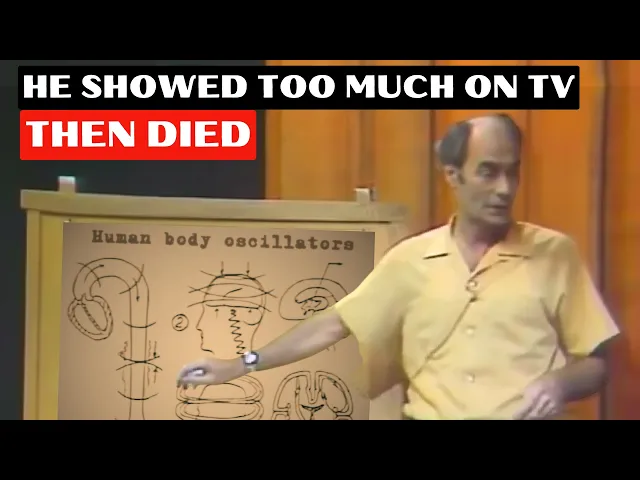
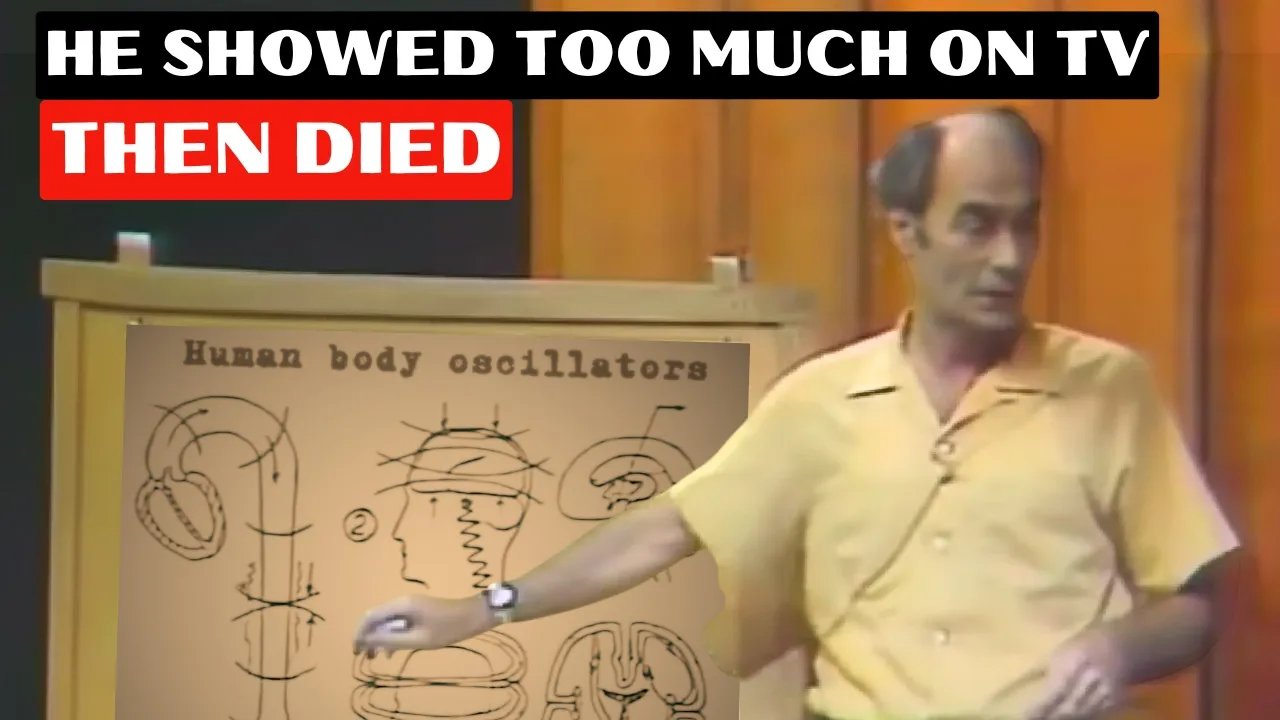
And [music] as an engineer, he looked at the body in terms of vibrating systems or oscillators. And in this case, there are five. The heart aorta system, the brain itself, a cavity in the brain which is filled with fluid, a ventricle and then the brain itself, the sensory cortex and then all this results in an electromagnetic field around the head.
A system which comes into harmony within itself becomes more powerful than others and it will entrain. This is another term he used. it will entrain or pull after itself a system that is out of harmony.
So once this oscillator or resonating system comes into harmony, it will trigger the rest one after the other. It's a domino effect. So as the heart pumps blood through the aorta and he called the aorta the biggest plumbing in the body.
So it's a tremendous impact on the body and it shakes the body so that it vibrates. It hits the bifurcation into the legs and a certain plane wave is reflected up. The next pulse come down and the the plane wave and the pulse clash [music] and it creates a disruption in the body.
When the harmonious seven hertz vibration is set up, it seems that the heart and the lungs begin to talk to each other and they begin to work in harmony so that a pulse comes down and waits for the reflection to come up and they both go up together [music] and then the next pulse comes down and there is no clash occurring anymore and the body goes into resonance triggering the next oscillator which is the brain. And looking at the head again from the point of view of engineering, it's a rigid box resting on a resilient column which is the the spine. What happens is as the body goes up and down the skull is vibrated [music] and the uh brain which is a gel-like substance is floating in a fluid the cerebro spinal fluid so that each time the body goes up [music] it's it's hitting the skull and then goes down and so up and down it goes and it creates a plane wave within the brain.
The brain has a characteristic called po electric which means that when it's stimulated [music] mechanically it develops an electromagnetic field around it which is this field right here eventually. So this is the second oscillator which triggers the third. This is the fluid fil uh cavity in the brain called ventricle.
And due to this regular vibration of seven cycles or seven hertz per second, a standing wave is created is established in the ventricle [music] which uh again creates a very harmonious uh frequency and this in turn triggers the uh uh sensory cortex. This is a cross-section of the brain. And this is a cross-section of the third ventricle filled with fluid.
On top of the third ventricle is a drum-like surface with a bundle of nerve fiber [music] crossing it which connects the right and left brain hemispheres. And this is very important because as the fluid vibrates harmoniously, [music] it activates this um fiber nerve fiber and it harmonizes the two brain hemispheres. And we know that consciousness opens up when the um uh synchronization of the functioning of the two hemispheres occurs.
And then a certain current is established in in the sensory cortex in the lobe of the brain. And as I said before, all this results in an electromagnetic field around the head so that the head actually becomes an antenna capable of sending out and receiving information which it could not do otherwise. [music] And in that state uh higher perceptions become possible.
And this was Ben's theory that through the mechanism of condundalini uh and the resonant state of the body higher perceptions become available. After understanding how Bentov and Mertila described the human body as a set of resonant systems, an inevitable [music] question arises. Is it possible to experience this for oneself?
Bentoff never left behind a fixed technique or a step-by-step method. And perhaps he did so intentionally. For him, the process was not about forcing [music] anything, but about allowing the body to do what it already knows how to do.
Enter coherence. According to his view, the first step is not to activate anything but to reduce noise, to quiet the body, to remain still. The primary way to reach this state of stillness is through meditation.
By remaining motionless and calming the mind, the body gradually [music] begins to relax. Slow, steady breathing then acts like a metronome. Little by little, the heart rate, the nervous system, and [music] brain activity start to synchronize.
Eventually, the entire respiratory and cardiac system enters a kind of automatic mode. It sustains itself in [music] a state of rest operating at its most basic and efficient level. One could say that [music] the goal is to allow the body to fall asleep while consciousness remains awake, clear and attentive.
At that point, [music] you no longer control the breath. You stop being the body and the mind moves beyond its limits. And it is from this state according to Bento that perception begins to change.
Consciousness is no longer anchored solely to the surface of movement and instead starts to touch the deeper layers of reality. This is when we connect with [music] something far more vast. When we cross the boundaries of this 3D reality and [music] perception expands beyond illusion.
When we make contact with the source that projects the hologram. where all answers reside and all [music] information becomes available. There are more advanced techniques [music] that can help intensify these processes, especially through breathing.
Practices designed to mobilize energy [music] within the body and promote the circulation of cerebral spinal fluid such as ancient [music] bandas and pranayyamas studied for millennia or more contemporary methods like those taught by Dr Joe Despensza. Even so, meditation remains an excellent starting point. Many of these breathing techniques as well as yoga are not aimed at the final [music] state itself, but at preparing the body and the nervous system so that in total stillness, these deep states [music] of samadei can arise naturally.
So um eventually as [music] this current continues starts at the toe and goes up around the body and it opens up certain energy centers in the body known as chakras and eventually the current begins to go round and round and its function is to clear the body of stress so that it can actually perceive higher realities. Another thing that happens is that this current or alignment goes also through the pleasure centers. So that actually a person in this state uh is in a state of bliss and a yogi sitting in a cave in Himalayas is actually having a lot of fun.
>> Bentov referred to the condalini syndrome as the set of physical, energetic and psychological sensations that many people experience when consciousness begins to expand. the nervous system entering into resonance with deeper levels of reality. But Bento went further.
He asked a crucial question. What is it that we actually begin to perceive when consciousness expands? This is where his vision takes a radical turn.
According to Bento, reality is not primarily made of solid matter, but of empty space, a dynamic vacuum filled with potential. Through the nervous system, our senses allow us to perceive only what is in motion, what oscillates. Everything else remains outside our field of perception.
>> We are dealing with two realities. One is this physical solid reality but the information about it is given us by our senses. So that is our subjective reality.
So what is the objective physical reality? If we magnify the atom and zero in on the electron and now we think now we will get the answer to what physical matter is. But if we analyze the electron, all we find is an oscillating electromagnetic field.
There's no physical matter as such. So we think, well, maybe the nucleus will give us the answer. And we zero in on the nucleus and we find that it too is only an electromagnetic oscillating field in the void because between the nucleus and the electron and outside of them there is nothing but void.
the same void that fills in the interstellar space. If you took an actual pendulum and would swing it and attach a pen to the to it and you would draw a piece of paper under it like this, it would describe a sine wave. Here the pendulum moved and stopped, moved and stopped.
And reality really are the spaces between the points of rest. We perceive reality when there is motion and reality is really nothing but oscillating fields in the void. And the reason I can touch this screen and I don't go through the floor is because my atoms or the electrons of my atoms are actually repelling the electrons of the floor.
But if I would speed up my vibration, then I could very well go through the floor. Now let us take a hypothetical situation where we are taking a wavelength let's say a red photon which has a very large amplitude the distances between the points of rest are very far apart and then we take the same uh let's say one inch in other words the same unit of frequencies and we speed them up so that within the same length we have many more ups and downs and uh let's say it's a violet photon and then the points of rest get a little closer together but we get more of them within that span then we speed it up even more uh let's say the gamma rays or x-rays and we see that we get even more spikes [music] and or waves and they get even closer together. Now let us imagine a hypothetical situation where the speed has become so fast that it's become infinite.
At infinite speed there will be no more oscillation and the points of rest will in fact overlap and you would get a straight line. Now what kind of state would that be? First of all, we see that it's a paradox because the infinite speed now has become total rest.
We could probably call it the state of the absolute. It's the source out of which all the frequencies arise. And it will also have the maximum energy.
All energy is in it. But it's all in a potential state. And when it begins begins to vibrate then it creates all these different frequencies which begin to interact as we saw before creating uh our reality.
So one could summarize this by saying the absolute is the point where extremes merge and a state of rest implies infinite [music] speed. In fact they become one and the same. And this state, the absolute state, is the substrate for all reality which emerges out of it.
>> Like a pendulum, we constantly oscillate between movement and rest, which according to Bentov occurs approximately 14 times per second, or in other words, at 7 hertz. In movement resides our physical and perceivable reality while in moments of rest is where the absolute [music] exists. This process happens so quickly that we are not aware of when it occurs.
We perceive ourselves only in this material reality without being conscious of the moments we inhabit in rest. However, if we manage to position our consciousness in these moments of rest and [music] expand them, we can truly experience them, transcending the boundaries of the material world and expanding subjective time. This can be accomplished through techniques such as meditation.
This is precisely what Bento managed to do. explore those other realities. Bring back the information obtained in those states and share it.
When a person becomes aware of those moments when the pendulum stops, when all movement ceases, consciousness expands and the perception of time changes. Those who have gone through these experiences often describe that time seems to stop or at least slow down. If this is our solid reality and like a pendulum, we oscillate and we take off every now and then and we touch that absolute state of total rest.
But it happens so fast that we're not even aware of it and we come back as if nothing had happened. But suppose we can expand that state and experience it and in fact we can. Then this is what will happen.
Here is our reality and here is the other reality which we now have expanded and we can uh be conscious on that level sim simultaneously with this level so that we can actually have the benefit of both and we can explore that reality and bring back the information and this is in fact what Ben did and the information that I will be talking about from now on will was received in those states of expanding ed consciousness. Usually in those states of expanded consciousness, there is a different perception of time. People who come out of those states usually say time has stopped or at least it's slowed down.
What is happening here? And to put it in some kind of perspective, Ben designed this diagram. This is our time space.
And this is the now moment where they cross which is going from the past into the future. The eternal now moment and we can project one second on it, two seconds on it and so forth. It's very reliable and we can measure it and we can catch trains on time and be uh to work on time and so forth.
However, superimposed on that are two other vectors of spacetime which are our subjective spacetime and usually they overlap and we don't even know the difference. But in altered states of consciousness there is a deviation and the angle of deviation actually determines the depth of that state. And look what happens if we project one second.
We see that now in this position of the subjective time we have two seconds for one objective second which means that our time has already doubled. Now visualize the situation where the subjective time tilts more and more and more where it practically becomes parallel with objective space and this is what it would look like. Our subjective time is now overlapping objective space.
What kind of situation would that be? Well, it would take no time to go anywhere because you are everywhere at once because your subjective time has over overlapped objective space and it's become infinite. This would be the state of samadei.
the ultimate expansion of consciousness in which you you your consciousness fills the entire universe. Perhaps Bento never meant to give us definitive answers. Perhaps his greatest contribution was not explaining what reality is but showing us how we might begin to perceive it differently.
If the body is a system of resonant oscillators and consciousness emerges from coherence, then the exploration does not happen outwardly but inwardly in silence in stillness in those moments when movement fades and something deeper begins to reveal itself. Bentov reminded us that the boundary between science and direct experience is far thinner than we imagine. that what we now call mystical [music] states may in fact be natural modes of human functioning, forgotten but not lost.
This is where today's video comes to an end. If you'd like to go deeper, you can watch my other video on Bentov. Thank you very much for watching until the end.
See you soon.