What's popping sinners? It is me, MT, and welcome back to the Heavy Spoiler Show, y'all. Ryan Coobler Sinners is an absolute triumph of cinematic storytelling that uses the horror genre to tell a meaningful tale about the power of music and the sanctity of identity.
All presented flawlessly through Cougler's mastery of camera framing and movement. But no scene in Sinners compares to the absolutely religious experience of listening to Sammy play his steel guitar and club juke for the first time as his mystical power of music allows him to break down the barriers between space and time to connect souls together throughout time. So today we are going to break down the elements of that scene that make it one of the most perfect moments in all of cinema.
So get ready for some heavy spoilers ahead because we are about to break down this sinner's spiritual sawmill suaree. Now, the scene starts about 55ish minutes into the movie, which according to my breakdown experience, usually tends to be where one of the most important scenes of the movie tends to take place. I don't know why, but 55 minutes seems to be the golden number.
At this point in the movie, Stack and Smoke Moore have successfully gotten their juke joint staffed and filled with patrons having a grand old time. And now it's time for blues musician Delta Slim, played by Delroy Lindo, to introduce Miles Kaitton's Sammy Moore to the crowd to play the night's next song. And the way that Delroy introduces Sammy to the patrons of Club Juke, very much felt like it was purposely done in the same spirit of a church pastor calling up one of his deacons to do a sermon.
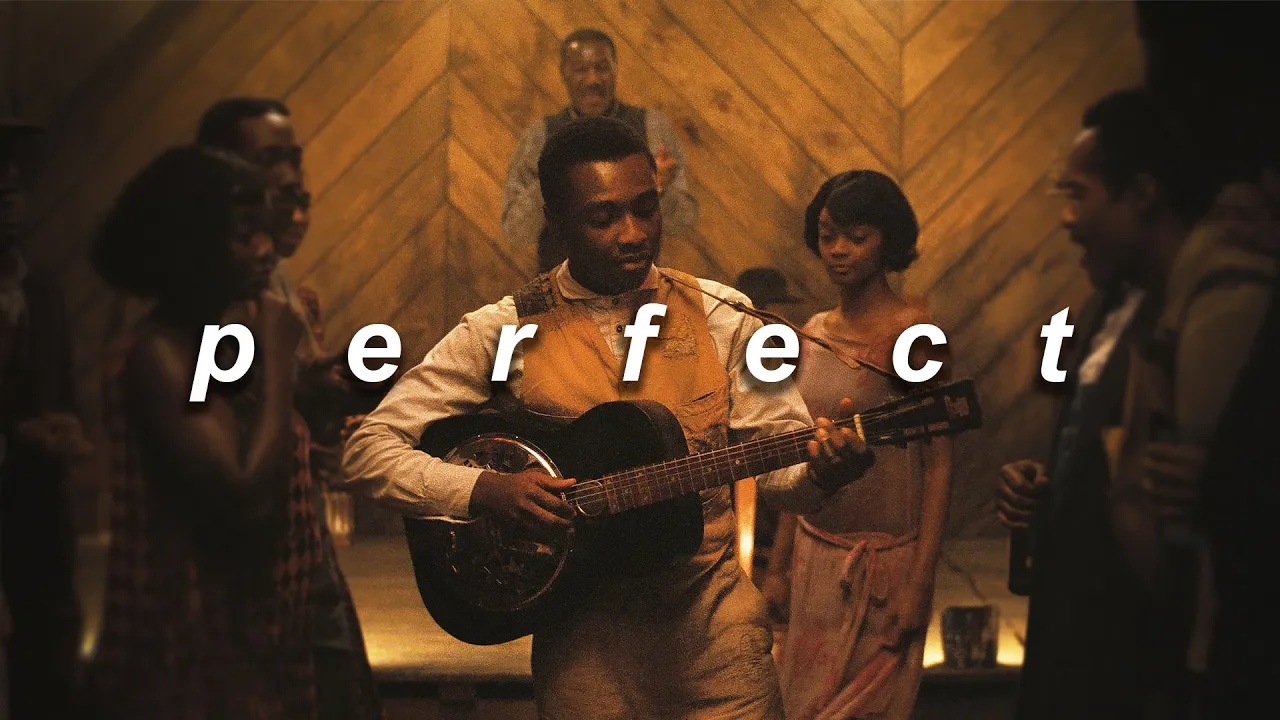
Delta introduces Sammy with pride of Sammy's unique gift for the blues. a stark contrast to Sammy's own pastor of a father who sought to control his son's true identity and calling. Sammy then humbly approaches the front of the room and starts playing the guitar.
But Delta Slim immediately stops him and tells Sammy to tell the crowd who he is and where he came from. A super important detail to note considering this movie's main message about being proud and true to one's own identity. Delta being Sammy's new musical pastor father figure for the night is encouraging Sammy to share who he is and his story with the world, allowing Sammy to feel more at home with his new congregation.
And after Sammy introduces himself, he notes that he made the song that he's about to sing specifically for his father. And as he sings, the lyrics act as Sammy's confession to his preacher father for lying to him about not loving the blues so he could appear to be the perfect little preacher boy that his father always wanted. And not only this, but the song's chorus having the words, "Somebody take me in your arms tonight," repeated shows that Sammy is also feeling guilt about his true nature as a sinner who seeks sexually intimate companionship.
That's right, everybody. I'm talking about the devil's premarital sex, which is of course a big no no in the Bible. That being said, it is interesting to note how right as Sammy secures himself a woman that would take him in her arms or legs rather, that's when the vampire killing in the movie starts to happen.
Almost like the devil himself was descending onto Sammy's life to punish him for having relations out of wedlock. I mean, Lucifer is the fallen angel of music in the Bible after all. So having these dark vampires be summoned by Sammy's music to punish him for his sinful lifestyle would be thematically appropriate.
Ludwig Goransen, the film's composer, who has worked with Ryan Cougler on every one of his films, wrote Sammy Moore's song I Lied to You, along with singer and songwriter Raphael Sadik, who previously worked on movies like 1995's Higher Learning, and 1991's Boys in the Hood, while also writing and producing songs for popular R&B artists like John Legend, Whitney Houston, Stevie Wonder, Earth, Wind, and Fire, and Mary J. Blah. But in regards to Ludwig specifically, both Ryan and Ludwig actually met as roommates at the University of South California and have been tied ever since.
And this is sort of random, but I highly recommend everyone watching this video to also watch Voices Rising: The Music of Wakanda Forever over on Disney Plus because it really shows off how incredibly talented and open-minded Ludwig Goransson is when it comes to crafting music for his films, especially films about the black experience and black history. It is truly some next level stuff and one of the best documentaries that Disney has ever created in my opinion. But yeah, Ludoo was actually there the entire time this scene was being shot, acting as the DJ and playing the song over and over again so the extras had something to actually dance to.
And as Sammy sings the chorus of this song, the movie then cuts to Sammy talking to Delta Slim a few hours before showtime. Delta tells Sammy that the difference between the blues and Christianity is that the blues were not forced onto black people much like how Christianity was forced on them. Because the blues were uniquely a result of a heritage of black musical excellence.
Delta calls the blues a sacred element of African-American roots because it was the result of generations of powerful African musical magic, the mystical evolutionary byproduct of generations of black struggle and perseverance. and Sammy himself was a direct descendant of storytelling African Grio who also shared Sammy's magical gift. Then after this, we are brought back to the dance floor where Ryan Cougler's seamless oneshot finally begins.
Starting off with the sound of Sammy and the rest of the crowd humming together. A moment that reminded me a lot of how humming like this used to happen all the time during the days of slavery when persecuted black people around the country would comfort themselves and feel a sense of unity through harmonious song helping them endure hard times. So to me this humming at the start of this continuous shot very much sets the tone for how Sammy's music was about to unite these connected black souls together throughout time.
Then, as the music begins to move throughout the room, director Ryan Cougler puts the audience in the perspective of the moving magical music itself, almost like the audience was actually this invisible mystical ghost of ancient musical power, a holy spirit of sound communing in fellowship with this congregation of sinners. Then, as we, the music, start to move about the room, the spirits of long deadad African tribal ancestors slowly fill that room, dancing and playing music in their own way. They represent the past with their music evolving over time to eventually become the roots of blues, jazz, and rock music.
Which is why we see a black man with sunglasses and a guitar show up immediately after this, shredding like the iconic African-American guitarist Jimmyi Hendris. Then after this transition from steel guitar to electric guitar, we then hear the music start to summon some modern-day hiphop after summoning a DJ onto the stage. And once the music really starts to bump in, that spirit then starts to float amongst the dancers while also summoning the spirits of more black music lovers throughout time to either add their instruments to the DJ's track, or just to dance along to it.
We see Delta Slim playing some piano, an African tribesmen playing the drums, some modern-day twerking black women, and two dudes doing the cripwalk, all while the music slowly builds up to becoming a symphony of sounds from different eras. The camera then begins to follow Grace Chow as she picks up her husband B to dance with her. And as she does, the spirits of Chinese dancers from the past are summoned by the music as well, showing that this musical connection is not just exclusive to the black experience.
Then the music swells up to its highest peak of intensity, leading to Sammy wailing out a long sustained note that burns with such an intensity that it physically elevates the spirit of the music towards the ceiling itself. And that burning intensity, fueled by the fire in all of their hearts, is what causes the roof of Club Juke to symbolically catch fire and burn down, exposing the dancers of Club Juke to the stars themselves. And I love Ryan Cougler's decision to have the camera focus on the starry night sky here, because to me, these stars feel like the symbolic representations of every one of these dancers ancestors that came before.
Like this burning roof feels like the audience is literally watching the veil between life and death burn away to a crisp through the power of Sammy's music, allowing for all those spirits who have passed on to the sky the chance to look down on their descendants and connect with their joy. And not only this, but when the fire spreads to the walls and completely burns the wooden exterior of Club Juke down completely, a true sense of freedom of expression is conveyed as the audience gets to see all of these socially repressed people express the joy of communal fellowship out in the open. It's almost like we're watching everybody in that juke joint temporarily forget everything about the oppressive world that they live in and be transported to a dimension without time or bigotry where they can just be their happy selves and let their inner light shine as their souls burn with the music.
This sense of true freedom, which none of these people were really afforded to at that time, is why an older Sammy Moore would claim that night as the greatest night of his life. By breaking the boundaries of time and allowing all of these black souls to rejoice with one another, Sammy has basically brought a slice of heaven down to 1930s America. Because that's basically what heaven is if you really think about it.
Everyone throughout time having fun together without a single worry in the world. Like Sammy Moore was truly a preacher in his own right with Club Juke being his church. And that I feel is an additional piece of significance when it comes to us watching the walls of Club Juke burn down.
Because growing up in a religious household myself, what I found with a lot of churches is how preachers tend to almost exclusively preach to congregations of already converted people while simultaneously silently judging those who choose to live their lives in their own way outside of the faith. I mean, not all of the time, but a good chunk of the time, churches tend to feel like these exclusive Jesus clubs whose doors and walls were meant to shield the congregation from the wicked world of sinners. Club Juke, on the other hand, was a sanctuary built on the foundation of true freedom of expression and joy without limits or judgments.
And while yes, Club Juke did have bouncers that turned away certain types of people at the door, this was only done because of the very real threat of racial violence and retaliation in that time period. I mean, Smoke and Stack had no issue with white people solely because of the color of their skin. However, they knew that problems would eventually find their way to their doorstep once other racist white people heard that there was a blackowned establishment that encouraged interracial mingling, especially if they saw a white woman like Mary being all over Stack's package like she was that night.
She was all over his package, and it really bothered me because Haley Steinfeld is my wife. That being said, Sammy's church that he created was truly what a real church is supposed to feel like. A true sanctuary where people are 100% safe to be their true selves without fear of judgment or some centuries old rulebook that they have to follow in order to have some true divine religious experience.
And I also really enjoy how no noticeable editing cuts happen during this entire sequence until the white vampires appear in the frame, drooling at the power of Sammy's music and the sight of all these souls dancing as one. Like a cinematic way of letting the viewer feel how interruptive the presence of these culture vulture vampires are as they approach. We spent all that time flying around the celebration of blackness and individuality with a steady and purposeful flow, almost like we were a ghost until that flow is brought to a screeching halt by Remick and his vampire horde, who immediately snap everything back to reality as they begin walking towards Club Juke.
To me, this abrupt ending to this excellent camera movement felt like a symbolic interruption of all of that musical magic. A cinematic record scratch that the audience could visually see and experience as they're brought back to earth after being elevated by the spirit of the music. And to make this powerful and creative scene a reality, Ryan Cougler visualized and planned extensively for weeks with both Ludwig Goransen and phenomenal cinematographer Autumn Deral and would ultimately divide the filming of the scene into three separate parts, each taking a half a day of shooting to complete.
And while this incredible sequence looks like it was filmed in one take, that's just movie magic at work, baby. Due to the restraints of filming with IMAX cameras, they were only allowed to film around 90 to 105 seconds at a time. So, this entire sequence was essentially stitched together in the editing bay by Cougler and his amazing team.
Never in my life have I experienced a scene quite like this one. Getting to witness a celebration of African and Asian musical culture set to such a fire soundtrack was such a phenomenal treat. And Ryan Cougler's inspired decision to have the audience step into the shoes of the spirit of the music itself allowed me to experience how it feels to be the living spirit of emotionally and spiritually heightening sound.
And much like how Sammy's love for music could not be contained by his father, the music itself during the scene could not be contained within the walls of Club Juke as the energy of the building grew more and more intense, bursting out of the ceiling itself. This entire scene perfectly embodies the this little light of mine song that we hear Sammy Moore sing in the postredit scene of the movie. By singing and dancing to the blues, these African-Americans are exercising their right to let the raw emotion that fuels their souls burn as brightly as possible, allowing each and every one of them to become one in their shared pain and joys.
And in a world where freedom of expression was severely limited by the color of one's skin and their country of origin, juke joints like Club Juke were crucial outlets for those who desperately needed a public space where they are encouraged to celebrate their true identity. So for Ryan Cougler and the gang to allow the audience to be a core part of that experience was truly something special and I honestly don't think I will ever forget my first time watching this movie. But anyways, thank you guys so much for watching this video.
You guys can follow me at Mastertainment or on Twitter, Blue Sky, Instagram, YouTube, wherever I am on the internet. But most importantly, follow Heavy Spoilers here on YouTube by hitting that subscribe button and maybe even hitting that like button if you guys enjoyed the video. But like always, I have been MT.
You guys have been amazing and I'll catch you guys later. White.