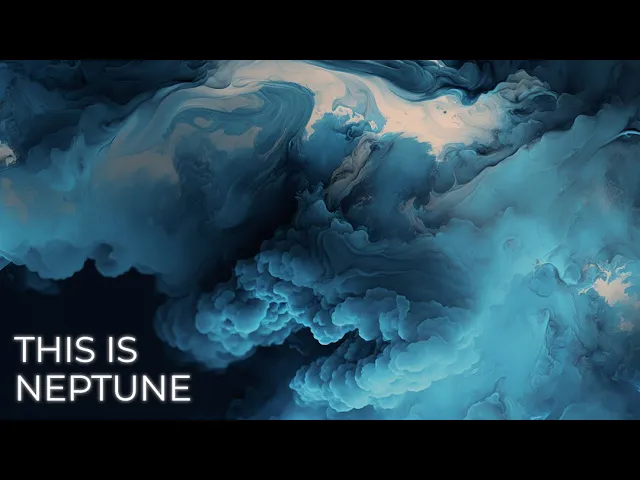
more than 30 times farther from the Sun almost at the edge of our solar system there's one mysterious planet Neptune it's impossible to see it even from the highest points on Earth without a telescope because of its remoteness Neptune is the least explored planet in our entire system but what could be so mysterious about this planet would you be surprised if we told you that Neptune one of the coldest planets in the system can support an ocean of super hot water today you'll learn about that as well as Neptune's strange Rings what makes it so
blue and also what is now known about its famous satellite Triton Neptune is an ice giant about four times wider than Earth it has a radius of about 15,300 Mi and a volume of 15 trillion M cubed which means that Neptune is 58 times larger than Earth in volume the planet is composed mostly of water methane and ammonia like the other ice and gas giants in our system Neptune has no solid surface its Atmos spere extends deep into the planet to the mantle which is composed of methane and ammonia ice and a rocky core nevertheless
scientists believe that the ice giant could theoretically have an internal hot ocean but how can a planet sustain such an ocean since it's so far from the Sun it would take sunlight 4 hours to reach the giant surface Neptune's average atmospheric temperature is negative 360° F making it one of the coldest objects in the solar system in addition according to recent research most of Neptune cooled from 2003 to 2018 despite warming near the South Pole from 2018 to 2020 likely due to seasonal changes in atmospheric chemistry the reason for the likely formation of the ocean
inside the ice giant remains unsolved however scientists suggest that this strangeness can be explained by internal heating heat released due to gravitational compression or gravitational interaction between Neptune and one of its satellites tridon on the other hand researchers Sloan victorovich and Andrew ingersol believe that the probability of oceans on Neptune due to its heat is very low only 15% at this time according to scientist calculation only in a billion years will the chance of an ocean there increase to 40% after the giant cools down another explanation for the huge internal energy could be Neptune's collision
with some Cosmic object because Neptune is the only planet that emits nearly three times as much energy as it receives from the Sun this is also confirmed by the unusual 28° tilt axis almost as much as on Earth because of this Neptune also experiences Seasons similar to ours but on Neptune one season lasts about 40 years one year for Neptune is 165 Earth years yet one day on the ice giant takes 16 hours this rapid rotation of the planet creates super powerful wind which we'll talk about a little later Neptune's atmosphere is 80% % hydrogen
it also contains 19% helium and about 1% of other gases including methane by the way Neptune's Blue Collar is caused precisely by methane clouds in the upper layers of the atmosphere methane molecules can absorb solar shortwave radiation reflecting the blue color however the nearest Planet to Neptune Uranus also contains a similar distribution of gases but unlike Neptune the color is pale blue Dr Patrick Irwin of Oxford University suggests that this color difference may be due to the density of methane fog thus the atmospheres of both planets have several aerosol layers the bottom deep layer consist
of a mixture of hydrogen sulfide ice it's because of this layer that some areas can be seen closer to the poles for example they appear darker on Neptune the second layer is probably just what affects the colors of the planets it's a layer of haze particles in which methane ice probably forms the ice then precipitates as a rain of methane snow since Neptune's atmosphere is much more active than that of Uranus Neptune forms this snow more efficiently so its second aerosol layer is thinner it is precisely the lower density that causes this Rich blue color
the last third atmospheric layer also forms large particles of methane ice and is in fact an extension of the second layer in addition to its intense color Neptune is also characterized by dark and white patches all over its surface all of these spots are storms resulting from the planet's very rapid axial rotation Neptune is the windiest planet in the system wind currents there can reach 12200 mph which is almost four times stronger than Jupiter however the ice giant has one similarity with Jupiter a huge storm the name of this Vortex is simple enough the big
dark spot the earth-size Cyclone orbiting at500 mph was first detected by the Voyager 2 space CFT in 1989 however in 1994 another telescope the Hubble noticed the spot had disappeared and a small new spot appeared in the northern hemisphere so unlike the 300-year-old Cyclone on Jupiter Neptune's large scale vortices only exist for 2 to 6 years in 2018 Hubble detected another new spot similar to the one discovered in 1989 the formation of these storms is still unknown but scientists suggest they originate deep in the atmosphere forming over several years these storms still have something to
show scientists the new 2018 spot began drifting Southward the following year where it would have disappeared however unexpectedly for researchers the storm turned around and began moving back North what's more a small one probably separated from the big spot NASA scientists believe the small Vortex may be part of the process of breaking up the big storm which has never been observed before such Cyclones in previous observations have been accompanied by white methane clouds called scooter because of the speed of motion greater than that of the big spot they probably form over vortices or gases freeze
into ice crystals the lack of clouds the researchers say may help been understanding the formation of patches on Neptune and similar ice giants like other gas giants Neptune has another feature a ring system in 2022 the James web Space Telescope took a near infrared image of the icy giant showing its faint rings and satellites the last image of Neptune's rings was taken more than 30 years ago by Voyager 2 in web's new photo about five rings can be seen all rings are named after astronomers who have contributed to the study of Neptune the closest and
most loose ring is called hi it consists of about 40% to 70% dust and is 26,000 Mi and has a radial width of 1240 Mi the second ring of larier is much brighter but much an error its width is a little over 62 Mi the next ring is the widest of all this is the lasso ring 2,485 Mi wide the percentage of dust there is very small ranging from 20% to 40% the fourth orago ring is hard to see it is one of the smallest rings with a radius of 35,5 40 Mi and it's on
the edge of the lassel and probably because of its low dust content is hardly noticeable the last Adams ring has an orbital radius of approximately 39,7 24 Mi moreover Adams is only 35 km wide making it the narrowest Ring of Neptune but what makes this ring stand out in its arcs the arcs are mysterious bright seals of dust around the perimeter of the Ring each of Adam's arcs has a name Freedom Brotherhood courage and equality interestingly they are not static at all these arcs especially Brotherhood and equality exchanged their material and changed their size why
these arcs formed is still unknown but researcher impy deer suggest that the cause may be the collapse of a parent companion or other object in the rochet limit in addition to the Rings web also recorded seven of Neptune's 14 satellites all of the ice giants moons are divided into regular and irregular web captured six ordinary inner satellites some of these satellites like despa and galatia form Neptune's rings playing the role of Shepherd for dust however definitely the most interesting thing in web's image is the most distant bright satellite Triton in the photo Triton looks like
a star because it glows much more than Neptune the strange glow is because the satellite is almost completely covered by nitrogen ice and therefore reflects about 70% of all sunlight that falls on its surface Triton is Neptune's largest satellite it is larger even than Pluto it has a diameter of 1,680 Mi which can be equated to 99.7% of the mass of all Neptune's moons it is also the coldest geologically active object in the entire solar system its surface temperature reaches 391 de F just because of its light reflecting icy surface like any of the moons
of the ice giant Triton experiences wave blocking meaning that only one side of it is turned toward the planet however it's retrograde bra orbit sets it apart from other satellites which is unusual and unique to all other satellites in our system that means that Triton has an inclined orbit which causes it to move in the opposite direction to Neptune also because of this orbit its poles and equator alternately face the Sun but what could have caused such an unusual orbital tilt most likely Triton never formed with Neptune scientists believe that Triton originally evolved in the
Kyper belt but at some point it was able to be captured by an ice Giant and it's assumed that Triton could hypothetically move around another object therefore the captured Triton slowed down which prevented it from colliding with Neptune moving toward Neptune the satellite could also destroy other moons Neptune has very few satellites compared to for example Jupiter around which there are almost 70 objects there probably could have been more and they would have been larger had not Triton been captured by the Giant's gravitational pull Triton's features don't end there if you look closely at pictures
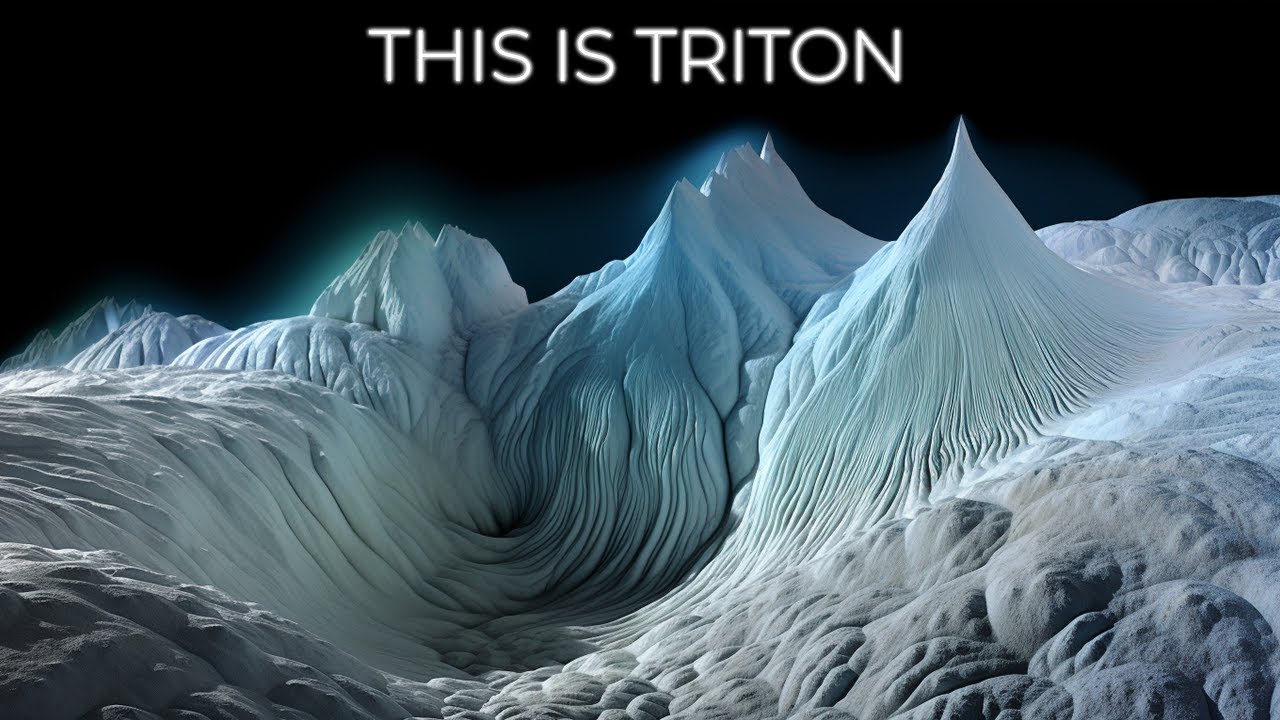
taken back in 1989 by Voyager 2 you can discern the satellite's unusual Mosaic surface modeled with plumes according to to the analysis of the craters by scientists their surface could be from 10 million to 100 million years old and in some places the smooth surface on the manifestation of cryo volcanism therefore scientists believe that the moon may have a subsurface ocean the plumes also probably hinted this and also depict a depression similar to a lake Basin despite its low temperature Triton probably retains a lot of ammonia beneath its surface which slows the freezing of the
water on the other hand plumes may appear due to heating by sunlight causing nitrogen to compress beneath Triton's icy surface until the nitrogen escapes at this point proving that the satellite could be an oceanic world is very difficult in addition solar heating probably formed the moon's thin nitrogen atmosphere however the possibility of Life developing there as on presumably Enceladus is too early to tell given that Triton was part of the Kyper belt does this mean that Neptune can influence its objects the Kyper belt is the boundary of our solar system also the comet's Source the
belt extends from Neptune 30 Au by about 20 Au the belt is predominantly composed of small objects like asteroids and tens of thousands of more large objects including dwarf planets like Pluto were it not for the gravitational influence of an ice giant it's likely that a planet could have formed from the Kyper belt in addition scientists have noticed that some objects in the belt including Pluto are in Long Range resonance with Neptune usually such objects plantes smals can only temporarily come into resonance with a stable fixed in one place Planet therefore scientists suggest that it's
likely that Neptune may have migrated from the inner regions of the solar system meaning that it may have originally formed close to the Sun thus the migration of the ice giant was probably able to keep many Kyper Bel objects within the solar system when without resonances gravitational effects could have pushed them outside the system and even in our Direction Neptune definitely has many unexplored Mysteries at this point we don't know for example the exact composition of Neptune's interior or in general how ice giants are formed so we have to wait for future scientific Expeditions that
will help us better understand the chemistry of these worlds and unravel many of the Mysteries that interest us [Music]

![The Insane Science of Neutron Stars [4K]](https://img.youtube.com/vi/qX6h72IyKSo/maxresdefault.jpg)


![Voyager 2's Discoveries On Neptune and Uranus [4K] | Zenith | Spark](https://img.youtube.com/vi/W0ly_BOLK48/maxresdefault.jpg)