Okay, real fast! This is an essay with a lot of talk about silly, nasty, video game gore. In my opinion, it’s much more “goofy” than “disturbing,” but you know yourself and your surroundings so just make the right call for you.
Also remember, you could be watching this on Nebula! You know, people don’t really talk about getting “gibbed” anymore. Depending on your age and adjacency to LAN parties, you might not know that people ever talked about that word.
Gibbed, or jibbed, was a term born of the 90s PC first-person shooter boom. It meant…this. To go from a recognizable form to a collection of gory parts.
To become…giblets. “Gibbed,” as a word, existed before first person shooters. Sometimes it referred to a piece of material– a metal, machined to hold other parts in place.
Other times, it was a way of preparing a fish; older cookbooks refer to a “gibbed herring. ” Modern dictionaries will tell you it means castrated– in Hunter S. Thompson’s book “Songs of the Doomed,” a character says “These people have no balls…they’ve been gibbed - like cats.
” But the etymology of getting video-game gibbed didn’t come from any of these sources– it came from meat, specifically the offal of a bird, the organs, the gizzard, the heart and the liver. It also came from Adrian Carmack, an artist and one of the cofounders of id software. In DOOM, id’s 1993 mega-hit, when you killed an enemy with standard weaponry, they would die in standard ways- their model would change to reflect that they had been shot, and they would fall over.
But sometimes, if you dealt a particularly high amount of damage in one shot– by hitting a dude with a rocket, for instance, a different animation would play. Instead of simply falling over, the enemy explodes, their model turns to viscera. This was what Adrian Carmack termed “gibbing,” a special sort of kill.
The popularity of the term parallels the popularity of what we now call “boomer shooters. ” In 1996, the term explodes onto the scene alongside the release of id’s Quake, quickly gaining traction in online forums and magazines. In June of 1996, the video game magazine MAXIMUM explained in parentheticals that gibbed meant “exploded into bloody chunks.
” The first public use of it I could find online was from the same month, when a user on a quake forum declared that they had killed God, quote, “gibbed that muthaf***a CLEAN! ! !
” By December of 1999, magazines like HYPER were already telling the legend of the term’s origins, writing it came from “somewhere in the bowels of id software. ” (And while we’re here- John Romero maintains that it’s pronounced jibbing, as it comes from giblets. But in the popular usage, most people went with the hard G) Most of these games I’m showing are from that golden era– in fact, the clips themselves are generously provided by the YouTube channel “Errant Signal,” who’s been cataloging these games in his excellent series “Children of Doom.
” But as lighting-fast, rambunctiously gory shooters faded from popularity, so too did “gibbed” as common lingo. Most magazines dropped the phrase from their vocabularies by 2005 or so– I remember reading a 2011 Game Informer preview for Killzone 3 and being absolutely baffled by the line “players have to scatter or risk being insta-gibbed. ” Gears of War: Judgement, released in 2013, included a challenge to get a certain number of “gib kills” and gameFAQS is littered with forum posts by confused players, asking “what is gib”?
Although I wasn’t an early DOOM or Quake player, I have a certain fondness for the term and what it represents. It feels, I dunno, revealing? You’re fighting these deadly enemies, they’re zooming around, you’re trying to outsmart them, you manage to tag one with a rocket, and…blam.
They’re gore. They’re chunks. They’ve been meat all along.
“Gibbing” is just one part of video games’ absurdist love affair with the insides of characters' bodies. Consider Mortal Kombat, a game so violent that its 1992 release was basically responsible for the creation of American game rating systems. The game is so legendary for its violence that returning to it in 2025 feels amusingly quaint– even the famous “fatalities” that defined the series are charmingly simple here, mostly just variations on punching a guy’s head off or burning him into a skeleton.
Mortal Kombat 2 expanded the fatality system in ways that only heightened its goofiness- Johnny Cage can somehow decapitate a guy three times in a row. Kitana explodes a man, and the ensuing shower of body parts contains multiple pelvises from a single body. There is no attempt at realism here– gore becomes its own canvas, an artistic goal completely separate from anatomical accuracy.
Even the modern Mortal Kombats, with their cutting edge graphics, work in this meat-space. In the most recent entry, you can literally jam an ice-spike through an opponent’s brainstem mid-fight, and after the animation plays out, that opponent gets back up and keeps on fighting like nothing happened. Although the interiors of their bodies are more accurately rendered than in 1992, there’s no sense that the individual parts of those bodies– the liver, the ribcage, the brainstem– actually do anything.
I don’t see Jax get his kidney crushed and think “oh no, how will his body filter blood now? ” Instead, the body is still just a gruesome canvas. All of this detail exists for the sole purpose of conveying the most evocative image of…meat, of giblets.
When I think about games that effectively reduce the human body to empty flesh, one title that immediately springs to mind is Prototype, developed by Radical Entertainment in 2009. It took me 16 years to actually play Prototype– I only beat it about two months ago. But its imagery has stuck with me ever since I saw the original trailer.
The shtick of Prototype is similar to a lot of superhero fantasies. You’re super fast, super strong, you can run straight up buildings and glide over the city. It is not dissimilar in that way from the probably-better-remembered game Infamous, released by Sucker Punch literally two weeks before Prototype.
In famous also features climbing, gliding, and throwing stuff. But where the protagonist of infamous charges up his powers by absorbing electrical energy, Alex Mercer, the antihero of Prototype, needs the organic. He needs bodies.
My prevailing impression of Prototype, based on that original trailer, was a single scene: Alex Mercer in the middle of Times Square, his body writhing and then exploding outward in dark tendrils, impaling tanks, soldiers, civilians, anything that happened to get in the way, absorbing the energy of everything with a pulse. I can now say: this was a fairly accurate impression of how it feels to play Prototype. A game in which the only value of a body is its consumable gore.
The narrative setup of Prototype is more nuanced, though not by a whole lot. Over the course of a couple weeks, New York is ravaged by some sort of scifi bioweapon, one which turns humans into zombies and spawns big fleshy growths all over the buildings. However, this same virus has somehow made it into Alex Mercer’s bloodstream, gifting him strength, resilience, and the ability to change his body at will.
Mercer fights both the zombies and the fascistic military unit attempting to lock down the city. At the end, he kills a big zombie “supreme hunter” and stops New York from being nuked, saving them from the virus and the military. That is a fairly standard setup for a gritty 2009 open world game.
But what this synopsis doesn’t convey is the game’s absolute indifference, if not open hostility, to the NPCs who make up this digital version of New York city. Prototype features a remarkable number of people walking its streets, far more than other open world games of the time or even today. The streets are so packed that you will inevitably sprint right through an NPC, or land on top of one after leaping off a building, or catch a half-dozen in a stray sweep of your weaponized arms.
And the game, in response to this casual slaughter, does…nothing. I don’t think I’ve ever played a game that has such a non-reaction to bystander casualties. Moreover, there is not a single mission or even sidequest in the game that requires you to directly protect the civilians of the game.
But that’s not to say the inhabitants aren’t mechanically meaningful. The crowds of New York largely exist in the game as an…all-you-can-eat buffet. See, Mercer regains health by grabbing and literally consuming bodies, the inky arms of the virus reducing an entire person into a quickly-absorbed goo.
And yes, you get MORE health by absorbing powerful enemies. But anyone can be consumed. Many times throughout the game, overwhelmed and fleeing a battlefield, I simply grabbed whoever was unlucky enough to be walking by and pulverized them for nothing more than a quick health boost.
Mercer can also shake his pursuers by disguising himself. In other games, this might mean finding a change of clothes– in Prototype, of course, it means murder. The virus gives Mercer the ability to shapeshift into anyone, provided he kills them first.
The animation for this is disturbingly quick– he walks up behind someone, grabs them, and near-immediately becomes them, no trace of their original body left. They are devoured, swiftly and totally. I want to be clear: I don’t view these mechanics as failings of the game.
On the contrary, Prototype’s callousness towards the individual is one of its most fascinating attributes. It is the story of a man who’s trying to save the city, but doesn’t care for a single person in it. And the behavior rewarded by the game reinforces this feeling.
We are encouraged to view every passerby as a person without individuality, valuable only in the ways their death can benefit us. Yes, it’s very possible to “gib” someone in Prototype. But on a deeper level than simple gore, the game has already reduced its humans to nothing more than the sum of their flesh.
I started thinking about Prototype while playing one of my favorite games of last year, Bokeh Game Studio’s jaggedly-named SLITTERHEAD. Slitterhead’s opening credits do not immediately present it as a game “about meat. ” Instead, a floating camera zooms through the streets of the game’s environment, showing off tiny slice-of-life scenes.
A bored cashier looks out at a busy street, an old woman climbs into a taxi, a student plays video games on a bench. Alongside these scenes we get the names of the people who made the game. But the title itself holds back, not comfortable to appear next to these snippets of life.
It’s only when a detective finds a body in an alley, stuffed inside a dumpster like so much rotten food, only when the camera leaves the perspective of the detective and gazes out from the empty eye socket of the corpse itself, that we finally get the name of the game, appearing as we retreat further and further into the desiccated skull. SLITTERHEAD. Now that’s how you start a game!
Although most of the people we saw during those opening credits are characters in the game, we don’t control any of them– at least, not directly. We instead play as a floating spirit named Night Owl who has the ability to possess and control others. First, just a dog in an alleyway.
Eventually, anyone in the city. Night Owl soon runs across that bored cashier and old woman and student and recruits them all. Night Owl, see, is waging a war against a breed of monster that also possesses the bodies of the populace; a creature called a Slitterhead.
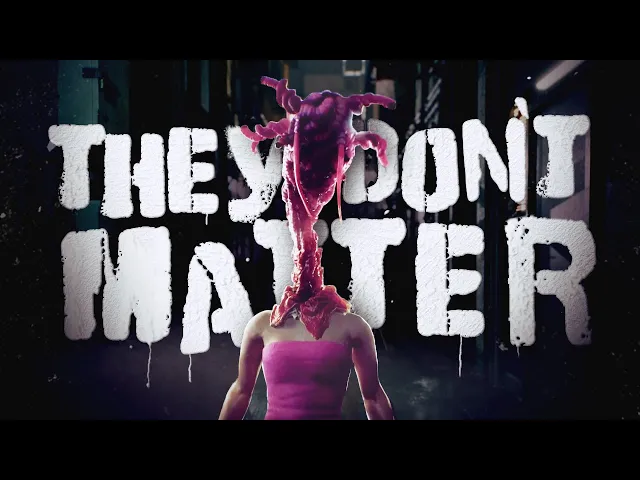
The transformation of a human into a slitterhead is not unlike the mutation of Alex Mercer’s virus-riddled body. From within the confines of their frame, tendrils of flesh and fluid burst forth, settling into something altogether Other. But while Mercer’s changes just net him useful new abilities, a slitterhead’s emergence essentially destroys the body that harbored it, the shell of its formerly-human skin dangling limply behind its new carapace.
Slitterheads are so large that the transformation defies physics. I have to imagine the monster’s prior form as just skin stretched over the limbs and tentacles of the horrors within, like the body of a caterpillar just before parasitic wasps eat it from the inside-out. In deeper and darker corners of the game’s story, slitterheads grow into even more horrible forms, tiny bodies sprouting massive brains that are harvested and eaten like mushrooms.
But as gross as they are, the slitterheads themselves aren’t what gives the game that feeling of…human disposability, that the inner life of a person matters not at all. That comes from what the player does. When you start a mission, you get to pick a couple “rarities” to bring with you, special people like the cashier or old women, that have unique traits.
You’ll start the mission controlling one of them. But within minutes, you’ll leave them behind. “Night Owl,” the spirit you play as, can hop into a person’s brain and immediately take over their motor functions.
This is the language through which you have to play Slitterhead – no single human, not even a powerful “rarity,” can complete a level on their own. When the game asks you to chase down a fleeing monster, you do so by hopping from mind to mind, leap-frogging through people in pursuit of the beast. When the game asks you to climb to the top of a building, you use individuals as rungs of a ladder, projecting up balconies and through windows.
And when the game asks you to get back down that building, you simply hurl whatever body you happen to be in off of it. You, Night Owl, can survive by spiriting into someone else on the way down. The body that hits the ground and crumples like wet clay?
Not your concern. You’ve already moved on. The fights are like this too.
Corner a slitterhead and you’ll be given the opportunity to kill it, but they are Too Fast and Too Strong for a mano-a-mano battle. Instead, arenas will be filled with terrified civilians that you can possess and use as temporary fighters. You might inhabit one of these people for only seconds; run up, hit the monster twice, flee to another body when the slitterhead turns its ire towards you.
Through the eyes of that other body, you will see the person you previously controlled get sliced to bits. Again, it doesn’t matter to Night Owl. A body without you controlling it might as well be a side of beef.
Valuable only in its ability to be destroyed– in fact, valuable because blood itself fuels your most powerful abilities. It’s here that the game’s setting also comes into focus. The narrative takes place within “Kowlong City,” an obvious portmanteau of Kowloon and Hong Kong.
The structure of the city is most directly taken from Kowloon Walled City, an anarchic enclave of such staggering density that it housed some 35,000 people in a square of land smaller than my local minor league baseball stadium. Kowloon Walled City was, before it was destroyed in 1993, the most densely inhabited place in the world. And each of those 35,000 residents were full, distinct people with families and memories and internal lives, but my god, if you were, say, a disembodied spirit without empathy, would this place not seem like the world's largest tin of sardines?
Effectively limitless bodies to use and leave behind, many of the people there already written off as disposable by the government that abandoned them? And to the game’s credit, this nihilism towards the populace doesn’t go unnoticed. Whereas Night Owl starts with a purported goal of “saving everyone from slitterheads,” his hostility towards the monsters far outweighs his care for the people they’re attacking.
Random civilians getting caught in the crossfire is literally part of his battle strategy– how could he not start to view them as unimportant meat shields? In 1991, author Terry Bisson wrote a short story for the scifi magazine “OMNI,” titled “They’re Made Out of Meat. ” The story, less than a thousand words long, is written as a conversation between two aliens discussing the discovery of a new intelligent species.
One of the aliens, though, is in total disbelief– after all, its partner just said the species is made out of meat. A: "That's impossible. What about the radio signals?
The messages to the stars. " B: "They use the radio waves to talk, but the signals don't come from them. The signals come from machines.
" A: "So who made the machines? That's who we want to contact. " B: "They made the machines.
That's what I'm trying to tell you. Meat made the machines. " A: "That's ridiculous.
How can meat make a machine? You're asking me to believe in sentient meat. " B: "I'm not asking you, I'm telling you.
These creatures are the only sentient race in the sector and they're made out of meat. " … A: "Thinking meat! You're asking me to believe in thinking meat!
" B: "Yes, thinking meat! Conscious meat! Loving meat.
Draming meat. The meat is the whole deal! Are you getting the picture?
" Humanity, a 2023 game by developer Enhance, does not have a speck of blood or gore in it. And yet, are its characters any more than meat? Each level in Humanity has a surreal sort of beauty.
People pour out from a glowing doorway in an endless procession, an abstracted collection of every age, race, and gender. And they simply walk in a straight line, thousands upon thousands of them, moving aimlessly forward. Most times, this walk will take them straight into an abyss.
And this parade will continue plummeting into nothing, happily and without complaint, forever! There is no penalty in the game for doing this. Humanity spills over the side like liquid, like single cell organisms, like the video-game version of lemmings.
Or, in some later levels, this same collective isn’t vanquished by gravity but by other people, each line clutching weapons and marching against each other, fighting to a standstill in the middle of nowhere. They are as undifferentiated as the hordes in Prototype, as disposable as the possession targets in Slitterhead. But rather than playing as a singular entity that takes advantage of this infinite meat-space, the game tasks you with organizing them, guiding them, helping them realize they’re something more.
Whereas the perspective of Prototype and Slitterhead is basically “humans are meat, parentheses grotesque,” Humanity feels more like “humans are meat, parentheses beautiful. ” But I dunno, maybe that’s too harsh on our games full of gore and nihilism. Prototype ends with the revelation that the character we’ve been controlling the whole game is not Alex Mercer, but the virus itself, an inhuman thing, a collection of impulses.
Throughout the game, it has grown and changed by the thousands of others we’ve “assimilated,” assuming not just their form but their memories. Thinking meat. Draming meat.
By the end of the narrative, Mercer is, in some twisted way, the most human, made out of the reconstituted parts and reconstituted thoughts of the entire city. In order to get the best, “true,” ending of Slitterhead, you have to run through the game’s missions again and again, this time intentionally minimizing bystander casualties, battles against the same monsters recontextualized as fights to protect as many people as you can. It turns out, maybe the residents of Kowlong aren’t quite as disposable as they first seemed.
And at the end of this essay, I have to admit the greatest irony of this whole thing: people in video games are…not meat. Even the most lifelike, most perfectly rendered human onscreen is just code, ones and zeroes, no matter how explosively they gib. We are the thinking meat that made these unthinking representations.
They are the mindless programming that will jump off a building or absorb a city or get an ice spike jammed through their brainstem. Although they appear to be nothing but gore, ready to be exploded, they should be so lucky to experience the fragility, the impossibility, of an existence in our delicate human bodies. They should aspire to be meat.
Okay, thank god. For the last several months I’ve just had the phrase “humans are bags of meat” rattling around my brain and I’m hoping that the release of this essay will excise it, in some way. That’s often how my ideas start, with just a near-meaningless little phrase that I keep coming back to.
But, believe it or not, there’s a whole lot that happens between that and releasing something like this. Earlier this month, I was actually able to take part in a workshop about making video essays. I got up on a stage, stood directly in front of a projector, and talked for more than 45 minutes on every part of my process, from getting an idea to doing research to editing and thumbnail strategy.
This is the most in-depth I’ve ever got about how I make my videos- and you can watch that workshop right now, only on Nebula. You might know Nebula as “that other streaming platform that Jacob puts all those videos on,” and that is not. .
. inaccurate. I’ve got more than two dozen videos you can only watch on Nebula, from cooking videos to live talks to full other essays.
But Nebula is so much more than that– it’s a more stable home for all sorts of high-quality work from smart people. It’s a platform where you aren’t subjected to constant ads, where we aren’t under threat from random copyright strikes or demonetization, where I don’t have to worry about all my videos being fed into a giant AI slop bucket designed to replace me goddamnit. Anyway, Nebula is cool, and it’s also cheap.
If you sign up with the link in the description, you can get a full 40% off an annual subscription, which breaks down to only three bucks a month. And after you’re done watching my workshop and pile of other videos, maybe check out Abolish Everything, an awesome new show Nebula just launched, or the one-minute reviews of adventure games InnuendoStudios is putting there every week, or listen to exclusive episodes of my podcast, Something Rotten. The world is your oyster, when Nebula is your oyster.
What- what exactly is the oyster in that metaphor? I don’t– I swear to god, if my next video is somehow about oysters, I am going to be so mad. Anyway.
A year of Nebula. 40% off. Sign up with my link.
Humans are bags of meat. Sh*t! “Alright Meat, give him your heat.
” “Why’s he always calling me meat?