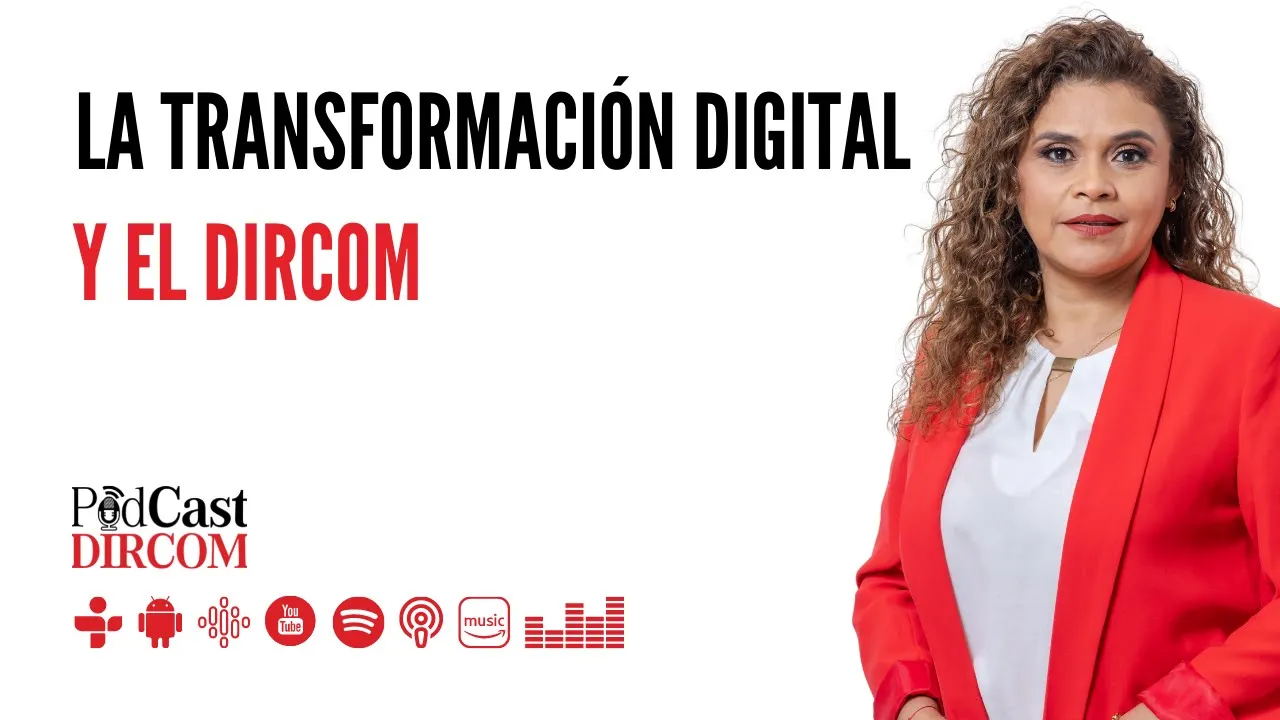
Hello mate, welcome to this fascinating world of communication! To the DIRCOM PodCast! As you can see, I have a Peruvian colleague by my side, and I'm going to tell you who she is, to talk about a sensational subject that, as you already know and I've been struggling with the subject of digital, I'm passionate about.
I'm talking about "digital transformation". So. It is very comprehensive, of course.
Now I'm going to discuss it with Maribel, I'll introduce her to you right now. What is digital transformation? How does it impact small, medium or large, public or private organizations?
Or you as an independent professional, with your micro-entrepreneurship. Maribel, in addition to being Peruvian and now she is going to tell us exactly where, what city, province, department she is in, is a PhD in Communication. She has a degree in Communication Sciences and for about 20 years she has been working with a consultancy that you can see behind there called "MyM".
Welcome Maribel! How are you? Hello Juan José, how are you?
A pleasure to be with you here, in this group and to be able to contribute with my knowledge. Thanks! Maribel said it at the beginning, we are going to talk about issues that have to do with technology, which I am passionate about.
Already in the nineties, 1996/1997 was a fascinating world that I loved and took it to my work. The topic, as I said, has to do with digital transformation. Welcome to talk about this topic!
I want to tell our colleagues something very important: Maribel is President of the Peruvian Association of Communication Professionals. I put on my glasses to be able to read because I see less and less. This is important to me, Maribel, because you also have an idea, a contact, a dialogue with different members and communication professionals there in Peru.
Maribel, what is digital transformation? Can you give us an introduction? Yes, look, well, in recent years the Internet has completely transformed our lives and has revolutionized our environment, especially in companies and I think also the profile of the communicator in all disciplines.
Lately, we have been hearing a lot about "digital transformation" that is taking place rapidly, but progressively in companies and in society. So this is where the communicator comes in. Communication professionals must identify the areas of transformation, from the angle of processes and people.
What would be our role and our field of action, what we are going to do is contribute and it will be fundamental with what we are going to do. If we talk about concepts, we can say that in a practical way and from the point of view of the statement, digital transformation is the use of digital technologies to improve the experiences of our customers. Remember that there are internal and external customers.
And what we have to do is improve all these processes to make the operations of our companies efficient. Yes, Maribel, it is a rather difficult issue in the face of this pandemic that continues today. We are in the year 2021.
I think that within all the horrible that we are experiencing with this pandemic, due to the Coronavirus and now due to its variants, it has forced many small, medium and large companies to turn to digital transformation. For what we already know. If you are listening to this in years after 2021 and you don't know it, many companies could not go out, there was confinement.
You could not enable face-to-face to be able to sell or provide services, etc. There in Peru, I imagine that it has also happened that many companies, colleagues will have told you, have been forced to do something that they had not been paying attention to, that they had not been updating and modernizing: the digital transformation of all processes. What can you tell me about this topic?
In reality, I believe that we have all been involved in this difficult situation of Covid-19 and I believe that communicators are not outside of this reality. Rather, I was just telling you, now with the creation of Apepcom we have been able to unite many communicators from various parts of the country, from the north to the south, even to the jungle, which are quite remote places and often do not take those of us in the provinces into account within this professional profile. Because whoever speaks to you also lives in the provinces.
I am from Trujillo, the capital of eternal spring. From here, several communicators from all cities joined us and then we began to investigate, to find out what the reality was at this time of Covid-19. And unfortunately we came across the surprise that the institutions were not being managed and that the director, the SEO and the manager were not accompanied by a communicator.
So, I think that from there began a great need to be able to revalue the profession, to be able to show the capabilities we have and the contribution we can provide. Especially in these situations, where it is very necessary to have the presence of a communicator. Then I'm going to talk to you about something you said about the jungle.
Later I am going to ask you something about that and how the subject affects the public that integrates some communication tactic; how is it done with the use of technology, but I'll tell you about it later because with the end of your answer it just comes to me to ask you: Within the digital transformation cycle, where do we find the communicators? We are definitely in the area of processes and people. More than in technologies.
Although I would not rule out also presence in designing the technologies because it is very important to know the customer experience and design them based on the customer, because for that we must align ourselves now. Because it must be understood that the center of the companies are now the customers. When we talk about the "digital transformation of society", when we refer to the process of how we adapt to the technological environment that is taking place now.
It is what we live. Where it involves people, organizations, institutions and companies. It is here, in this process of digital transformation, that various factors come into play, such as the company's internal communication, the organization's ability to adapt to changes, as well as the adoption of the business model and the ability to listen to customers .
customers, using the new digital communication channels. At these points, we are definitely the communicators. A company is transformed because the people within it are going to change and adapt to these new work requirements.
In the morning I read a little to prepare myself on the subject. Kotler spoke of the "4 P's" that all communicators know: product, price, term and promotion. But now Kotler emphasizes a very influential and current element: co-creation.
A fairly important theme in co-creation is crossing, which also leads us to this open innovation. It is about uniting the public with the company. Ask for the opinion of third parties on any particular issue, of any need.
Listen to the external customer. That is one of the tasks that communicators now have to highlight: adapting to what this public needs and not only the external one, but also listening to my internal client, whom we must not leave aside. Maribel, while you were talking about this topic that I'm passionate about, as I said at the beginning, I love all of this.
You named the internal public. Sometimes it happens to me that, when I travel to do audits in different companies, to audit their communication or visibility plan, I find that the internal public is more advanced, technologically speaking, with the use of different technologies than the company itself. The company tends to continue with its labor and organizational processes with old paradigms.
And I see the internal audience eager, excited to optimize. Because digital transformation also optimizes work processes. Now, within what you are telling me, what is our job then?
To your understanding. I try to ask questions for a medium level, of all our audiences in Latin America. Within what you have been developing, what would then be our work in the digital transformation process?
What would be ours as communication professionals? Communication, communication and more communication. I think we should have it first.
That should be emphasized in the person who is going to lead this whole process. Of course, using all the traditional and digital tools, because just as there are internal audiences that are millennials and centennials, there are also adults from Generation Z to Baby Boomers who are still the oldest people. That's what Maribel was going to tell you!
When you say "Communication, communication, communication" I love it. Within the "communication, communication" it is also part or that this communication implies teaching and training. Exactly for what you were saying about the different audiences they may have: internal or external.
But accompanied by that communication. Communication itself is action, with training. Teaching, right?
And also for managers who are sometimes in a past from which they do not want to leave, as in a comfort zone, and it causes the organization to fall behind. We definitely have to soak all the arteries of the company in what communication is, but being very clear that the actions that are going to be carried out are in favor of the company and, obviously, in favor of the internal public interest. You have to seduce, showing all the benefits that will come in return.
Actually, communicators are managers of communication and information processes. We work to direct these strategic communication processes, which is what Dircoms do. So, we do management in the institutions and we study the communicative reality, because neither can we direct ourselves to make a whole transformation plan, focused with the latest technology when our audience is, suddenly, Generation Z or Baby Boomers who do not drive much what is technology.
So, the processes to communicate are important at all times within the digital transformation. We must also work to strengthen corporate identity and culture, but this time focused on what digital culture is. Good point!
This is where internal communication comes in and we can even say endomarketing, where we manage it from the point of view of human talent, together with other areas of the institutions. Because the internal public is very important in this in this process. The collaborator must be aware of the change and, above all, must participate.
That's where co-creation comes in. It is our responsibility. Sorry to interrupt you, I love the topic that our main resource is our internal public.
The main resource is the human resource. It must be integrated into this transformation. It seems essential to me.
And not with impositions, but by being a collaborator giving opinions, suggesting and giving advice, etc. , so that the work is even more comprehensive. Were you going to say anything else?
Yes, there is an important issue here, as you mentioned: there are different types of audiences. But as communicators, since we have the capacity to generate communication analysis, we must identify what these needs are that the company is going to have. In this case, we are going to find some technological and training needs, because we must work based on their knowledge.
Because neither can we generate a whole technological emporium when our internal public is not trained. So here it is important to develop those digital "skills" to strengthen the institutional image. All this within the digital transformation process.
And obviously the activities and achievements must be disseminated through various types of information that show the progress of this digital transformation. We must generate, above all, valuable content. Valuable content to educate our audiences about these changes and present them in various communication products, whether graphic, audiovisual, sound, multimedia, digital.
Today you told me about all the platforms that we have here at Grupo DIRCOM, which is great because it will reach different audiences of different ages and they will use it in different situations. In the same way, we have to manage this digital transformation in companies. We have to manage the platforms and the digital media, because the most important thing in this process is to generate a positive customer experience and, obviously, a positive internal customer experience as well.
I also love that, because sometimes I find companies in the countries where I move through Latin America, that launch some digital platform without having analyzed or studied the use and customs of their audiences. As if the simple fact of inaugurating and announcing that they are going to use this or that platform will be instantly consumed. And it is not like that.
You have to adapt, try to be on those platforms where you can. As long as you can and have time, within your strategy, to maintain communication, dialogue, interaction, updating, etc. Do not open a profile or a platform and leave it.
Yes, I fully agree Maribel. You have to try to be on the different platforms, taking into account the usability of my audiences of course. What would be, in your opinion, the pillars that one should take into account in a digital transformation?
I think that the relationship with internal and external customers should be one of them. The efficiency of internal processes must involve the collaborator. I think the most important thing is this cultural change.
The change of brand identity. Adapt to this new cultural change. In digital transformation, it implies the interrelationship between technology, data, processes and cultural change in the organization, but we must support strategies or support communication plans to involve all of this.
Cultural change is very important, extremely relevant in this process, since it is the human factor and the organizational culture that will determine the success of any transformation. And we are not only talking about the digital issue. Here the priority must be in the strategy of the actions so that the digital transformation includes the training and preparation of employees and collaborators.
That is where we enter to carve communication professionals with programs. Many change management programs to help them understand this process. That's exactly what I was going to ask you as one of the last questions!
The answer is obvious, but the Dircom, the person in charge of the Communication area, the Director of Communication, should he be integrating the "girl" table of this cultural change, of this digital transformation? What do you think? Of course yes, obviously yes.
The Dircom must lead the ideas of digital transformation and it will be opportune to create these strategies to transmit passion for that idea, because although it is true that it is a new idea, that passion must be transmitted with actions and strategies. Without passion we are not going to be able to move anyone either, but above all we need our internal and external public to understand this process. Individually it is impossible to get the change.
We need people involved who infect the entire organization with passion. And also create a team of digital ambassadors. That would be the proposal: that they be agents of change, that they be authentic agents of change.
Young people, also adults and older adults, different generations. To work both on the implementation of the strategy and the action plans. And, obviously, in the follow-up.
You mentioned in one of your questions the fact of generating strategies without analyzing the market, without analyzing your audiences. I think that this is a reality that happens a lot in my country since it beats us every day and we forget about this investigation. So, let's investigate to be able to generate these actions, but always the Dircom, I am completely sure and convinced that it has to be at the head of the leader of this entire proposal, and the leader of the organization itself.
Maribel you were very clear. I thank you for all these concepts. I don't know if you want to give a few final words regarding the digital transformation and as suggestions or advice for those who are watching or listening to us in Latin America or Ibero-America, rather.
Thank you very much Juan José for your invitation. Actually, it is very important for us to show the professional capacity of the social communicator and now, with this process of digital transformation, it is very important to understand that transforming the business model is to adjust to these customer needs. Many times the owners of the companies think that by buying technology they are already transforming themselves digitally.
No, we must adapt and adjust to the needs of the digital customer, who is practically the new consumer we have here. This is really our objective as a communicator: to adapt to them, to prepare ourselves for our internal and external audiences with the appropriate strategies to support this change. And adapt to the digital environment.
Therefore, it is extremely important to identify which elements are going to help us or limit us in this process. As has been exposed, the creation of a business communication strategy is essential to face the necessary actions in this transformation process, and I think that communicators are going to be there. Without communication we can't do much.
Maribel, I tell all our audiences: in the description field of this PodCast there is all the information of interest. While you were talking, they appeared on the Dircom channel. TV, on our YouTube channel your users of social networks, email and website.
But, we have a very large audience in Latin America that listens to it on the different podcast platforms. Give me at least one username or email. One or two ways for them to contact you.
I invite you to contact us through our social networks: "Apepcom". On Facebook we have a fan page. In addition, the communication email: "comunicación@apepcom.
pe". In my case, the personal email "gerencia@mymycomunicaciones. com" Maribel, thank you very much.
I send you a very big hug DIRCOM! Thank you for this passion for communication! We will be in touch again soon, with some other topic that we can collaborate in this management of Latin American knowledge in the matter of communication, but by Latino experts like you.
Thank you very much Juan Jose. See you soon to celebrate the day of the communicator in my country.