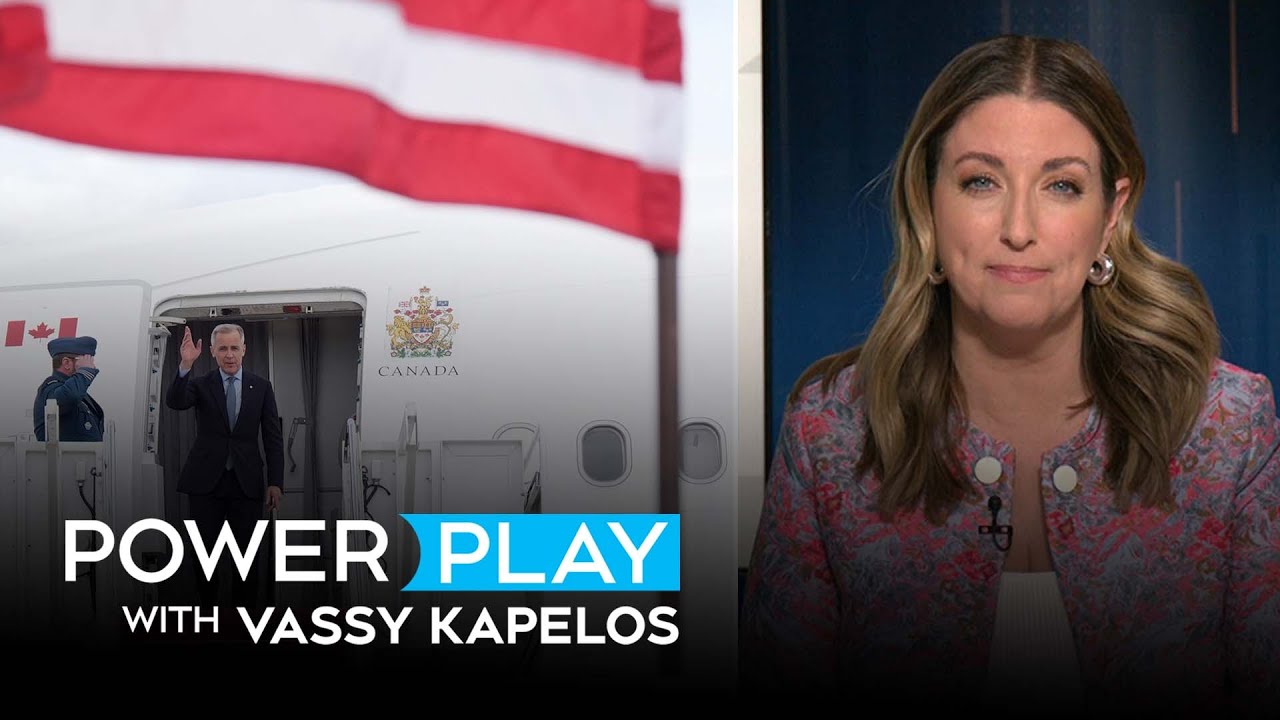
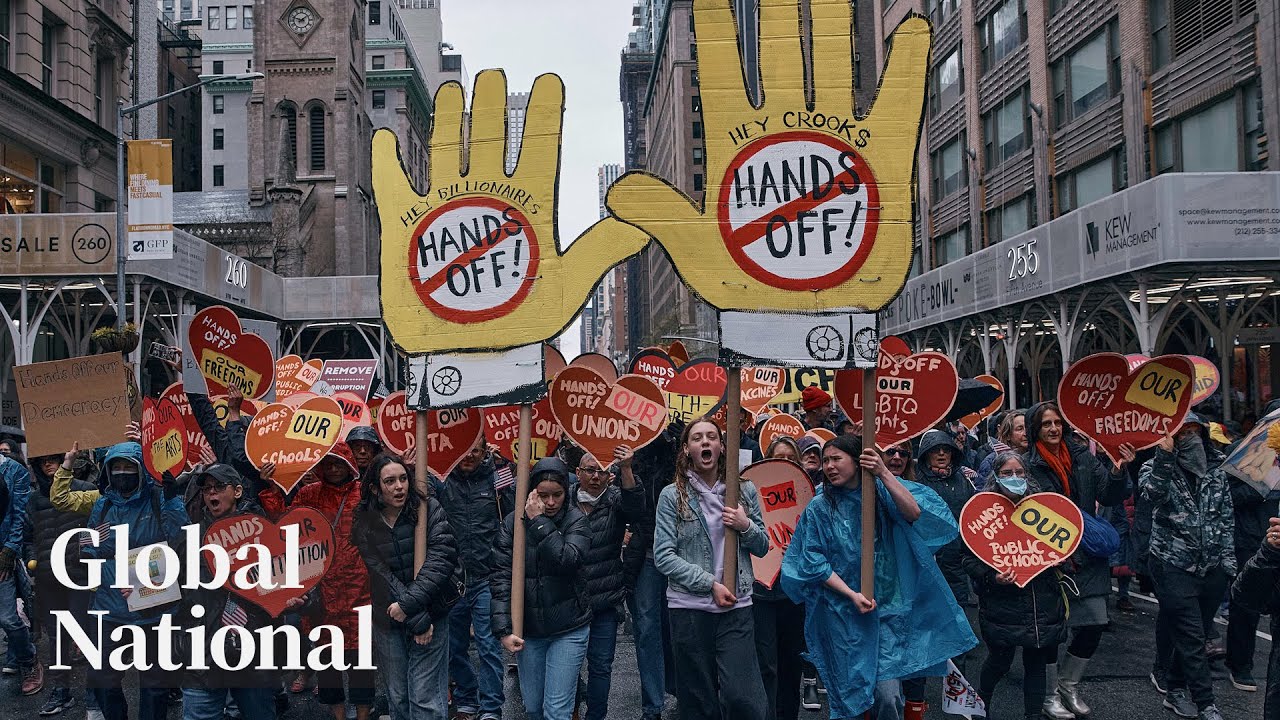
[Music] On this Wednesday, the first federal debate in Montreal. Four leaders face off in French. Obviously, they're going to attack.
Why one party was disinvited. Canada's economic uncertainty. How the trade war has affected consumer spending.
Banks right now are pretty desperate for business. And where interest rates are likely headed, feeling ignored. Look at the people who are falling through the cracks.
The calls for political parties to put a stronger focus on eliminating poverty. And an exciting chapter in history kicks off. It's about more than sport.
The first matchup of Canada's only professional women's soccer league. Global National with Donna Freezen. Good evening and thanks for joining us.
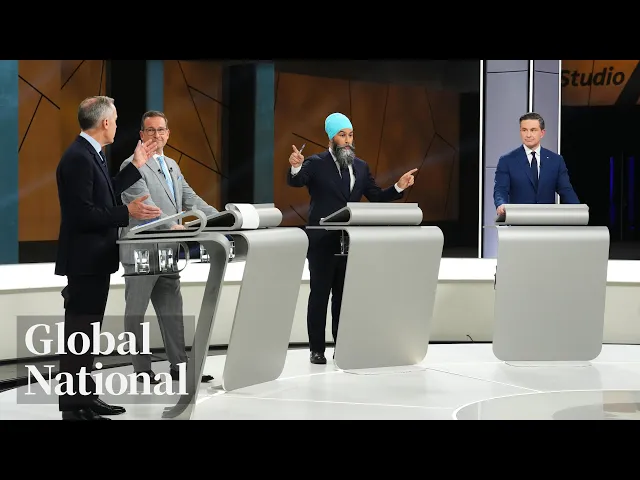
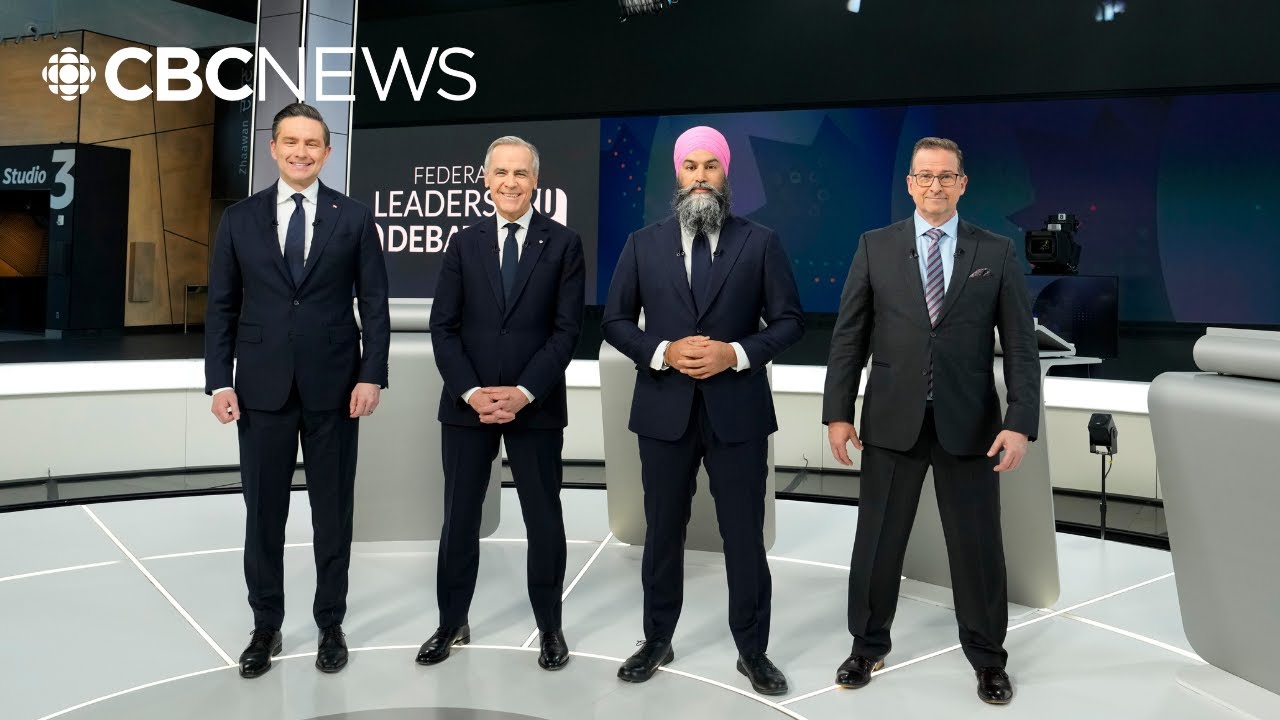
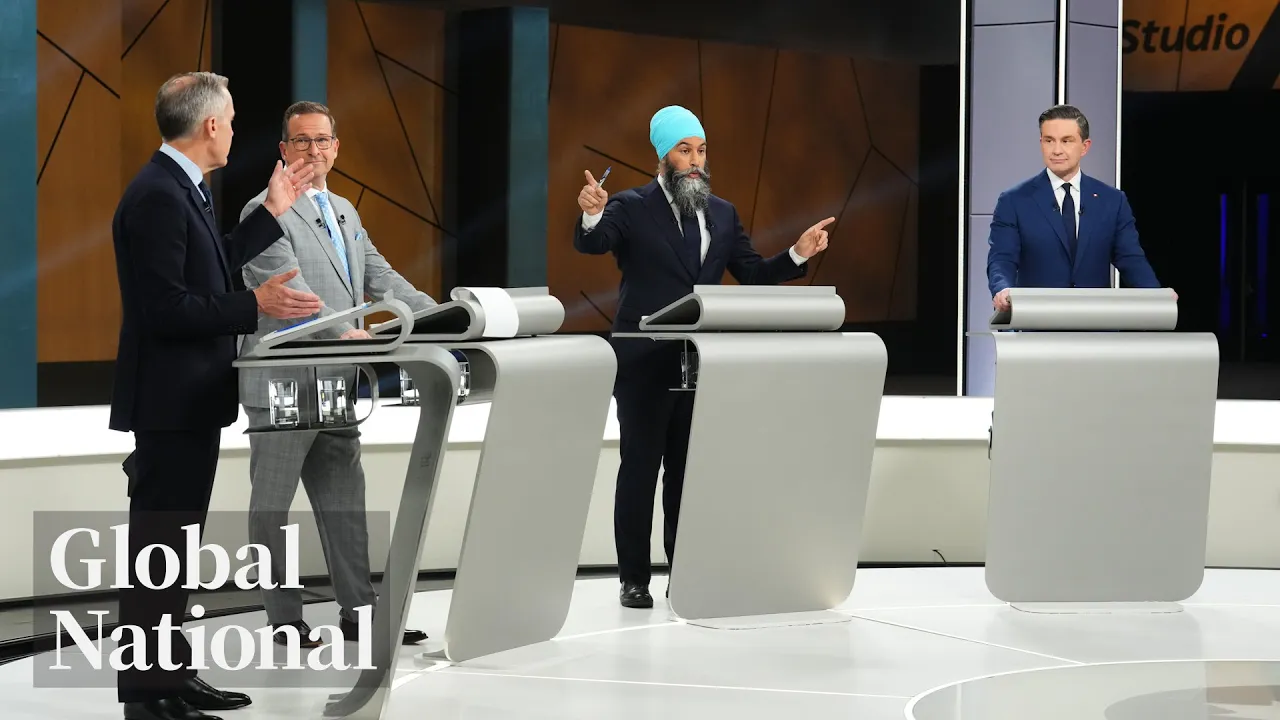
The first of two leaders debates in the federal election campaign has just wrapped up. This one was in French. It is the first time Canadians saw the party leaders face off.
The Green Party was not part of it. This morning, the Greens were told by the debate commission they were no longer invited because they didn't meet the criteria. The party calls that undemocratic.
The commission says the Green Party originally met the criteria, then dropped 15 candidates and fell below the threshold needed. McKenzie Gray is covering the French debate for us tonight. See you in go ABS.
Go. A cheer for the local team whose final regular season game pushed the French leaders debate up two hours. And it was the self-p profofessed hockey fanatic Mark Carney who was quickly body checked.
Conservative leader Pierre Paul repeatedly trying to tie Carney to Justin Trudeau. Attacking Carney with a softer edge. to this wacko policy by this wacko prime minister compared to the parliamentary pitbull that's been polyv signature for the past 20 years a style that might not play well in Quebec it needs to be a balance I mean they obviously they're going to attack but they have to be be careful careful when they're going to attack Mr Carney Trump the first portion of the debate focused on Canada US relations the central topic of the liberal leaders campaign but it was clear Carney had the weakest wrench on stage Canadian not always using the right French word giving space for the NDP's drug meets to attack polyv saying he's too much like Donald Trump a potential Achilles heel for polyv in a province he's not popular in the possibility of a polyv government has sent blocka voters flocking to the liberals, leading the leader of the block to largely ignore poly and attack, saying a liberal government would be hostile towards Quebec.
Tonight's debate will likely be a dress rehearsal for the English language debate set for Thursday Donna. Millions of Canadians will watch, including the roughly onethird of Canadians that multiple polls show haven't decided who they'll vote for. All right, Mackenzie Gray in Montreal.
Thanks. Our Ottawa bureau chief, Mercedes Stevenson, is with me. Mercedes, how do you think this debate went for these leaders?
Donna, all of the leaders performed relatively well tonight. The first time that Canadians have had the opportunity to see them head-to-head. of particular interest how Mark Carney and Pierre Polyv would perform when they were in this scenario.
We've seen both of them out on the campaign trail and in the case of Pierre Polyv, we've seen him in the House of Commons for well decades now, but we've never seen them take each other on and there was a lot of questions around how the two leaders would present themselves and what kind of points they would make. As far as election debates go, typically they only really influence an election if somebody really knocks it out of the park or does terribly. I don't think that either of those things happened tonight.
What will be interesting is how the various performances change Canadians perceptions. Let's take a look at how sort of each of the leaders presented themselves. Mark Carney came across as the man saying Canada is in crisis and I am the negotiator to handle this.
That has been a tried andrue line for him on his campaign that people see him as someone who can solve the problem with Donald Trump. He was appealing to the concern about the existential crisis Canada could be in with Trump's threats about the 51st state and he presented himself as the economist who knows how to navigate difficult times. He spoke well and for someone who struggles in French had a relatively good presentation.
Pierre Polyv was a much friendlier version of himself. This comes after a lot of polls in Quebec were saying that Quebecers weren't comfortable with some of his rhetoric and tone which could be aggressive and name calling. He looked much softer in this debate.
He was smiling. Much more reflective of what we saw from him uh earlier this week on Sunday when he was on a French talk show called Tulleand on Parl on there. He did not attack his opponent.
He focused more on presenting a more personable version of himself. Jug meet Singh the NDP leader probably honestly his best performance so far of the campaign. He landed a few elbows and he appealed to Canadians to form a minority government not a majority.
Whether that complexity will be uh communicated to Canadians and change how they vote remains to be seen. And then there was of course Ephan Blashett, the BQ leader. This is really his comfort zone in his backyard.
He was actually a little less aggressive than I expected him to be. He is trying to win voters back who are looking at going to the Liberals. For all of these party leaders, Quebec is critical to potentially winning an election, and they've all struggled with the exception of Mark Carney.
But the Liberal support for him in Quebec could be soft. What happened tonight and what will happen in the English debate tomorrow may determine election fortunes or it may be the last week on the trail. So far, Donna, I haven't seen anything that would swing this dramatically one way or the other.
Okay, Mercedes, thanks. The English debate is tomorrow and because of that, Global National will be airing at different times in some parts of the country. We'll be on at 5:30 in all of Ontario.
Then we'll have postdebate coverage at 7 on Global BC and Global Okonogan, 10:30 in Alberta, 11:30 in Saskatchewan. And you can also stream us on your website, our website, globalenews. ca.
A little later, Eric Sorenson looks at where things stand for the Green Party after decades of pushing for political relevance in Canada. There are a couple of stark warnings today about the economic consequences of President Trump's trade war. America's top banker, the chair of the Federal Reserve, says the tariffs are unlike anything seen in modern history.
and Jerome Powell said today they're putting the US on the path to weaker growth, higher unemployment, and faster inflation. And the head of the Bank of Canada, which held its key interest rate at 2. 75% today, says that uncertainty makes it impossible to forecast Canada's economic future.
As Anne Gabiola explains, really, the situation is no clear. The governor of the Bank of Canada says trade wars and tariff threats are making it impossible for the central bank to issue its usual economic forecasts. Faced with pervasive uncertainty, Governing Council will proceed carefully with particular attention to the risks.
Instead, it's considering two scenarios. One assumes most new tariffs will eventually be negotiated away. That process will be unpredictable and businesses and households remain cautious.
that could stall our GDP this year and drops inflation below the bank's 2% target. Scenario two is more grim. A long lasting global trade war.
Inflation spikes and we're plunged into a deep recession. We really don't have a clear picture of even the form these tariffs are going to take, what's going to remain in force, what's going to get rolled back. The direct impact of Trump's tariffs have so far been limited, but uncertainty has already tanked business and consumer confidence.
Both are pulling back on big purchases and major decisions. In the housing market, it's given many prospective buyers pause. Our research shows it's certainly not the cost of borrowing that's keeping people on the sidelines.
People on the sidelines because of uncertainty. It's created a buyer market for those who feel good about their job security. Banks right now are pretty desperate for business.
It's been a slow year for mortgages. there's a good chance you might be able to get a good rate um if you get in there and negotiate. We'll have to wait until the first week of June for the central bank's next scheduled interest rate announcement.
And the economist consensus is that unless there's a major change in US protectionist isolationist policy, the bank is likely to cut. Donna. Okay.
And Gaviola, thanks. Those who struggle to pay for food and a place to live are the ones squeezed the hardest when the economy tanks. With election day less than two weeks away, Heidi Petroic talked to those who see the realities of poverty every day and believe it isn't getting the attention it deserves.
Aene Osmond always feels welcome here for a meal and a sense of community. But when it comes to the federal election, the 62-year-old feels left out. I just feel like I'm, you know, in in the middle there that you nobody is accounting for.
And it's not just me. Like many Canadians, the benefits she gets haven't increased and others she doesn't qualify for. They're feeling the kind of crunch, the squeeze, right, of increasing costs, generally increasing rent costs.
We're not hearing food insecurity or hunger talked about specifically. Food Banks Canada counted up 2 million visits to food banks in March of 2024, the most in Canadian history. It's called on all parties to commit to reducing food insecurity by 50% by 2030.
We can't have a strong Canada when we have a quarter of the population not knowing where their next meal is coming from. People in the bottom income brackets don't even have wealth. All they own is debt.
Stats can numbers show close to 4 million Canadians, almost 10%, live below the poverty line. One group focused on ending child poverty wants leaders to start talking about ways to help, like expanding access to the Canada Child Benefit. It's not really reaching those who are living in deep poverty.
We're talking about kids with disabilities, lone mothers, indigenous children, and with close to 17,000 Canadians sleeping in a shelter on an average night as of 2023. It's just not enough to get folks uh away from living in tents. The head of the nonprofit behind this new affordable housing project in Halifax says what's really needed is an unconditional guaranteed basic income that's going to help people meet their basic needs uh from so they can lead a dignified and respectful life.
Look at the people who are falling through the cracks. That's Abalene Osman's message to candidates and what she'll be thinking about on voting day. Heidi Petroic, Global News, Dartmouth, Nova Scotia.
Ontario is the latest province to try to remove interprovincial trade barriers. Premier Doug Ford introduced the Protect Ontario through Free Trade within Canada Act. Province says it unconditionally removes all exceptions to trading between the provinces.
Ford also signed deals with the premers of Nova Scotia and New Brunswick, agreeing that any good, service, or registered worker that is recognized in one province is acceptable in the other. A recent Bank of Canada study found interprovincial trade barriers cause the same impact as a 21% tariff. There are some new numbers that reflect how many Canadians are turning their backs on the United States.
Figures from US Customs and Border Protection show just over 4. 1 million travelers crossed the US northern border last month, down nearly 900,000 from the year before. The 17% decline is one of the worst year-over-year drops recorded outside of the CO 19 pandemic.
President Trump has met with Japanese trade officials at the White House. It's one of the first face-to-face negotiations to take place since the introduction of his sweeping tariffs. Japan declared a national crisis earlier this month over the potential hit to its trade.
Although a pause on some tariffs was welcomed, Japan's chief trade negotiator has said he is looking to build a relationship of trust during his two-day visit to Washington. No state will be impacted more than the state of California as it relates to the unilateral authority that's being asserted by the Trump administration to impose the largest tax increase in modern American history. That is California's governor.
He is suing President Trump over his sweeping tariffs. Gavin Newsome filed a lawsuit today asking the levies be blocked, arguing Trump's use of emergency powers is unlawful and requires approval from Congress. California, the world's fifth largest economy, stands to lose billions to tariffs and is this is the first US state to challenge Trump's policies.
Toronto police are searching for two suspects after a deadly shooting. Multiple gunshots were heard shortly after 11 last night in Toronto's Riverdale neighborhood. One man died at the scene, another died later in hospital.
Police don't believe it was a random attack. Witnesses saw two suspects running toward a nearby park. Police are working to identify the victims.
And police are asking for the public's help in finding a suspect they believe is responsible for a hit and run at Toronto's Metropolitan University. 23-year-old Ryan Petro has been identified as the person involved in a targeted attack on an individual, according to police. Yesterday afternoon, police described Petro as dangerous and say he should not be approached.
Two people were taken to hospital. All are expected to recover. A key ruling from the UK's highest court.
Coming up, it's unanimous decision on the definition of a woman. Britain's highest court has delivered a landmark ruling on the legal definition of a woman. In a unanimous decision, the Supreme Court ruled the terms woman and sex in the UK Equality Act refer to a biological woman.
It's a big victory for a campaign group in Scotland that has long argued biological sex is immutable. Redmond Shannon reports on the ruling and the reaction. Some of the women who took this case to court could barely believe it.
How are you feeling? Absolutely jubilant. The unanimous ruling of five British Supreme Court judges ends a dispute between a woman's rights group and the Scottish government.
In 2018, it passed a law allowing trans women who hold a gender recognition certificate to be regarded as women when it comes to gender quotas in public organizations. Opponents argued it would allow trans women access to female spaces like bathrooms and prisons. The judges have said what we always believe to be the case, that women are protected by their biological sex, that sex is real, and that women can now feel safe, that services and spaces designated for women are for women.
The ruling does not deny trans women the right to identify as female, and the judge said the law still protects them from being harassed or discriminated against because they are trans. But we council against reading this judgment as a triumph of one or more groups in our society at the expense of another. It is not a nod to the culture war lightning rod that gender has become.
Legal experts say the ruling does add clarity, but disappointed trans groups say it remains to be seen how the law is applied in different scenarios. As I've spoken to lawyers and other people, it seems to be contradictory. It's not clear what it actually means in effect.
After the court's ruling, Scotland's first minister says his government will look at its implications while trying to balance the rights of all. Redmond Shannon, Global News, London. In the US, the Trump administration is suing the state of Maine for allowing transgender athletes to participate in girls and women's school sports.
US Attorney General Pam Bondi accused the state of failing to protect women and girls by not complying with Trump's executive order to rescend all federal funds from educational programs that deprive women and girls of fair athletic opportunities. Maine's governor says the matter is about state rights and defending the rule of law against a federal government bent on imposing its will. It's not easy being green.
Ahead, what's the future for Canada's Green [Music] Party? It's been just over 40 years since Canada's Green Party was founded. And over those years, its core values of nonviolence, social justice, and ecological thinking have received national attention, as has longtime leader Elizabeth May.
But it never really broke through in terms of elected MPs. And now being excluded from this federal election's leadership debates is a significant blow. Eric Sorenson looks at where the party goes from here.
Okay. Keeping the Green Party in the game is the battle Elizabeth May has been waging since entering federal politics. I stand before you with many more scars.
If elected to power, Greens would ban CFC's and garbage incinerators. Greens have been fighting for the environment and political relevance in Canada for decades. and you lead.
It wasn't until May won the federal leadership in 2006 and got into the 2008 debate that the Green Party started to gain widespread notice. You just sweep it across the table, don't you? She won the Green Party's first federal seat ever in 2011, but the party is still small and struggles to stay in the public eye.
The loss of its spot on the debate stage is a heavy blow. Absolutely. The highest vote count we we get is in the elections when we're on the stage in the debates.
The Greens were already struggling, unable to effectively counter the loss of public support for the carbon tax. Then, Canadian voters turned to Donald Trump's highstakes threats to Canada's economy and sovereignty. Voting for a third party, a party that has no chance to win might not be um as easy to do now for some people as it uh as it was say in 2019 or 2021 when the where when the stakes were not seemingly as high.
This election is closer to a two-party contest than any Canada has seen in decades. And not being on the debate stage just adds to the pressure the Green Party feels that it's being squeezed out. Pednau, a former journalist and human rights advocate, is still trying to get into the English debate Thursday and not giving up on the party's fight across the country.
One thing is clear, we will keep campaigning. We will keep fighting for a greener, fairer future for Canadians. One thing the Green Party has going for it, it's accustomed to fighting from behind.
Eric Sorenson, Global News Toronto. League of Their Own. Next, how the Northern Super League could be reshaping Canadian women's soccer.
Professional women's sports in Canada are finally getting the attention and respect they deserve. There's hockey. The PWHL's Canadian franchises lead the league in attendance.
Basketball, Toronto's getting a WNBA team next year. And tonight, as Neu Garcher reports, some of Canada's best soccer players are kicking off the Northern Super League's first season. Canada has long been home to worldclass soccer talent.
But for women, the dream of playing professionally often meant leaving home until now. Canada's first ever women's professional soccer league is here to change the game. I live in Toronto.
I know. The Northern Super League is set to reshape the landscape of women's sport in this country. It's like a wedding.
You're spending the whole year preparing and like the longest preeason um that probably most of us have ever had. Um and the moment is finally here. So now it's important to I've been told enjoy the process of it.
It's a dream made possible by the vision of the league's founder Diana Mat. We built six new teams from scratch. We and all these players have essentially made the decision to leave existing clubs, existing leagues where they know the playing quality, they know their teammates, they know the coaches, and they came to this brand new league because they believed in what we're building.
This creates a different future for a huge group of Canadians, you know, whether that's on the technical side, the medical side, the media side. It offers players the opportunity to stay in Canada with a minimum salary of $50,000. Mat believes the NSL's unique approach, built by women for women, will set it apart.
A lot of the professional soccer leagues around the world were built by men's soccer investment. We have the third largest player pool in the world when it comes to girls and women that play soccer. The Vancouver Rise and Calgary Wild kick off the inaugural game Wednesday in Vancouver.
A match marking a new era for Canadian sport and a chance to build a lasting legacy for women's soccer. Nitto Garcha, Global News, Vancouver. And that's Global National for this Wednesday.
I'm Donna Fzen. Tonight, Canada showcases Thunder Bay, Ontario, Richmond, BC, and Albert Memorial Bridge in Reginaina. Keep them coming.
Send your pictures of Canadian pride to Global National at globalenews. ca and thanks for watching. Hope to see you here again tomorrow.
Bye-bye.