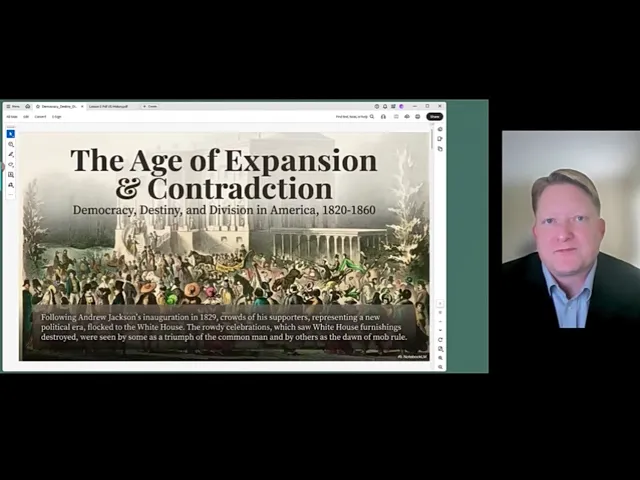
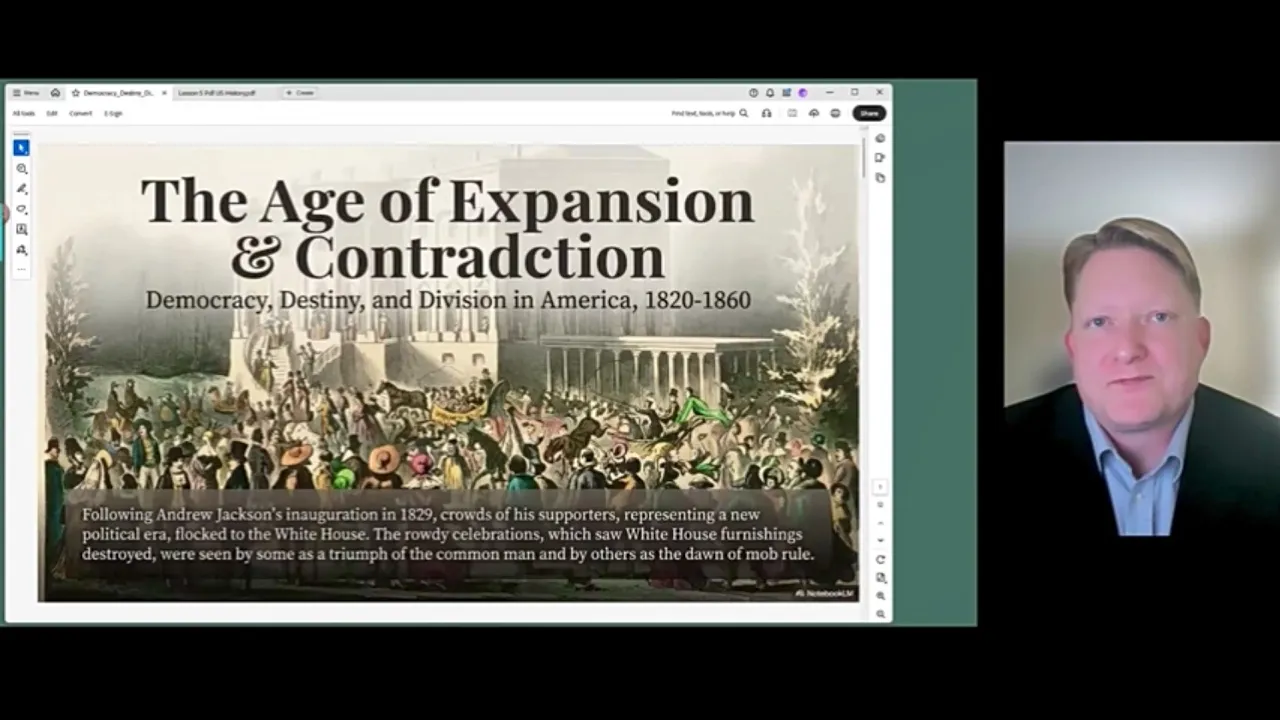
Hello and welcome to week five. This is a pretty important section, chapters 10 and 11. Partly because at the time of this recording, there is a lot of interesting debate and parallels between this section in the textbook and what's going on in the United States today. The age of expansion in contradiction is coming from chapter 10 about jonian democracy and chapter 11 discusses expansion toward the west. Now to try to paint a picture for this it's important to discuss a little bit about what we already touched upon. So think of these European colonists from a
hundred years before or more and their thought process about kings and royalty and aristocrats and there's a very clear hierarchy within society and that means that there is a hierarchy within the minds of people and citizens within their countries. Now obviously not all countries but for the purposes of this discussion the people that would become Americans certainly had a concept of kings and wealthy landowning people, rich people, slave owning people and then everybody else that would be we might say secondass citizens. Even though the constitution provides certain protections to everyone, it continues to be a
point of debate that if all men are created equal, then who are these people that we're talking about? Does it include women, for example? And there are contradictions built into this, which is one of the reasons why the debates continue. And once you get far enough away in time from certain pivotal events like the Boston Tea Party or the Revolutionary War, people don't remember or respect some of what people had gone through or the mindset of people at the time. For instance, there aren't that many people who remember World War I, [clears throat] if any.
And among that population of people, where they were, what country they're from, and their experience rel related to it, or World War II for that matter, it's easy to make to describe or make comparisons to people who are aligned with Nazis or with the totalitarian right or left or the Kamur Rouge or people who have who were killed in gulogs for instance. But it's hard for us to do history only through the text. And that's one of the reason that's one of the challenges of being able to do history well is to be able to
tell the story as accurately as possible. Meanwhile, many people are talking about things for example today and they may even make reference to history without really having a grasp upon the history they're talking about. And in terms of the President Donald Trump, Andrew Jackson is one of the presidents that's discussed in this chapter who Trump in particular, he likes him. And this is a time of tremendous expansion of the American country geographically, but it's also a time of tremendous cruelty. And I suppose one could call that strength to be able to do such things like
it takes strength and power to be able to make something happen. The power means the ability to make something happen that would not otherwise happen. And the ability to have power over others means that you can do tremendous tremendously cruel things. you can also create tremendous amounts of change that may in the long term be considered a positive thing. And I'm sure the discussions that Donald Trump has had about Greenland and so forth, it's probably in his mind the similar concept that he thinks Jackson may have had and others around this time in terms of
the expansion west. So when Jackson was inaugurated, it was this populist movement of signaling to the elite that common people [clears throat] could have power within a democratic constitutionally elected republic. And it was a rejection of the elite in some ways. And it ended up being this big party that end that turned up basically into a kind of riot. And as it says here in the beginning, crowds of supporters representing a new political era flocked to the White House. And I believe many people felt this way about many different presidents over time. People thought about
John F. Kennedy who was a Catholic being elected to the presidency as a very shocking and amazing thing. Certainly, I think Reagan was an actor and he was had a certain charisma. It was something different and new. Probably Trump as well was unprecedented as a sort of TV personality who got elected. While lots of people don't really vote in the United States, when you have that situation, [snorts] you need to have a very competitive race between 50 states and this electoral college we have in order to be able to become elected president. So among the
half or so of people that vote, you're going to get maybe half that go one way or another. And then whoever wins means that a lot of the rest of the country doesn't maybe feel very represented or they feel like they lost. This is obviously true in most countries. When your party loses, you feel like you lost and then you're not sure if the elected leader is going to represent your interests. This is often called tyranny of the majority, which is what democracies are. It's a popular vote in a way, although we don't win presidential
elections by popular vote in the United States. We win them by electoral college vote. We'll discuss that in a minute. And anyway, if you have a majority vote, let's say the popular vote wins, and it's 51%, let's say, 49% may feel like they lost. And then you end up with this tyranny of the majority perhaps and the rest maybe are just subject to the whims of that 51% that get to gloat and be happy and celebrate about their victory. And yeah, the last part here is a common man. Some saw this as triumph of the
common man and by others as the dawn of mob rule. And I think there are parallels through history how when you get a certain kind of elected leader that people feel maybe crude or crass or under uneducated for instance or too young or too old or whatever. There's a tendency for pockets of the society to want to reject that or be hostile or criticize it rather than participate in a sort of nationalist pride and project that whoever the leader is we should honor the office of the president for example. So this style starts to shift
and from republic to democracy is one point here. So the founders envisioned this republic. So when you write this philosophical document the constitution and the bill of rights and there are safeguards in the electoral college in order to protect the rights of the 50 states is the main thing. Leadership based on uh elite ideas of virtue and a code of deference. This is important. So the code of difference comes back to this hierarchy that you have some people that maybe are just better than you or some people that we should consider better. In the American
cultural mind, I'm not sure people won't like to hear it phrased that way, but we still say things like hello Mr. President, for example. We don't say your excellency or use some kind of title like that which is still observed in many countries when you run into a when you encounter a king or even a a president sometimes they have these very grand titles and so you should give respect to people which I think is probably an important element of civil society we talked about a couple weeks ago in order to have a society that
is able to function properly there needs to be some level of respect and trust among people walking around on the street. Although do you give more respect to people who are military officers or police officers, firefighters or doctors or lawyers or the wealthy highle maybe high level people as opposed to maybe somebody else maybe a farmer or a coach driver, a taxi driver for example which in terms of the lang language of the constitution all people all are created equal and in that sense are in entitled to all the same rights as anybody else. But
if you from this older perspective, if you are highly educated, for example, or you have a certain family tree, then maybe you should be treated differently. And I think here that the shift in the United States at this time becomes much closer to what we see today. 1820s is, you know, 200 years now, but it's I think it's much closer to 2020 than it is to 1620, if you understand my meaning there. And so this rise of universal suffrage and people were having a hard time in industrialization and living in cities tended to produce lots
of illness. So in the 1820s this deference to pedigree began to wayne which means that people started to dislike the idea of highlevel people demanding to be treated a certain way or getting special treatment and privileges and rights which is it's very much a kind of anti- Protestant belief which is America at this time is this staunchly Protestant country. I think that many people who struggled and suffered but are very pious and religious people probably who also rejected the king of England wanted to be able to come to a place where they didn't have to
bow and scrape and be like a peasant farmer on a lord's land that they could be kicked off at any time and were subject to the whims of aristocrats and highle people. And so by this time, a majority of white men gain the right to vote regardless of property ownership. So keep in mind too that while society is still grossly unfair, even among white men, they're still mostly farmers and commoners, markets, market workers, rather than rich, landowning, powerful, elite people. And you can see yourself, if you're like a white male at the time, you could
see yourself as, well, wait, I thought this is I'm entitled to some equality here. Why am I not able to get the same kind of situation as some of these other people who are powerful and rich and landowning and wealthy? [snorts] And I think people probably have some of that sentiment today. I'm not sure we don't have time to get into all the details but my I suspect listening to people in this country now this debate continues. People often feel that life is unfair and life probably is unfair for many people but that the opportunities
of some because of luck or circumstance or position are not spread out equally to everybody such that they can also get a chance to have a billion dollars or or something like that. And there may be an element of greed in there. This is more of a psychological question I don't really know the answer to. But I think if we the desire for humans that first chapter right gold the idea of glory and wanting to achieve something I think it's still there in the background people still wanting to and today right wanting to improve their
circumstances for themselves and others wanting to be wealthier wanting to be respected. So this difference and thing and if they feel like the distance is getting too great between common people and the ultra rich then maybe you start to see some backlash and I think in the United States today we're seeing some of those tensions as well. So this corrupt bargain issue brings this point to to a very clear head. So in 1824 main Democratic Republican candidates split the vote. So split the vote basically means that you have a population and if you have for
example like one person from one party and two from the other, we would say these two people split the vote because they're both popular but when they split they create a greater chance for this one person to win and often now pe you know the these parties are very sophisticated. So they try very hard to prevent that kind of thing from happening. Having third parties and having circumstances that split the vote to create because it creates an opportunity for someone to win who may not be able to win on a one-on-one competition. And Andrew Jackson,
John Quincy Adams, Henry Clay and William Crawford. Just in terms of historical note, Andrew Jackson becomes president. John Quincy Adams is also a president whereas Henry Clay and William Crawford were not. Jackson won the most popular in electoral votes but not a majority sending the decision to the House of Representatives. So what that means is that generally speaking now you can lose the popular vote in the United States and still win the election if you win the electoral college. But sometimes if you have to reach the threshold, you have to get enough votes in the
electoral college. So if there are too many candidates and too many people across all of the states spread out all the electoral votes, no one will have a majority and so no one can become president and so it's going to have to go to the Congress to be able to decide who's going to become the president and they might have to have another election. It can that can happen. It's very rare and now generally great efforts are made in order to prevent that kind of situation from happening. And so the bargain is the speaker of
the house Henry Clay used his influence to secure the presidency for John Quincy Adams. And if you think about this is exactly the kind of thing where when Donald Trump was going to be try to become president the first time there was an FBI director James Comey who came out and he used his platform and his media presence to be able to cast some shade and doubt on Hillary Clinton who was the then candidate at the time. People don't know whether or not that's the reason, but she ultimately lost even though people thought that she
was going to be a landslide winner. It's a very similar kind of thing. Henry Clay uses his influence and he starts talking and pushing the vote in in toward the way of John Quincy Adams and then shortly after Quincy Adams wins, Henry Clay is appointed Secretary of State. So this we call this payforplay. You help me, I help you. which again in in the last 10 years we've seen a lot of those kind of things in the political arena in the United States that if you do something for me maybe I'll be able to do
something for you. It's not unique in world politics. It's not unique in world history certainly although it does question whether that is the kind of fairness that the philosophy of the founding documents and the constitution the bill of rights would want to exist. like life is although life may not be fair I think it's important again if we want to trust each other have a civil society I believe that we should try to have our institutions be set up to have to fulfill those ideals and then put people in those positions that are going to
do them well and not necessarily cheat or steal or lie or whatever the case may be. Anyway, so Jackson supporters were very angry and they said, "This is a corrupt bargain. You stole the election." And Jackson had won the popular vote. So the consequence is this corrupt bargain became this rallying cry. And so it builds momentum, right? When people get angry, they're much more likely to be loud, to make their vote known, and to get their friends together, to go out and vote when the opportunity arises. This is in part what happened when in the
mo in the previous election when Trump was going against Biden ultimately ended up winning. And [snorts] so Trump had four years off and then he came to run for president once again. And probably people had thought that Trump that Biden that Trump had lost the election maybe unfairly. So people got upset and angry. There was a big mob in Washington DC and people died in that in in that instance and then ultimately the power was seated to Joe Biden and then four years later Trump comes back again. In any case, it convinced many Americans that
a new political party was needed to defend the will of the people against aristocracy of Washington. And this laid the groundwork for Jackson's overwhelming victory in 1928. in 1828. This is also going to lead the way toward the party that's called the wig party. But I want to emphasize once again that we're adding language here, but these are pretty easy sentiments for humans to understand, right? That people feel like things are unfair or I want my team to win or if there's cheating that gets that doesn't get caught or corrected, people feel a sense of
indign indignance. Yeah. And President Jackson wages war on the monster bank. So the second bank of the United States was a powerful national institution, but Jackson's supporters viewed it as an undemocratic tool of the wealthy elite. They called it the monster bank, an emblem of special privilege and that harmed ordinary Americans. Now think like this. Think about the stock market today. Or think about people like some famous people own very large amounts of land. They have very large amounts of stock, especially technology stocks. they have a tremendous amount of wealth and there's a lot of
there's a phrase these days like eat the rich this kind of thing. I think that this sentiment is still everywhere from 1820 to 2020. Like I think this is still common that that if you are feel disenfranchised, if you feel that your situation is very bad, you're more likely to side with the people that you feel are going to help you out. Which is very ironic in the case of someone like Donald Trump because he inherited $50 million or something like that. And by all accounts, he's lived a very elite aristocratic lifestyle. [snorts] And he
was very aggressive as a business person and had many failures and successes that he turned into a political leverage. And yet when he spoke to people, he said, "I'm on your side basically to against the powerful elite." So he did have this kind of Jackson jonian attitude of I'm going to take on the big banks and I'm going to fight the corrupt people in Washington. So he said we're going to drain the swamp for example as one of those things that he coined that people really liked and that gave him more political momentum. So Jackson
is the hero and Jack and Jackson is the tyrant. I think people still have this with most presidents in the United States. The United States has become increasingly polarized. It has become increas increasingly divided both it's been divided across geography since the founding of the United States but also across class. So we've long been divided by class, race, geography, the country is extremely is extremely diverse place in many different ways. But when we get into our political leadership, the Congress, the Supreme Court, and the presidency, the the executive branch, if it's not your side that
wins, you tend to see the other person as corrupt or as a wararmonger, whatever. And so we have Jackson as the hero. Okay? So in 1832, Congress led by Henry Clay once again passed a bill to recharter the bank. And Jackson used his executive power to veto the bill. And this is about how a bill becomes a law. So in the United States, if you want to have a law be made at the federal level, you need to go through a few different stages and like so the courts cannot make laws. It has to be
done by the Congress. The Congress can make a law and the courts can decide if they think that law goes against the constitution or not or some previous legal precedent and then it can go to the president to stamp it and say yes I I approve of this and it is a very complex stance between these three branches if they are all trying to check each other trying to hold each other accountable. If one branch or the other decides to um play favorites or have favoritism toward another branch or a certain president or whatever, then
you can really twist and skew outcomes and results. And so in this particular case, Jackson just says, "I don't like it." And he vetos the bill. So he basically says that the his veto is a victory for farmers, mechanics, laborers against the rich. And incidentally, Jackson himself was a wealthy person. people like the fact that he's a military man as well and which people liked and they saw it as taking out these big institutions is somehow going to help the common person and while the other side will be Jackson as the tyrant King Andrew Jackson's
opponent saw his veto as subsequent action as a tyrannical abuse of power and they formed a new political party called the wigs which I mentioned before arguing that King Andrew was trampling the constitution acting like a monarch And this is happening today. I think the cover of Time magazine somewhat recently had a picture of Donald Trump with a crown or something like that that no kings as a movement. There they had a meeting in Davos somewhat recently and they had a on the mountain side someone put no kings in bright lights or something like that.
And that if the Congress of the United States, for instance, just gives their power up to a president, then that president is going to have a lot more influence and control over what happens in the United States. And especially because the president of the United States is in charge of the military. That means that person can deploy the mil and international contracts and trade relations. So that means that person can do things about tax like how taxes and tariffs can work and using the military in order to do certain things and it could be do
certain things that just a personal preference to go in and do something which could end up being highly illegal and yet those things happen. They happen all over the world. Obviously, there are countries where people political leadership do terrible things to their citizens and there are countries where the countries do terrible things to their neighbors and it's very difficult because the international system is called an anarchy. It does there are no there's no world government to control individual countries and so in this way this is called this is a realist perspective. Most people see the
international sphere as the system of realism rather than a system of interdependence which it is. We rely on each other for however much certain countries are against each other. They also generally recognize that we all need each other to some extent. Now there are exceptions obviously there are some countries that have particular ideology where they really want to kill everybody in the other place. They have charged ideological reasons for disliking other countries and cultures. That is certainly a real thing too. In the United States, however, the stopping power of water once again is so powerful
that it makes it so that most of the problems come from within the United States rather than from an outside invader, for example. Whereas, if you're in the middle of Europe, most of the time the problems are coming from neighboring countries rather than some outside neighbor. Typically islands too are insulated from outside invasion very often because it's hard to get to them and crossing water is often difficult. Okay, let's keep going here. So, we're going to move quite quickly in from these as I'm going to put my mouse here. these 13 colonies that we started
with in the early formations of the United States. As we get into the north and the south and developing industrialization, in developing agricultural established productivity within the south, especially in the United States and then ultimately there going to be a few key moves. We talked about the Louisiana purchase. We could talk a little bit about what the chapter discusses especially in 10 talks about how this largely belongs to Mexico. Now, Mexico in this particular time, it doesn't have quite the military might. It has just, how do I phrase this? There's a legacy there, which for
much of history has been a strong argument toward maintaining one's country. But then again, you 99% of most countries and cultures that have ever existed are not around anymore. I don't know how to frame that but the United States and these particular presidents within this time frame are going to push west and one thing is we have Texas here in the bottom which I mentioned before is also technically part of the south here's our Louisiana purchase we're going to get some things in here when about Florida and Canada is up here there's going to be
some land transaction and ultimately this huge chunk of land here is mex is Mexican territory that there's going to be a war over and we're setting ourselves up also for a civil war within the United States because again there's this divide between people within the United States as people are trying to get more gold and glory and all with God on their mind I think to some extent they all believe that they're right otherwise why would they fight about anything they believe that they are on the side of the Right. And so yeah, this manifest
destiny being which is interesting this use of terms because it's the same kind of thing that was used in order for kings in Europe to be able to say that they had the right to lead that they had the divine right of kings. This idea gripped the nation of manifest destiny that the United States had a divine right and duty to spread its democratic values and Protestant culture across the continent from the Atlantic to Pacific. And again, it has there's an element of we're going to look down on the Native Americans and we're going to
look down on nonprotestants and we're going to look down on basically whomever is not within the framework of our thinking. And so even Native Americans like the Cherokee for instance that align themselves closely with the West and all the trappings of what Western society was had a hard time of it. By the time we get to California and have a gold rush and Chinese migrants coming over to build railroads and farm for gold, there's tremendous anti-Asian pressure in California at the time as well. By the time we have 1945 comes along, Pearl Harbor attack from
Japan to the United States, we had Japanese internment camps as well. And so race relations I don't know how [clears throat] to phrase this but all I think most all countries have some kind of race relations whatever [clears throat] they look like and whether the citizens of those countries think of those relations as being good or bad or healthy or whatnot. [clears throat] Excuse me. But the within the United States certainly even the Irish were considered foreign as white people but they were unique had unique accents, unique culture and had to be divided and separated
all the way up until really almost the 1930s. [clears throat] So the homogeneity of the United States was definitely not like that we refer to today certainly did not exist at the time. It's really more about power and who has it and what are we doing with it [sighs] and so we're moving. So the path to the lone star so the lonear republic we're referring to is Texas here. So the American settlement of Mexican Texas begins in 1820 and Mexico encouraged American settlement into this area because obviously if um the more people that you have
in your territory just like encouraging immigrants into countries today that have low birth rates, you want more people to come because your economy is built on people living there and farming there and working there and selling goods and products and so forth. And however, the mistake in this is that the people who came into the colonies and came to the United States instead of moving west quickly had this idea that I have a right to this if I'm living there. Like what do you have over me if I if just because you say you're in
charge of this particular area or country? Who are you to say that? And which of course is is weird is an unusual way to to view things, I think. But again, we have to try to look at it in within the perspective of the time. And so people living there, these Anglo-American settlers resisted Mexican laws, particularly Mexico's 1829 abolition of slavery. And the settlers accustomed to democratic norms also clash with the centralized authority of the Mexican government. [clears throat] So it's you don't realize it, but you cross the border and you're in another country and
there's tensions that arise. So you ultim you get a revolution and independence and in 1836 Texas declares independence after suffering a brutal defeat of the Alamo. Texan forces under Sam Houston defeated General Santa Ana's army at the battle of Santainto and the victory secure the independence of the Republic of Texas which was not recognized by Mexico. And of course why would Mexico want to recognize land that they lost? And they're ultimately going to lose Arizona, New Mexico and California as well. And uh there are uh I don't know 20 or 30 years ago there was
discussion of uh I don't know fringe discussion of people saying if we cannot take the Mexican land back then we'll just migrate and make it a de facto Mexican country. And I don't know what the percentages are now but there are many Latino people living within the western south of the United States. It is obviously right next to Mexico and it borders several states. So, it makes sense and it's probably one of the things that many people dislike that that fact and they want to build this wall and so forth, separating Mexico from the United
States because there's a lot of people who move freely and there's a lot of migrants who are not legally coming in with visas and passports, but then they're working and making money and they take the money back to Mexico and all of this kind of thing. It's worth it's probably worth looking up the numbers and trying to do some research about that if it interests you. The key thing here though is just this revolution independence of Texas again creates a mindset that we can just take it. And so this 5440 fight so Pulk James Pulk
also president 1844 slaveholder from Tennessee is elected president on the platform of aggressive expansion. And so hey why not? It worked in Texas. We have the Louisiana purchase now. And why? Think about this. Because the more that you can expand, then the more that you have a personal opportunity to become to get gold and glory for yourself. And there's generally a strong sentiment within Protestant Americans at the time that especially if they're very religious, that part of me doing all this is proving myself to God. that I'm going to like I'm going to prove myself
as worthy. I'm going to do great things and look at me. I'm going to have this piece of land and I'm going to it's so much better than my ancestors had. [clears throat] And so that's why I said think about how short a time period that is. Even from the end of the 1700s to 1844 is just one lifetime. You could have been a kid in early American days and you could have witnessed this huge rapid expansion toward the west and even all the way up through Texas and beyond. So we get Oregon from Britain
under the slogan 5045 and purchasing California from Mexico and the war with Mexico 1846 to 1848 I alluded to before. After annexing Texas in 1845, Pulk sent troops into a disrupted disputed border region between Duncas and and the Rio Grand Rivers. When Mexico and forces engage, US troops both declared that Mexico had shed American blood upon the American soil and asked Congress for a declaration of war. So that's one of the things is Congress technically has war powers. So even though the president of the United States controls the military, you're not able to go to
war without approval from Congress. Now, that's hard for people to understand how is it that the United States gets into all of these military conflicts. And that's exactly what it is. They just the president can get into military conflicts but not war, if that makes any sense. And so there are things like we call them wars in English like the Korean War, but it wasn't I don't believe that it was technically approved by Congress that and even if it was there's other instances that you have a military action outside of the United States that's certainly
aggressive behavior and yet not approved by Congress and so not officially declared a war in the history books. Okay. So the US victory in this war was decisive. In 1848, the Treaty of Guadalupe Hadalgo seated nearly half of Mexico's territory of the United States. And this Mexican session included the lands that would become California, Nevada, Utah, Arizona, New Mexico, and parts of Colorado, and Wyoming, which again is the western south of the United States. Colorado is pretty central west, and Utah is very far north. I don't know how much of that. I'd be curious if
to know actually because Utah is so far north that and it I don't there are not even many people living there now. So I'm wondering right now how many how much of a Mexican presence there was in let's say 1840 for example. It's easy to say there's all this land that we have or and especially we talked about Native Americans having access to all of this land but didn't really have land ownership in their cultural sense of like society and civilization. It'd be interesting to know if someone's an expert on Mexico, what what the mentality
was at the time in the government in the government and if they felt like this was going to be a place that people might farm or that they actively use for hunting or something like that. It's an interesting question. In any case, the United States is going to move. It's going to expand their territory all the way to the ocean and and they're going to take this going for gold and glory trying to be able to expand what it means to be an American their access to opportunity and they're going to push keep pushing into
I would say not just land but into a cultural space and so this has happened a lot this continues to happen to this day some we call their abilities to change voting lines in the United States which is called gerrymandering. Sometimes this is done in because they know certain ethnic populations vote either Republican or Democrat and so they try to change the lines to improve their chances to win which most people think of as cheating. There are there's something called gentrification. So sometimes you have neighborhoods that change or cities that change and the cultural or
ethnic demographics of those cities start to change and then the people who used to live there maybe they start to feel upset and angry about that. What happened to my city? Why is my city changing? And this kind of thing. And so in that cultural space, you can have this reaction, which I think is what some people would argue it hap happened during 1964 Civil Rights Act was in part a reaction to these tense racial challenges between blacks trying to have access to opportunity within the United States, but not being afforded equal rights under the
law, which is what Martin Luther King Jr. argued that the Constitution provided them. And he was right, of course. And it's one of the reasons why he's famous today. He points out something that's painfully obvious to everyone. But again, the way people act and people's cultural mentality is not necessarily what the law says it's supposed to be. And I think we have continue to have that today. I think probably today there's going to be we'd have to have a big debate about it, but there's some discussion of whether it's about race or whether it's about
class. But that's certainly one thing that's 100% defensible, which is that there are definitely rich and poor people and in the United States and everywhere. And I think a lot of especially poor people might blame and if they feel angry about that they might very easily blame their circumstances on somebody else or some somebody else who's a different racial or ethnic group or cultural group or they're immigrants or they are richer or poor whatever the case may be. So let's so this goes into Indian removals act [clears throat] and so while expanding democracy for white
men Jackson pursued a policy of Indian removal and he championed the 1830 Indian removal act which called for the forced displacement of five civilized tribe the Cherokee the creek the cha the chasaw and the seal and then their ancestral lines in the process which my understanding is that the United States has made an effort to have reparations made. So reparations are when the country many years later realized that they were wrong or they did something horribly ethically or morally inappropriate. Especially if we think of this from like a Christian or Protestant perspective and then they
try to go and give land back or try to make some concessions or say sorry. It's very rare. Politically it's difficult because obviously presidents come and go and congress people come and go and so it's not so it's easy to make a really terrible decision and then say I that's what I believe should have been done but in the process lots of people died and it's not the first time and not the last time that such things have happened and probably will continue to happen although the scale is important to note so the military forced
the removal of over 15,000 Cherokee which who were marched to present day Oklahoma. Okay, let me see if I can get it here. So, the Cherokee here and moving to Oklahoma over here. That's a long distance. So, this is called the Trail of Tears. And this forced migration led to over 4,000 deaths, men, women, children from starvation, disease, and exposure. Now there is of course as there is today going to be another side of this coin which is you have courts you have the democratic processes in play and you have people who are trying to
fight for the rights of others. So the Cherokee Nation fought their removal legally winning in favor ruling in a Supreme Court case worship versus Georgia. Chief Marshall John Marshall affirmed Chief Justice excuse me John Marshall affirmed tribal sovereignty. However, President Jacken defied the court's decision reportedly saying John Marshall made his decision now let him enforce it. This is called this is where the check and balance thing comes in. It's courts don't have a lot of power on their own and the president has more military control and this is where if the president defies goes against
the courts especially the Supreme Court then in theory the Congress is supposed to get involved now in order to be able to enforce the laws that the Supreme Court said should be enforced. The question is whether that happens or not. Currently in the United States today, we're seeing that that's not necessarily happening. The president right now is wielding a lot of power and throwing a lot of weight around to cause things to happen the way that he wants them to and his his group of people. The Congress is not showing much interest in resistance and
the Supreme Court also seems to be largely in line with him because some of its members were appointed by him. the president is allowed to appoint members of the Supreme Court who die or need or going to step down and need to be replaced. And it so happens that a few of them were replaced after Obama got out and Trump got in the first time. Okay. Um a firebell in the night. So the Missouri crisis of 1820. And so then this is this thing. So Missouri compromise line here. So the debate of western expan expansion
always was intertwined with slavery. So that was like the subtext of a lot of what we've been discussing today. And so Missouri petitioned for statehood in 1819. It threatened to upset the delicate balance between the 11 free states and the 11 slave states in the Senate. So again, you have polarization. You have different states having different levels of power, different interest. And you can see we're starting to develop this north and south divide that ultimately is going to be leading toward civil war, although they didn't know it at the time. And after the bitter after
a bitter debate in Congress, the Missouri Compromise of 1820, it admitted Missouri as a slave state admitted Maine as a free state, maintaining the balance and prohibited slavery in the rest of the Louisiana purchased territory north of the 3630 parallel. And so again, if you're going to expand west and you want to maintain political or ideological control or a balance of power, you're going to have difficulty because once these territories get settled, you're going to have states that are going to want to be that are going to be formed by people and they're going to
have certain ideological ideas, too. And if you lose control over some of those ideas, then you might lose control of the government and then some of the things that you like. for example, slavery might go away and this is ultimately going to lead to the to a civil war. And so this becomes an ongoing issue that we're battling along multiple fronts at the same time. So the Mexican secession issue. So it and I I don't know how much of this we need to get into. This is a little a little detailed. So Wilmo Proviso Mexican
secession and free soil party. This is it in as we get down into 11 I think. So this congressman proposed that slavery be banned in any territory acquired from Mexico and that was originally one of Mexico's interests in the first place while people in Texas who had succeeded did not share that attitude and the failure of the major parties to stop slavery's expansion led to the creation of the free soil party in 1848 and their platform free soil free speech free labor free men opposed the extension of slavery into the western territories attracting anti-slavery democrats
and wigs and again the United England in particular had eventually ended slavery and these ideas were known and the philosophical arguments were known and people who were supposed to be good Christians understood that this was probably unethical but then you have those that can make the alternative argument that there's slavery throughout the Bible for instance so we should have a rationale And ultimately, it's people not wanting to change. And one of the most important parts about that is gold. People are not going to want to change their attitudes, especially or laws, especially in ways that
will cost them money or land or resources or ownership over things that give them status, glory, gold, for example. And so they're going to want to fight about it. While others on the other side, it's easy for them to criticize. And even though I think obviously everyone agrees that they're in the ethical, it's worth trying to understand why there was a conflict in the first place. So the compress the compromise of 1850 and [clears throat] California's application for statehood as a free state in 1849 threatened to once again upend the sectional balance that prompted threats
of secession from the south. So California was admitted to the Union as a free state. the status of slavery in the remaining Mexican session territories, New Mexico and Utah, would be decided by popular sovereignty. [clears throat] The border between Texas and New Mexico was settled. The slave trade, but not slavery itself, was banned in Washington DC, and a new stricter fugitive slave wall was passed, requiring all citizens to assist in the capture of of escape slaves. So, obviously, if you're a slave and you can get to a free state and try to and live a
free life basically, then now there's an incentive to try to run away. And so it's like your pro your property is leaving you and you know you want someone to help you bring it back. So if your dog runs away, you want your neighbor to help. It's basically the similar kind of concept. This is a very dangerous time and a very scary time for many people. Especially because if you were thought of as complicit, oh, I helped free slaves. Then I'm going to be looked at and shamed by the people maybe who expected me to
do something to support them and their slaveolding interests. Obviously, the fugitive slave law enraged many in the north, leading to an increase in resistance and deepening moral and political divide between north and south. And this dividing house again, the age of Jackson expanded American democracy and territory at unprecedented scale. And this dual expansion was built on profound contradictions for sure. A democracy for white men was financed by the seizure of native lands and the labor of enslaved people. True. Every new mile of territory forced the nation to confront the question of slavery, especially right from
being divided down the middle long ways at this 36th parallel and creating a crisis that no compromise could solve. And the temporary relief of 1850 only delayed the inevitable. The house was now divided and the stage was set for the Civil War. And that's about that's a it's a lot there's so much in there and there's a lot to unpack. This is one of the more important sections of the class, especially in understanding the nature of politics and people in the United States today. So, let's stop there and I hope that was an interesting lesson.
Let's pick it up and we'll get into war pretty soon. Thanks very much everybody.