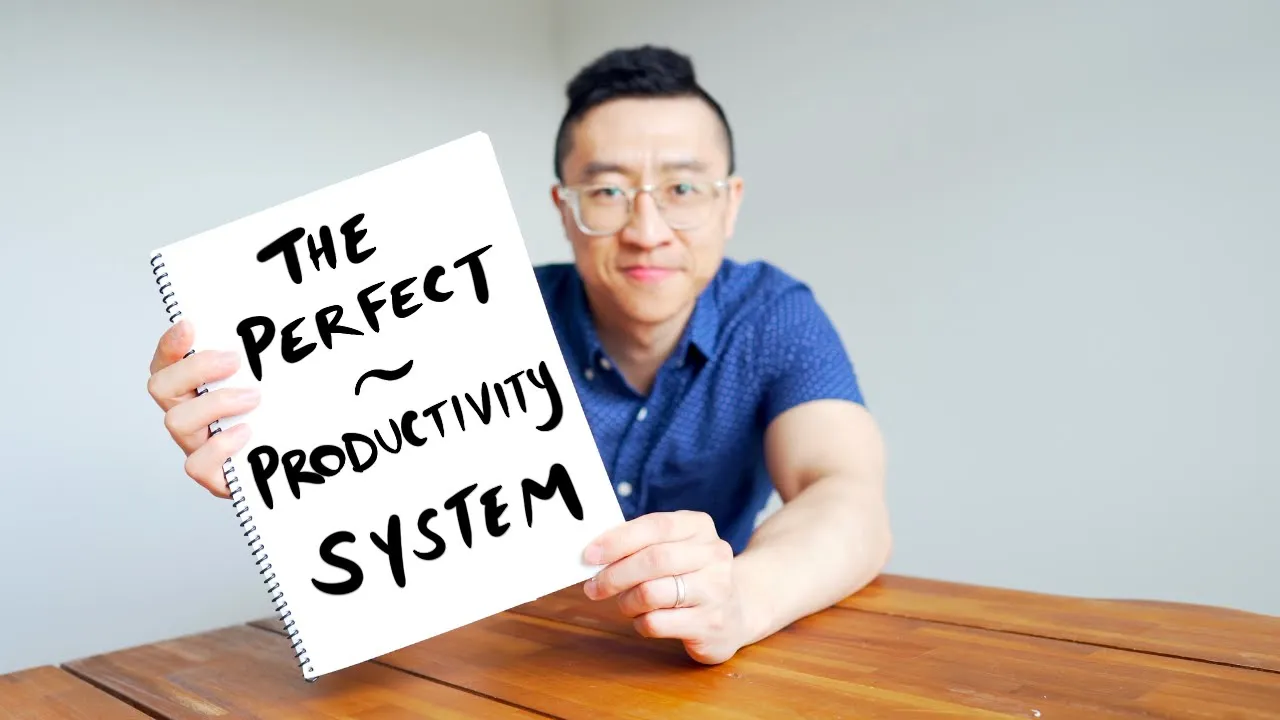
What if I told you you could achieve more in 90 days than most people do an entire year? I know it sounds crazy, but today I'm going to teach you the perfect productivity system that achieves literally anything. This productivity system is structured to help you systematically tap into the deepest networks of your brain, allowing for something scientists call diffuse mode thinking.
When you engage in this type of thinking on a regular basis and attack a problem with singular focus over 90 days, you get to use the full might of your brain's supercomputing power, people don't understand how significant of an edge this gives you. And so they squander it, feeding their brains garbage, and then they expect their brains to checkmate life like some grand master. When that obviously doesn't happen, they look up a bunch of productivity videos and go down a self-help rabbit hole, ending up more confused than ever.
Because most productivity videos are either way too basic or way too rigid and distract you from the only thing that matters, getting done and doing it at scale. For me, graduating from Harvard for undergrad and Yel for medical school and Harvard again for residency was no accident. It was strategically mapped out week after week, month after month, using a system just like this.
To understand this, we had to first talk about Tetris. Back in the day, I played a bunch of Tetris, right? After a while, I noticed something weird.
Even when I closed my eyes, I would still see falling blocks. Even the world looked like one big Tetris game. The buildings on my street, the shapes on my desk.
I thought to myself, am I losing my mind? I learned later that this had a name. It's called the Tetris effect.
At first, I ignored it and continued to play. But then I noticed something interesting. I was getting better, much better, especially after days where the Tetris effect was particularly strong.
That's when I realized there's something here. The Tetris effect is basically your brain experiencing what I call a neuronal echo. It's your brain rewiring itself to better tackle the problem at hand in real time.
Because contrary to popular belief, your brain never stops growing. It's a highly efficient adapting neuroplastic machine and it's constantly absorbing everything you throw at it. Spend a bunch of time focusing on Tetris and it's going to rewire itself to think about the entire world through the same lens.
I'm talking thoughts, dreams, the very fabric of reality. But Tetris isn't special. Focus on anything deeply enough and the same rewiring happens.
You know those light bulb moments you get? You're in the shower, you're taking a dump, and out of thin air, the answer something just comes to you. Guess what?
That wasn't an accident. It happened because of something you did earlier. You gave your brain a problem to work on and focused on it so intensely that the neuronal patterns working on it continued to echo in the background even when your conscious mind moved on to something else.
These echoes continue reverberating in your subconscious connecting dots for you until finally something clicks and you get your breakthrough. That's the power of diffuse mode thinking. And that's why this productivity system is powerful.
It was built for this very purpose, to engage these processes systematically to guarantee you get light bulb moments on a regular basis. Most people have no idea this is even a thing. Because what do most people give their brains?
Junky meme videos and garbage, right? Or the opposite, they overwhelm their brain with a million unrelated problems, pushing to solve them all at once. Your brain is a supercomput, but it only functions as a supercomput if you give it a single problem to work on.
Think about your own computer. When you open Microsoft Word, PowerPoint, 100 tabs on Chrome, and push it to do a million things at once, what happens? The whole damn thing freezes.
You can't even get it to do the simplest of things. Problem is, most people live in a state like this as the default. You can either halfass many things at once or full ass the one thing that matters.
That's why the first step of this productivity system is to figure out the one problem you want the entire might of your supercomput brain to work on. Write this super goal at the top of the page. Get crystal clear on what this looks like and then obsess over it.
You need to want it more than life itself. It needs to be something you are willing to leave this planet not having achieved. Once you figure that out, the next step is simple.
Start from the top and work your way backwards. This is the idea of reverse goal setting. Ask yourself, if I want this super goal to happen, what are the three main things I need to achieve?
Break down your super goal into its three most important components. I like to think about this in the form of a story. If I were to tell my future grandkids the story of how I accomplished this goal, how would I structure it?
I imagine the story as a threeact play. Each acts theme is one of these three important components. But don't stop there.
Keep going. What are the four most important milestones you must hit to achieve each of these components? Four is the magic number because in a 90-day three-act play, you have four weeks per act.
That means one milestone per week. This is how you break down an intimidating super goal, something that feels almost unachievable into weekly bite-sized chunks. The perfect cadence for hitting milestones.
Because taking one month to hit a milestone is conceptually too long. Knowing you have an entire month to accomplish something kills any sense of urgency, and it's too late for feedback. That means you only have 12 times a year to course correct.
Not good enough. On the other hand, one day is too short, creates anxiety and the desire to excessively micromanage. But 7 days, that's entirely within your control and especially practical when you reserve the last day of every week for reflection and analysis so you can course correct to ensure your story is always on track.
In case it's helpful, I create a notion template that lays this all out. It walks you through the entire system beginning to end. Now that you know how to structure the entire story, let's dive into how you structure each day.
I do what's called the inverted pyramid method. A few hours of deep work a day divided among just three things a day. Your three most important things.
I spend the most amount of time with my most important task. That's 2 hours. I give an hour to the second task and another hour to the third.
These deep work sessions are slotted specifically when I have the most energy. Because the more energy you have when you focus, the stronger your neuronal echo becomes. According to New York Times bestseller Daniel Pink, we all have a U-shaped rhythm when it comes to energy.
There's initial peak in the morning, a slump in the afternoon, and then a recovery in the evening. This dip in energy during the slump is actually perfect, and it's something this productivity system is designed to exploit. For this to work, you need to be absolutely laser focused during your deep work sessions.
Absolutely no distractions at all. I put my phone in the other room, turn on a white noise machine, and lock my door. You're doing this not only to be more efficient in the moment, but to ensure the deepest networks of your brain are also engaged, too.
I imagine I'm literally in an intense game of Tetris because that's the only way the Tetris effect is going to happen. And then during the slump, I purposefully relax and let my mind wander to promote diffuse mode thinking. You know, in the show Stranger Things, there's this concept of the upside down.
this parallel universe. I think of these wandering sessions in exact same way. Deep work sessions are my responsibility.
But when I wander, the subconscious me living in that parallel universe gets to work. This way, even during the slump of the day, I'm still working via these neuronal echoes. This is how you maximize brain efficiency and productively use the entire day without actually using the entire day.
And it doesn't even take that much effort as long as you space out the sessions correctly. 1 hour of deep work to start the day and 1 hour of deep work to end the day is more than enough. And just like that, all of the wandering in the middle suddenly becomes productive.
I supercharged this process even more by peppering my subconscious during these wandering sessions with mental cues because, yeah, you're busy. You got to cook, clean, pet your hamster, walk your grandma, and a million other obligations. And so it helps to have a bunch of reminders everywhere to push your subconscious to engage in diffuse mode thinking.
Could be as simple as a little sticky note on a bathroom mirror or putting a relevant podcast on in the background while you do your chores. Sure, you may not process every word and that's okay. You're not in deep focus mode, but bits and pieces of it will hit you in your subconscious, reminding your brain, this is the problem you're trying to solve.
And look, these are some nuggets that may help because in my head there's a little meter, a little cup I'm trying to fill up with all these passive, easy to do actions. As long as I constantly drip little bits of stuff into the dense neuronal jungle of my brain, some of these drops are for sure going to get through and fill up the cup of my subconscious. And when it does, when this little meter gets filled and I hit a certain threshold, the Tetris effect is going to happen.
And when it does, insane compounding returns is what you get. This is the concept of singular focus. You'll know you're there because you'll start to consistently experience light bulb moments all the time.
The just three things a day rule keeps things from getting overwhelming, but it also doesn't leave a lot of room for messing around. Three tasks a day means 21 tasks a week, but if your last days for rest and reflection, that leaves you only 18 tasks for each milestone. It's like you're building a house.
If you only have 18 nails, each nail better count. If I put a nail here, does it keep the wall up or does it do absolutely nothing at all? I don't want to waste my time hammering nails randomly into the floor.
Right? Each time I do a task, this is my exact thought process. What kind of nail is this?
Is it even necessary? If I take this nail out, is the house going to collapse? If so, I better nail this down first.
This is the concept of impact factor. Always have that sense in mind. What's the impact of this nail?
Is it 20%, if so, I shouldn't even be wasting my time on it. 80% or more. That's the rule.
Only work on nails with real impact. This is the crucial step of the system and why this notion template explicitly forces you to reflect on this as a specific step in the process. In the beginning, you may not know what these nails look like, and that's fine.
But as you build your house, you'll begin to build that sense because you'll see what worked and what didn't. That's the feedback loop you need to always pay attention to. Because if you don't, you might be wasting all your time putting nails into the floor.
We don't even have four walls or a roof yet. Unfortunately, this is how a lot of people operate. They think, "As long as I'm busy, I must be doing something right.
" Sure, I guess. But that's why it's going to take that same person an entire year to do what you'll do in just 90 days. There are actually six more strategies built into this productivity system that the notion template goes over.
All designed to ensure these next 90 days are as smooth as butter. In my Substack, I walk you through all of them. talk about the triple 31 method for structuring the entire year and teach you how to build what I call an emergency kit, a break glass in case of emergency.
Stepbystep personalized protocol to follow if you ever feel overwhelmed. And as always, links are all in the description. Follow this system and there's no way you won't hit your super goals over and over again.
Any rate, hope this gave you some food for thought. Until next time, my friends. Smell you later.