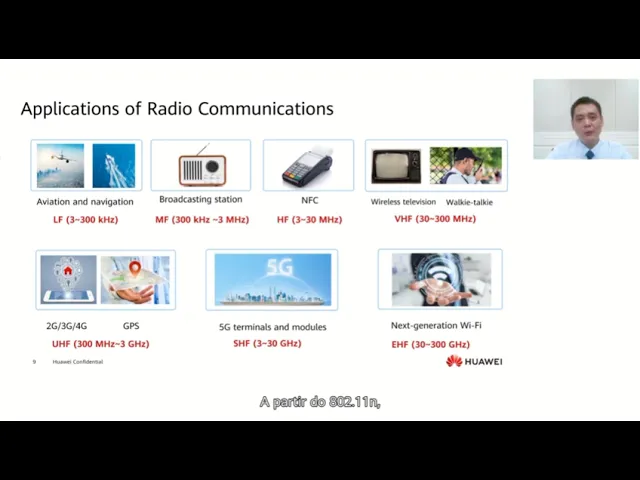
hello everyone in this video I will introduce you the first course of hcia 5G certification that is 5G development and evolution this course aims to help you understand the basics of communication the driving forces of 5G the progress of 5G standardization and current 5G industry chain and ecosystem on completion of this course you will be able to understand the development of mobile communication understand the driving forces of 5D development understand the 5D standardization progress and be familiar with the 5G industry chain and ecosystem this course consists of five parts first I will introduce the basics of mobile communication networks the development of communication industry and 4G applications in our daily life then I will introduce the driving forces behind 5D development why and where we need 5G as Protocols are vital to all networks the progress of 5G standards will be explained in the third part the fourth part focuses on the development of 5G industry chain and ecosystem any technology cannot be developed merely by one or several Enterprises it can only grow mature in an endtoend ecological industry environment lastly I will introduce the latest global commercial use of 5G which and how countries companies and Telecom operators have deployed 5G commercially now let's start with the development and evolution of mobile communication so what is communication actually we are doing communication every moment such as a letter home a phone call a message a video chat among family members or this class video that I am recording for you communication occurs as long as information is exchanged and transmitted between people and people or even between people and nature there are various common communication modes in life such as phone calls short messages instant messaging various applications and social media it has been summarized that communication signals have become the fifth most essential factor in Modern Life in addition to air water food and electricity in 1837 Samuel mors from the US invented the telegraph uh which we can often see in spy movies this marked the first device to quickly transmit information to any corner of the world in 1875 Bell invented the telephone in the 19th and the early 20th century telephones had no dial pad so it was impossible to dial a number directly instead an operator will connect the calling parties telephone with a rotary dial was invented by 1920s and the push button phones went to Market in the 1970s and the 1980s however users need to be near a fix line phone to receive calls as such people wanted a more convenient communication tool first pagers were invented becoming a transition products with a pager the C party could see the calling party's number but could not communicate with the calling party directly a pager was also known as a beeper because It beeped after someone called in 1973 DrMartin Cooper of Motorola in the United States invented the first handheld cellular phone which was big sized after continuous transformation mobile phones have evolved from big-sized cell phones to keyboards and then two smartphones now we have how do this electric devices communicate is this really through electricity communication can be divided into two types by communication media wired communication and wireless communication the medium of wir communication is visible and touchable such as lines of fixed line phones network cables of desktop computers Optical fibers connected to routers and two Mega COA cables connecting devices wireless communication mainly uses electromagnetic waves to transmit information mobile phones Wi-Fi GPS microwave and satellite communication are all of this kind the Spectrum division is shown in the figure the speed of light is the frequency multiplied by the wavelength as the speed of light light is fixed the frequency is inversely proportional to the wavelength a larger frequency leads to a smaller wavelength this point is very important for us to study electromagnetic waves and a wireless communication uh for the convenience later I will call the electromagnetic waves as en en waves for convenience spectrum is a physical quantity that exists in nature and cannot be increased or decreased therefore Spectrum needs to be carefully allocated the propagation characteristics of EM waves vary across frequency bands in low frequency bands the wav length is long and EM waves are more likely to defract and Scatter leading to a small propagation loss long average distance and a strong defraction capability high frequency bands come with short wavelength large propagation loss short coverage distance and poor defraction capability low frequency resources are limited and the system capacity is small high frequency resources are abundant and the system capacity is large use using the Spectrum more efficiently and obtaining a high transmission rate with a limited Spectrum uh becomes a goal for continuous breakthrough in Wireless communication and what a very high frequency VHF after high frequency UHF and super high frequency shf let's see the next page International telecommunication Union itu defines the usable frequency range of EM waves at 3 KZ to 300 khz which are divided into low frequency LF medium frequency MF high frequency HF very high frequency VHF ultra high frequency UHF super high frequency shf extremely high frequency ehf and a tremendously high frequency thhf that is deer radiation the use of frequency bands and the history of human Science and Technology have been developed together the entire development of Science and the technology is a process of building houses in frequency bands the frequency band with a range of 3 khz to 300 khz is called a very low frequency V LF and LF its wavelength can reach tens of kilometers and has strong defraction capability to easily cover the entire Earth therefore this frequency band is initially used for navigation of air and sea Transportation when the capability of a radio wave to transmit information such as sound was discovered MF immediately become the preferred frequency band for regional radio stations MF is also used in many navigation systems in the radio broadcasting field HF is also called short wave the first Global broadcasting station and Global Communication radio station were implemented in the HF range as HF allowed for outra long distance transmission through ion fa reflection without requiring the ultra high power of transmit station radio frequency identification RFID and the near field communication NFC work in this frequency range where NFC Works in 13. 56 mahz and RFID uses 27. 12 MHz this frequency band is selected to reduce the design difficulty and the manufacturing costs of the receiver and transmitter rather than increase the transmission distance since LF and HF have been used for transmitting sound globally VHF was then developed and utilized to achieve visualized two-way communication FM radios walki talkies Pages cordless phones and the wireless TVs all work in this frequency band the popularity of these products has profoundly affected Social Development in addition VHF is utilized in international Maritime communication Aviation navigation Aviation ground communication and so on most the digital wireless communication Technologies such as GSM wcdma and LTE uh that is also called 2G 3G and 4G and as well as GPS and some 5G services are provided in the UHF range given the massive applications the use of this frequency range must be licensed in most cases in countries around the world in a form such as an operator specific license countries also Define an unlicensed frequency band which is generally used for Wi-Fi and Bluetooth in in the UHF range using the 2.
4 GHz frequency band does not need to be licensed by a country as long as the devices power complies with regulations uh the USF is rather congested with large number of wireless communication working in it therefore a higher frequency band is required to further improve the transmission rate from 802. 11n onwards the f 5 GHz unlicensed frequency band is used to achieve above gahz level Wi-Fi speeds due to its large bandwidth the 5 GHz unlicensed frequency band helps further improve the transmission rate and the bearing capability in LTE development as for the 5G communication standards the mm Wave band 28 GHz in addition to the 2. 4 gahz frequency band that has been used in LTE is utilized to achieve an ultra high transmission rate in 5G in the Next Generation Wi-Fi standard i e 802.