- One, two, three, four, five. Hello, hello, hello. Okay, here we go.
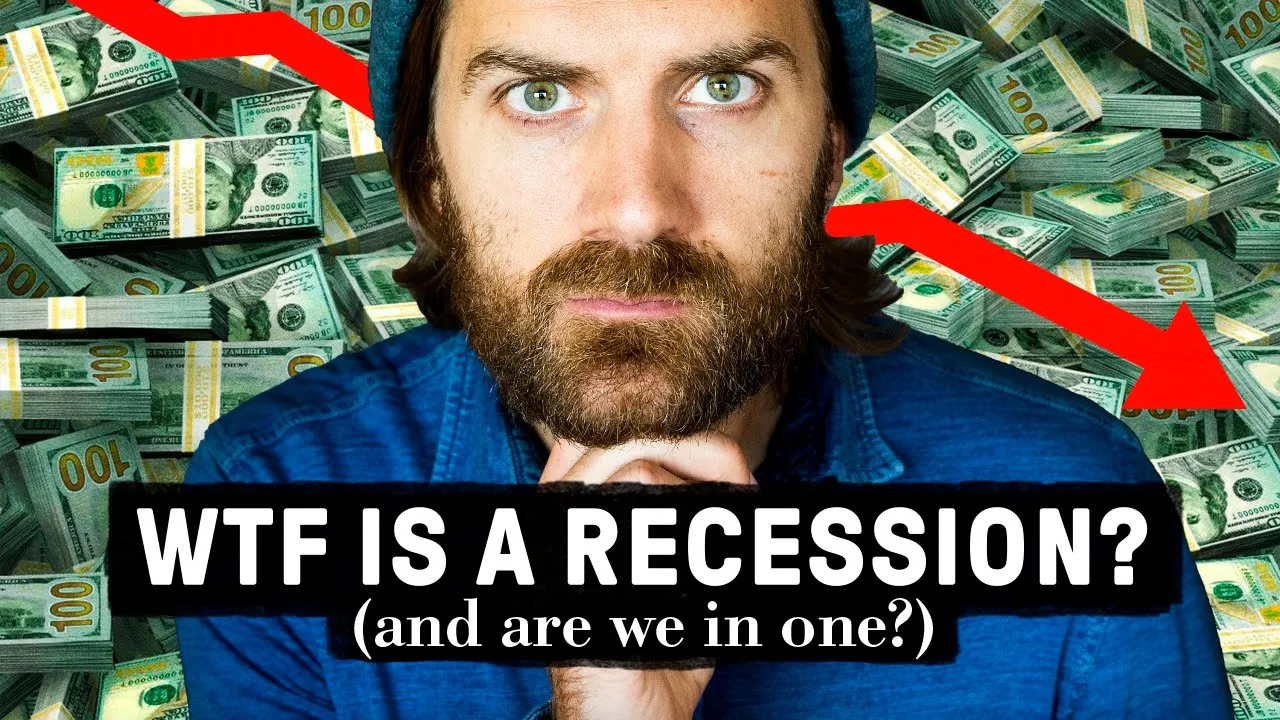
I wanna explain to you what a recession is. I'm doing this because you're gonna hear this word a lot lately. And depending on how bad it gets, you'll likely feel its effects.
So give me 12 minutes to explain recession. Plus, of course, the inevitable time it takes me to read an ad, which is something I must do in order to pay my employees and feed my children. I'm sure you can understand.
I spent four years in university studying economics preparing for this very moment, so let's go. - Are we at a turning point headed for a recession? - Storm clouds of recession looming and the storm is really coming.
- With inflation at a 40-year high, many experts warn of a possible economic slow down. - A recession is almost inevitable. We use the word "economy" to summarize what is literally billions of things.
Billions of people making billions of decisions all connected to each other, and yet the result of all of these decisions is one of two things, this line either going up or going down. (ominous music) This all-encompassing number on a graph is called the gross domestic product, GDP, which, by the way, is kind of the most undescriptive, useless title ever given to anything. GDP is like the receipt of an economy.
Every single thing that was made and sold in an economy all added up into one giant number. Now there's a very technical definition that you can go explore in the sources if you're that kind of person, but for now, just imagine every TV and piano lesson and slice of pizza and car wash and pair of shoes and smartphone and video game, everything that the people purchased from the businesses in your economy in one year all added up and packed into this one dot and plopped on a graph. So what we're looking at here is Britain's GDP in 1990.
Everything that the economy made and sold to the people added up to about a trillion pounds. That was their GDP for that year. This is the best way that we can summarize how big an economy is, how much it produces, how well it's performing year after year.
Let's look at a graph. This is what GDP looked like in the old days, like in the agrarian days. You had ups and downs year by year, but really, overall, this graph is pretty flat.
The economy didn't really have an upward trend. It wasn't growing. That's because back in the 1300s the economy was a completely different world than what we live in today.
It was pegged to things like farming, which was pegged to things like weather or plague or war. So like here's the Black Death that killed 40% of Europe's population, and here is the Great Frost, a weather event that ruined a bunch of crops and therefore made the economy shrink for a year. Okay, so this is how it was in the agrarian days, but brace yourself for what happens next.
(upbeat music) This flat line just turned into a steep cliff, and that's because humans started doing science, not just to make themselves smarter, but because they were incentivized to, to make more stuff to, make it more efficiently. All of this happening as humans were developing and spreading a new set of economic rules, rules that rewarded those who invented, produced, and sold stuff that made life better for both the buyer and the seller. The system was called capitalism.
Capitalism plus industry was the cocktail that allowed this to happen. By the way, pause the timer for a second because I need to just say it is painful how little I'm able to include on this topic. Go into the sources and just poke around and you'll see so much good juicy history on capitalism and the Industrial Revolution.
Let's move on. Back to the timer. So every year people could make more and more stuff.
They could sell more stuff. And there was more and more GDP, more stuff being made and sold in the economy, not just in England, which is this graph we've been using as the example, but eventually in the whole world. Okay, but there was a catch to this new system.
Unlike the old agrarian days where you could have a graph that kind of stays generally flat over time, this new system was built off of the idea that the line kind of has to go up. Capitalism works because it incentivizes people to make products and businesses that are better and better every year, more and more productive, pushing this line higher and higher every year. And the kind of voodoo magic of capitalism is if the line doesn't go up, bad things happen.
(dramatic music) Okay, so here's where it all comes together. We're trying to get to recession right? By the mid 1800, the capitalist experiment was fully underway, at least in the western world and Japan.
The rest of the world was being brutally exploited to make all of this happen. Anyway, topic of another story. See How Europe Stole the World, part one and two, part three coming soon.
(exhales) The amount of stuff being made and sold in the economy was going up more and more every year. This graph is definitely going up, but what about all these? Soon a mysterious pattern emerged in this line.
Every few years the GDP graph would go down for a little bit. The amount of stuff being made and sold would shrink, not necessarily tied to weather and war and plague, but just cause. Before eventually recovering and continuing on its way up.
And these little dips in the line we call recession, a receding of the amount of shit we can make and sell. Here is the GDP of the United States since 1948 and here are all the recessions. There've been like 12.
I mean, we just got out of one of these. We had a very short but dramatic recession thanks to COVID-19. But the last long recession was back here, the financial crisis around 2008 the one that you probably think of when you hear the word recession.
- Subprime derivative. - A subprime mortgage meltdown. - A housing bubble.
- Okay, wait, wait, wait. But why does the graph go down in the first place? Like what makes it go down?
You can't answer that by looking at just this big line. You have to zoom into one of these dots and see what has to happen to create this number. (upbeat music) At the very heart of the capitalist economy you have two major players.
You've got people and businesses, or as economists like to call it, households and firms. In this case, let's just say the entire economy of your country is actually the size of your neighborhood, and you're going to your local bakery, an important business in your neighborhood economy. You and your neighbors show up to this bakery and you pay $3 for a loaf of bread.
The bakery is a business that uses that money to pay its workers, but these workers aren't like some special class of people. They're just other people in the economy who also are gonna go spend money too. The bakery also has to pay rent to a landlord who's also just another person in the neighborhood.
So those people then go off with their new money that they just got paid and they spend on other businesses who also have workers to pay and rent to pay. And suddenly your money is flowing to all the people who work in the economy, and everyone's feeling good about it. They have jobs, they have a solid income, they can buy cool stuff.
The bakery and other neighborhood businesses feel this demand and they go, "we need to hire more people so we can make more bread. " And lucky for them, there are investors, and the investors are stoked on all of this demand so they start investing in the bakery and all the other businesses, giving them money to hire more people, to make more bread, more buying, more jobs, more stuff being added to the total. The GDP is going up, the economy is growing.
Okay, but what happens when some outside force comes in to disrupt all these good vibes? It all starts when you show up to your bakery one day and you notice that something changed. Suddenly the price of a loaf of bread is actually $4.
And the baker's like, "Sorry, dude! The price of flour has gone up. " You know, inflation, supply chains, whatever.
They say something. But the point is what it does to you. Suddenly you're feeling like, oh, maybe I can't afford this bread.
Or even if you can, you see that something's up or maybe you hear that the interest rate is going up, something that we're hearing about a lot lately. And so now you're thinking, oh, maybe I shouldn't spend money on expensive artisan bread but save that money and I can actually get a good return. If you're an investor, the higher interest rate's kind of freaking you out because now it's more expensive to borrow money.
You think twice before investing in the bakery. Another option is that you're hearing rumors about a coming economic downturn because of some war somewhere, and you judge that it would be wise to save your dollars instead of spend on expensive artisan bread or whatever. Meanwhile, your neighbors are seeing and feeling the same things, and they decide that this bread is a little bit too expensive for them and they'll just make bread at home.
Less bread is demanded from the bakery, AKA, there's a disruption in your local bread market, AKA, there's a mismatch between bread demanded and bread supplied. The bakery hired too many workers during the good times. They now don't have the revenue to pay them all, so they have to lay some of them off or cut their pay.
Unemployment is now going up. "I lost my job today," says your sad looking neighbor one evening, which kind of freaks you out even more. Maybe you should be more careful about your spending.
And now it's starting to spread. What was just a decision to not buy bread anymore means that many employees in the neighborhood won't get paid and now they can't go out and spend money, which means that other businesses have less revenue to pay their employees, and now more people are hearing about this and deciding maybe they don't wanna be spending, and suddenly there are fewer and fewer transactions, less lending and investment. And now this economy that was once buzzing with activity is experiencing a domino effect.
Less stuff is being made, less stuff is being bought. Your neighborhood economy is literally shrinking. It's making less stuff.
Your GDP is lower than it was the year before. Your neighborhood is in recession. The point I wanna make here is that this is the result of loads and loads of people making a bunch of micro-decisions on whether or not to spend their money.
And because of the system we're in, these decisions have a massive chain reaction that affects everyone who participates in the economy, meaning everyone. That's the blessing and the curse of capitalism. Okay, let's just pull ourselves out of the analogy with all the pretty animation and talk about the real world for a second.
You're probably wondering, are we in a recession right now? Are people spending less money so that the economy makes less stuff? Is GDP doing this?
I mean, maybe! We don't know yet! And especially with this one, it's kind of a weird one.
It's hard to tell. We're getting contradictory signals from the economy. Here in the United States we had two quarters in a row, which is like six months, of a shrinking GDP, and this, for a lot of analysts, is the definition of a recession.
Two quarters in a row of shrinkage? We're in a recession. But then just a few weeks ago, the news came out that the third quarter of 2022, the economy grew again.
I mean it was by less than 1%, but it grew. So that's not a recession yet. Plus, during a recession, the number of unemployed people spikes.
But check out where the unemployment rate is right now. It's nice and low. That's not recession.
So the signals are contradictory. By the way, if you want a deeper dive into how recessions are officially classified and declared and by whom, check the sources in the description. There's a whole super deep dive into that.
Most of you would be like snoozing after two seconds if I went into it. What we do know is that people are a little bit freaked out. They're being more cautious about their spending, and that's because of a cocktail of causes that you've heard about in the news.
COVID-19 giving way to energy prices and supply chain disruptions and this war in Ukraine. The result is less of this and more of this, and that's because hundreds of millions of people are making hundreds of millions of little micro-decisions every day to spend less money in an economy that only works if everyone spends more money and pushes businesses to make more stuff. And that's the point I want to make here.
The big takeaway. We talk about the economy like it's some kind of science. I mean, I have a degree in economics, a social science.
We look at graphs, we do calculus, and we feel like we're scientists. And in a big sense we are. But what this graph hides is that what we're dealing with here are people, people who make decisions based on how they feel, and that's really hard to predict and control.
We do it. See the inflation video for how the Fed is like a puppet master. We do it, but it's really hard to control and predict.
So a recession is almost certainly coming. You may be watching this in like nine months and the recession is here. I don't know.
The fact is by looking at this line, what we can say is that a recession is natural and normal. It is a part of our modern economic system. It will likely come and then go.
People will lose jobs, businesses will close, and at some point, for a million tiny little reasons, things like policy and just general feelings in a bunch of people's guts, this graph will stop going down and it will start going up again. That we can be sure. (exhales) Do you know what else we can be sure of?
I'm gonna keep making videos. And in fact, I have just made one of the most ambitious videos in my entire life. It is about Swiss bunkers.
There are bunkers everywhere in this country. And the result is this video game (airplane flying) I'm really proud of that publishes next week here on the channel. (energetic music) but I actually published it early.
It's available right now. You can go watch it literally like right now. if you go to Nebula.
They turned their mountains into a literal giant fortress. Yes, you heard me right. They turned their mountains into a fortress.
Nebula is a platform where I'm gonna start publishing my videos a week early. You can go watch them before anyone else does with no ads and no interruptions at all. This is not a rock, this is a door.
If you like my videos, you're gonna like the stuff that's on Nebula. Like this hour and a half long documentary on the Colorado River by Wendover Productions. It's insanely well produced.
RealLifeLore, a YouTuber I deeply respect, has a "Modern Conflicts" series that is only available on Nebula. Can't get it anywhere else. In addition to tons more smart creators.
It seriously seems too good to be true. So how much is this gonna cost you? That's what you're all asking.
Well, if you go in through the front door, just like go to Nebula and sign up, it's five bucks a month or $50 a year. But there's a hack for this that makes it way cheap, like ridiculously cheaper, like less than a dollar a month. Click the link in my description and it'll take you to Curiosity Stream.
Curiosity Stream is a partner of Nebula and they have this bundle deal right now where if you sign up for Curiosity Stream and you use my code, johnnyharris, make sure to use the code to support my channel. Choose literally the cheapest plan. It is less than a dollar a month if you do the annual thing.
It doesn't say it here, like it literally doesn't say it anywhere, but if you do this plan and you enter my code when you're checking out, you will get an email from Nebula that says your Nebula account has been activated, create a password. And now you get to watch my videos a week early, ad free, and tons of other amazing ad-free content, a lot of it exclusive to Nebula. Doesn't exist anywhere else.
Curiosity Stream is full of its own amazing repository of documentaries. But I'm telling you how to get into Nebula for a dollar a month so you can watch my videos a week early. More than any other ad read I have ever done, I can say without a doubt that clicking that link and using that code, johnnyharris, helps support this channel.
And it also helps support independent YouTubers who are trying to make really good stuff. If enough people sign up for Nebula using my link, they are going to help support a big ambitious documentary project I wanna work on. It's a documentary project I can't really publish here on YouTube 'cause I have to play by sort of the ad-friendly guidelines, I have to play the attention economy game.
I love that, that's fine. But Nebula wants to support me making more and more ambitious stuff. You signing up gets you access to all this stuff but also helps support us make great stuff.
So anyway, literally just choose any Curiosity Stream plan and use my code, and that's it. It's late. It's getting dark out there.
Hope everyone's having a good winter. And I'm tired. It's a Friday today.
You're probably watching this on some other day, but I'm gonna go home and take a nap.