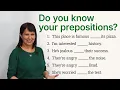
This is a combined grammar and vocabulary lesson, okay? In this lesson, we're going to focus on ten adjectives and the prepositions that go with them, but along with those ten, you'll get 25 for free, okay? What do I mean by that?
I mean that along with the ten adjective and preposition combinations, you'll get other expressions and vocabulary words that we can use in exactly the same way, okay? So let's see how to do that. And also, whether you're a beginner or a little more advanced, you'll still find this lesson useful because we'll take the basic expression and then we'll give you lots of other more advanced expressions and vocabulary which you can also use, okay?
So let's get started. So here's the first expression. Now, I haven't put in all the answers.
You're going to help me with that, right? Okay? So you have to tell me which preposition goes with these adjectives, okay?
Here's the first one. That's very nice _______ you. Now, when we say "preposition", we need a preposition here.
We mean a word like "in", "at", "on", "of", "with", etc. , okay? Those are those little words that are called prepositions.
So what's the expression here? What's the correct preposition that's missing? That's very nice _______ you.
Do you know it? So we should say "That's very nice of you. " That's very nice of you, okay?
It's a very nice thing to say to someone. But you can also say "That's very kind of you. " That's very thoughtful of you, okay?
I mean, somebody who has really done something very kind and put in a lot of thought and doing something very nice for you, okay? It's very thoughtful of you. That's very generous of you, okay?
Generous is somebody who maybe spends a lot of money or shares a lot of whatever they have. It doesn't have to be money. It could be their time, it could be their experience, it could be something else.
Or "That's very sweet of you", okay? A lot of people say that too, especially, you know, between women, they say that a lot. That's very sweet of you.
That's very nice of you, that's very kind of you, okay? So, say that out loud as I'm going through them, and that way you will get more comfortable with using it in real life, alright? And also, you'll get the pronunciation right.
The more you use it, the easier it will be for you. Next, let's go to number two. He's worried something the test.
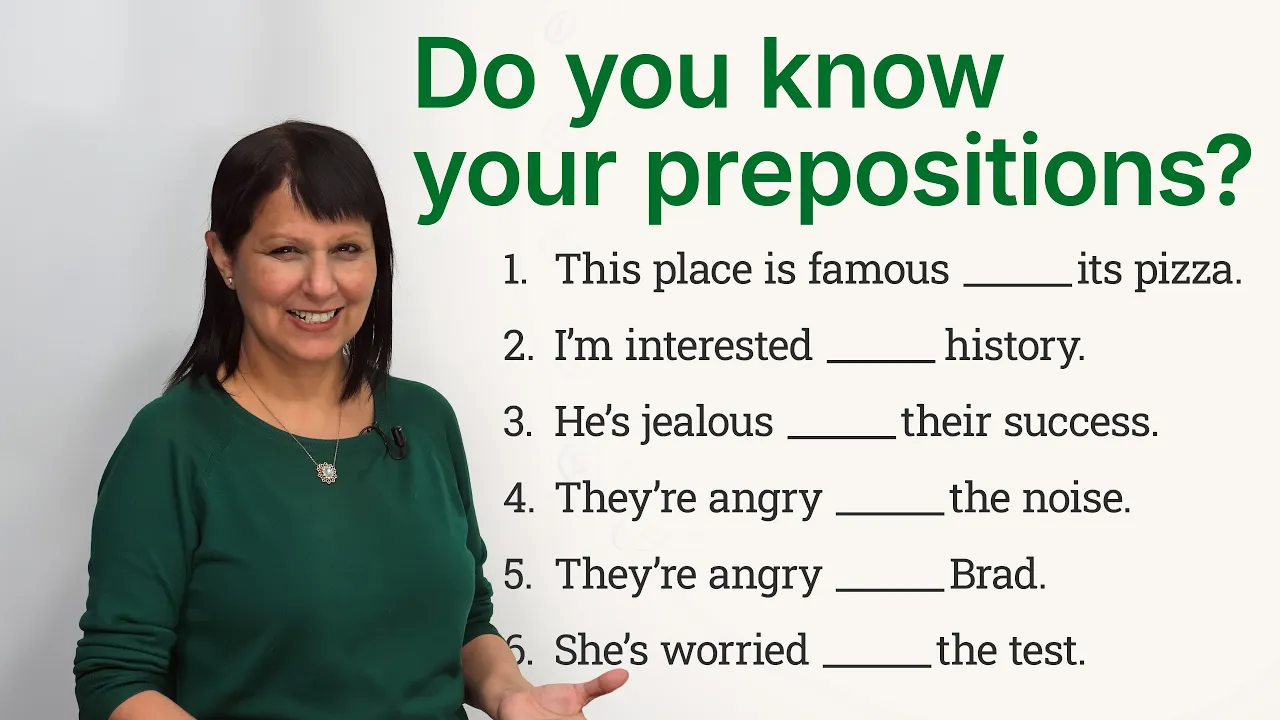
What's the missing preposition? He's worried about. He's worried about the test.
That's the correct preposition to use with "worried". So, we could also say, say it with me, he's nervous about the test. He's anxious about the test.
He's stressed about the test. He's upset about the test. Okay?
So, these are other words similar in meaning, not exactly the same. Nervous means you're, you know, what you feel before a test, a little bit scared, and so on. Anxious is similar to nervous, okay?
Stressed is you're really kind of, like, freaking out because you're so worried, and upset just means you're not very happy about something, okay? Alright. So, that was "worried about".
The first one was "nice of". Okay, number three. She's good _____ math.
What's the preposition we need there? She's good at math. Okay?
So, in English, we say somebody is good at something. We can also say somebody is bad at something. Okay?
So, here are some other vocabulary words you could use in the same way. You say them with me. She's excellent at math.
She's skilled at math. She's bad at math. Or she's terrible at math.
"Terrible", of course, meaning very bad. And "excellent", of course, meaning very good. Okay?
So, by learning this one expression, "She's good at math", you can also learn lots of other expressions. And choose the one which seems, like, more natural for you. Try to learn one or two from each set, here.
Okay? Number four. I'm happy _____ the news.
Which preposition do we need here? I'm happy about, okay? I'm happy about the news.
Or, I'm excited about the news. Or, I'm sad about the news. Or, I'm depressed about the news.
Okay? Now, "sad" and "depressed" are, of course, negative; "happy" and "excited" are, of course, positive. "Sad" is the opposite of "happy", and "depressed" just means very, very sad.
Okay? Okay? And "excited" means very, very happy.
Okay? But what's important is the preposition also that we use after these adjectives. So, say it along with me.
Happy about, excited about, sad about, depressed about. Okay? Good.
Let's do number five. "He's afraid _______ spiders. " What do we need there?
"He's afraid _______ off. " Okay? So, in English, we say "to be afraid of something".
In some other languages, there are other prepositions in all of these cases, especially this one, but so be careful. Now, we can also use some other vocabulary words which are similar in meaning. So, instead of saying "He's afraid of spiders", we could say "He's scared of spiders", "He's frightened of spiders", "He's terrified of spiders".
"Terrified" means very, very frightened; very, very scared. Okay? Very, very afraid.
Okay? So, "afraid of", "happy about", "good at", "bad at", "worried about", and "nice of". Those were the first five, and now we're going to do five more with lots of other vocabulary words.
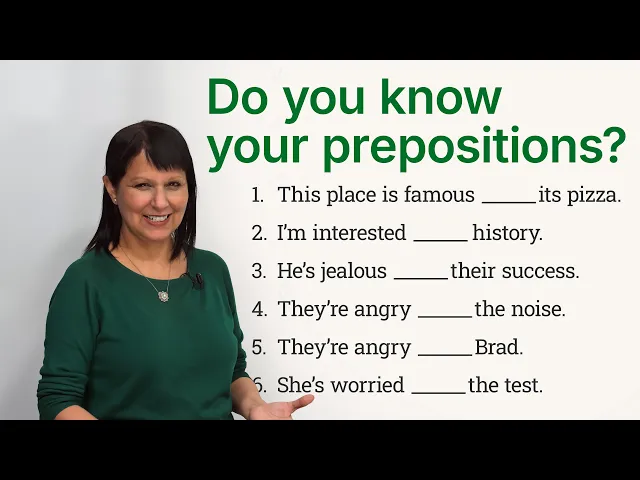
Okay, so let's do number six. "This restaurant is famous _______ its pizza. " What's the preposition that we need?
"This restaurant is famous for its pizza. " Okay? Famous for something.
Or you could also say "This restaurant is well known for its pizza. " Or you can also just say "This restaurant is known for its pizza. " Okay?
Now, you can talk about a place like this, or you could also say a person. Okay? "This person is famous for his acting", or "She is famous for her singing.
" All right? So, it's not just places that we talk about, but also people. Number seven.
"She's married _______ my friend. " A lot of people around the world make a mistake with this one. Do you know it?
"She's married _______ to my friend. " Okay? Not with "to".
"She's married to my friend", or "She's engaged to". To be engaged means to be. .
. To have a plan to marry someone. Okay?
These two people have a plan to marry each other. They are engaged. And then at a later point, they get married.
All right. Number eight. "I'm interested _______ history.
" Okay? "I'm interested _______ history. " So, which preposition do we need there?
"I'm interested _______ in. " Okay? Again, this is a really common mistake.
It must be because the preposition used in different languages is obviously not "in", so be careful if your native language is one of those which has a different preposition. This is. .
. I see this mistake all the time in writing, in speaking with my students. Okay?
So, be careful of that one especially. All right. Let's look at number nine.
"He's jealous _______ their success. " What does it mean to be jealous? Well, somebody has something and someone doesn't feel happy that somebody has something.
It could be a person, it could be a thing, it could be something that they have achieved and it's a sort of a bad, negative feeling. You don't want them to have that. "He's jealous _______ their success.
" "He's jealous _______. " Okay? "He's jealous of their success.
" You could also say, "He's envious of their success. " So, "jealous" is kind of a negative word for that emotion of not being happy about something that somebody else has, and "envious" is like it's more positive cousin. Okay?
And "envious" is like you wish you had that, but you don't sort of feel bad that the other person has it. Okay? So, "he's envious of", in terms of the preposition, it's the same preposition.
And this is another word, it has a different meaning. "He's suspicious of their success. " "He wonders how they became successful.
Did they do something illegal? Did they do something immoral? " "He's suspicious.
" He's not feeling very secure about it or very sure about it. Okay? But again, "suspicious of".
Number ten. There are two options here, depending on what we are trying to say. Okay?
"They're angry _______ the noise. " So, which preposition do we need there? "They're angry about", okay?
"They're angry about the noise", we'll come back to this. "But here, they're angry _______ John. " So, here, we say "They're angry at John.
" Okay? So, it's like this. "You're angry at someone, but you're angry about something.
" Okay? "They're angry about the noise. They're angry about the delay.
They're angry about the cancellation. " Okay? So, here are some other vocabulary words you can use, other adjectives instead of "angry".
You could say "They're mad at", "mad" is a little more casual, more informal. And you could also say "They're furious about the noise". What does "furious" mean?
"Furious" means very, very angry. Okay? So, it's angry at a high level.
"Furious". Okay? Again, "furious about".
And again, here, "They're", you could also say "They're mad at John", "They're furious at John". Okay? But here, "angry at someone", "angry about something".
All right? And here, "jealous of", "interested in", "married to", and "famous for". All right?
So, this is obviously an area with prepositions. It's very easy to get confused because, as I said, in native. .
. Your native languages probably, there are different prepositions, or sometimes no prepositions. And in this case, these are the ones we need.
Okay? So, the best way to master this is with a lot of practice. So, the first thing you could do to help you to remember these really well is go to our website at www.
engvid. com. There you can do a quiz on all of these and just really practice them.
Okay? You can also just try to review them during the week; it's not always enough to just sort of learn them once. You need to use them, you need to practice them.
Put them somewhere so that you can see them more often and use them. Put it on your fridge, put it on your bathroom mirror, put it anywhere. Okay?
Somewhere you'll see it and use it. All right? Sometimes.
. . I remember once I heard it said.
. . There was an expression and it said "use it" or "lose it", so don't do that.
Okay? Use it and keep it. All right.
So, what's the next thing you can do? Subscribe to my YouTube channel and that way you can keep getting new lessons, especially if you ring the bell after you subscribe. And with all that, I wish you lots of luck and lots of happy learning.
Enjoy yourself while you're learning. Okay? The prepositions don't have to make you feel sad; they can make you feel happy once you get them.
Okay? All the best with your English. Bye for now.
Bye.