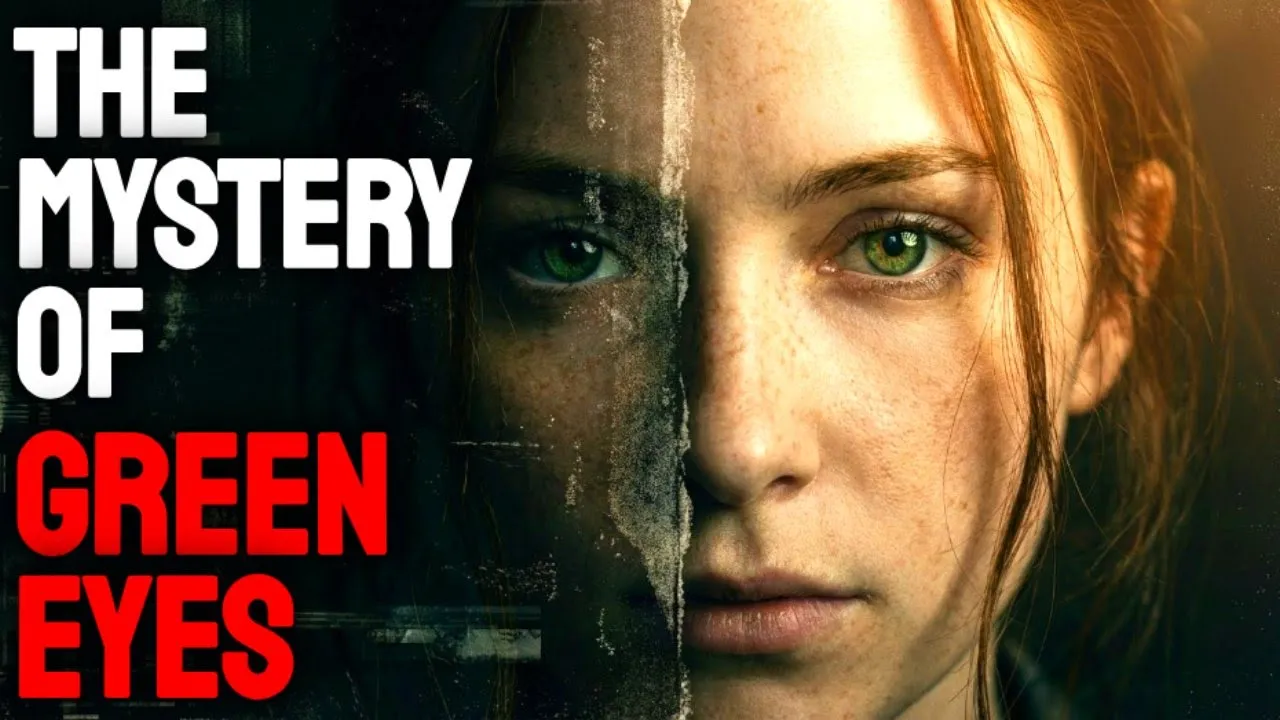
Imagine you're sitting across from someone in the soft glow of candle light. They look up and you catch it. That flash of green. Not blue, not brown, not hazel. Pure unmistakable green. Like light filtering through leaves in a forest. Like sealass tumbled smooth by centuries of waves. There's something about green eyes that stops you mid-sentence. Makes you look twice. makes you wonder if you're seeing Something almost supernatural. And here's the thing, you basically are. If you're using this to fall asleep, perfect. That's exactly why I make these videos. Subscribe if you want and drop a
comment telling me where you are and what time it is. I love checking and seeing Tokyo at dawn, Los Angeles at midnight, someone in Prague having breakfast. All of us fascinated by the same mystery. Out of every 100 people you pass on the street, only two will Have green eyes. Two out of 100. That makes green eyes rarer than any other eye color on Earth, rarer than blue, rarer than hazel, way rarer than brown. Only 2% of the global population carries this trait. To put that in perspective, there are more people with naturally red hair,
which is about 1 to 2% of the population, depending on where you are, than there are people with true green eyes in many regions. But here's where it gets really strange. Despite All our advances in genetics, despite mapping the human genome, despite understanding DNA better than ever before, scientists still cannot fully explain why green eyes exist. They can't tell you definitively why they're so incredibly rare. They can't predict with certainty when or how this trait emerged in human history. It's 2024 and we can edit genes, clone animals, send robots to Mars, but the mystery of
green eyes still unsolved. Think about that for a second. We live in an age where we can trace our ancestry back thousands of years with a simple cheek swab. We can identify genetic markers for hundreds of diseases. We can tell you what percentage Neanderthal you are. But ask a geneticist exactly why your eyes are green and they'll give you theories, educated guesses, probabilities, not certainties. The story gets even stranger. Green eyes don't actually Contain any green pigment at all. zero. There's no green dye, no emerald colored molecules, nothing actually green in a green eye. If
you could extract the biological material from a green iris and examine it, you'd find brown and yellow pigments. That's it. The green you see, it's an optical illusion. A trick of light scattering through layers of tissue. The same physics that makes the sky blue is what makes green eyes green. So, if green isn't really there, What are we actually seeing? And why does it captivate us so completely? Throughout history, green eyes have been associated with magic, danger, mystery, and desire. Ancient civilizations wrote about them in myths. Medieval Europeans feared them as signs of witchcraft. Poets
compared them to emeralds and enchanted forests. Artists struggled for centuries to capture their exact shade on canvas because green eyes seem to change color depending on the light, the Surroundings, even the mood of the person. But beyond the mythology and the romance, there is a genuine scientific puzzle here. Evolution doesn't usually preserve traits that are this rare unless they serve some purpose. And yet, green eyes persist across generations, scattered sparsely through human populations, concentrated in certain regions, but appearing randomly in others. Some scientists think green eyes Emerged around 10,000 years ago, roughly the same time
humans developed blue eyes. Others believe they're much older. The genetic mutation responsible involves a gene called OCA2 and another called H ERC2. But the way they interact to produce green specifically is still being debated. It's not a simple onoff switch. It's more like a dimmer dial that somehow got stuck at just the right setting to create the rarest eye color On Earth. And here's what we're going to explore. We're going to travel through time from prehistoric caves to ancient empires to medieval castles. We're going to meet the greeneyed rulers, artists, and legends who shaped history.
We're going to dig into the genetics, the evolution, the psychology of why we perceive green eyes the way we do. We're going to examine the myths that surrounded them, the fears they inspired, the desire they provoked. Because the story of Green Eyes isn't just about biology. It's about human perception, cultural meaning, evolutionary mystery. It's about how something so rare, so unexplained, so seemingly impossible managed to survive and fascinate us for thousands of years. and nobody knows the full story yet. That's what makes it perfect for tonight. A mystery that science still can't completely solve. A
trait that shouldn't exist but does. A color that Isn't really there, but everyone can see. Let's begin. Here's something that will blow your mind. Green eyes contain absolutely no green pigment. None. Zero. That emerald color you see looking back from the mirror or across a crowded room, it doesn't actually exist in the physical structure of the eye, it's an optical illusion, a trick of physics that happens in real time every moment someone looks at you. Let's start with the basics because understanding why Green eyes are so rare requires understanding how eye color works at all.
And it's not what you learned in high school biology. Your iris, the colored part of your eye, is essentially a complex piece of biological architecture made up of multiple layers. The back layer closest to the interior of the eye contains cells loaded with melanin, the same pigment that colors your skin and hair. This layer is dark brown in virtually everyone, regardless Of what color their eyes appear to be. It's the front layers that create all the variation we see. In the front portion of the iris, you have what's called the stroma, a network of collagen
fibers and cells that can contain varying amounts of melanin. When these cells are packed with melanin, light entering the eye gets absorbed and the iris appears brown. Simple enough. Brown eyes are just eyes with lots of melanin in the stroma. They're the genetic Default, the baseline condition that most humans have carried for most of our history. But here's where it gets interesting. When those stroal cells contain less melanin, or when the melanin is distributed differently, something remarkable happens. The light entering the eye doesn't just get absorbed, it gets scattered. This is really scattering. The same
phenomenon that makes the sky blue and sunsets red. When light waves hit Particles smaller than the wavelength of the light itself, shorter wavelengths scatter more than longer ones, blue light has a shorter wavelength than red light, so it scatters more easily. When light enters an iris with relatively low melanin content, the blue wavelengths scatter back out toward the observer while the longer wavelengths penetrate deeper and get absorbed. Result: blue eyes. Except there's no blue pigment involved, just melanin Levels low enough to allow scattering and the physics of light doing the rest. So what about green
eyes? If blue is just low melanin plus light scattering and brown is high melanin, where does green fit in? This is where the genetics gets genuinely strange, almost maddeningly complex. Green eyes require a perfect storm of factors that very rarely occur together. You need moderately low melanin in the stroma, enough to allow some light scattering, But not as little as you find in blue eyes. But you also need something else, a yellowish pigment called lipo chrome distributed through the iris. When the blue scattered light combines with this yellow pigment, the result is green. Think of
it like mixing paint, except you're mixing light frequencies and biological pigments in a living structure that's constantly being illuminated from different angles. The balance has to be incredibly precise. Too much melanin and you get brown. Too little and you get blue. The yellow lipo chrome has to be present in just the right concentration and distribution. Miss any of these factors by even a small margin and you don't get green. This is why green eyes are so vanishingly rare. They require multiple independent genetic factors to align perfectly. And those factors are themselves influenced by complex gene
interactions that scientists are still Working to understand. For decades, biology textbooks taught eye color as simple mandelian inheritance. Brown was dominant, blue was recessive, and that was basically it. Two brown-eyed parents could have a blue-eyed child if they both carried the recessive gene. Simple, elegant, wrong. The real genetics of eye color involve at least 16 different genes, possibly more. These genes don't work independently. They interact with each Other in cascading networks that influence melanin production, distribution, and even the structural properties of the iris itself. Change one gene and you might shift the whole system toward
a different outcome. The two most important genes, the ones that do the heaviest lifting, are called OCA2 and H E R C2. Both are located on chromosome 15 right next to each other, which is probably not a coincidence. OCA2 controls the production of the Protein that generates melanin in the iris. If this gene is fully functional, you produce lots of melanin and you get brown eyes. But HC2, which sits right beside it on the chromosome, acts as a kind of regulatory switch, a specific variation in H EC2, can dial down the activity of OCA2, reducing
melanin production without shutting it off completely. When both copies of your HERC2 gene carry this Particular variant, melanin production drops low enough that you get blue eyes. When you have one copy of the variant, but not both, or when you have other genetic factors influencing melanin levels, you might land in that narrow middle zone where green eyes become possible. But here's what's genuinely mysterious. What keeps geneticists up at night? We can identify the major genes involved. We can see how they interact. But we still can't predict with Certainty what color eyes a child will have
based on their parents' eye colors or even based on their full genetic sequence. Two browneyed parents can have a greeneyed child. Two blue-eyed parents can occasionally have a browneyed child. Siblings with identical genes at the major eye color can have noticeably different eye colors. something else is happening. Some additional layer of complexity we haven't fully mapped yet. Part of it is that those other 14 plus Genes all contribute something. Small effects that usually don't matter much but sometimes combine in unexpected ways. Part of it is environmental factors during development. Subtle variations in how genes get
expressed in the growing fetus that can shift the final outcome. And part of it honestly is probably just quantum randomness at the molecular level. Individual chemical reactions going one way or another during critical developmental windows. Effects too small and too numerous to ever fully predict. This is why even identical twins who share literally 100% of their DNA can sometimes have subtly different eye colors. Not dramatically different usually, but measurably so. The same genetic recipe playing out in two different developmental environments, influenced by countless tiny random variations in gene expression timing, chemical concentrations, and cellular Interactions.
By the way, I'm curious. If you're watching this right now, would you mind commenting where you're watching from and what time it is for you? I'm genuinely interested in how many people with green eyes might be listening to this in different parts of the world. Maybe drifting off to sleep in Dublin while someone else is just starting their day in Delhi. Eye color distribution varies so much by region That you're probably spread across every continent. The rarity of green eyes becomes even more apparent when you look at the specific genetic combinations required. You need the
right variance in OCA2 and H EC2 obviously, but you also need variance in genes like SLC24 A4 which influences melanin distribution patterns in the iris. You need the right version of TYR which affects the type of melanin produced. You need specific variants in genes like IRF4 and TYRP1 That fine-tune pigmentation levels throughout the body. Each of these genes comes in multiple versions, and each version has different effects depending on what other versions you inherited at other locations. The number of possible combinations runs into the billions, but only a tiny fraction of those combinations produce green
eyes. And remember, all of these genes are inherited independently. You get one copy from each parent, Chosen essentially at random from their two copies. The odds of getting exactly the right combination from both parents simultaneously are staggeringly low unless both parents already have genetic varants that push toward green or blue eyes. This is why green eyes cluster in certain populations particularly in northern and central Europe where those genetic variants are most common. But even there among populations where green eye variants are relatively frequent, The actual occurrence of green eyes remains low because you need so
many factors to align. What's even stranger is that the amount of melanin required for green eyes sits right at a kind of genetic knife edge. Increase melanin production by just 10 or 15% and the eyes shift to hazel or light brown. decrease it by a similar amount and they shift to blue. The window for true green is remarkably narrow. Some researchers think this instability might actually Explain why green eyes are often described as changing color in different lighting conditions. They're not actually changing, of course. Your genes don't rewrite themselves when you walk from sunlight into
shadow. But because green eyes sit right at that boundary between scattering dominated blue and pigment dominated brown, small changes in lighting can shift the balance of what the observer perceives. In bright sunlight, the scattering might dominate, Making green eyes look more blue green or even blue. In dimmer light or against certain colors of clothing, the yellowish lipo chrome might become more apparent, shifting the perception toward yellow, green, or hazel. The eyes themselves haven't changed, but the optical conditions have, just enough to tip the perceived color one way or another. This is also why green eyes
can look dramatically different in photographs depending on the camera Flash, the ambient lighting, and even the color of the background. You're seeing the same physical structure under different illumination conditions, which changes the balance of scattering and absorption, which changes the mix of light wavelengths that reach the camera or your eye. The genetics gets even more complex when you consider that eye color isn't fixed at birth. Babies often start with blue or gray eyes because melanin production hasn't Fully ramped up yet. Over the first year or two of life, melanin gradually accumulates in the iris and
the final adult eye color emerges. For most children, this means a shift from blue gray to brown. But for potential greeneyed children, there's this precarious developmental window where melanin levels have to stop increasing at exactly the right point. Too early and they stay blue. Too late and they go brown. Only if the genetic regulatory Systems hit the brakes at precisely the right moment do you end up with green. This developmental timing is itself under genetic control. But it's influenced by dozens of genes and probably by environmental factors during infancy that we don't fully understand yet.
It's yet another layer of complexity piled onto an already bewilderingly complex system. Scientists have made enormous progress mapping the genetics of eye color over The past two decades. We've gone from thinking it was controlled by a single gene to identifying at least 16 major contributors and understanding some of the complex interactions between them. But the complete picture remains elusive. There are still cases where genetic testing can't explain the eye color that appears. There are still surprises where children's eye colors don't match what the genetic data predicts. There are still mysteries in Why certain gene combinations
produce the effects they do. Green eyes sit right at the heart of these mysteries. They're rare enough that they haven't been studied as extensively as brown or blue. They require such specific genetic combinations that every greeneyed person represents a kind of natural experiment in the limits of our understanding. When scientists finally complete the picture, when they can predict eye color with perfect accuracy from genetic data Alone, green eyes will probably be the last color they crack. Not because they're more complex than brown or blue necessarily, but because they occupy that narrow middle ground where every
genetic factor matters and small variations produce large effects. Until then, green eyes remain what they've always been, a genetic puzzle wrapped in an optical illusion, a trait so rare and so delicate that its very existence seems Almost improbable. A reminder that even in the age of genomics and molecular biology, human variation still holds mysteries that resist simple explanation. And yet every greeneyed person walking the earth is living proof that somehow against considerable odds that perfect storm of genetic factors can align. That billions of years of evolution can produce something as unlikely and as striking as
emerald eyes looking back at you from a human face. Let's go back way back to a time when ice sheets covered half of Europe and the world was a very different place. Around 10,000 years ago, maybe earlier, somewhere in the cold reaches of Northern Europe, something remarkable happened. A mutation, tiny, seemingly insignificant. A single nucleotide change in a gene called OA2. And from that microscopic alteration, green eyes were born. But we're getting ahead of ourselves. To understand where Green eyes came from, we need to understand where they didn't exist. For most of human history, for
hundreds of thousands of years, nobody had green eyes. Brown was the default. Dark brown, the color of our African ancestors, the color selected for intense UV protection under the brutal sun of the equator. When early humans looked at each other, they saw brown eyes looking back, always brown. It was the only option evolution had provided. Then humans started Moving. Around 100,000 years ago, small groups began leaving Africa, spreading into the Middle East, eventually reaching Europe and Asia. They carried with them the genes of their ancestors, including those browneyed genes that had served humanity so well
for so long. But they were entering new worlds, colder worlds, darker worlds, places where the sun wasn't an enemy to be defended against, but a rare visitor to be welcomed. In Northern Europe, the rules changed. UV radiation wasn't the constant threat it had been in Africa. The sun hung low in the sky, filtered through clouds and mist. Winter days were short, sometimes just a few hours of weak daylight. The intense melanin protection that had been essential at the equator became, well, optional. And when something becomes optional in evolution, things get interesting. The genetic evidence points
to a Specific region somewhere around the Baltic Sea, the Black Sea, stretching across what we now call Scandinavia, Northern Russia, and Eastern Europe. This was the likely birthplace of green eyes. Not a single moment, not one person waking up with green eyes when their parents had brown. Evolution doesn't work that way. It was gradual, spread across thousands of years and countless generations. Here's what probably happened. The OCA2 gene, which Had been faithfully producing melanin for eye pigmentation since the dawn of humanity, developed a variant, a mutation that reduced but didn't eliminate melanin production. People with
one copy of this variant had slightly lighter eyes. People with two copies had even lighter eyes. And in some individuals when this variant combined with other genetic factors, particularly variations in a nearby gene called H C2, something extraordinary occurred. The precise combination of reduced melanin in the iris's front layer with some melanin remaining in the back layer created an optical effect. Light scattering through the iris in a way that produced not brown, not blue, but green. Archaeological evidence for ancient eye color is frustratingly scarce. Eyes don't fossilize. Soft tissue disappears, leaving us with bones and
teeth, but no direct way to look Into the eyes of our ancestors. But modern genetic techniques have opened a window into the past that would have seemed like magic just a few decades ago. When researchers extract DNA from ancient remains, teeth and bones preserved in the right conditions for thousands of years, they can identify the specific genetic varants associated with eye color. And what they found is fascinating. Ancient remains from northern and central Europe dating Back 7,000 to 14,000 years show an explosion of eye color diversity that didn't exist before. The genes for blue eyes
start showing up frequently. The genes for green eyes appear, though less commonly. Brown eyes remain, but they're no longer the only option. One of the most remarkable discoveries came from a 7,000year-old skeleton found in Spain. Genetic analysis reveal this individual had the genetic markers for dark skin but light eyes, probably blue or green. This tells us something important. The mutations for eye color evolved separately from skin color adaptations. They weren't part of some master plan for creating northern European features. They were independent evolutionary experiments that happened to occur in populations living in similar environments. But
why? That's the question that keeps geneticists up at night. Why did green eyes and light eyes generally become common in Northern Europe when they're so rare everywhere else? Was it random genetic drift? Or was there some advantage to having green eyes in Ice Age Europe? The honest answer is we don't know for sure. But we have theories and some of them are pretty compelling. Theory one, sexual selection. When humans moved to Northern Europe, they became isolated in small populations. The ice age was in full force. Groups were scattered, separated by glaciers and frozen tundra. In
small isolated populations, rare traits can become common just by chance, especially if people find those traits attractive. Maybe green eyes being unusual became desirable. Individuals with green eyes might have had more reproductive success simply because they stood out. Over thousands of years, what started as a rare mutation became relatively common because people with green eyes were more likely to find mates and have children. This is called the founder effect, and it's incredibly powerful in small populations. Think of it like this. You take a bag of marbles, mostly brown with just a few green ones. Now
you reach in and grab just 10 marbles randomly. Maybe you happen to get three green ones just by chance. Now those 10 marbles are your starting population. Suddenly 30% of your population is green instead of the original 5%. Over generations, that Proportion could stay high or even increase even though there was no survival advantage to being green. Theory two, vitamin D synthesis. In northern latitudes with limited sunlight, vitamin D deficiency becomes a serious problem. Vitamin D is crucial for bone health, immune function, and dozens of other biological processes. Your body produces it when sunlight hits
your skin, but darker skin, which has more melanin, blocks some of that UV Radiation. That's great in Africa where there's too much sun, but problematic in Scandinavia where there's too little. Lighter skin evolved in northern populations specifically to allow more vitamin D production. But here's the interesting part. Some researchers think the same genetic changes that lightened skin might have had spillover effects on eye color. The genes involved in pigmentation are complex and interconnected. Mutations that reduced Melanin in skin might have also reduced it in eyes, not because light eyes were advantageous, but because they were
a side effect of advantageous light skin. Theory three, and this one's more speculative, visual performance in low light. Some scientists have suggested that lighter eyes might provide better vision in the dim, cloudy conditions of Northern Europe. The reasoning goes like this. Less pigmentation means more light can enter the eye, potentially improving Vision when light is scarce. But most vision scientists are skeptical of this idea. The amount of light entering the eye is controlled by pupil size, not iris color. And lighter eyes actually cause more light scattering which can reduce visual acuity. So if there was
a visual advantage, it wasn't a simple matter of more light equals better vision. Theory 4, it was completely random. Sometimes evolution doesn't need a reason. Mutations happen. If they're Not harmful, they can spread just by chance, especially in small populations. Maybe green eyes spread through Northern Europe not because they helped anyone survive, but simply because they didn't hurt anyone's survival and they happened to be present in the small groups that founded northern European populations. The truth is probably some combination of all these factors. Sexual selection making them desirable, genetic drift amplifying them in small populations,
Linkage to advantageous traits like light skin carrying them along for the ride. What we know for certain is that green eyes emerged in Europe during or after the last ice age and they remained concentrated in European populations for thousands of years. As those populations expanded and migrated, they carried the greeney genes with them. When Indeuropean peoples spread across Europe and parts of Asia around 5,000 years ago, they brought their genetic Diversity, including eye color varants, to new regions. Later, European colonization and migration over the past 500 years spread greeney genes across the globe. But here's
what's remarkable. Despite all that mixing, despite thousands of years of migration and interbreeding, green eyes remain concentrated in the same regions where they originated. Northern and central Europe still has the highest proportion of greeneyed People. Ireland, Scotland, Iceland, and parts of Scandinavia have the most. The genes spread, but they never dominated anywhere else. Why? Because green eyes require a very specific genetic combination. You need varants in multiple genes, all working together to produce that precise level of reduced melanin that creates green rather than blue or brown. It's like winning a small genetic lottery. The odds
are low unless both your parents carry the right Varants, which means green eyes stay rare unless they're already common in your population. And there's another factor. Those small ice age populations where green eyes first became common, they experienced something geneticists call a bottleneck. The population crashed to very low numbers, maybe just a few thousand people surviving in isolated refues, while glaciers covered everything else. When populations crash like that, rare Variants can become common just by chance. If a few of those survivors happen to have green eyes, then when the population expanded again after the ice
retreated, green eyes would be much more common in the descendants than they had been before. It's the same principle that drove human evolution during the great bottleneck 900,000 years ago. small populations, intense selection pressure, or random genetic drift, and traits that were rare becoming common in The survivors. The ice age bottlenecks in Northern Europe were nowhere near as severe as that ancient crisis. But they were enough to reshape the genetic landscape of European populations. When the ice finally retreated around 11,000 years ago, the descendants of those survivors spread across Europe, carrying their green eyes with
them. And for the first time in human history, when people looked at each other, they might see green looking back. Imagine you're standing in ancient Egypt 3,000 years ago. The sun beats down on limestone walls covered in hieroglyphs and you're staring at an image that will persist through millennia. The eye of Horus. And here's what most people don't realize. That eye, that symbol painted on tomb walls and amulets and temple facads across the Nile Valley. It wasn't just any eye. In many depictions, it was colored green. The Egyptians didn't Choose green randomly. They never did
anything randomly. Green was w in their language, the same word they used for fresh papyrus, for growing things, for life itself. It was the color of the annual Nile flood that brought fertility to the desert. The color of resurrection and rebirth. And most importantly, it was the color associated with Osiris, the god who died and came back to life, who ruled over death and renewal. When Egyptian priests ground Malachite Into powder to create green eye paint, they weren't just decorating themselves. They were invoking divine protection, connecting themselves to forces of regeneration and immortality. Green eyes,
whether natural or painted, were portals to the eternal. Windows into realms where death could be conquered and life could be renewed. But here's the fascinating part. Natural green eyes were almost certainly incredibly rare in ancient Egypt. The Population was predominantly North African and Middle Eastern in genetic origin, carrying browneyed genetics that had dominated the region for hundreds of thousands of years. So when someone with actual green eyes appeared, imagine the impact. They would have looked like walking embodiment of Osiris himself, like people touched by divine power. We don't have explicit Egyptian texts describing greeneyed individuals,
but we have something more telling. The Obsessive use of greeney paint by both men and women, the elaborate cosmetic rituals that surrounded it. This wasn't just fashion. This was transformation, an attempt to capture something rare and powerful and make it your own. Move west and north to ancient Greece and you find a different story, but one equally concerned with what eyes reveal about souls. The Greeks were obsessed with physioamy, the idea that physical characteristics revealed inner Character, and they paid particular attention to eyes. In Greek texts, eye color becomes a marker of temperament, ancestry, and
fate. Homer describes Athena, goddess of wisdom, as having glaucopus eyes. The word is usually translated as greyeyed or owleyed, but some scholars think it might have referred to a greenish or sea colored gaze. Regardless, it was unusual enough to be noteworthy, special enough to mark divine heritage. The Greeks divided the World into categories, and people with unusual eye colors fell into liinal spaces. Not quite one thing or another. Green eyes would have been rare enough in the Mediterranean world to provoke comment, common enough in northern populations to be associated with foreigners, with barbarians from beyond
the civilized world. The Romans inherited this Greek fascination, but added their own interpretations. Plenny the Elder, writing in the 1st century AD, devoted sections of his natural history to human variation. He noted differences in eye color between populations, treating it as evidence of the world's diversity. But he also repeated folk beliefs about eyes and magic, about the power of certain gazes to curse or protect. In the Roman world, the concept of the evil eye, the fastenus, was taken deadly seriously. People wore amulets, painted Symbols on their walls, performed rituals to protect themselves from malicious gazes
and unusual eyes. Eyes that stood out, eyes that were rare, those with the most dangerous and the most powerful. Someone with green eyes in ancient Rome might have been viewed with a mixture of fascination and weariness. Beautiful, yes, striking, certainly, but also potentially dangerous, marked by something that set them apart from Ordinary people. Now travel further north and west into the misty territories of the Kelts, and later the Norse. Here, green eyes were less rare, but no less magical. In fact, they became intimately associated with the other world, with the fairy folk and supernatural beings
that populated Celtic and Norse mythology. Celtic legends speak constantly of the Al Sea, the fairy people who lived in burial mounds and sacred groves. These weren't Tiny creatures with butterfly wings. They were humansized or larger, powerful and dangerous, capable of blessing or cursing mortals who encountered them. And one of their distinguishing features, repeated across countless tales, was their unusual eyes. Green as new grass, green as deep forest pools, green as things that shouldn't be green. When a child was born with green eyes in Celtic territories, there might have been whispers, changelings, the story Said, fairy
children left in place of human babies. Or perhaps the child carried fairy blood descended from unions between mortals and the otherworld folk. This wasn't necessarily viewed as entirely negative. The fairy folk were powerful and their blood could bring gifts, second sight, healing abilities, poetic inspiration. But it also marked you as different as someone standing with one foot in each world. The Norse had similar beliefs. Their mythology spoke of the alpha elf beings who were more than human who possessed knowledge and powers that ordinary people lacked. Eye color appears less frequently in Norse texts than in
Celtic ones. But the association between unusual features and supernatural heritage runs through the sagas. When saga writers wanted to mark someone as special, as touched by fate or descended from gods, they gave them distinctive physical traits. Green eyes Would have fit perfectly into this category. Common enough in northern populations that everyone knew what they looked like, rare enough that they remained noteworthy. A person with green eyes might be viewed as lucky, as carrying the favor of the gods, or they might be viewed with caution, as someone whose fate was entangled with forces beyond mortal understanding.
shift east and south to the Middle East, And green eyes acquire yet another layer of meaning. In Arabic and Persian folklore, the jin, those beings made of smokeless fire who inhabited the spaces between the human and spirit worlds. They were often described with striking unusual eyes, sometimes golden, sometimes green as emeralds. The connection between green eyes and supernatural power ran deep in Middle Eastern tradition. They were considered both beautiful and potentially Dangerous. The evil eye aligned in Arabic was a constant concern. And eyes that were unusual that caught attention that stood out. Those were believed
to carry more powerful blessing or cursing. But there was also an association between green eyes and wisdom, particularly mystical or esoteric knowledge. In some Sufi poetry, green eyes become metaphors for spiritual insight, for the ability to see beyond the surface of things into Deeper truths. This might have been pure symbolism, but it might also have been influenced by actual people with green eyes who became famous as teachers, poets, or mystics. The rarity of green eyes in Middle Eastern populations would have made them all the more striking. Most people in the region carried genetics for brown
eyes inherited from ancient populations that had lived there for hundreds of thousands of years. So when someone appeared with green eyes, Perhaps from mixed ancestry or a rare genetic variation, they would have stood out dramatically. Now travel further east to ancient China and you encounter a world where green eyes were so rare they might as well have been mythical. Chinese civilization developed in relative isolation with population genetics dominated by East Asian variants that produced dark eyes almost universally. Green eyes would have been virtually unknown except Through occasional contact with western traders or nomadic peoples. Chinese
texts from various periods mentioned people with unusual eyes, typically describing them as coming from the far west, from the mysterious kingdoms beyond the Taclamakan desert. These weren't just geographic descriptions. They were markers of otherness, of people from realms so distant they might as well be imaginary. When Buddhist missionaries began Arriving in China during the Han Dynasty, some may have carried genetics for lighter eyes, inherited from populations in Central Asia or even further west. Chinese descriptions of certain Buddhist teachers mention their unusual appearance, including their eyes. This would have added to their mystique, marking them as
bearers of foreign wisdom from exotic lands. But there's also evidence of suspicion. Physical traits that deviated too far From the norm could be viewed as inospicious as signs of imbalance or disorder. The Chinese medical tradition emphasized harmony, the proper flow of chi through body and world. Unusual features might be interpreted as symptoms of disharmony, of something out of proper alignment. Someone with green eyes in ancient China would have been an absolute anomaly. They might have been viewed as exotic and fascinating, as representatives of Distant civilizations. Or they might have been viewed with weariness, as people
whose very appearance suggested they didn't belong, that they carried influences from beyond the boundaries of the civilized world. And here's what ties all these diverse mythologies together. The universal human tendency to assign meaning to rarity. Every culture that encountered green eyes, whether frequently or almost Never, created stories to explain them, made them significant, connected them to power, magic, divinity, danger, or wisdom. This wasn't superstition in the dismissive sense. This was humans doing what we've always done, trying to make sense of variation, to find patterns, to understand why some people look different and what that might
mean. When you live in a world without genetics textbooks, without understanding of recessive traits and Population distributions, you create other explanations. Gods and spirits, fairy blood and divine favor, curses and blessings passed down through generations. The myths weren't random. They reflected real observations about how rare green eyes were in different populations. They encoded information about ancestry and migration, about which groups had more or less genetic diversity for eye color. They just explained these patterns Through the frameworks available to them through stories of gods and other worlds rather than chromosomes and melanin production. And those stories
persisted precisely because green eyes remained rare enough to seem special. Common enough that everyone knew they existed. rare enough that encountering them still felt significant. They occupied that perfect sweet spot of human attention, familiar yet extraordinary, Natural yet seemingly magical. In every ancient civilization that left records, green eyes meant something. They were never just eyes. They were signs, portents, markers of identity and fate. And the stories we told about them reveal as much about us as they do about genetics. They show how desperately we want the world to make sense. How instinctively we create meaning
from mystery. But the myths were just beginning. As Civilizations grew more complex and interconnected as religion spread and mixed, the meanings assigned to green eyes would evolve, becoming darker, more dangerous, more entangled with questions of good and evil, salvation and damnation. The medieval world was coming and it would have very different ideas about what green eyes meant. Picture this. You're living in a small European village in 1486. Your neighbor, a woman named Margaret, who's lived next door your entire life, has been accused of witchcraft. The evidence? Her cows produced more milk than anyone else's that
summer. She knew which herbs to use when the blacksmith daughter fell ill. And most damning of all, she had eyes the color of spring moss, an unnatural green that seemed to shift and change in the candle light. 3 weeks later, she burns. This wasn't fiction. This was reality for thousands Of people across medieval Europe. And if you had green eyes, you were walking a razor's edge between fascination and execution. The medieval period, roughly 500 to,500 CE, was a time when the human mind desperately tried to make sense of a world that seemed ruled by chaos.
Plague could wipe out a third of a village in a week. Crops failed for reasons nobody understood. Children died of fevers that appeared from nowhere. In the absence of scientific understanding, People looked for other explanations. They looked for signs of the devil's work. and sometimes they looked at eye color. Here's what made green eyes particularly dangerous during this period. They were rare. Population genetics from medieval European skeletal remains suggests only about 1 to 2% of the population had truly green eyes. But unlike other rare traits, eye color was immediately visible. You couldn't hide it. And
in a world where difference Equal danger, where deviation from the norm suggested corruption or demonic influence, visible difference could get you killed. The witch trial manuals make this horrifyingly explicit. The Malus Maleficarum, the Hammer of Witches, published in 1487, was basically a how-to guide for identifying and prosecuting suspected witches. While it doesn't explicitly list green eyes as proof of witchcraft, it obsessively catalogs physical peculiarities that Might indicate diabolic corruption. Unusual birth marks, strange eye movements, any physical characteristic that deviated from what was considered normal. Court records from witch trials across Germany, France, England, and Scotland
repeatedly mention eye color as part of the evidence presented against the accused. In a 1590 trial in North Beric, Scotland, witnesses testified that one of the accused had eyes that glowed green like a cats in the Firelight. In Bavaria in 1628, a woman named Anna was partially convicted based on testimony that her green eyes had bewitched a local official, causing him to forget his prayers. The trial transcripts are chilling in their detail, describing how her gaze could supposedly cause milk to sour, babies to sicken, and men to lose their reason. But here's where it gets
complicated. Where the medieval mind reveals its capacity for profound contradiction. Those same green eyes that could get you burned as a witch could also mark you as blessed, chosen, touched by divine favor if you were born into the right circumstances. Medieval nobility actually prized green eyes, particularly in Northern Europe, where the trait was slightly more common. Royal chronicles from the period describe kings and queens with emerald gazes, sea colored eyes, eyes like precious stones. Elellanar of Aquitane, one of the most Powerful women of the 12th century, was repeatedly described in contemporary accounts as having remarkable
green eyes that seemed to see into men's souls. But Elellanena was a queen. The village herbalist with the same eye color was a witch. The difference wasn't the eyes, it was the power. Medieval illuminated manuscripts reveal this paradox beautifully. In religious art, saints and blessed figures are sometimes depicted with green eyes, Particularly when the artist wanted to emphasize their connection to the natural world or their role as healers. St. And Hildigard of Bingen, the 12th century mystic and healer, is shown in several contemporary illustrations with green eyes that seem to glow with divine wisdom. But
in the same manuscripts, demonic figures succubi tempters and servants of Satan are also painted with green eyes, though usually with a more yellow green serpentine quality. The artists were trying to capture something real about medieval perception. Green eyes were liinal, existing between categories. Not quite brown, not quite blue, shifting with the light in the viewer's angle. In a world obsessed with clear categories, with bright lines between good and evil, saved and damned, holy and corrupt, green eyes represented dangerous ambiguity. Medieval medicine, such as it was, Couldn't explain this ambiguity. It could only try to fit
it into existing frameworks and the dominant framework was hummeral theory inherited from the ancient Greeks and systematized by physicians like Galen. According to hummeral theory, all human characteristics resulted from the balance of four bodily fluids, blood, flem, yellow bile, and black bile. Eye color was thought to be determined by which humors were dominant in a person's Constitution. Blue eyes, the medical texts explained, resulted from cold, moist, flegmatic humors. Brown eyes came from hot, dry, caloric humors. But green, green was problematic. Some medieval physicians argued it indicated a perfect balance of humors, a temperate constitution that
was neither too hot nor too cold, too moist nor too dry. This would explain why greeneyed individuals seem to have unusual abilities or perceptions. They Were perfectly balanced, ideally suited to see the world clearly. Other physicians took a darker view. They suggested green eyes indicated corruption of the humors, a mixing of bile with flem that produced not balance but contamination. This theory conveniently supported the association of green eyes with witchcraft and demonic influence. If your humors were corrupted, perhaps your soul was too. The 13th century physician Gilbertus Anglicus wrote extensively about eye color in his
medical compendium. He noted that patients with green eyes seemed more susceptible to certain ailments, particularly those involving visions or altered states of consciousness. He recorded cases of green-eyed patients who reported vivid dreams, prophetic visions, the ability to see things others couldn't. Was this evidence of medical insight or medical prejudice? We can't know. But his Observations influenced medical thinking for centuries. For ordinary people living with green eyes during this period, survival required constant navigation of these contradictory beliefs. If you were wealthy or wellconed, you might emphasize the associations with nobility and divine favor. You might commission
portraits that highlighted your unusual eye color. marking you as special, chosen, blessed. If you are poor or marginalized, you Learn to avoid direct eye contact to keep your gaze lowered to minimize the one physical feature that marked you as different. Some people tried to hide their eye color entirely. Historical records mention various folk remedies and techniques meant to darken or change eye color. drops made from walnut husks, picuses of crushed herbs applied to the eyelids, even surgical procedures that attempted to alter the iris. None of These worked, of course, but the fact that people tried
reveals how dangerous it could be to look different. The literature of the period reflects this ambivalence. In medieval romances, greeneyed characters appear as both heroic and villainous figures. In the 12th century romance of Alexander, the title character's companion, Busphilis, is described as having humanlike green eyes that mark him as a magical creature, neither fully animal nor fully Human. In the 14th century poem, Piers Plowman, a false prophet, is identified partially by his unsettling green gaze. But perhaps the most telling literary treatment comes from the medieval Arthurian legends. Morgan Lefay, Arthur's halfsister and the most powerful
enchantress in the mythology, is almost always described as having green eyes in the medieval texts. But Morgan is neither purely good nor purely evil. She's complex, ambiguous, Sometimes helping Arthur, sometimes working against him. Her green eyes are presented as the physical manifestation of this ambiguity, the outward sign of someone who exists between worlds, who can see paths others cannot. This gets at something profound about medieval thinking. The people of this era weren't stupid or ignorant. They were trying to understand a complex world with the tools they had. And what they saw when they looked at
green eyes was genuinely Unusual. A rare trait that seemed to correlate with other unusual characteristics. The mistake wasn't in noticing the correlation. It was in the explanation they constructed. Some individuals with green eyes probably were more observant, more perceptive. Not because of the eye color itself, but because being noticeably different from childhood might make you more attuned to social dynamics, more careful about reading situations and people. The Heightened awareness that comes from being marked as other could look like magical perception to observers who didn't understand the psychological mechanisms at work. Others with green eyes might
have gravitated toward roles like healing or midwiffery precisely because those were positions where their difference could be reinterpreted as positive rather than threatening. If people already think your unusual eyes give you special sight, becoming a Healer lets you lean into that perception in a socially acceptable way, at least until the witch trial started. By the late medieval period, roughly 1450 to600, the persecution reached its peak. Tens of thousands of people, mostly women, were executed for witchcraft across Europe. We don't know how many had green eyes. The trial records rarely preserved such details systematically, but the
scattered references that Survive suggest that unusual physical characteristics, including eye color, were frequently cited as evidence. And here's the truly haunting part. The very rarity that made green eyes seem magical also meant that executing greeneyed individuals had a significant impact on the gene pool in some regions. Population genetic studies of modern European populations show reduced genetic diversity in regions where witch trials were most intense. We may have Literally burned some of our genetic heritage out of existence, killing people for traits that were simply rare variations of normal human genetics. But some survived. They always do.
And they carried the genes forward into a world that would eventually understand eye color not as a mark of divine favor or demonic corruption, but as a simple quirk of genetics. Beautiful precisely because it's rare, meaningful, because we decide it is, not because the Universe has written destiny into the color of our irises. The medieval period taught humanity a brutal lesson about the dangers of fearing difference. But it also preserved something important. The stories, the art, the literary traditions that recognized in green eyes something worth noticing, worth wondering about. That sense of wonder would survive
even after the fear finally died. They weren't just random people who happened to have unusual Eyes. The greeneyed figures who rose to prominence throughout history seemed to understand something fundamental. That difference properly wielded becomes power. That rarity becomes mystique. That what sets you apart can make you unforgettable. Take Alexander the Great. The historical accounts are inconsistent, which tells you something right there. Some ancient sources describe him with two different colored eyes, heterocchromia, one dark, one Green or pale blue. Others say both eyes were unusual, perhaps greenish gray. The details matter less than what people remembered.
They remembered his gaze. In a world where brown eyes dominated, where anything else marked you as different, Alexander's unusual eyes became part of his legend. His soldiers believed he'd been touched by the gods. His enemies found his stare unsettling. The Persian nobility, accustomed to their own darkeyed kings, saw something Otherworldly in the young Macedonian who conquered their empire before he turned 30. But here's what's fascinating. Alexander understood the power of his appearance. Ancient historians report that he cultivated a specific pose, head tilted slightly upward, eyes catching the light. He knew how to make people remember
him. In an age before photographs, before any way to preserve someone's actual face, what mattered was The image you burned into people's memories and unusual eyes, green or partycoled or simply pale in a sea of darkness. Those eyes became unforgettable. The question is whether his eyes actually helped him conquer half the known world, or whether they just made it easier for the legend to grow afterward. probably both. Success has a way of making every unusual trait seem mystical in retrospect. But there's something deeper here. Throughout history, people with rare physical features often faced a choice.
Hide what made them different or lean into it. Make it part of their power. Alexander chose the second path. Then there's Cleopatra, the last pharaoh of Egypt, the woman who seduced both Julius Caesar and Mark Anthony, whose intelligence and charisma nearly changed the course of Western civilization. What color were her eyes? Nobody Actually knows. Egyptian art wasn't realistic portraiture. It followed strict conventions that had nothing to do with accurately representing someone's appearance. The few contemporary Roman descriptions focus on her voice, her wit, her presence. Eyes aren't mentioned specifically, but centuries of later writers gave her
green eyes. Why? Because the legend required it. A woman powerful enough to control the most powerful men in Rome Couldn't have ordinary features. She needed to be exotic, mysterious, different. green eyes fit the narrative. They suggested Egyptian mysticism, foreign otherness, a beauty that transcended normal categories. Whether she actually had green eyes doesn't really matter to history. What matters is that storytellers decided she must have because green eyes made the story Better. This tells us something about how we construct our legends. We take what we know happened, someone's actual achievements, and we retrofit them with features
that seem to explain the inexplicable. How did this woman from a dying dynasty manipulate the most sophisticated politicians in Rome? Well, she must have had something unusual, something that gave her an edge. Green eyes work as well as anything. By the Renaissance, green eyes had become Something artists actively sought out. Not for themselves necessarily, though some painters certainly had them, but for their subjects. Look at Leonardo da Vinci's work. He was obsessed with capturing unusual eye colors, with representing the subtle variations that made faces distinctive. His notebooks include detailed observations about green eyes, specifically how
they changed in different lighting, how they appeared almost luminous in certain Conditions, how difficult they were to mix on a palette. Other Renaissance painters faced the same challenge. Tishon, Raphael, Caravajio, they all struggled with representing rare eye colors accurately. The problem was partly technical. The pigments available in the 15th and 16th centuries didn't include anything that could really capture the appearance of green eyes. You couldn't just mix blue and yellow and get that distinctive greenish Gold. You needed glazes, layers of translucent color built up over time. Many painters simply gave up and painted everyone with
brown eyes regardless of reality. But some persisted. They experimented with different techniques trying to capture the way green eyes seem to shift color depending on the light. This wasn't just artistic obsession. It was economics. Portraits with unusual striking eye colors commanded higher prices. Patrons Would pay extra to have their rare features accurately represented. And if you didn't actually have green eyes, but wanted to be remembered as someone who did, well, painters could be persuaded to take certain liberties. This created a feedback loop. Wealthy patrons wanted to be painted with striking features. Artists who could deliver
those features got more commissions. And anyone looking at these portraits centuries later would see a world full of greeneyed nobility, Whether or not that reflected reality. The Renaissance literally painted green eyes into prominence. Then came Napoleon. The accounts are more reliable here because we're dealing with modern history. Photographs were just around the corner and dozens of people left written descriptions. Most agree his eyes were unusual, not pure green, but a kind of greenish gray that appeared to change depending on his mood and the lighting. Some observers Found them piercing. Others described them as cold. Several
noted that he had a way of fixing his gaze on people that made them uncomfortable, like he was looking through them rather than at them. Napoleon was short, we know that, 5'6 in a world where military commanders were expected to be physically imposing. He compensated by cultivating other forms of presence. The handing coat pose, the distinctive bicorn hat worn sideways, and yes, the stare. Contemporaries report that he practiced his expressions in mirrors. He knew how to use his face as a weapon, and those unusual eyes were part of his arsenal. During military campaigns, he would
ride to the front lines and simply look at his soldiers. Officers reported that his gaze alone could inspire men to charge into situations where death was virtually certain. Whether this was the actual power of green gray eyes or the psychological Effect of being stared at by the most famous man in Europe is impossible to separate. But Napoleon clearly believed his appearance mattered. He controlled his image as carefully as he controlled his armies. Literature tells a different story, or maybe the same story from a different angle. When writers started giving characters green eyes, they were signaling
something specific. Not always The same thing, but something. In Gothic novels, green eyes often mark the supernatural. Vampires, witches, characters who existed between the human and inhuman worlds. The green gaze suggested danger, otherness, powers beyond ordinary human capacity. But sometimes green eyes meant something else entirely. Innocence marked by difference. Heroins with green eyes were special, set apart, worthy of the reader's particular attention. The rare Eye color became a kind of literary shorthand. This character matters. This character is unique. Pay attention. Jane Austin played with this. Several of her heroins have unusual eye colors. And while
she doesn't always specify green, the description suggested. Hazel, gray, green, eyes that change depending on what the characters wearing. This was signaling to contemporary readers that these weren't ordinary women. They had the wit, the intelligence, the Independence that the rare eye color represented. Charlotte Bronte went further. Janeire's green eyes become central to the story. Rochester is fascinated by them, keeps commenting on them, finds them unsettling and attractive in equal measure. They represent Jane's refusal to be ordinary, her insistence on being seen as fully human despite her low social status. The green eyes become a symbol
of her inherent worth, something she was born With that no amount of poverty or mistreatment can take away. By the Victorian era, green eyes had accumulated so many associations that writers could deploy them in multiple ways. They could signal villain, mysterious foreign origins, supernatural power, or transcendent beauty, depending on context. The rarity had become mythologized. Greeneyed characters weren't just rare. They were significant in ways that Browneyed characters simply weren't. This created a strange historical echo. Real people with green eyes found themselves living up to literary expectations. If you had green eyes in the 18th or
19th century, people treated you differently. Not necessarily better or worse, but differently. They expected you to be more interesting, more mysterious, more memorable. And those expectations, subtle as they were, Probably shaped how greeneyed people presented themselves. The same thing happened with historical documentation. When recorders described notable figures, they were more likely to mention unusual eye colors. Brown eyes went unremarked because they were common. But green eyes got recorded, commented on, worked into the official narrative. This means our historical record is biased toward remembering the Eye color of green-eyed individuals while forgetting everyone else's. So when
we look back through history and see all these famous greeneyed figures, we need to ask ourselves, were they actually more successful, more influential, more memorable? Or do we just remember their eye color because it was unusual while forgetting the equally successful browneyed people who stood beside them? The answer is probably both. Having rare features genuinely can Provide advantages. It makes you memorable. It gives you something distinctive that people associate with you specifically. In politics, in art, in any field where personal recognition matters, being physically distinctive helps. But the myth also creates the reality. Once green
eyes become associated with power, mystery and significance, people with green eyes start being treated as more powerful, mysterious, and significant. The expectation becomes self-fulfilling. And so the legend grows. Alexander's piercing gaze, Cleopatra's exotic allure, Napoleon's intimidating stare. Each generation adds new names to the list. new greeneyed figures whose success seems somehow connected to their rare trait. Whether the connection is real or imagined doesn't really matter anymore. The story has taken on a life of its own. Imagine you're an evolutionary biologist, but not in a Lab. You're standing on a windswept hill somewhere in ancient Eurasia,
watching a small band of humans move across the landscape. The air is cold, the light is thin and slanting. People huddle around a fire, faces glowing orange in the dusk. One of them turns toward you, and in that moment, the fire light catches their eyes. Not brown, not blue, green. In evolution, that shouldn't just be an aesthetic detail. It should be a clue, a sign that Something about those eyes helped their owner survive or find a mate or raise more children than the people around them. because that's the basic rule of natural selection. Traits don't
just persist for no reason. Over thousands of generations, evolution is merciless. Anything that's costly, anything that's neutral in a harsh environment tends to get worn away. So why did this strange in between color survive? Why do green eyes exist at all? To answer that, you Have to think the way evolution thinks. It doesn't plan or design or prefer beauty for its own sake. It keeps what works. It discards what doesn't. And sometimes it lets odd little quirks slip through, then slowly magnifies them for reasons that only become obvious in hindsight. With green eyes, we're still
trying to figure out which of those stories is true. Start with the simplest idea. Survival. In many parts of the world, dark eyes dominate because they Work like built-in sunglasses. The extra melanin in brown irises absorbs more light, protecting delicate structures inside the eye from UV damage. In places where the sun is brutal, where glare reflects off water, rocks, and sand, that's an advantage. More protection, fewer eye problems, better chances of surviving long enough to have children. But green eyes don't follow a straightforward survival story like That. They're not heavily pigmented like dark brown, and
they're not as depigmented as light blue. They sit somewhere in the middle, a compromise built from a thin layer of melanin and the way light scatters through the iris. Green isn't a pigment at all. It's an optical illusion created by structure and physics. So, the question becomes, why did this illusion catch on? One theory doesn't start with survival at all. It starts with attraction. Think About a small isolated population somewhere in prehistoric Europe or Western Asia. Winter is long. Resources are scarce. Everyone knows everyone. Faces are familiar, almost interchangeable. And then one day, a child
is born with eyes just a little different, lighter, stranger, not brown like almost everyone else. There's a hint of color that nobody can quite name. Maybe that difference doesn't help them hunt. Maybe it doesn't keep them Any warmer, but it does something else. It makes people look. In evolutionary terms, that's not trivial. The psychologist phrase for this is sexual selection. Traits that help you survive are one thing. Traits that make other people choose you as a mate are another. Peacock tales don't help peacocks escape predators. They actually make it harder. But they persist because pee
hens like them. Over time, preference can be as powerful as predation. Some researchers think light eyes in general and green eyes specifically might have followed a similar path. In small northern populations after the last ice age, where food was somewhat more secure and death rate slightly lower, the strict hand of natural selection may have loosened just enough for aesthetics to matter. Unusual eye colors could have become signals of uniqueness, health, or simply not closely related to me, which is also Useful in a small gene pool. If generation after generation people with these rare striking eyes
were chosen just a little more often as partners, their genes would spread slowly at first, then faster until one day a neighborhood, a valley, maybe an entire region has a noticeable number of individuals with green or hazel or blue eyes. Under this view, green eyes are less like armor and more like a song. not built for survival in the narrow Sense, but for attracting attention in a world where attention could mean offspring. But sexual selection is only one possible story. Another begins far from romance with the soft, pale light of northern winters and the problem
of vitamin D. Your body can make vitamin D when sunlight hits your skin, but at high latitudes, that sunlight is weak for large parts of the year. Over time, Humans in northern regions developed lighter skin, a reduction in melanin that allowed more UV radiation to penetrate and trigger vitamin D production. People with slightly lighter skin had fewer problems with bone development, immune function, and pregnancy. They survived and reproduced at higher rates. Some scientists argue that eye color may be pulled along by this same process. The genes that influence skin, hair, and eye Pigmentation are intertwined.
Change one and others can move with it. If natural selection was strongly favoring lighter skin in low UV environments, that pressure might have relaxed the old dominance of dark eyes, too. A whole range of new eye colors from blue to hazel to green could have emerged and persisted in these populations as a kind of side effect of adaptation to latitude and sunlight. Under the vitamin D hypothesis, green Eyes don't necessarily do anything special by themselves. They're passengers traveling with other pigment changes that were directly useful. Their existence is a shadow cast by the sun angle
over ancient Europe. But not everything in evolution is purpose- driven, even in that indirect way. Sometimes things happen simply because of chance. Picture a tiny village 10,000 years ago, maybe 50 people. Everyone related in one way or another. A few Families dominate the local social structure. One of them carries a rare version of an eye color gene, a combination that produces green eyes. Now imagine a harsh winter, disease, bad luck, a failed harvest. Many families die out entirely. But the family with the greeneyed lineage survives, not because of their eye color, because they happen to
be camped in a slightly better location or had better stored food or just got Lucky. In population genetics, this is called genetic drift. random changes in which lineages survive independent of their traits. When populations are small and isolated, drift can dramatically reshape the genetic landscape in just a few generations. Rare traits can become common. Common traits can disappear. No advantage, no plan, just the roll of evolutionary dice. Green eyes may have risen to noticeable Frequencies in certain regions, partly through this kind of drift, especially in post ice age Europe, where groups were scattered, often small,
and occasionally cut off by mountains, forests, or coastlines. In some valleys, the rare greeney variants might have been lost. In others, they might have spread purely because the lineages carrying them were the ones that happened to survive and have many children. That's the Unsettling side of evolution. Sometimes what looks meaningful is just a fossilized accident. But there's another possibility. One that pulls us back toward function in a more subtle way. Some researchers have started asking whether eye color diversity itself might be linked to disease resistance. Not because green or blue or brown eyes magically block
infections, but because the genes that shape pigmentation don't work alone. They sit next to other Genes. They interact with signaling pathways. They affect how cells in the iris, skin, and even the immune system behave. There are hints, only hints so far that certain pigment genes correlate with different risks for autoimmune conditions, for some types of cancer, for light sensitivity, even for pain tolerance. Nothing conclusive, nothing that clearly says green eyes protect against X or blue eyes increase risk of Y, but enough to suggest that the story Might be more complex than simple aesthetics. It's possible
that in some ancient environments, a particular combination of pigment related genes, ones that happen to produce green or hazel eyes, also nudge the immune system in a way that made certain infections slightly less deadly or slightly altered hormone levels or influence behavior. tiny advantages that over thousands of years could help maintain diversity in eye Color rather than allowing a single optimal type to sweep through the population. In that scenario, diversity itself is the advantage. A population with a mix of eye colors and the underlying genetic differences they represent might be more resilient to new diseases
and environmental shifts. No single epidemic could wipe out everyone with the same vulnerability. Variation becomes a form of insurance. So where does this leave us? Sexual Selection and beauty, latitude and vitamin D, genetic drift and sheer luck, disease resistance and hidden tangled gene networks. All of them offer part of an answer to the question, why do green eyes exist? But none of them on their own fully explains the pattern we see today. Why green eyes cluster strongly in some populations and are almost absent in others. Why they appear more often in women than men in
some studies. Why they Sometimes correlate with other traits in ways we don't yet understand. The truth is we don't have a single simple explanation. We have a puzzle with many pieces missing. Modern genetics has started to fill in some of those gaps. Large-scale DNA studies across Europe, the Middle East, and Central Asia are mapping which variants of pigment genes show up, where, and how they travel through time. Ancient DNA taken from burials lets us reconstruct eye color frequencies in populations that lived thousands of years ago, comparing them to modern distributions. Computer models simulate how sexual
selection, natural selection, and drift might interact under different scenarios. Some research teams are even looking at how people respond psychologically to different eye colors, how quickly we notice them in a crowd, How we interpret expressions, how we assign trust or danger, trying to see whether our brains themselves might be wired to treat rare colors differently. Out of all this effort, one picture is emerging with some confidence. Green eyes are not a single mutation, not one magic gene. They're the product of a delicate, unlikely balance. Enough melanin to avoid the pale blue of almost pigmentless eyes.
Enough structural scattering to shift that brown toward a Visible green. Multiple genes, multiple variants, all lining up just so that makes them rare. But rarity alone doesn't explain persistence. For that, you probably need all the forces together. Slight survival advantages in some environments. Slight mating preferences in others. Random drift in small groups. Hidden links to immune function or metabolism. A web of tiny pressures and accidents. All working over many thousands of years. In the End, green eyes are a reminder of how evolution really works. Not as a clean linear story, but as a messy branching
history of chances taken, disasters survived, and odd little traits that somehow improbably make it through. When someone with green eyes looks out at the world today, there is no single reason their ancestors kept that color. No one advantage that guaranteed its survival. just a long chain of winters and summers, migrations and meetings, loves And losses in which that rare combination of genes was never quite erased. It slipped through every bottleneck. It survived every turn of the dice, and now in the present it looks back at us, mysterious, luminous, and still not fully explained. Close your
eyes for a moment and picture the planet at night. Not the city lights, but the hidden lights. Millions of pairs of eyes, most brown, many dark as polished wood, some gray like morning Fog, some blue like glacial ice. And here and there, scattered like tiny signal fires across continents. The rarest of them all, green. They're not clustered in a single homeland. There is no secret greeneyed country where everyone shares the same gaze. Just like those ancient meta populations that survived by being scattered, green eyes survived by never being trapped in just one place, never entrusted
to a single people or a single Climate. Instead, they flicker in and out of history, appearing in a fisherman in Iceland, a shepherd in Afghanistan, a farmer in Argentina, a school child in Pakistan. Little genetic lanterns in the human night. If you want to find the greatest concentration of green eyes on Earth, you have to follow the map north and west. Cross Europe. Let the land grow cooler, the skies cloudier, the summers shorter. Eventually, you reach a cluster of islands at the edge of the Atlantic. Ireland, Scotland, parts of the British Isles, the northern fringes
of Europe. Here, the odds change. In a Dublin cafe or a Glasgow street, green eyes no longer feel like a once-ina-lifetime encounter. Studies suggest that in Ireland and Scotland, a striking proportion of people have green or blue green eyes, far higher than the global average. In some regions of Northern and Central Europe, green and hazel green eyes are common enough that they shape how people imagine normal human faces. But even here, they are not universal. Put a 100 people in a room in Dublin and you'll see brown, blue, gray, hazel, and then only in a
fraction of faces. That unmistakable mossy sealass green. Evolution doesn't like putting all its bets on a single trait, even in a place where that trait is favored. The North Atlantic climate with its low light levels and cloudy skies may have helped lighter eye colors spread. Sexual selection. People simply choosing partners whose eye color they found unusual or attractive may have amplified that signal over centuries, but the green never took over entirely. It remained a minority, a variation sitting on top of a complex genetic background. If we could watch time-lapse maps of Europe from above, we'd
see those green Eyes slowly drift, carried by migrations, wars, marriages, trade, Viking ships hugging coastlines and fjords, carrying north European genes, and with them occasionally green eyes to the British Isles, to Iceland, to Normandy, even farther. merchants crossing the Rine, farmers moving east into the Baltic lands, nobles and peasants alike forming families across borders that didn't exist yet. Each movement a roll of the genetic dice. And Then the map does something unexpected. Those glowing green points don't just stay in the north. They reappear thousands of miles away in lands that seem at first glance completely
disconnected. Travel in your mind's eye to the mountains and valleys of Afghanistan and Pakistan. Harsh ridges, high passes, a land that has seen armies, caravans, empires rise and crumble. Walk through a village Market, past stalls of spices and fabrics, and look closely. Among the deep brown eyes that dominate this part of the world, every so often you notice something that seems out of place. pale eyes, gray hazel, and often enough to be remembered, piercing green. For many viewers, the most famous example of this came in a single photograph. In 1984, a National Geographic Photographer entered
a refugee camp in Pakistan and took a portrait of a young Afghan girl. Torn headscarf, freckled face, a gaze that seemed equal parts terror, defiance, and exhaustion. Her eyes were an almost unnatural green, shot through with amber, ringed by darkness. The image became iconic, reproduced endlessly, a symbol of a distant war and a suffering people. What fascinated many viewers, though, wasn't just the expression, it was the color. How could a girl from the mountains of Afghanistan have eyes that looked to Western observers like those of a Celtic child from the coast of Ireland? But that
assumption that green eyes belong to Europe and somehow strayed into Asia is itself a modern myth. The truth is more complicated and more interesting. The lands of Afghanistan, Pakistan, and Central Asia sit on one of the great crossroads of human history. For tens of thousands of years, this region has been A highway, a meeting point for populations from every direction. Some scientists and historians point to the legacy of stepnomads, Indo-aranian tribes, Cytheians, Sarmatians, later Turic and Mongol peoples. Others look to the armies of Alexander the Great, pushing eastward from Macedonia in the 4th century B.CE.
leaving garrisons intermarriages and mixed descendants in places like Bactrea and the Hindu Kush. It's tempting to Imagine green eyes in those failances and cavalry units carried along the dusty tracks of Central Asia. There's even a long-standing folk theory that some modern Central Asian communities with fairer features are descended from those henistic soldiers. Genetic studies show that the picture is not that simple. Yes, there are traces of Mediterranean, West Asian, and even European-like ancestry in some groups. But there are also far older layers, Ancient Iranian, South Asian, and Central Asian lineages that long predate Alexander, layered
together like sediment in a cliff face. Silk Road travelers added more layers. For centuries, caravans moved between China, Persia, India, and the Mediterranean, bringing silk, spices, metal work, and jeans. A merchant from Samacand with hazel eyes might have children with a woman from a mountain village where everyone for generations had brown eyes. Most of their descendants would still be browneyed. But now and then, when the right combination of genetic variants lined up, a child would be born with eyes the color of green glass. The Ptune people living across Afghanistan and Pakistan have long fascinated outsiders
with their diversity of features. Many Ptunes have the dark hair and brown eyes typical of the region. Some though show lighter eyes, hazel, gray, blue, and green. Stories circulate in villages And on the internet claiming descent from lost tribes, wandering armies, forgotten migrations. The reality is more modest, but no less remarkable. The Pton genetic tapestry is complex, shaped by millennia of local continuity, mingled with periodic incoming threads from Central Asia, the Middle East, and perhaps at times beyond. Green eyes do not need a single heroic ancestor to explain them. They require Only that the right
set of genes from different directions at different times end up meeting in the same person. In the rugged valleys of the Hindu Kush, as in the damp coasts of Ireland, that has happened often enough to be noticed, rarely enough to be remembered. Now let's cross an ocean. Sail west across the Atlantic. Past the point where ancient navigators dared not go. Reach the coasts of Brazil, the eststeries of Argentina and Uruguay, the highlands of Chile, the Andes of Colombia. Walk through the streets of Monte Vido, Buenoseres, S. Paulo among faces that reflect indigenous American, African, and
European ancestry in endless combinations. You will sometimes see green eyes looking back at you. In South America, green eyes rarely trace back to a single source. They are the product of collision and convergence. When European colonizers arrived, Spanish, Portuguese, later Italians, Germans, and others, they brought with them the genetic varants for lighter eye colors that had become relatively common in parts of Europe. Many of them carried the same alals that circulate in Ireland or Scandinavia, the same genetic dice that when rolled a certain way can produce green. Those colonizers did not remain separate. Over centuries,
they mixed with indigenous populations whose ancestors had crossed into the Americas tens of thousands of Years before. and with Africans brought across the ocean in chains. The result was a vast spectrum of skin tones, hair textures, facial features, and eye colors. In certain families, a great grandmother with brown eyes and indigenous ancestry, a great grandfather from Portugal with blue eyes, and a hidden African ancestor from Angola might all contribute pieces of a genetic puzzle. A few generations later, a child is born In Lemur or Porto Allegre with eyes that surprise everyone, unmistakably green. In parts
of southern Brazil, Argentina, and Uruguay, large waves of European immigration in the 19th and early 20th centuries increased the frequency of lighter eyes. Yet again, green remained relatively rare compared to blue and brown, hovering in that strange middle zone. You might see it more often among certain lineages in certain neighborhoods tied to particular Migration histories. An Italian family from northern regions, a German community in the interior, a Spanish line from Galatia. But it never becomes the norm. It remains something people remark on, something that feels special. If you could animate all these stories at once,
Northern Europe, Central Asia, South America, you'd see that green eyes are less a single lineage and more a repeating pattern. The same underlying genetic toolkit, reshuffled by history Into new combinations again and again. Each region adds its own context. clouded skies or blazing sun, islands or mountain passes, colonial frontiers or ancient trade routes. Yet the trait emerges in all of them like a melody that can be played on many different instruments. And it isn't standing still. Human movement has never been greater than it is now. In a single generation, families can move from Karachi to
London, from Dublin to Sa Paulo, from Carbal to Berlin, from Warsaw to Sydney. Airplanes have replaced caravans and triammes, but the genetic consequences are similar. Variants that were once geographically constrained are now mixing on a global scale. A child with one parent from rural Pakistan and another from Scotland might be born in Toronto. A Brazilian of mixed indigenous, African, and Portuguese ancestry might have a child with a Swedish partner in New York. The old regional patterns of eye color are quietly dissolving and reforming under the pressure of globalization. Where green eyes might once have been
extremely rare or nearly unknown in some regions, they now appear with increasing frequency. Not because the genes are new, but because they are meeting in new ways. At the same time, the global population is growing and most people still have brown eyes. Even as mixtures Increase, the overall rarity of green eyes remains. In a world of billions, they are still a minority trait. But the map that describes where they appear is becoming more blurred, more intricate, harder to outline with simple geographic labels. In a century or two, if someone tries to draw a map of
where green eyes are from, the answer may feel even more diffuse than it does today. They will belong to no single country, no single ancestry, no single story. They will be The quiet legacy of ancient survivors, of migrating farmers and conquering armies, of Silk Road merchants and colonial ships, of refugees and students boarding flights to new lives. And yet every pair of green eyes will still be individual. A unique re combination of genes that slipped through countless bottlenecks, weathered extinctions and empires, crossed mountains and oceans, and ended up at last expressed in a single person
looking back at you across A room. Those eyes are not just a color. They are a record written in shades of moss and seawater of how interconnected our world has always been and how much more entangled it is becoming. Picture this. You're sitting across from someone you've just met. You don't know their name yet. You don't know their job, their history, their joys, or their failures. But you do know one thing instantly before a single word is spoken. Their eyes are green. Your brain Does something before you even realize it. It tags this person. Not
consciously, not with language, but with impressions, interesting, mysterious, maybe artistic, maybe intense. You don't decide to think these things. Your brain simply offers them up the way it offers up the color of the sky or the brightness of a flame, a quiet whisper. This one is different. Psychologists have a word for this kind of silent judgment. They call it the Halo effect. One visible trait, one striking feature bleeds into everything else. If someone has a rare or beautiful characteristic, we tend on average to assume other good things about them too. Attractive becomes intelligent. Unusual becomes
deep. Rare becomes special. Green eyes are almost perfectly designed to trigger this effect. They sit in that narrow band between the common and the impossible. Not as familiar as brown, not as stark as light blue. They are the In between shade, the color of moss on stone, of deep water lit from within, of leaves when the sun is low. And because they are rare in most of the world, they stand out. They demand explanation. Our minds are storytelling machines and when they see something that needs explaining, they don't wait for data. They improvise. Psychological studies
of eye color perception are surprisingly consistent. When researchers show people identical Faces with digitally altered eye colors, patterns begin to emerge. Brown eyes are often rated as trustworthy, stable, grounded. Blue eyes carry associations of youth, innocence, sometimes coldness or distance. Green eyes, though sit in a different category. Words like mysterious, creative, unpredictable, seductive, and intelligent show up again and again. None of this means greeneyed people actually are more intelligent or more creative. It means that when we Look at them, we are primed to see them that way. A teacher might interpret a green-eyed child's silence
as thoughtfulness, while reading the same silence in another child as shyness or defiance. A hiring manager might remember the green-eyed applicant as interesting or sharp, even if their resume is identical to everyone else's. The difference isn't in the eyes themselves. It's in the stories we attach to them. This is how the halo Effect works. One salient detail colors the whole picture, like dye dropped into water. But it goes deeper than a single psychological trick. Our response to green eyes is also shaped by culture, by history, and by what we've been taught to find beautiful or
dangerous. In parts of Northern and Eastern Europe, where lighter eyes are more common and green is not impossibly rare, the associations can be subtler. Green might suggest individuality. Yes, but not magic. In Some surveys from these regions, green eyes tend to be rated as attractive, but not necessarily more trustworthy than brown or more innocent than blue. They are simply part of the familiar spectrum. Travel south or east, though, into regions where dark eyes dominate and green is almost never seen, and the picture changes. In some Mediterranean cultures, green eyes have been linked historically to both
charm and danger. The evil eye traditions sometimes linger Around unusual eye colors, including pale green or gray. A gaze that is different can be a blessing or a curse, something to be admired and a little feared in parts of the Middle East, Central Asia, and North Africa, where green eyes occasionally appear like rare flashes of lightning in a dark sky. They often carry strong symbolic weight. Stories about prophets, saints, or legendary lovers sometimes mention strange or light eyes as markers of Destiny. In modern surveys, people in these regions often list green eyes as highly desirable,
precisely because they are so rare. Rarity becomes value in East Asia, where brown eyes are overwhelmingly common and historical contact with greeneyed populations was more limited. The symbolism can be different again. Lighter eyes, including green or hazel, sometimes read as foreign, exotic, western. In some modern media out of Japan, Korea, and China, Green eyes mark characters as otherworldly, spirits, game avatars, fantasy heroes. Here, the halo effect merges with the idea of the outsider. Green eyes don't just suggest mystery. They suggest a different world entirely. Yet wherever you go, one pattern tends to hold. Rare physical
traits draw attention, and attention shapes judgment. Evolutionary psychologists have tried to make sense of this Traction. Humans, like many animals, are drawn to novelty up to a point. Too much difference can trigger suspicion. A little difference can be fascinating. When researchers ask people to rank preferred eye colors in hypothetical partners, green often scores unexpectedly high, especially in cultures where it is not dominant. Men and women alike sometimes rate greeneyed faces as more intriguing, more sensual, or more memorable. There are Theories about why. Some suggest that rare traits may once have served as honest signals of
genetic variation. If you live in a small, relatively isolated population, someone with a visibly unusual trait might carry gene varants from a different lineage. Pairing with them could, in theory, reduce inbreeding, bringing new combinations into the gene pool. Over time, a mild preference for rare traits. Green eyes, for example, could be Favored. But these are theories, not certainties. The evidence is mixed and humans choose partners for many reasons besides eye color. Status, kindness, shared values, proximity, even simple chance often matter far more. What studies do show more reliably is that we notice eyes. We're drawn
to them first when we look at a face. And when those eyes are green, our brains tend to linger. The people who carry those eyes notice this, too. Ask greeneyed Individuals about their lives, and certain themes repeat. Being told endlessly, "Your eyes are amazing. Strangers commenting on their gaze. Teachers seating them near the front because you look like you're paying attention even when they aren't. Romantic partners describing them as intense, enchanting, or hard to read. For some, this is flattering. For others, it can be strange or even uncomfortable. They talk about being Remembered more easily
than they'd like, about being cast in roles they never auditioned for. The mysterious friend, the creative one, the flirt, the cold beauty. A simple pigment pattern in the iris becomes a kind of costume they're asked to wear over and over again. This is the quiet power of perception. It doesn't just shape how we see others. It shapes how they learn to see themselves. Growing up with green eyes in a community where they are rare can subtly Nudge someone's identity. The child praised for their unusual gaze might lean into art, performance, self-expression. Because people keep telling
them they look like an artist or an actor. Another told that their eyes are scary or witchy might become more guarded, more self-conscious, or might adopt a tough or enigmatic persona as a kind of shield. None of this is destiny. Many green-eyed people glide through Life barely thinking about their eye color. But for others, especially in adolescence, the constant attention can leave an imprint like footprints on wet sand. Modern media magnifies this effect. Think of how often fictional characters with green eyes are given specific roles. The morally ambiguous anti-hero, the seductive spy, the powerful witch,
the clever thief, animators and casting directors know exactly what they're Doing. They're tapping into centuries of symbolism, layering those associations onto the screen so your brain can recognize them in an instant. In films and series, green eyes seldom belong to the bland or the forgettable. They are the eyes of people who disrupt the plot. The ones who show up, change things, and leave everyone else different than they were before. Even when the script never mentions their eye color, the camera does. A closeup in dim light, a flash of Green in the shadows. Your mind fills
in the rest. This representation feeds back into real life. When a child with green eyes grows up seeing that their eye color is reserved again and again for witches, rebels, queens, or sorcerers, it can quietly shape their expectations about themselves. Not in a literal sense. They don't expect to wield magic, but in mood. They may feel consciously or not that they are supposed to be unusual, that ordinary is not an option. At the same time, repeated portrayals can reinforce stereotypes in the broader culture. Viewers come to associate green eyes with manipuliveness, seduction, or danger in
women, and with charm or moral complexity in men. when they meet real people with similar eyes, a faint echo of those characters might color their first impressions, even if they never say it out loud. So, when we talk about green eyes, we aren't just talking about melanin, collagen Fibers, and light scattering. We're talking about a kind of psychological mirror, a tiny disc of living tissue that reflects back our biases, our myths, our desires. Your ancestors, who stared into firelight and told stories about strange spirits and forest dwellers, were trying to make sense of the same
experience you have when a pair of green eyes catches the light across a crowded room. Something in you pauses. Something reaches for Meaning. Are they more intelligent, more creative, more dangerous? The honest answer in statistical terms is almost certainly no. Green eyes are a quirk of genetics, a roll of evolutionary dice. But your brain isn't built to be satisfied with that. It wants patterns. It wants characters, so it writes them. In the silence before sleep, when the images of the day start to blur, imagine all the faces your species has ever Seen. Billions of gazes,
most brown, some blue, a small shimmering fraction green. Imagine the stories that gathered around those rare eyes. Praise, fear, love, suspicion, fascination. None of them quite true. None of them entirely false. All of them reflections of the people doing the looking. In the end, the psychology of perception doesn't just tell us how we see green eyes. It tells us how we see each other. How a tiny difference can become a Legend. How simple color can carry the weight of mystery simply because we decided somewhere along the way that it must picture a candle lit scriptorum
somewhere in late medieval Europe. A monk bends over a sheet of vellum painstakingly illuminating the face of a saint or maybe an angel or maybe a demon. Gold leaf for the halo. Deep lapis for the robes. And then for the eyes, he pauses. Instead of the safe dark brown he sees in every face around Him, he reaches for a different pigment, a faint mix of blue and yellow, a pale, uncertain green. He probably didn't think of it as genetic rarity. To him, it was symbolism, a way to show holiness, otherness, danger, or grace. But from
that moment on, those green eyes would stare out from the page for centuries, watching readers who would never know the real human faces that inspired them. In the history of art, green eyes almost always mean something More than just eye color. If you follow them through time, you can see how our ideas about them shift, evolve, and sometimes contradict themselves completely. In medieval manuscripts, when they appear at all, green or green tinted eyes are usually reserved for the extraordinary. Demonic figures, temptresses, or supernatural beings might be given eyes that do not match the everyday pallet
of the village. A dragon in the margin coiled around a Letter with glowing green eyes. A sinner in a moralizing tale whose shifting gaze is painted with a ghostly sickly hue. Green becomes shorthand for the dangerous and the uncanny. As painting moves into the Renaissance, something changes. Artists begin to look more closely at actual people. Portraiture explodes. And suddenly, in among the careful depictions of merchants and nobles and scholars, you start to see eyes that are not quite Brown, not quite blue. Leonardo's models, Bauticelli's women, the anonymous faces in Dutch portraits. Every so often, a
painter will capture that hazel green, that gray green, that indefinable color that seems to change with the light. In these portraits, green eyes aren't always magical or threatening. Sometimes they're just observed, a record of reality. But the old symbolism doesn't disappear. Look at pre- raffleite paintings in the 19th century. Women with pale skin, long red hair, and striking green eyes. Their sirens, enchantresses, tragic heroins. The color of their eyes is never neutral. It's a plot point painted directly onto the canvas. By the time we reach modern photography, the game changes again. Now, instead of painstaking
pigments, we have lenses, film stocks, and selective lighting. Black and white photographs mute eye color, hiding the rarity of green behind Shades of gray. But when color photography becomes common in the midentth century, green eyes suddenly jump out again. Movie stills, magazine covers, fashion shoots. Photographers learn that under the right light, green eyes don't just reflect, they glow. They become marketable. Writers notice this, too. In literature, the moment an author mentions a character's green eyes, they're making a choice. They're giving You a signal, a hint, a quiet nudge that this character is not quite like
everyone else. Think of Scarlett O'Hara in Gone with the Wind. Her eyes are famously described as green, often flaring with temper or darkening with desire. Margaret Mitchell could have given her any eye color, but green fits the character she wants you to see. Unpredictable, willful, impossible to fully control. Her green eyes are not just physical description. They're a Visible sign of her defiant, disruptive nature. Then there's Harry Potter. From the first pages of the series, you're reminded that Harry has his mother's green eyes. JK Rowling ties that color to memory, sacrifice, and love. The green
isn't a mark of seduction or danger here. It's inheritance, a living echo of someone lost. Over seven books, you have your mother's eyes becomes a kind of refrain, a reminder that identity isn't just what you do, but What you carry. Other authors use green eyes to hint at the supernatural. Witches, fay, shape shifters, and morally ambiguous heroes are often given green eyes as a kind of literary shortorthhand. Without saying a word, the writer tells you, "Watch this one. They're important. They're unusual. They might be dangerous. Or they might save everyone." Sometimes green eyes are used
to mark cultural distance. An outsider in a crowded city. A foreigner In a homogeneous town. A child born into a family where no one else looks like them. When a novelist chooses green eyes, they're often choosing difference. Filmmakers understand this instinctively. Hollywood has spent decades learning how to turn green eyes into a visual weapon. Close-ups linger just a little too long. Lighting technicians arrange soft boxes and catch lights to make pale irises burn against darker backgrounds. Directors tell actors, "Look up right into the lens." And the audience feels the impact straight through the screen. In
the early days of color film, stars with lighter eyes had a technical advantage. Their eyes registered more clearly, more vibrantly under harsh studio lights. Actresses and actors with naturally green or hazel green eyes like Vivian Lee, whose portrayal of Scarlett O'Hara only reinforced that literary image, became iconic in part because the Camera loved their eyes. Over time, Hollywood also learned to fetishize them. Posters zoom in on a single eye. Taglines talk about those eyes. Villains with piercing green gazes stare out from the shadows. Fem fatal and mysterious strangers are cast, costumed, and lit specifically to
highlight that rare shade. In fantasy and science fiction films, green eyes are often exaggerated with contact lenses, pushed into neon, cat-like, or unnaturally bright tones to Signal inhuman power. The message is subtle but constant. Green eyes are special, desirable, valuable. Poets have been saying the same thing in softer, stranger ways for centuries. In many European traditions, green eyes in poetry are linked to nature. The color of forests, moss, new leaves after rain, a lover's green eyes are likened to spring, to renewal, to the dangerous beauty of deep water you can't quite see the bottom of.
Other times, they're Linked to jealousy. The greeneyed monster, a phrase popularized by Shakespeare, doesn't originally refer to eye color at all. It's a metaphor for envy. But over time, in the popular imagination, the two ideas blend. Green eyes and jealousy, green eyes and passion, green eyes and the unpredictable storms of emotion. In Persian and Udu poetry, eyes, regardless of color, are often the central image of love. But when color is Mentioned, green can carry a complex charge. The color of gardens, paradise, and also of spiritual knowledge. Sufi imagery sometimes ties green to divine mystery. A
poet might describe eyes as green not just to say they're beautiful, but to hint that they see more than ordinary eyes, that they look beyond the surface of the world. In modern song lyrics, green eyes become more intimate. They used as anchors for memory. Her green eyes in the doorway. His green Eyes across the bar. The color is a hook, a way to fix one person in the mind forever. Not just eyes, these eyes. As all these images pile up, paintings, novels, poems, films, a new industry quietly moves in to monetize the dream. The modern
beauty industry has become expert at selling the illusion of rarity. If only 2 to 3% of people have naturally green eyes, then green eyes become a kind of luxury good, something you can buy, at least for an evening. Colored contact lenses promise emerald, jade, sea green, or mystic hazel. Makeup tutorials teach specific techniques for green eyes, even if the model doesn't actually have them. Warm copper eyeshadows, plum liners, gold highlights carefully chosen to make any hint of green in hazel or light brown eyes seem more pronounced. Brands name products after gemstones, forests, mermaids. They're not
just selling pigment. They're selling a story about what your Eyes could be. Advertising leans hard into this. A perfume commercial shows a woman with striking green eyes walking slowly through a city at night. Everyone turns to look at her. The subtext is clear. Buy this product and you join her. You become the one with a gaze no one can ignore. But there's another side to this story. Because for the small number of people who actually wake up with green eyes every day, all this representation doesn't feel abstract. It's personal. When every movie, book, and ad
tells you that your eye color is mysterious, seductive, dangerous, or sacred, it shapes how you see yourself. A green-eyed child might grow up hearing constant comments from adults. Your eyes are so unusual. You're going to be trouble when you're older. People would kill for that color. Some learn to enjoy the attention. Others feel watched, singled out by something they never chose. In cultures where green eyes are Extremely rare, they can become a source of both pride and unease, a mark of specialness and of not quite belonging. Someone with green eyes in a primarily dark eyed
community might be seen as exotic, foreign, or suspicious, depending on the local stories and histories wrapped around that color. Media doesn't just reflect these feelings, it amplifies them. A greeneyed teenager who has grown up on stories of powerful, magical, or impossibly Attractive characters with eyes like theirs may lean into that identity or push hard against it, trying to be seen for more than a pigment in their irises. And for everyone else, exposure to these images changes perception, too. Studies in psychology suggest that we don't just passively observe physical traits, we load them with expectations. If
you've spent your life seeing green eyes portrayed as passionate and unpredictable, You may without realizing it start reading those traits into the real people you meet who happen to have them. In this way, a simple biological variation, light interacting with melanin and collagen fibers in the iris becomes a cultural mirror. Art, literature, film, poetry, and advertising take that tiny genetic accident and build stories on top of it. Then those stories feed back into the lives of the people who carry the trait. The result is a loop. Green eyes create myths. Myths change how we see
green eyes. Over centuries, layer after layer of meaning accumulates until it becomes almost impossible to look at a pair of green eyes and see just a color. You're seeing every painting, every poem, every whispered comment behind them. And yet behind all of that, the quiet mystery remains. This rare color, born of scattered genes and ancient migrations, still has the power to stop us, catch Our breath, and make us wonder why something so small can feel so significant. Now, drift your mind forward. We've wandered through ice age bottlenecks, bronze age myths, medieval superstitions, and modern science.
But green eyes are not just a relic of the past. They're an unfinished story still being written in the DNA of people alive tonight. And the final chapters haven't been drafted yet. So, what happens next? Picture a slow motion map of the Earth at night. City lights glowing like constellations pinned to the land. Airplanes arcing between continents. Each one carrying a handful of eye colors. A handful of genes quietly reshuffling the human deck. For most of history, green eyes were clustered. Pockets in northern and central Europe, small enclaves in Western Asia, scattered occurrences elsewhere, often
rare enough to be noticed, commented on, Even feared. But the modern world doesn't respect those old boundaries. Every year, more people move, intermarry, and have children with partners whose ancestors stood on entirely different shores. Genetic isolation, the quiet, slow process that once preserved local traits is dissolving. In its place, something new is emerging. A truly global gene pool. So, what does that mean for green eyes? At first Glance, you might think they're destined to vanish. Brown eyes are genetically dominant. They're supported by multiple pathways to high melanin production in the iris. Put a dominant trait
into a mixing bowl with recessive or partially recessive traits, and the dominant one tends to win, at least in the short term. But evolution doesn't play simple games, and neither does population genetics. Green eyes occupy a strange middle Ground. They're not just weak blue or muted brown. They're the product of specific combinations of multiple genes, most famously the OCA2 and hair 2 region on chromosome 15, but also a constellation of smaller variants scattered across the genome, each nudging melanin production and distribution in subtle ways. When populations mix, those combinations don't just disappear, they spread. Imagine
a rare melody carried on dozens Of instruments. As orchestras blend, the tune doesn't vanish. It becomes harder to predict, but also capable of emerging in new places, in new ways. Future genetic models suggest two things might happen at once. In some traditional heartlands of green eyes, especially where birth rates are falling and migration is high, the proportion of greeneyed individuals may slowly decline. The old local genetic pockets Are being diluted. But globally, the total number of people carrying the key variants for green eyes may actually increase. Greeney alles will be less concentrated, more diffuse, but
present in more families on more continents in children whose grandparents might never have shared a language. This is the quiet paradox of the future. Green eyes may remain rare in percentage terms yet more common in absolute numbers, less associated with one region, more Scattered across the planet, the rarest gaze slowly becoming the world's shared inheritance. And then there is a different possibility, a more deliberate one. For most of human history, eye color was fate. You took what your parents' genes handed you. There was no negotiation. Now, for the first time, that's beginning to change. In
laboratories tucked away behind unremarkable doors, scientists are learning to read and Rewrite the genetic code itself. Crisper clustered regularly into space. Short palindroic repeats. Sounds like something a medieval scribe might have invented, but it's really just precise molecular tool. a guided pair of scissors that can cut DNA at chosen spots and encourage the cell to repair it in specific ways. So far, most crisper experiments in humans focus on life and death questions, blood disorders, immune Deficiencies, genetic diseases that cut life short. But the same technology in theory could target the pathways that determine iris color.
Turn down melanin production and brown could become hazel, blue, or something in between. Nudge the right varants and a child could be born with eyes the color of sunlit moss, even if no one in the family tree ever had them. The idea is simple. The implications are not. Where is the line between healing and enhancement? between Treating disease and editing appearance. Is it acceptable to erase a lethal mutation, but not to choose an eye color? Does it matter why parents want green eyes for their child, for beauty, for uniqueness, for cultural reasons, for no reason
at all other than that they can. Bioethicists argue late into the night about questions like these. Philosophers wander into the debate. religious leaders, lawmakers, patients, parents. Some warn that once we open the door to cosmetic gene editing, it may never close. We might slip into a world where traits that were once natural lotteryies become consumer choices, where eye color is sold like paint swatches, and where rare is no longer a gift of chance, but a product line. Others point out that human beings have always tried to shape their children's futures through education, nutrition, environment, even
arranged marriages. Crisper, they say, Is just a more direct, more transparent version of what we've been doing in slow motion for millennia. For now, most countries draw a hard line against using gene editing tools for non-medical traits, especially in embryos whose changes would echo through future generations. But laws can change. Technology tends to move faster than regulation and faster than our ability to absorb its consequences. In the meantime, green eyes remain for almost everyone an accident of inheritance, a roll of the genetic dice. And yet, even as humanity debates whether we should edit traits like
eye color, green eyes themselves are quietly teaching us about genetics in ways no laboratory could have predicted. Because they are rare, they stand out in genetic studies. Researchers can more easily trace the statistical fingerprints of unusual traits across large data sets. Each greeneyed volunteer in a bio bank is like a lantern illuminating a small corner of the genome. By following those lanterns, scientists have discovered that eye color is not a single onoff switch, but a symphony of regulatory elements, enhancers, repressors, subtle timing signals that determine when and where pigment genes turn on. To understand green
eyes, you have to understand gene networks, not just single genes. This matters far beyond Eye color. The same logic governs far more serious conditions, autoimmune diseases, cancers, metabolic disorders. Many of them are not caused by one broken gene, but by delicate imbalances and complex pathways. Green eyes offer a visible, harmless window into how those pathways behave. Why does one person with a particular variant end up with green eyes while another with nearly the same genetic code has hazel? What environmental factors, what tiny epigenetic marks tip the balance? These are the same questions researchers ask when
they study why one person develops a disease and another with similar genes does not. In this way, every rare trait becomes a teaching tool, a puzzle piece that helps us see the deeper pattern. And there are still puzzles even now with genomewide association studies scanning millions of markers. Scientists haven't pinned down Every variant involved in green eyes. Some populations don't fit the expected models. There are families where eye colors appear in combinations that on paper shouldn't occur as often as they do. There may be undiscovered genes involved in iris structure, in light scattering, in how
melanin is packaged inside pigment cells. There may be subtle developmental processes in the embryo influenced by hormones, nutrition, or random cellular events That push an iris toward green instead of hazel. On top of that sits perception itself. Two people can look at the same pair of eyes and disagree on what color they see. Lighting, surrounding colors, even cultural categories shape our labels. In some languages, there is no separate word for green eyes. They're folded into blue or gray. In others, the same eyes might be called green in childhood and hazel in adulthood as melanin slowly
accumulates. So, when a Researcher writes green in a database, they are capturing not a hard scientific measurement, but a snapshot filtered through human vision, language, and context. That fuzziness leaves room for mystery. And maybe that's not a flaw, but a feature. Because underlying all of this, the future mixing of populations, the rise of gene editing, the ongoing studies and lingering questions, is a deeper principle. Diversity. Our species survived ice age bottlenecks not by becoming uniform, but by proliferating variations. Different bodies, different minds, different strategies for the same problems. In biology, sameness is fragile. Diversity is
resilience. Green eyes are one tiny thread in that tapestry, but they matter. They remind geneticists that not everything useful is common. Some protective gene variants against disease began as rare quirks, passed quietly Along until the right environment made them valuable. Some of the Denisven genes that help modern Tibetans breathe at high altitude were once limited to a few scattered individuals. A world that tries to optimize traits, picking standard eye colors, standard heights, standard builds risks accidentally pruning away the rare alals that might one day be the difference between vulnerability and survival. So when you see
green eyes, you're not just Looking at an aesthetic curiosity. You're seeing an argument for keeping the human genome wild and varied, for resisting the temptation to flatten everything into a single fashionable norm. And yet, even if one day we could choose every detail of our children's appearance down to the precise shade of their irises, something important would remain beyond our control. Because no matter how much we map and modify, some aspects of nature continue to slip Through our fingers. The way certain green eyes shift color with the weather, the way a child suddenly opens their
eyes in the delivery room and everyone falls quiet, caught off guard by a shade no ancestor seems to remember. The way stories arise around those eyes. Old myths whispering through modern minds, unbidden and unplanned. We can sequence genomes, edit genes, simulate entire populations on supercomputers, But we cannot fully explain why certain colors, certain patterns, certain rare combinations move us the way they do. Perhaps in the end, that's the future of green eyes. They will continue to spread, to blend, to appear in unexpected faces on distant shores. Scientists will continue to chase their genetic secrets and
use what they learn to unravel far more serious mysteries of health and disease. Ethicists will continue to argue about Whether we should ever choose them in a lab. And yet, despite all that effort, a part of their power will remain stubbornly unscientific. An echo of something older than civilization. A quiet reminder that even in a world of algorithms and edited genomes, some of nature's rarest traits are most beautiful precisely because they are not entirely ours to design or to predict or to control. They simply appear. A glint Of emerald in the crowd, a rare gaze
looking back at us from the future, carrying secrets we may never completely decode. From that small beginning, we followed a very long trail. We walked from campfires where greeneyed strangers were called witches and shape shifters to temple courtyards where they were treated like omens from the gods. We listened to stories of sea spirits, forest fay, and dangerous lovers whose green eyes promised both salvation and Ruin. Then we stepped forward into laboratories and genome databases into diagrams of chromosomes and complex polyenic models where those same eyes are reduced to letters and probabilities and statistical noise. And
yet when you put all of it together, the myths, the art, the half-remembered legends, the migration maps, the genetic charts, something stubborn remains. A residue of mystery science hasn't erased. We can say that green eyes are rare. We can Trace where they appear most often and how they likely spread with ancient peoples as they moved across coasts, rivers, and mountain passes. We can talk about melanin and light scattering, about OCA2 and herk 2 and the intricate switches that turn pigment on and off. But we still can't say with full confidence why natural selection allowed such
a fragile, unlikely trait. Not only to survive, but to hold such power over human imagination. Maybe that's what makes them so compelling. Green eyes sit at the crossroads of everything that makes us human. Biology and story, chance and choice, hard data and soft perception. They remind us that diversity is not just about survival in a harsh environment, but about the strange, almost unnecessary beauty that evolution occasionally throws into the world as if for its own amusement. They show us that even something as Simple as looking into another person's eyes is never really simple. You're seeing
ancient migrations, thousand-year-old romances, wars survived, winters endured. You're seeing the outcome of uncounted genetic rolls of the dice. Most of them ending in brown or blue. A few of them landing improbably on green. And beyond that, you're seeing the limits of our understanding. We like to imagine that if we just study long enough, collect Enough samples, run enough simulations, every question will eventually have an answer. But green eyes whisper a quieter truth. Some of the things that move us most deeply. Why this color feels mysterious. Why it catches in poetry and painting. Why it lingers
in memory. Belong to realms our instruments can't quite reach. The part of the universe measured in symbols, emotions, and dreams. As you drift towards sleep, you don't have to solve any of it. You can Let the question stay open. Somewhere between the glow of a campfire in the Bronze Age and the cool light of a modern screen, between superstition and science, green eyes continue to watch us, and we continue to wander back. Thank you for wandering through this long night of history with me. From ancient altars and medieval alleyways to genetics labs and modern city
streets, your time, your curiosity, your willingness to sit with a mystery, That's what keeps journeys like this possible. If you're still awake and you'd like to help this story travel a little further, you can gently tap like or subscribe so you don't miss the next quiet walk through the past. If you feel like sharing, I'd love to know where you're listening from. What country, what city, what little corner of the world is turning dark or beginning to lighten as this plays. There's also a membership option here on YouTube for those who want to support the
channel more directly. It's completely optional, never expected, but always deeply appreciated. Whether you join, subscribe, or simply listen in silence and let the words wash over you, you're part of this small community of night travelers exploring history together. For now, you can let the stories fade like the last reflections in a pair of closing eyes. The world will still be full of Questions in the morning. Green eyes will still be there, rare, unrequired, and somehow essential, reminding us that even in an age of explanation, there is room for wonder. Rest well. And when you next
meet that rarest gaze in memory or in life, you'll know you're looking into something that no one, not even science, can fully explain. Pain.