“Arrakis . . .
Dune . . .
wasteland of the Empire, and the most valuable planet in the universe. Because it is here—and only here—where spice is found. Without it there is no commerce in the Empire, there is no civilization.
. . he who controls it, controls our destiny.
” Today it will be our goal to give context to this enigmatic statement by introducing you to the incredibly rich work of Frank Herbert which has had a profound impact on the fictional universes that suffuse our culture today. We will explore the History of the Imperium, The Galactic Factions, and the Planet of Dune. So grab your worm hooks and strap in.
the world of dune is absolutely fascinating it's been a pleasure diving into the lore through various books videos and films however for me the best way to experience the universe has been to truly immerse myself in the action through dune the board game originally published in 1979 it's now making a triumphant comeback in two versions thanks to today's sponsor gale force 9. the first version is a reskin of the original featuring all the amazing complexities that made me fall in love with it however with complex rules a 6 player roster and a roughly 2 hour play time it can admittedly be a bit daunting to get started thankfully the team has been able to refine and evolve much of the gameplay with a brand new version called dune a game of conquest and diplomacy with 2-4 players and a 30 to 60 minute run time it packs all the same action of the original into an ever more tense pacing a typical turn will see a storm blow through spice blows card draws troop revival army movements battle and spice collection all factions have their asymmetries and player interactions are highly fluid which means that no two matches play alike as an avid fan of the original i can't recommend these games enough so check the link in the description below to order a copy for yourself and now back to guy michaels It is the 11th millennium AG, or the 27th millennium AD by the reckoning of the ancient calendar. For those of you who might be from one of the backwater planets, here is a quick recap of humanity’s history.
It has been a long time since mankind first emerged from Terra and began to colonize the stars in the 2100s AD. This trend would accelerate in the centuries that followed during an era that would become known as the Little Diaspora. By the end of this roughly 500 year period, the off-world population came to dwarf that of Earth by a factor of 20-to-1.
Yet given its high population density and historical role as leader, the cradle of humanity still maintained its position as the imperial seat of a burgeoning space Empire. However this would all change abruptly in 2798 AD when our home world was devastated by a massive asteroid impact. The event accelerated the inevitable transfer of power to earth’s colonies and now Ceres would be the one to take up the imperial seat.
Under its reigns, humanity would become an Empire of Ten Worlds with colonies and outposts radiating dozens of light years beyond the sun. By the year 5000 AD, Ceres claimed to be the master of an Empire of a Thousand Worlds. Yet the further we pushed into the unknown the more dispersed and isolated we became.
Imperial power and communication was stretched incredibly thin at this time. Its authority could only be maintained through increasingly drastic measures. It is perhaps because of this that a rebellion broke out which destroyed the imperial seat on Ceres, shattering the stars into hundreds if not thousands of fragmentary Empires.
These would be successively united, divided, and reunited over the following millennia with the peaks of each intermittent Golden Age further expanding the boundaries of the known universe such that it now stretched 100s of light years beyond our first sun, encompassing over ten thousand worlds. Traversing such vast distances was only possible by technological advances that allowed ships to approach and eventually surpass the speed of light. However the ever increasing pace of development did not come without a cost.
The rise of incredibly sophisticated, sentient AI in particular posed an unprecedented threat to the freedom of mankind and sparked a multi-generational, galaxy wide uprising at the start of the 17th millennium AD. By the end of the so-called Butlerian Jihad, untold billions of lives had been lost but the last of the thinking machines was finally purged. This pivotal moment had a dramatic impact on the trajectory of human history.
No longer would we rely on the treacherous crutches of such AI. In fact the formation of a new religious text meant to guide humanity forward in this new age held as one of its primary commandments “Thou shalt not make a machine in the likeness of a human mind. ” Yet while such proclamations surely protected mankind from the dangers of its near fatal downfall it also severely curbed humanity’s ability to regain the strength it once wielded during the golden ages.
But nature abhors a vacuum and the void left by the AI would soon be filled. In the wake of the Great Revolt, the biological potential of humanity was pushed to its limits in a bid by various groups to claim dominion over the new galactic order. Individuals known as Mentats for instance emerged with unprecedented cognitive abilities to gather, store, and analyze data at a level that rivaled and at times exceeded that of the AI which had preceded them.
The female dominated Bene Gesserit meanwhile used genetic experimentation and training to hone incredible skills that would be put to use subtly guiding humanity through intelligence gathering, diplomacy, and societal engineering. But perhaps most consequential would be the Navigators who leveraged the effects of precious spice gas to enable prescient abilities. This ability to peer into the near future allowed them to safely guide ships through the otherwise perilous process of space-folding.
Vast distances could now be traversed in the blink of an eye using ships equipped with both navigators and the preexisting FTL Holtzmann engines. Another important development in this new age of humanity would be the transition to a feudal-like galactic order. This had arisen from a realm in anarchy which had seen all facets of its social structure completely collapse.
In these conditions it was only natural for military and economic entrepreneurs to rise to the fore with personal relationships serving as the new glue of civilization. The imperium of man which now arose found its stability resting on three legs: The Landsraad, the Imperial Throne, and the Spacing Guild. The first of these, the Landsraad, was in essence a galactic version of the “United Nations”.
It had existed prior to the Great Revolt and was made up of representatives sent by various governments who together controlled over 10,000 planets. The institution had a general council with many smaller assemblies meant to deal with issues of all shapes and sizes but its primary role was to adjudicate disputes between members. Following the Butlerian Jihad, the inner workings of the Landsraad would reorganize around the new feudal order of the galaxy.
This is best evidenced by its voting structure. Let us quickly review. 400 of the 1,000 available votes were reserved for the Great Houses.
These were governments of vast wealth and power who often controlled one or more planetary systems. They were admitted or removed from the body by a vote of its existing members with the number of Great Houses varying over time from a few dozen to over 100. Generally each Great House would have its own highly centralized form of government with an elected or hereditary leader.
Depending on their status, they would be granted between 1 and 10 votes. Minor Houses also held a total of 400 votes. However, owing to their great numbers, each wielded far less power.
In fact there were so many that they had to be grouped into “Circles of the Empire” in order to be given representation. On paper this was a rather simple system but the reality underlying this structure was a massive, complicated web of political interactions. The 100 votes of the Landsraad given to the Imperial House now leads us to a discussion of the 2nd leg of the Galactic Order, the Imperial Throne.
This seat of power was occupied by House Corrino whose head was granted the ancient title of “Padishah Emperor” or more generally the “Emperor of the Known Universe”. Yet while he technically ruled over all, the imperial throne truly only had direct control over a small number of systems. The rest of the galaxy was held in fief by the various Major and Minor houses we previously mentioned.
Numerous duties and obligations tied the Emperor to his Lords. The final 100 votes of the Landsraad were given to the Spacing Guild. This particular carve out occurred in the centuries shortly after the Butlerian Jihad when the members of the Landsraad were forced to come to a power sharing agreement with The Guild that ultimately marked year 0 of the new calendar.
The strength of the Spacing Guild was owed to a monopoly on faster than light space travel which gave them a stranglehold over international transport, trade, and banking. Much of their organization remains opaque but it is clear that the heart of their operations lie with the Guild Navigators whom we previously mentioned were key to safe FTL space folding. For 10,000 years these three legs of the Empire would uphold the realm’s stability.
However each would be in constant competition with the other, their plans within plans ever threatening to overturn the current galactic order. It is on the planet of Arrakis where we see these machinations converge at the start of our story. Let us now explore the stage on which the play shall be set.
Arrakis is the 3rd of 6 planets orbiting the paired celestial bodies of Canopus and Canopus B, a giant white dwarf star and the white hole it feeds on. This system lies approximately 313 lightyears from old earth, falling far beyond the major population centers and trade routes of the imperium. For this reason it long went ignored.
However exploration of the planet would ultimately reveal a secret that catapulted it from the fringes of imperial attention to center stage. To quote princess Irulan: “Arrakis . .
. Dune . .
. wasteland of the Empire, and the most valuable planet in the universe. Because it is here—and only here—where spice is found.
Without it there is no commerce in the Empire, there is no civilization. . .
he who controls it, controls our destiny. ” It will take a crash course in the planetology of Arrakis to put this incredible statement in context. Initial, long range observations of the planet reveal it to be smaller than old earth with two satellite moons.
It orbits its sun in a roughly circular path with almost no axial tilt resulting in negligible seasonality. It has around 0. 9 Gs with an atmospheric composition of mostly nitrogen and oxygen comparable to ancient terra.
However where it differs are in the anomalously high levels of ozone and low levels of water vapor. These work together to produce the so-called wasteland of Dune. The low water levels are indicative of a planet that has almost entirely been desertified with high surface temperatures during the day and low temperatures at night.
The upper, ozone rich atmosphere meanwhile maintains a high temperature, resulting in the formation of dramatic convection currents. At their mildest they form localized vortices that feed a steady stream of dust into the sky. At their most violent however, they become supercharged by larger flows circulating between the equator and poles, forming massive, lightning-ridden Coriolis storms with wind speeds measured in the hundreds of kilometers per hour.
It is such weather phenomena, rather than any flowing water, which have shaped the surface of Arrakis. Were one to draw back the veil of dust clouds, an incredible landscape would be revealed. Clustered around the poles are two small ice caps, the planet's only source of readily accessible water.
Meanwhile the majority of the surface consists of vast deserts and dunes. These would dominate the planet were it not for the high levels of geological activity on Arrakis which have seen the rapid formation of mountain ranges and deep valleys. Owing to the tectonics of the planet, many of these tend to run roughly north south or east west.
Looking down from the pole this has resulted in the formation of a sort of ring, known as the Shield Wall, which serves as a buffer against the worst of the Coriolis storms raging across the equatorial regions. It should be no surprise then that life on Dune can be exceeding harsh. This is even more true when one considers the traumatic history of the planet which has seen most species die off from a variety of environmental catastrophes.
Out of this evolutionary gauntlet only a few, highly adapted organisms managed to survive. Planetologists have identified many species of hardy flora and fauna but none are more prolific than the famous sand worms. These are fascinating yet poorly understood creatures.
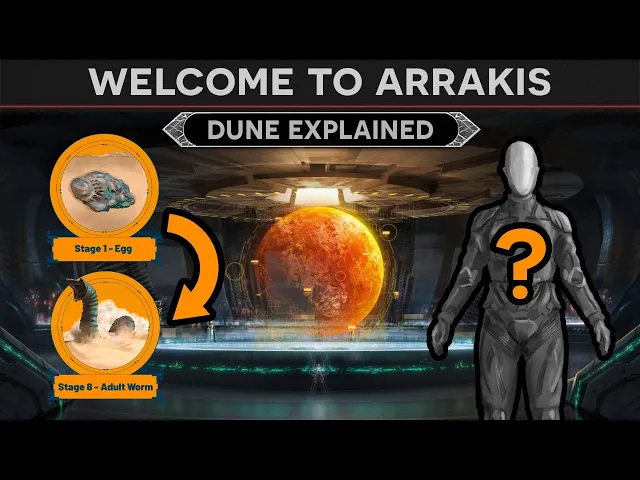
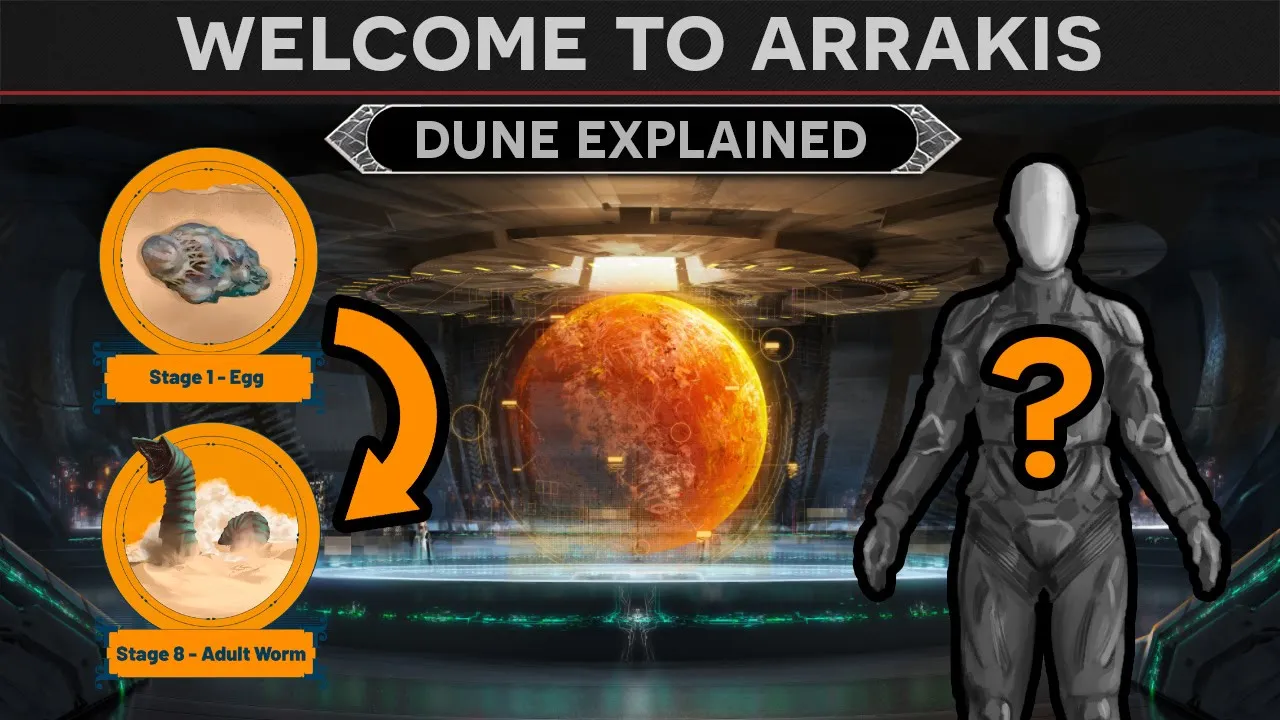
Research suggests that they begin life as small larvae birthed from eggs in a deep desert nesting site. These Sandtrout have small, flexible bodies some 10 to 20 cm in length. Thousands are born at a time and quickly scavenge both water and nutrients from around the nest.
They have even been reported to act together, efficiently isolating and herding liters of water back through the sand for kilometers at a time. Over several months the accumulated excretions of the larvae in the nest site begins to change the chemistry of the area, forming a pre-spice mix. Eventually CO2 build up reaches a critical pressure, erupting in a powerful explosion known as a spice-blow.
Here the biochemical contents of the nest are brought to the surface and exposed to both sun and air. The mixture then quickly undergoes a process turning it into spice melange. Its use for human consumption shall be explored shortly.
For now, the presence of the chemical reaction triggers the surviving larvae to join together. Soon they will begin to metamorphose into segments of what will become a juvenile sand worm. In this stage in its life, the superorganism will be able to range far across the sands of Dune, deriving all of its nutritional needs from inorganic compounds and sand plankton.
For hundreds of years, they will travel in search of an ecological niche to fill. In some cases this might mean maintaining their current size of several meters while other times unfavorable conditions may trigger a reversion of the juvenile back into its larval swarm form. Out in the deep desert however, worms of Arrakis have been known to grow seemingly without bound.
Some of the largest specimens are believed to be over a thousand years old, measuring over 400 meters in length and close to 100 meters at their widest. Mature adults will finally have entered their sexual stage. Here the female will typically create a nest by thumping out the sand which in turn attracts a male.
The newcomer then proceeds to consume the female, their internal sex organs merging in the process and producing a fertilized egg sack which will be excreted in the nest site, unleashing the next generation of worms. This cycle seems perfectly suited for Arrakis and has been nearly impossible to replicate on other planets where worms have been imported. The end result is that it is here on Dune that the worms exclusively live.
But while they may be a product of their unique environment they also play a key part in its development. After all, their accumulated biomass represents one of the greatest reserves of water on the planet, their metabolism serves as the primary source of oxygen production, and their maturation cycle is the only known way to generate the prized resource that is the spice melange. But just what is it?
Spice melange is a narcotic of natural origins whose most prominent effects when consumed include the following: Improved overall health Extended life expectancy by as much as three times Expanded sensory perception and awakened mental abilities including prescience for some users Yet these benefits do not come without a cost. Users will easily find themselves addicted to the narcotic. Habitual use will cause one’s eyes to turn blue while heavy users will see even more severe physical abnormalities.
In extreme cases, humans can even cease to appear humanoid as occurs with the highest order of Guild Navigators who literally spend their waking hours swimming in tanks of Spice melange. Its effects were first, and best understood, by the earliest human inhabitants of Dune. These were the Zensunni nomads, a far travelling people, long in search of a home.
Over thousands of years they too would be molded by the harsh environment of Arrakis, ultimately emerging as the distinct group known today as the Fremen. They are a hardy folk whose close knit tribal groups scratch a living out of the various Sietches tucked into the rocky outcroppings of the planet. They live and die by the conservation of water, adopting extreme measures to preserve every precious drop.
For instance one’s very breath and perspiration is recycled using advanced stillsuits while the bodies of the deceased are rendered down into fluid for later use. As the Fremen nightly chant goes: “Now do we consume that which will one day be returned… for the flesh of a man is his own, but his water belongs to the tribe. ” Ever a resourceful people, they have learned to live off the harsh lands just like the worms of Dune whom they revere as the sacred yet feared Shai-Hulud.
Harvesting Spice plays a large part in their society, not just for its narcotic properties but as a resource for the production of textiles and other goods. At some point however, word of this exotic material escaped beyond the secretive Fremen communities. Soon the various factions of the empire would descend like vultures upon Arrakis.
Prospecting missions were sent out to scour the desert for existing deposits while keeping a vigilant eye out for new Spice-blows. Despite the hazards of the job, the rewards were well worth the risk. Now small extraction and processing operations quickly scaled up to the huge industrial levels necessary to feed the needs of an increasingly addicted Empire.
Currently it is House Harkonnen which has been granted fiefdom over Arrakis by the Imperial Throne. Their duty is to ensure that the Spice flows. For this privilege they pay a tribute to the Emperor and keep the rest for themselves.
Such an arrangement has been hugely enriching to House Harkonnen which has a reputation for maximizing profits of their holdings. This is done by slashing expenses and raising income no matter the ethical implications. All who protest are met with a brutal policy of fear and terror.
Under this imperial regime, the Fremen have suffered greatly. Yet among the litany of hated influences from the offworlders there is one gift which they truly hold dear: The seed of hope planted by an imperial planetologist that one day their harsh planet can be transformed into a verdant utopia. It is towards this dream that they now strive with united purpose and religious zeal.
In the year 10,191 AG, Imperial politics led to the revoking of House Harkonnen’s fiefdom over Arrakis. In their place would be sent House Atreides. While the color of the hand which cracked the whip usually meant little to the Fremen, rumors that the approaching Lord brought with him an heir born of a Bene Gesserit mother soon bred whispers in every Sietch.
Could this be the prophesied Mahdi who would lead them to freedom? Whether or not such myths planted long ago truly held any relevance in this age, it is sure that the winds of change were blowing across Dune. But to what end, only time will tell.
I have to give a huge thanks to our team of artists and animators for bringing the world of Dune to life. They poured a tremendous amount of passion into this project and we couldn’t be happier with the results. If you’d like to support them and the channel please consider contributing to our Patreon or buying some of their awesome designs available on our store.
In the meantime be sure to like and subscribe for more content and check out these other related videos. See you in the next one.