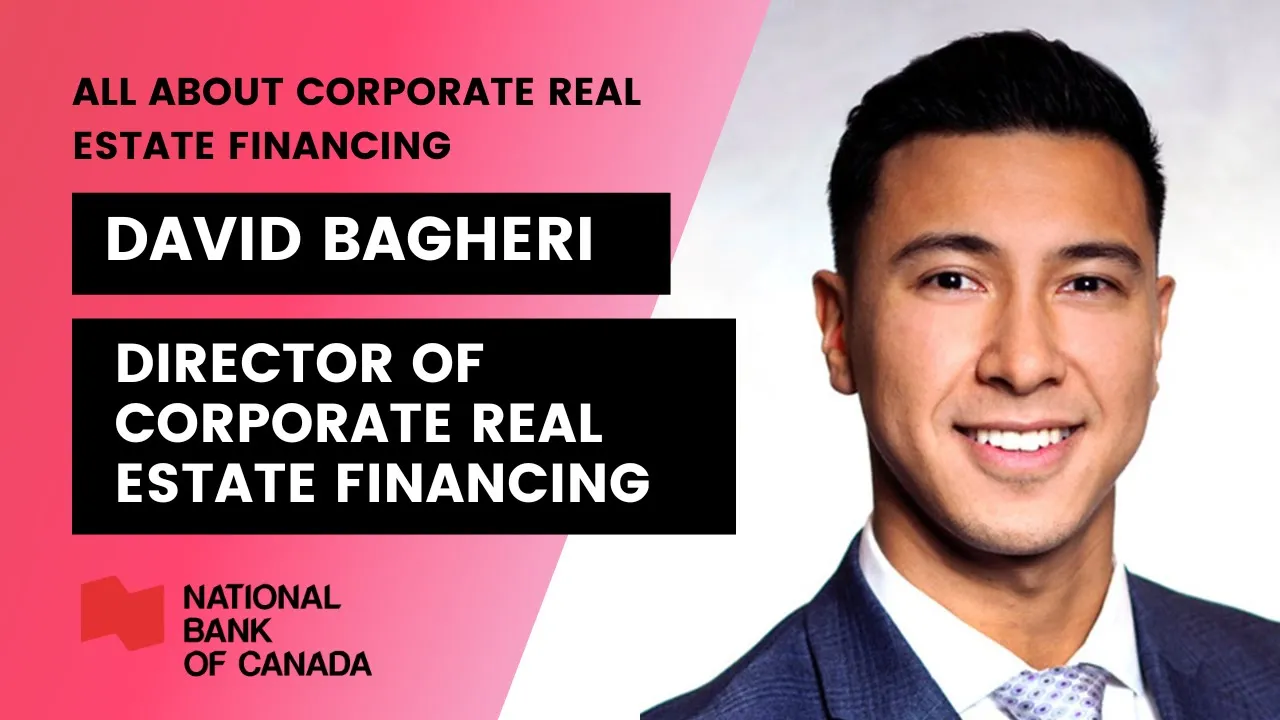
welcome everyone to another episode of our podcast today I'm joined here with David bagari who will be talking about his experience in real estate so really excited to be talking with you today David can you start off with talking about your past educational work experience and just telling the listeners a little about yourself yeah of course hi everyone my name is David Beary I am currently a CFA Charter holder working at National Bank as a director of real estate financing and the corporate real estate team in this role I help large scale developers with all
their financing needs whether it be construction projects portfolio rebalancing and even advising them on market trends in this position I've gained a lot of experience from underwriting all the way to relationship management so I started off my career at TD Bank working my way up from a teller all the way to a manager customer service and this is where my interest and finance really tooken hold of me and I've enrolled at Ryon University I think it got changed to Toronto Metropol at that point so yeah upon graduation I knew that I wanted to stay in
finance but more specifically in capital markets it's the Glamorous Life of Finance so yeah so part graduation I knew I want to stay there so coming from a non-targeted school was a lot more difficult than I thought I didn't realize this at this time regardless if I still had the good grades the barriers to entry was a lot harder than I imagined so fortunate enough I did get a job at RBC Capital markets but this was more of a back office function I'm not taking anything away from the back office roles however during that time
uh again trying to break into the industry I thought maybe taking the back office route try to get into the front office front office basically being client facing back office doing more the admin roles so yeah it was again very difficult so at this time I realized what do I need to do do I need to go back to school or do I need to go do my CFA so I chose a CFA route it's a lot easier not easier just a lot quicker for me so yeah upon doing that I uh enrolled in the
CFA so luckily after doing two CFA tests I passed level one level two uh pretty quickly I think within a year the fastest you could do it and then I was fortunate enough to get into First National First National Financial is the largest non-bank lender commercial mortgages they are a brokerage where you would basically be positioned to start as an analyst and underwrite New Deals when I say underwrite New Deals my manager or originary at this time would find a deal you'll be like okay here is the rent Ru here is the operating statements valuate
this property and tell me how much we can lend on it so that was my job basically doing that and just through repetition and repetition I did that for two years and I really en enjoyed the Kool-Aid there I drank Kool-Aid juice it was just good corporate culture everybody there was young we're all around the same age and just good mindset good work Harding culture so I did that for two and a half years and I was like okay if I want to take the next step in my career I need to basically leave because
while at First National you are pitch and hold to certain assets so what I mean by that is you will do turn financing on certain aspects such as industrial retail multi-res commercial properties so I was fortunate again I I started searching out and seeking out and I got a job at National Bank my current employer but this is where I was just an associate director and a lot of my skills transitioned over did the exact same thing but now I was just going to our internal credit team because when the bank lends money the bank
lends money on their balance sheet First National was a broker they never lent in their own uh balance sheet so I did this for another two years and I was like okay it's time I've been in this position for five years now I need to do something different so I saw a position open up at Investment Banking corporate banking at IMO so I applied and I did get the job they said that they really liked me because one I had all the relevant experience in times of real estate and it's the exact same corporate culture
especially in corporate banking you would do credit applications to the credit team and get it approved and such and so so so let me Begin by saying it was everything you thought it would be in my mind it's it was glamorous you worked the long hours fastpac work hard Party hard yeah yeah but six months typical typical stuff yeah so six months passed and that's when interest rates starting skyrocketing so we did an unprecedented number of rate hikes it dried up the entire Market especially for corporate banking a lot of our clients didn't transact anymore
uh there was no more m&a deal so at the beginning like I said we just constantly head down 8:00 a.m. to whatever like 12:00 p.m. whatever yeah it was difficult but then it just dried up and then after two years of just doing what an analyst would do just doing annual reviews any reviews are just loans already in place we would just basically update the numbers based on the financial statements and Etc just make sure it's still good it just still operating and after two years and a half I just basically reflected with myself and
was like okay you get paid well handsomely or you push yourself and try to do something a little different be a little bit more entrepreneurial and that side of me was always tingling it was just like you need to start being able to business develop relationship management that's when I picked up the phone and called my previous employer at National Bank and just and just told them Hey listen I want to get a job back I want to become an account manager at this rule or director and they welcome me with open arms so I
just want to say that it's very imperative to never burn the bridges with where you were previously were because you never know I didn't go for an interview I just basically called them and they're like here's a six trigger job it's yours we want you to come back so that's an industrial where I am now I love that and I think it also shows how there's not one right career path and correct you might not be at the same company forever it's really natural to grow and change and have new interests yeah so that's really
great to hear that it was also reflected in your own career Journey as well oh I appreciate that like yeah I was going around everywhere trying to get to where I want to be but I'm hoping this is finally it does look kind of skeptical on your resume when you're jumping every three years because they want to know like oh why is this guy can't commit but once you find where you want to be I say you're allow to jump because if the current employer doesn't realize that your strengths and weaknesses and where you want
to be uh they should support you and taking you to that next step so yeah I'm happy I did what I did yeah and and off the top of question but for our listeners here could you explain what corporate real estate financing is or are there any similarities to like Investment Banking or Capital markets or those very prestigious areas a lot of fresh grads want to enter no no that's fair that's fair great question so corporate financing is it's a level in between commercial and corporate like commercial Capital markets so I'll give you an example
in bimo I would Finance kipa deals like real estate transactions maybe for a portfolio of properties where the tend typical lending would be 250 million to multiple billions so I did like multiple billion dos rul and corporate financing it's anything under let's just say a100 million hold single transaction hold so the deal itself could be a billion but just the bank's hold is 100 million limited and then anything above $70 million in financing we don't look at anything below that so there's like a little threshold but we deal with high-end private real estate companies as
well too okay wow sounds really cool there's glamour to it no no no there is glamour I can't say there's not glamour to it there is a lot of Glamour to it reason why I do like this job is because there's a lot of wine and dining for a lot of clients so go to raptor games like hockey games the Blue Jays correct oh I I don't even go to the Blue Jays I tell the analyst like just please take my spot just show a good Stu just just don't make a fool of yourself in
the company and you're good to go yeah that's amazing and what inspired you personally to kind of enter this field so I did alternative investments in the CFA I think it was level two and I didn't realize that real estate was an entire section in it I started realizing about cap rates and you can use operating statements and you can evaluate these things I was like what so doing that I want took a huge interest into it and then I found it just very easy it came to me very easily uh in terms of Market
support so that was when I got the academic uh intrigued into it and then what gripped me was when I worked at First National like I said I was fortunate to work with this gentleman called Brian Kimmel he is the Forefront leader of real estate in retirement homes any type of retirement home you could think of he played a a pivotal role in financing it either for be SE Sienna Chartwell he did all those for those companies so he did a huge financing in Oakville it was like aund million doll deal and when I went
there for a site inspection I was totally taken back by surprise like a resort I'm like wow I I helped do this I help this client buy this property or help develop this property and that's why that just hooked me I'm like okay it's a tangible asset I can definitely stay with it and say I helped be part of this transaction and I I hope that answers your question yes it does so there seems to be a very tangible impact yes we're doing almost exactly at the end of the day you can say that you
helped do this and you could just point to it and then another thing is that when you do do projects let's say you do a large multiphase condo development that's like $500 million there's maybe TW 10,000 units in there that creates a lot of economy for the city they have to hire all these workers through the entire years you have to pay them the bank basically pays them through these draws and everything like that I I'll get to that to later I think that's one of the questions so yeah yeah bringing in like what I've
learned in my economics class yeah yeah so moving on to more technical side I was wondering what are the different types of loans available to corporations oh this is a very good question yeah I think there's a lot more I'll touch base with it on the corporate side too the corporate banking Investment Banking side as well I'll throw that out there but I'll start with a simple one so there's one's called term financing this is your typical mortgage basically 25 year fiveyear term your payments are would you comprise the principal and interest two would just
basically be an interest only loan we would see these in transactions for a developer or a borrower trying to buy a land piece and just hold it for three years so bank will give the borrower $100 million and in three years you'll get back us $100 million plus the interest so that's the two most common there's three this is the third one is construction loans so the construction loans are cost to draw so I'll give you an example a borrower comes up to us and gives us a profarma and says the budget to build this
project is $200 million we go to our credit team and okay you know what this project is 200 million let's approve $150 million we would basically approve it and then there's a whole series of steps on how the client will attain the funds we just we just don't give them 150 million up front so there's a whole series to it so that we would engage cost Consultants Architects basically saying the borrower will be like okay I put in $100 million to build this thing here are all my receipts here are our uh the leans our
property is free and clear no one pressed charges on us we've been up uh front with all our bill payments and only after we get those draws and they're certified by the cost consultant saying that they reviewed everything we would uh issue them whatever cost incl incurred we will finance that and they'll get basically paid back once the Project's closed and that'll pay back the loan the fourth one the most common one you'll see in corporate banking is revolvers so revolvers are basically it's just a fancy term for line of credit okay yeah yeah so
you'll see them in the Capital Market side they're usually unsecured when I say unsecured there's no collateral assets that's pigeon hold they're basically financed against the company utilizing it's upheld based on financial covenants so you have to carry a debt to asset ratio under a certain percentage okay and Etc in commercial and corporate real estate financing we usually take an asset like say portfolio 10 assets they're worth $100 million and we would Finance 70% of it so we'll give you a $70 million line of credit you can use and pay back and then what we
take it's just the collateral on those properties you can't lend on those additional properties so those are types of four ones you'll see in corporate in banking real estate is the revolvers and that's the same for all types of commercial real estate I think that's it there's more but there's also some called Equity subscription line an equity subscription line is let's just say for example a big tier uh borrower say Brookfield wants to do a uh massive fund this fund can acquire large properties uh they can build projects all in this type of fund this
fund would have investors these investors will commit their Capital let's just say 10 billion okay of those Capital the bank would basically Finance 90% of all that Capital upfront and once everything is settled or once they' called the capital they can pay back the loan yeah really cool well with these deals I imagine there's also some risk involved so how would you say approach risk management when it comes to making and closing okay this is a good question so rule of thumb is always a three CES of credit it's uh character collateral I believe or
capital and then uh the other one is capacity characters exactly as a sounds do you trust a client are they current on all their bill payments and Etc Capital do they have the actual collateral in case everything goes uh Belly Up can they pay back and then capacity do they have the net income or the eida to make sure the payments are sound so this was all before interest rates completely went up so now we've been scrutinized our credit team has been scrutinized whereas they've told us to take a look at the client's liquidity position
so we always now it's imperative to always look at liquidity can they support the the project or the the payments for an X number of months another example is their developing a project and they have unforeseen cost of $50 million can they Pony up $50 million of cash and we need to stress that into the credit applications that we do it seems like there's a lot of analysis and synthesis involved as well oh of course it's not simple as oh yeah here's a pro formula this is what the uh projected revenue is here you go
please approve no no there's a lot of analysis into this as well we calculate residual risk we calculate the risk rated return on the capitals as well these are all things that we do on the back end but I don't want to bore you on these things too okay good to know yeah and aside from your role like what are some other parties involved and how do you think your roles are intertwined with each other okay in real estate there's a lot of moving Parts I heard this beautiful expression before in real estate it's like
a bag of marbles you don't know who you're ever going to shake hands with because everybody's connected at the end of the day so I'll give you an example when we do a deal closing there are for a condo deal or a project deal there's usually six thirdparty Consultants one is the appraisers we usually engage them to hey comment on the fair value market of this and we'll basically take their fair value and just use as a benchmark for Lending two is Insurance Consultants we would engage our Insurance Consultant to make sure their insurance certificate
is adequate so let's just say for example the Insurance consern Consultant wants to make sure they have the adequate fire Insurance the water flood insurance and Etc that's two three is the cost consultant they're the most important consultant in terms of projects because they basically go through all the cost they go through all the receipts and whatever responsibilities you have guided them to do because at the end of the day they work for the bank but at the borrowers cost so we tell them Hey listen if we want you to go through all the purchase
and sale agreements for each of those condo units we want you to do that charge the client but just to make sure they're fair and there's no fraudulent activities so the cost plays a very Insurance uh important part and lastly I would say the solicitors so the bank doesn't use their own solicitors they use bigname solicitors such as Denon Blakes Tories and their job is to basically we would give them a high level term sheet this is the loan amount this is how much you're getting these reporting covenants and their job is to basically take
that term sheet and draft a full some credit agreement like 100 50 pages and protect the bank's interest in this case so what they need to do it's they need to make sure that we're on side with it as loyal as the borrower is on side with it as well so those are the four important ones that we deal with for new projects there's other ones such as like building conditions there's also environmental site inspectors too environmental site inspectors they go and check the site okay they check if it's contaminated and they tell us Hey
listen the dirt here is very dirty if you make any drink drinking water here people are going to get sick Etc I think that shows how there's a lot of jobs or roles out there that a lot of students aren't even aware of it's really great that you're bring light to like all these diverse rules but in terms of your role do you have any tips for students to get in especially maybe coming from a non-target school oh that's a great question one I'll start off with the first one try LinkedIn search up anything in
terms of real estate like search up the company that you want and just try to find the directory of the company and then just search that individual and Link would they respond or would they be this this leads me to my answer they're not as stuck up as the C Capital Market people are they're a lot more open to just meeting you for a coffee trust me I've been there I've done that I knocked on a lot of doors and in capital markets it was a lot more difficult to break in but in real estate
especially in the financing side we get it is if you work hard you'll be compensated very well and even better than what do you call the capital markets people there's a reason why I laugh I did say it was handcuffs right so yeah yeah and then the next thing is attend industry events you can search up on Google there's something called trell Toronto real estate L uh leaders group I believe and they always hold events sometimes they're free sometimes they're not and I definitely recommend going to them because there's always networking events where lenders developers
borrowers investors everything you could think of they're all there it's good hands to shake hands and just get some names so I think that's the best way you can probably get it and again there's no even if you do come from a non-targeted school in real estate they do care if you have the technical skills but they also want to know that you're interested in real estate we like to see that people are actually interested in real estate to be in real estate too yeah yeah what I like to think of it is like the
passion and the soft skills isn't something that can be easily developed but the technical skills you can learn on the job of course that's exactly it for anybody that's listening Investment Banking anybody could do it corporate bank anybody could do it okay anybody could do it it just depends if you are motivated to stay there again it's job so there you go yeah that makes sense and I think networking events are also like really fun you get to like get food it's of course no I agree I love going to networking events you get to
talk to a lot of people shake a lot of hands and sometimes can create a lot of friendships too like I met a few people that I've can say that grown into my good friends now through these events and then you never know sometimes they just come knocking like hey I got a job you interested there's been several occasions where I turned down other positions because I'm like I can't I just got to this job and that I do highly recommend attending industry events they're free they're search up real estate networking events and there's hundreds
of them I think it's event bright there's always so many on that that site yeah that's awesome what are three networking tips you have for the students listening oh dress sharply that's one two know a little bit about real estate before you go in there so if they do ask you hey what do you think is a cool asset we should start investing in don't go blindfold and like go retail or say office because office is a taboo road right now and okay let's see what's the third one oh uh be open be open to
talking to people don't be timid I know it's difficult to open up and just try to engage others but I could definitely recommend if you do it you'll see benefits of it just try being open and just talking to people this the business development aspect is one thing I know I lacked especially in the past and that's why I've pushed myself out of my safety boundaries or safe Comfort zones to really explore that Avenue of skill sets those that type of skill I never had before so be open to talking to people you'll never know
like I said the the connection that you'll make just by talking to people yeah yeah I really like what you said there because I think the worst thing you can do is not at all because it's like a missed opportunity exactly you have to constantly try always push yourself and yeah networking is the best space to do it and don't be afraid to ask ask questions as well you they will see how eager you are to learn and they will they will understand that no one will ever penalize you for asking questions there's no as
such as a stupid question or do those it depends on where you are in capital markets there is stupid questions I can tell you that right now there's no mistakes in capital markets yeah zero mistakes get yeah okay so it also depends on the industry I guess correct it all depends on industry but you're always allowed to ask questions just make sure you do the backup research before asking the question too yeah yeah for sure and I'm sorry we keep on jumping back between actual H job task but in your opinion what are some of
the key factors that you think make up a successful real estate financing deal o okay every deal is different or Case by case uh how for the golden rule of thumb is location location location I know if you heard that before but it's extremely imperative in real estate uh give you an example if you're doing a new condo deal in Toronto um would you rather do the one in Toronto versus one in say uh Ottawa which one do you think will sell it faster so I say this because the Toronto one will typically sell out
faster when I say typically the market due to the interest rates increasing so much there is a little bit more complex but Toronto typically sells out faster than the other regions except for Vancouver so when I say it sells back faster the bank is able to take back their Capital that they deployed for that loan so that's why the risk is is getting drisk quicker the next uh key factor that we take a look at in a successful deal is the type of tenant quality so when you do a long-term type of financing for a
large industrial asset it it also depends on your tenant so for example you wouldn't want a tenant such as or retail asset such as the bay they're not performing as well you don't know if they're going to be able to pay their rents on time or our credit team will always like to have a AAA investment grade tenant such as soes L Blas or even the Google Amazon we just want brand names because we know they have the ability to pay the term so if you have those in the deal embedded in a deal it's
lot more likely to be Su uh successfully funded and without any hiccups from our credit team yeah for sure I hope that helps yeah yeah it does and I think it's really important to also try to get back like the lens you made so those are some really good criteria that I'm sure that I have learned as well what would you say are the biggest challenges you face in your role okay there are a few the the main one that I always typically see is timing execution so timing in real estate is it's pretty critical
as delays or mis opportunities really do affect the overall project viability I'll give you an example I'm financing a asset in Brampton right now north of $200 million closing date is set for the end of April and I have to one coordinate getting to credit getting it approved then I have to basically Engage The Lawyers have them draft up the agreement have us review it have the Bor review it and then there's a whole set of conditions that have to be met in order to fund the deal all this has to be done within a
month so toming execution is very important so how I say to rectify it is be proactive tell your clients that hey we're going to need about six weeks to eight weeks in order to successfully close a deal if you want to engage with me so that's one aspect the second aspect was Capital availability in projects National Bank likes to see 15 to 20% Equity what I mean by Equity is Cash equity in the deal why we say this is because they have skin in the game they're going to see the project go through because they
don't want to basically here just toss you the keys be like okay they just lost out on like $50 million out of their own pocket that would be bad yeah so we've been crafty with how we've been accepting other sources of equity such as mezzanine Deb and that's another space that I'm assuming these students don't know it's called private debt that could be quasi Equity so that plus their cash Equity we're allowable to continue with the project so those are the two that we see problems that I usually see in real estate okay okay yeah
but I feel like there's like challenges with every job so it's all about like how you approach and adapt to them correct sometimes they're difficult clients I have clients are more difficult they call you every day like what's the status of this deal are you sure we're going to close if we're not going to close I'm G to sue you there's stuff like that every deal is Case by case there's clients but like I also said there's also good aspects of the job as well too so when there are those difficult clients is it just
a matter of kind of working with them to meet their needs or open communication is always key you always tell them what you can do and never try to overd deliver best I ever got was tell them add yourself a couple business days and tell them I'll deliver it within a week and try to overd deliver on that date so at least you sell it for next week but you deliver in quicker that's how your approach is don't ever overpromise and you never deliver because you lose credibility with your clients yeah yeah and Trust I
imagine and Trust exactly and trust and also if you do try to push a deal to the credit team they will also view you as a subpar underwriter and will'll scrutinize your deals a lot more so it's always imperative to put in all the details and just make sure you answer every question up front and not to try to hide stuff to the credit team because they'll figure it out they're smart people yeah that makes sense yeah so on the flip side what would you say is the most rewarding part of your job uh building
key Marquee developments so for everybody that's in Toronto my bank help build the ice condos that's this Landmark condo three types of the three really tall condos in Toronto we help build that just having that visibility provides me with recognition like I help do that I help be a part of that oh yes I remember speaking and then there's also another property that I helped develop is the well it's the new one it's a flagship yeah yeah the flag yeah so we help develop the well as well so you're part of History you're like oh
wow I helped build this thing and then the other thing aspect to it is you're adding jobs to the economy with the cost to complete like a model the construction loans remember they have to incur the cost first so they incur the cost they're basically paying these Tradesmen to do the deal and then we would give them the loan to pay the Tradesmen that's how it works um so yeah adding to the economy actually helps me feel a little bit better about myself at the end of the day and then there are also good perks
about it there's closing dinners closing dinners everyone is where you basically have a Unwritten check for the night and you get to take out the clients or they take you out you go to the most expensive placees you want you can eat whatever you want drink as much as you want just really get to enjoy it with the clients and then there's this business development aspect where you want to take a gentleman out to a game you could do that as well everything's written off that's another bonus piece as well so any student that enjoys
the hard work the technical aspect and in combination with the business development aspect this is a perfect rule for that individual because in capital markets would say they are more so you're just going to be hired as an analyst and an associate your job is to run the numbers make sure it's perfect and do your time we have our people that are the account managers and they seldomly leave they like to stay in those jobs so okay that's good so it's really like sustainable in the long term no it's like it's a Turner they're always
turning over every year there's new they always years like exit opportunities yeah exactly yeah a awesome so just a wrap up question David where do you see the future of real estate heading in the future I think that with the projected population growth of Canada expected to surpass 50 million in the next few years we are going to see a lot more development in tertiary or secondary cities I say this like maybe Barry is already a large city but neighboring cities like Aurelia and Etc they're going to start seeing a large influx of develop ments
because we need to house everybody there and we don't have enough space Toronto's finite space I didn't mention this but that's why I also chose real estate because a lot of the old money old billionaires they started their U careers in real estate because it's a finite asset you once you own the land that's your land forever so that's one of the things too so Tron there's finite land and they're going to start building outwards and more outwards so I do see that there's going to be a huge push for multi-residential and single family homes
and in terms of industrial space I feel like industrial space there's going to be a lot more development in industrial because the world is moving to e-commerce and in e-commerce there's always going to be a need for warehousing assets a warehousing product so that's where inv Place yeah yeah definitely see all the all my favorite companies heading to e-commerce and of course everything I I never buy anything at the grocery store I go Amazon or get stff deliver Amazon's like one nexi delivery so prior to co we had same day delivery they stopped it and
I'm so disappointed with I know well thank you so much David for joining us I learned a lot about like the world of real estate financing and I hope everyone else listening did as well and it was awesome learning about your insights oh thank you so much I appreciate it
![DAX Filter Context Basics [Full Course]](https://img.youtube.com/vi/Rpa8mDH7mes/maxresdefault.jpg)





![Visual Calculations in Power BI - DAX Made Easy! [Full Course]](https://img.youtube.com/vi/JITM2iW2uLQ/maxresdefault.jpg)

![Power Automate Beginner to Pro Tutorial [Full Course]](https://img.youtube.com/vi/1p5kI7SYz4Q/maxresdefault.jpg)


![What Commercial Real Estate Brokerage is REALLY Like [Hours, Pay, Exit Opportunities]](https://img.youtube.com/vi/hBlOdqZUvfw/maxresdefault.jpg)