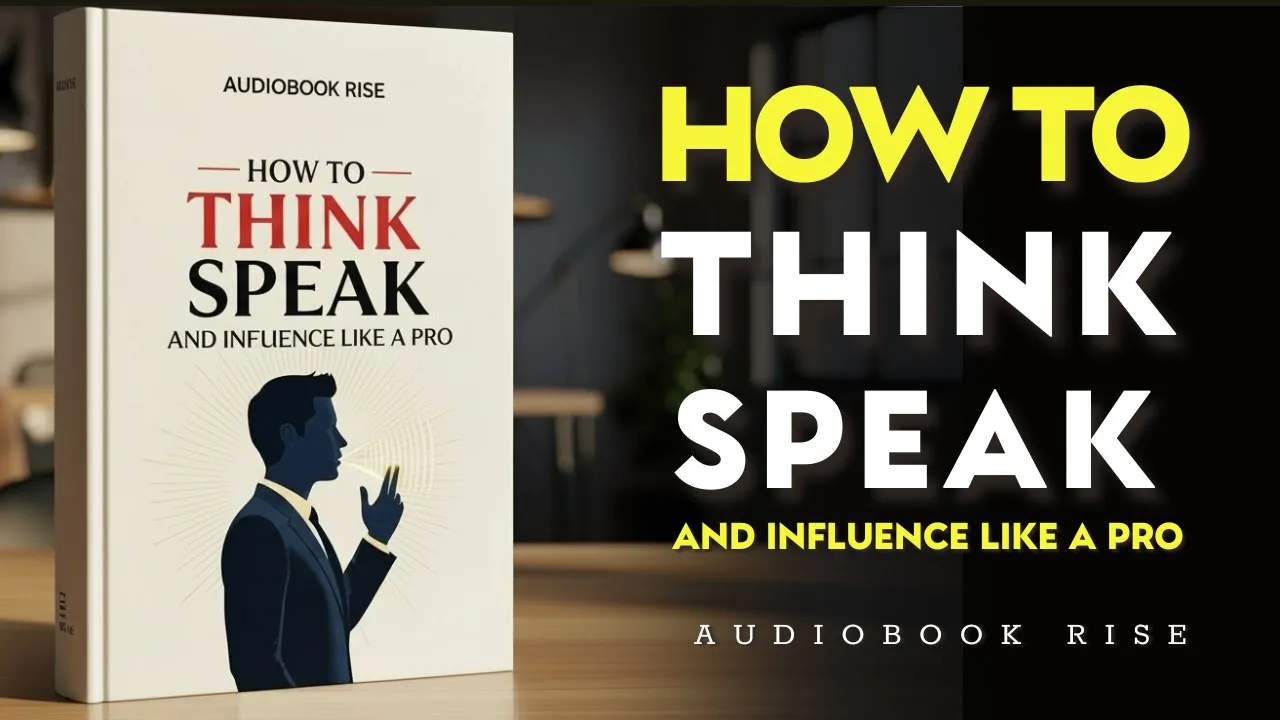
There's a truth most people don't want to face. If others don't feel clarity, strength, and certainty in your voice, they won't trust you. They won't follow you, and they won't take action because of you. You can have great ideas, deep experience, and real [music] value. But if the way you think and the way you speak doesn't reflect that, the world will never see your full potential. Most people still believe communication is About sounding smooth or talking confidently. But real influence doesn't come from being smooth. It comes from clear thinking. It comes from calm authority. [music]
It comes from choosing strong, precise words. It comes from controlling your tone, your breathing, your pacing, your timing, and knowing exactly when to speak and when to hold silence. Many fall into the same exhausting loop, speaking before their thoughts are ready, explaining more Because they weren't clear the first time, adding even more words because they fear they'll be misunderstood. They talk long but [music] don't talk sharp. They talk much but don't move anyone. They talk hoping to be heard instead of speaking with [music] the intention to lead. Meanwhile, leaders operate differently. They think before they
speak. They speak [music] less but speak better. They choose their words like tools, sharp, intentional, [music] Necessary. They hold a calm, steady voice that commands attention. They let silence [music] work for them. And people act not because they're pressured, but because they feel respect. The [music] difference between these two groups has nothing to do with talent, intelligence, or natural ability. The difference lies in four core pillars. Clarity in thinking, authority in [music] tone, precision in language, and timing in delivery. When You understand these four pillars, every conversation becomes an opportunity to lead. When you lack
even one of them, your words lose their weight immediately. What you're about to hear is not a motivational talk. It's not meant to just [music] sound good. This is real training, a sharpening of the mind, a refinement of your voice, a rebuilding of how you show up in the world. You will learn how to organize your thoughts, how [music] to control Your voice, how to choose powerful words, how to manage your emotional tone, how to structure your message, how to speak in a way that makes people act, and how to read the energy of the
room so you always speak at the moment where your words matter most. Throughout this journey, you will walk through 10 essential abilities for thinking, speaking, and influencing like a true professional. Each chapter gives you a challenge to Face, a core principle to remember, a visual image to hold, a practical shift to apply, self-reflection prompts to realign, and a punchline that lands like steel. You don't need to speak loudly to be heard. You don't need to sound perfect to earn respect. You don't need to perform to gain influence. [music] You just need to speak clearly, think
sharply, and show up with authority. Step into this journey with calm focus and a willingness to elevate the way you Think, the way you speak, and the way you move others. You don't need more. You need [music] clarity and strength. Let's begin. Chapter [music] 1. Think clearly. Before you speak, most people talk before they think. [music] And that single habit silently destroys their influence. When your thoughts are scattered, your words become scattered. When your mind is foggy, your message becomes foggy. And when your ideas are Half-formed, your impact becomes half-felt. This chapter begins [music] with
a truth most people avoid. You cannot speak clearly until you learn to think clearly. And clarity is the foundation of every professional communicator, leader, or influential voice you admire. [music] Many people believe communication starts the moment the mouth opens. But in reality, communication starts in the Silence before the first word. It starts in the space where you gather your thoughts, [music] shape your intention, and choose what truly matters. It starts with [music] clarity. Inner clarity. long before the sound reaches the air. You've seen people who speak endlessly but say very little. They circle around their
point, adding more words to fill [music] the gaps left by unclear thinking. They talk faster because they Feel unsure. They explain more because their message [music] is weak. And somewhere in that spiral, they lose the room. Here's the painful truth. A long message is not a strong message. A clear message is most people don't fail in communication because they lack intelligence. They fail because they're trying to organize their thoughts at the exact same time they're expressing them. The human mind is not designed to think, filter, refine, and deliver Simultaneously with precision. That's why people ramble.
That's [music] why they repeat themselves. That's why they sound less confident than they actually are. Clarity is not a talent. Clarity is a discipline. If your mind feels like a cluttered desk [music] filled with unrelated notes, distracting thoughts, and emotional noise, your [music] words will reflect that chaos. But when your mental desk is clean, your priority is visible. Your idea is sharp and your Delivery becomes purposeful. Imagine being asked a question during a meeting. Most people panic internally and rush to answer fearing that a pause will make them look unprepared. But rushing leads to overtalking,
overexlaining and underd delivering. The person who pauses [music] even briefly gains power not loses it. Because the pause is where clarity lives. The pause is where leadership begins. Great communicators [music] don't speak Faster. They speak from a calmer, more organized mind. They take a breath, gather the essence of their [music] thought, and release the sentence that matters. And because the sentence is clean, the room listens. Think of your ideas like water. When water is stirred, it becomes cloudy. When you let it settle, it becomes clear. Your thoughts behave the same way. [music] But clarity requires
something many people fear. Slowing Down. [clears throat] Slowing down doesn't mean thinking less. [music] It means thinking better. It means giving your mind space to separate the signal from the noise. One of the most powerful skills you can develop is the ability [music] to filter your thoughts before they become words. Ask yourself what you're truly trying to say. Strip away the extra. Remove the emotional debris. Locate the core of the message. And then Only then speak from that center. There is a remarkable shift that happens [music] when you speak from clarity instead of pressure. Your
voice steadies. Your delivery becomes intentional. Your ideas land with weight. People lean in rather [music] than tune out because people in every workplace, every conversation, every room respond to clarity with respect. Here is a truth that professionals eventually learn. If you cannot express Your [music] point in one clean sentence, your mind hasn't finished thinking yet. The single sentence is the test. When you can name the idea with simplicity and precision, you've reached true understanding of your own thought. This single sentence [music] mastery is what separates leaders from talkers. Clear thinkers can answer tough questions with
confidence [music] because they understand the essence of their message before diving into Details. They don't hide behind complexity. They don't fill silence with unnecessary [music] padding. They strike directly at the heart of the idea. And that directness is magnetic. But clarity is not only intellectual, it's emotional. [music] Emotional noise is one of the biggest barriers to clear thought. Fear of being judged, fear of being wrong, fear of sounding unprepared. These fears push people into overtalking and Underthinking. They rush through sentences desperately hoping speed will hide insecurity. But insecurity grows louder when clarity grows weaker. The
safest way to speak is to think clearly [music] first. When you know the core of what you're saying, you don't fear silence. You don't fear judgment. You don't fear interruption. You speak from grounded intention, [music] not from panic. Another powerful shift happens when you separate what you feel From what you mean. Feelings create noise. Meaning creates clarity. You can feel frustrated, confused, or pressured, but still speak with precision. The moment you recognize the difference, you reclaim control over your words. Ask yourself these grounding questions before speaking. What do I truly want to communicate? What is
the simplest, clearest version of this idea? Am I speaking from clarity or from emotion? These questions act like a compass that Brings you back to direction [music] and purpose. Clear thinking feels like leadership because it is leadership. People instinctively trust someone who knows what they're saying and why they're saying it. They feel safe. They feel guided. They feel like the conversation is going somewhere [music] meaningful. And ultimately, this is what influence is. The ability to guide someone's [music] thinking through your own clarity. Clarity sharpens your [music] message. Clarity strengthens your presence. Clarity deepens your credibility.
Clarity becomes your signature. In the professional world, people make judgments quickly. They decide whether you are confident, capable, prepared, or trustworthy based on how clearly you express your ideas. Clarity creates professionalism. Confusion destroys it. And the best [music] part is this. Clarity is always trainable. You can Practice [music] it every time you speak. You can refine it every time you think. You can strengthen it every time you choose intention over impulse. The more disciplined you become at thinking [music] before speaking, the more influential you become without even trying. Your words will land with precision. Your
ideas will make sense. Your presence will feel stronger. Your confidence will become visible. Because clarity is not just a communication Skill. Clarity is a personal identity. Clarity is a way of moving through the world with purpose. Clarity is the beginning of all influence. Speak clearly, but first think clearly. Chapter 2. Speak [music] with calm authority. There is a certain type of voice that makes people stop and listen. It's not the loudest voice in the room. It's not the most energetic. It's not the most charismatic. It's the calm voice, the Steady voice. The voice of someone
who leads without needing to push. Calm authority is one of the most powerful communication skills in the modern world. Not because it dominates, but because it stabilizes. Not because it intimidates, but because it reassures. Not because it demands attention, but because it naturally earns it. Most people believe authority comes from speaking louder, speaking faster, [music] or speaking with more intensity. But intensity without clarity creates pressure. not confidence. And loudness without intention creates noise, not leadership. Here's the truth professionals eventually learn. Authority is not volume. Authority is presence. And presence [music] begins with calm. You've heard
people who talk so fast they trip over their own sentences. Their pitch rises, their pace Accelerates, and their confidence visibly [music] drops. You can feel their anxiety even if their words are correct. The message might be fine, but the delivery makes it fragile. A shaky voice makes even a [music] strong idea sound weak. A rushed voice makes even a clear idea sound confused. A tense voice makes even a good idea sound defensive. But a calm voice, a centered voice transforms everything. A calm voice makes the same idea sound grounded. A Calm voice makes the same
message sound credible. A calm [music] voice makes the same speaker sound trustworthy because calmness signals [music] control. Calmness signals confidence. Calmness signals someone who isn't reacting, someone who is choosing. When your voice is calm, you speak from a place of steadiness rather than urgency. Your breathing deepens. Your pacing slows just enough for people to follow. Your tone lowers into a range that feels Confident rather than strained. And your presence expands without needing to force anything. People don't follow the loudest voice. People follow the most stable one. This is especially true in moments of tension. Presentations,
[music] interviews, conflicts, or high-stake conversations. When emotions rise, most people speed up, tighten their throat, and overexlain. They talk as if they're trying to outrun discomfort, but Speeding through discomfort only magnifies [music] it. Calmness does the opposite. Calmness absorbs tension. Calmness slows the moment down. Calmness reassures the room that the situation is manageable because you are manageable and that is influence. [music] Calm authority begins with your breath. Your breath is the foundation of your voice, your tone, your pacing, and your emotional stability. When your breath is shallow, your voice becomes thin and shaky. When your
breath is rushed, your words become rushed. When your breath is uncontrolled, your presence becomes uncontrolled. But when your breath is steady, everything else falls into alignment. Your tone drops into a calm, grounded [music] register. Your pace slows to a confident rhythm. Your thoughts settle long enough for clarity to form. And your presence expands in a way that feels intentional And strong. [music] A calm voice communicates one message before you say a single word. I am in control of myself. And when people sense that, they instinctively trust you more. Think about the leaders you admire in
business, [music] media, politics, coaching, or personal development. They rarely rush. They rarely raise their voice. They rarely allow their emotions to leak into their delivery. Instead, [music] they speak at a steady pace with a tone that carries weight without force. That tone is not accidental. That tone is trained. That tone is discipline. Calm authority isn't about suppressing emotion. It's about mastering the emotion so it doesn't hijack your message. It's about acknowledging your internal reaction. Fear, pressure, excitement without letting [music] it distort your delivery. Your voice is the Billboard for your nervous system. When you calm
your system, your voice reflects that calm. When your voice reflects that calm, other people feel calmer [music] around you and people trust the person who calms them. There is profound influence in being the stillest person in a chaotic room. A calm speaker gives listeners time to absorb meaning. A calm speaker lets words breathe. A calm speaker uses silence strategically, not as a void, But as a framing tool that strengthens [music] the message. A calm speaker doesn't fear pauses because pauses communicate confidence. The pause is not emptiness. The pause is emphasis. If you rush because you
fear silence, you lose authority. But if you intentionally pause before a key point, you gain gravity. Your words settle. Your presence deepens. [music] Your influence expands. Many people don't realize this, but calm authority also improves how Others feel about themselves while listening to you. When someone speaks calmly, the listener doesn't feel pressured to respond quickly. They don't feel overwhelmed or rushed. They feel respected. They feel safe. They feel that the conversation has room for them, too. And people always respect the communicator who creates emotional safety. One of the strongest signs of calm authority is the
ability to stay composed when challenged. Anyone can sound confident when everything is going well. But true authority shows when someone disagrees with you, questions you or interrupts you. A reactive speaker becomes defensive. A calm speaker becomes deliberate. [music] The calm speaker chooses their words rather than throwing them. They pause just long enough to regain control. They respond with clarity instead of emotion. And in doing so, they gain even more Influence because nothing is more powerful than a person who remains centered when others lose their balance. Calm authority is not passive. [music] It's not quiet. It's
not emotionless. It is intentional, focused, [music] controlled, and deeply confident. It says without [music] saying it, I don't need force to be heard. I don't need speed to sound smart. I don't need volume to matter. Your calmness becomes your credibility. Your steadiness Becomes your strength. Your presence becomes your influence. And the more you master calm authority, the more people will trust your voice, respect your [music] leadership, and follow your direction. Not because they have to, but because they want to. Speak calmly. Speak steadily. Speak from the center, not from the panic. This is how your
voice becomes powerful. This is how your presence becomes unforgettable. This is how you begin to influence like a true professional. Chapter 3. Use words that [music] carry weight. Words are not neutral. Words either strengthen your message or weaken it. Words either build your credibility or dissolve it. And words either move people or bore them. Most people speak with words that carry [music] no weight. They fill their sentences with softness. Maybe sort of kind of, I guess, basically. I think they water down their ideas without realizing it. Their message loses its force before it even reaches
the listener. And the worst part is they have no idea it's happening. Here's the truth. Every strong communicator eventually learns. Weak words create weak influence. Strong words create strong influence. If your words don't carry [music] weight, your presence can't carry authority. People Judge your confidence by the language you choose. Your vocabulary becomes the window through which they measure your credibility. When your words are soft, your presence feels soft. [music] When your words are precise, your presence feels powerful. People don't just listen to what you say. They listen to how decisively you say it. Think of
someone who constantly says, "I think this might be the right direction." Now, compare that to someone who says, "Here's the Direction we should take." Same idea, but completely different impact. A message wrapped in uncertainty rarely motivates anyone. A message grounded in clarity commands attention. You can [music] feel the difference instantly. Weak words make you sound unsure of yourself. Strong words signal that you know where you're standing. Strong communicators don't rely on volume to sound confident. Their power [music] comes from word choice. They use clean, Bold, decisive language. They eliminate clutter. They speak with intention. Weak
communicators hide behind filler words. Strong communicators replace them with clarity. Your words are the tools you use to shape thought. A dull tool makes messy work. A sharp tool makes powerful cuts. And your influence depends on how sharp your verbal tools are. Imagine a carpenter trying to build a table with a dull saw. The effort is enormous, but the result is sloppy. Now imagine the Same carpenter with a sharp blade. The same action becomes smoother, cleaner, more precise. [music] Your words function exactly the same way. Weak words force you to work harder to [music] get
your point across. Strong words deliver the message instantly. One of the biggest mistakes [music] people make is assuming that adding more words makes their idea clearer. It doesn't. It only adds noise. People don't remember long explanations. They Remember clean statements. Here's the truth. This is what matters. Let's decide. The next step is this. These phrases carry weight because they remove doubt. They show leadership. They show clarity. They show confidence. Most people weaken their message because they're afraid of sounding too direct. They're afraid of being judged. They're afraid of taking a position. [music] So, they bury
their message under layers of soft language. And the more they Soften, the more invisible they become. But here's the secret. Directness [music] is not rudeness. Directness is clarity. And clarity is a gift. [music] People don't want you to ramble. People don't want you to soften everything. People want to understand you. Strong words make that possible. When your message is clear, people know how to respond. When your message is vague, people feel confused. Confusion kills action. Clarity creates action. This is why strong communicators avoid filler words. Filler words are verbal crutches. They help you stand, but
they stop you from walking strongly. When you remove those crutches, your message stands taller. Your voice becomes cleaner. Your presence becomes more grounded. Powerful communication is not about complicated vocabulary. It's about intentional vocabulary. It's about choosing the words that deliver meaning With precision. Your message becomes sharper when you shorten [music] your sentences. Your message becomes stronger when you remove the extra. Your message becomes cleaner when you speak with purpose. But there's a deeper reason. Strong words matter. Your language influences your identity. When you speak with uncertainty long enough, you start thinking uncertain thoughts. When you
habitually say I guess, you begin to second guessess yourself. When you Constantly say maybe, you become a maybe person. Your words shape your behavior more than you realize. But the reverse is also true. When you speak with conviction, you begin to think with conviction. When your words are clear, your decisions become clear. When your language becomes sharper, your confidence follows. Your vocabulary is the thermostat of your personal power. Raise the language and you raise the identity. Strong communicators Understand this. They don't leave their words to chance. They speak like every sentence matters because it does.
Your language affects how people work with you, how they trust you, how they follow you, and how they respond to your ideas. It affects [music] your presence in meetings, your influence in negotiations, and your credibility in highstake [music] moments. Words are not decoration. Words are leverage. When you use words that carry Weight, people remember you. They remember the sentence that hit them. They remember [music] the clarity you brought. They remember how your words made them feel grounded. And if there's one thing people crave in a chaotic world, it's clarity. This doesn't mean speaking harshly or
aggressively. Strong words are not aggressive. They are intentional. They are firm. They are clean. Speaking with strong words means choosing confidence over hesitation. Choosing clarity over confusion. Choosing directness over avoidance. It means speaking in a way that reflects your value. People [music] respect a communicator who knows what they're saying. People follow a communicator who knows where they're going. And people trust a communicator whose words carry weight. Your words [music] can strengthen your identity. Your words can strengthen your confidence. Your words can strengthen your influence. In the Moment you decide to speak with clarity instead of
fear, everything about your presence begins to rise. Your meetings become sharper, your conversations become stronger, your leadership becomes visible, and your message becomes memorable. Because influence begins with language, confidence begins with language. Presence begins with language. Speak with words that carry weight. Speak with words that reflect who you are becoming. Speak with words that move People, not because they are loud, [music] but because they are clear. Chapter 4. Structure your [music] message. Like a leader, leadership is not just about what you say. Leadership is about the structure behind what you say. [music] A clear structure
turns ideas into direction. A weak structure turns ideas into noise, and every conversation becomes easier when your message has a spine [music] strong enough to stand on its own. Most people Struggle in communication not because they lack intelligence, but because they lack structure. They jump into a story without a point. They add detail before providing context. They speak for minutes before landing on the idea that should have come first. The message becomes blurry and their confidence [music] collapses along with it. Here's the truth. If your message doesn't have structure, your influence won't have strength. People
don't follow scattered Thoughts. They follow direction. A structured message is like [music] a road map. It tells your audience where you're going, why you're going there, and what they should pay attention to. Without that road map, your listener is left guessing. Guessing leads [music] to confusion. And confusion kills trust. When people don't understand your message, they don't assume the message is complicated. They assume you are unclear. And unclear communication makes People hesitant, doubtful, and disengaged. That's why leaders communicate with structure always. A strong message has an anchor, a central point that holds everything else together.
It has clarity at the top, support in the middle, and direction at the end. It takes the listener on a guided path instead of a wandering journey. And most importantly, it makes people feel like they're in the hands of someone who knows what they're doing. Structure is not restrictive. Structure is liberating. Structure sets your message free from confusion, chaos, and unnecessary explanation. Imagine walking into a meeting without a structured message. You begin talking. You share ideas. You go back and forth [music] between details. By the end, even you aren't sure what your point truly was.
Your listeners certainly don't know either. Now, imagine walking in with clarity. You know the core idea. [music] You know why it matters. You know the example that will support it. You know exactly how you'll conclude. The difference is night and day. One version sounds scattered. The other version sounds like leadership. Great communicators understand that structure builds confidence for both the listener and [music] the speaker. When you know where your message is going, your voice steadies, your pacing smooths out. Your delivery becomes controlled instead of [music] reactive and your presence becomes grounded. People trust the person
who demonstrates clarity [music] and direction. People follow the person who communicates with intention. A structured message always begins with a clear point. Not a story, not a buildup, not a collection of scattered ideas, a point. When you lead with your point, you instantly anchor your listener. They know what they should focus on. They know what the conversation is about. They know where the message is headed. And because they're grounded, they're ready to follow the journey you're about to take them on. A clear [music] point at the beginning is like flipping on a light switch. Everything
else becomes visible. Everything else becomes easier. Once your point is made, [music] the next step is support. the context, the example, the reasoning that validates what [music] you're saying. Support is what gives your message credibility. Support is what turns opinion into authority. [music] Support is what transforms a simple statement into a compelling argument. People don't just want to know what you believe. They want to know why you believe it. But the key to strong support is restraint. Too many [music] examples dilute the message. Too many details overwhelm the listener. A strong communicator gives just enough
[music] to illuminate the point, not drown it. After the point in the support Comes something most people forget. The pause. The pause is what locks the message in people's minds. The pause gives the listener a moment to absorb your thought. The pause adds weight, seriousness, and intention. And the pause signals that what you just said matters. A message without pauses feels rushed. A message with pauses feels meaningful. Finally, strong communicators close their message with direction. Direction Tells the listener what should happen next. It transforms understanding into action. It moves people from awareness to momentum. And
it prevents your message from simply floating [music] away into the air. Direction is leadership in its purest form. When you tell people what the next step is, you're not being pushy. You're being clear. You're being responsible. You're being the person who takes conversation and turns it into progress. A message Without direction leaves people lost. A message with direction leaves people empowered. This entire structure, point, support, pause, direction, sounds simple because it is simple. And simplicity is the backbone of powerful communication. The best communicators in the world aren't complicated. They're disciplined. They know what to say.
They know why they're saying it. They know how they'll land the point. And they know what happens after the point lands. [music] Leadership is predictable in the best way. People want to feel guided. [music] People want to feel clarity. People want to feel that the person speaking to them is thinking with intention. Your structure gives them that feeling. Structure is confidence. Structure is clarity. Structure is authority. Structure is leadership. [music] When your message has a clear shape, your presence has a clear impact. People listen differently. People respond Differently. People remember what you say. If you
want your communication to feel powerful, give it structure. If you want your message to hit harder, give it structure. If you want people [music] to act, decide, trust, and follow. Give them a message that leads them step [music] by step. Think of every conversation as an opportunity to guide someone somewhere. If you don't choose the path, [music] the message goes nowhere. If you choose the path clearly, The message becomes a journey people willingly [music] take. A structured message is not just about sounding smart. It's about leading with purpose. It's about speaking [music] with intention. It's
about giving your words a backbone strong enough to stand up in any room. Speak [music] like a leader. Structure your message like a leader and you'll influence like a leader. Chapter 5. Speak to make people act. Understanding is not the same as [music] action. Agreement is not the same as behavior. Nodding is not the same as commitment. And if your words don't move people, you're not influencing. You're just talking. This is one of the biggest [music] misunderstandings in communication. People think clarity is enough. But clarity without action is an unfinished message. You've seen it happen.
Someone presents a great idea and the room nods. Everyone agrees it sounds smart. Everyone says it's important and then nothing happens. Ideas don't fail because they're bad. [music] Ideas fail because they don't turn into movement. That is the gap between a communicator and an influencer. A communicator explains. An influencer [music] activates. A communicator shares information. An influencer creates momentum. [music] Your words should not only make people understand. Your words Should make people move. Action is the heartbeat of influence. If your words don't change what someone thinks, feels, or does, then the message didn't complete its
purpose. Most people don't speak to create [music] action. They speak to fill space. They speak to be understood. They speak to avoid silence. They speak because speaking feels productive. But speaking without action is just noise. When you speak with the intention to trigger movement, Your entire [music] style changes. Your tone sharpens. Your structure tightens. Your sentences become clearer. Your message becomes more focused because you're no longer communicating for the sake of talking. You're communicating for the sake of impact. Action-driven communication starts with one shift. [music] You must know exactly what you want people to do.
Not generally understand, not think about it, not take it into Consideration, but do something. People [music] won't act if the next step is vague. People won't act if the next step is overwhelming. People [music] won't act if the next step is hidden inside paragraphs of explanation. People act [music] when the next step is clear, specific, and doable. Think about every powerful leader you've ever watched. They never end a message by saying, "So, yeah." They never leave you wondering what's supposed to happen Next. Their communication always ends with direction. Direction is influence. Direction turns intention into
momentum. Direction transforms a [music] conversation into progress. Here's the secret. People want [music] direction more than they want information. Information informs. Direction guides. [music] And humans instinctively follow guidance when it is presented with confidence. This doesn't mean being controlling. This means being clear. The clearer your direction, the more willing people are to follow you. Unclear communication creates hesitation. Clear communication creates movement. Most people hesitate because the next step feels too big. Leadership is the art of shrinking the step until it feels possible. When you shrink the step, you eliminate resistance. When you eliminate resistance, you
create motion. And once motion begins, momentum accelerates Naturally. The difference between do something big eventually [music] and take this one small step now can determine whether someone succeeds or does nothing at all. Your role is to be the voice that removes friction. When you speak, imagine placing a hand on someone's shoulder and guiding them gently but firmly toward a result. [music] Not pushing them, not dragging them, guiding them. People don't want to be forced, but they absolutely want to Be led. To speak in a way that creates action, you must understand emotional energy. People act
when they feel urgency, not stress. Urgency. Stress freezes people. Urgency wakes them up. Urgency is created through clarity, timing, and direction. [music] When your message explains what matters, why it matters right now, and what the next step is, you create momentum [music] almost automatically. People don't have to figure out what to do. You've already done that part for them. That's why your language matters. Weak language kills momentum. Strong language sparks it. I think we should consider doing this soon. Creates nothing. Here's what we're doing next. Creates motion. People don't need a long argument. They need
a clear direction. They need to feel the energy in your conviction. They need to sense that you believe the next Step is right. Because your confidence fuels their confidence. When you speak with certainty, [music] you lend people your courage. You give them permission to move. You become the voice that turns hesitation into action. And that is [music] influence. Here's the emotional truth behind actiondriven communication. People are afraid to move alone. They're afraid [music] to make the wrong decision. They are afraid to take responsibility if something goes wrong. Your clarity becomes their safety. When you say,
"This is what we should do next." You remove their fear of choosing. You help them move forward with confidence. You become the person they trust to guide them through uncertainty. Influencers [music] don't just speak clearly. Influencers speak directionally. Every idea leads somewhere. Every message ends [music] with a movement. Every conversation Closes with purpose. Nothing is left floating. Nothing is left hanging. Nothing is left [music] unclear. This is how leaders talk. And here's another powerful truth. The clearer your direction, the more people will follow you, even if they disagreed with you at the beginning. Clarity is
persuasive. Certainty is persuasive. Direction is persuasive. Confusion is not. If you want people to act, finish your message with a strong closing line. This is what we do next. Here's our next move. The next step begins [music] now. These statements signal authority without aggression. They communicate leadership without force. They move people because people always lean toward the person who sounds like they know where they're going. [music] Action-driven communication is not about being dramatic. It's about being decisive. It's about speaking with purpose. It's about guiding people Toward results. You don't need to sound loud. You don't
need to sound intense. You need to sound intentional. Your words should make someone feel I know exactly what to do next. That clarity is influence. That confidence is leadership. That energy is what moves people. When your communication ends with direction, you transform ideas into action and action into momentum. You become the communicator who doesn't [music] just Speak well, but speaks effectively. You become the person people rely on when they need clarity. You become the voice that cuts through noise and creates movement. Speak to be understood, but more importantly, speak to make people act. Chapter 6.
Master [music] your emotional tone. Your message is never just the words you say. Your message is the emotion wrapped inside those words. People don't only hear your sentences. They hear your state of mind. And nothing reveals your emotional state faster [music] than your tone. Tone is the truth behind the words. Tone exposes [music] whether you're confident or insecure. Tone reveals whether you're centered or overwhelmed. Tone tells people whether they should trust you or question you. Tone is your emotional signature. Most people lose influence not because they said the wrong thing, but because they said the
right thing With [music] the wrong tone. A defensive tone makes a smart message sound insecure. A rushed tone [music] makes an important message sound sloppy. A tense tone makes a calm idea sound hostile. Tone shapes perception before logic [music] has a chance to speak. Here's the truth many communicators don't want to accept. You can say everything correctly and still fail if your tone gives you away. Emotional tone is the bridge between intention and impact. If The bridge [music] is unstable, the message collapses. If the bridge is controlled, the message carries weight. That is why mastering
your emotional tone is a non-negotiable skill. Your nervous system largely controls your tone. When you're stressed, your voice tightens. When you're anxious, your pitch rises. When you're angry, your rhythm becomes sharp and fast. When you're insecure, your sentences trail off instead of landing with confidence. Your voice broadcasts your emotions whether you want it to or not. This is why staying emotionally grounded [music] is essential. You cannot deliver a stable message from an unstable mind. Your tone will always reveal what you're trying to hide. It will expose whether you feel strong or fragile, [music] centered or
scattered. To master your tone, you must master your emotional state. A calm mind produces a calm tone. A calm tone produces trust and trust Produces influence. The goal is not to eliminate emotion. The goal is to control emotion. Emotion is powerful when directed, destructive when unleashed. Think about someone you admire for their presence. They don't rush when they speak. They don't sound reactive or rattled. Their tone stays grounded even under pressure. Their emotional steadiness becomes their advantage. [music] That steadiness is not luck. It's discipline. It's practiced emotional control. You can feel the difference instantly. A
reactive speaker [music] spikes the energy in the room. A grounded speaker stabilizes the room. People instinctively trust the person who remains composed when others lose control. To master your tone, you must first understand where tone comes from. Tone comes from breathing, pacing, tension, and internal dialogue. If your Breath is shallow, your tone will be shaky. If your muscles are tense, your tone will be tight. If your thoughts are chaotic, your tone will sound chaotic. Your internal world becomes your external sound. This is why the most powerful communicators speak from a place of inner stillness. Stillness
doesn't mean emotionless. Stillness means being centered. Stillness means choosing your response [music] instead of reacting from Instinct. And tone is nothing more than your response made audible. The moment you feel your emotions rising, frustration, stress, irritation, fear, your tone begins to shift. Your job is not to suppress it. Your job is to stabilize [music] it. Stability begins with awareness. You cannot control what you don't notice. So the first step is recognizing the shift inside you. Recognizing [music] when your breath shortens, recognizing when your pitch Rises, recognizing when your pace [music] becomes frantic. Awareness opens the
door to control. Once you notice the shift, the next step is [music] grounding yourself. Grounding is a simple act. Lowering your breath, slowing your pace, and reconnecting with your intention. Grounding turns emotional turbulence into emotional clarity. Grounding returns your tone to strength. Here's something most people don't realize. A Slow, [music] steady tone sounds more confident than a fast, energetic one. Speed communicates anxiety. [music] Stability communicates authority. And authority begins with tone. A calm tone makes even a difficult message easier to receive. A calm tone makes even a correction feel respectful. A calm tone makes even
a disagreement feel productive. When your tone is steady, your message becomes safe. Safety is influenced. People follow the voice that Feels safe. In high pressure moments, people look for emotional anchors. If your tone rises with [music] the tension, you become part of the problem. If your tone stays low and steady, you become part of the solution. A steady tone is leadership in sound form. Mastering tone also requires emotional separation. You must learn to separate the message from the emotions surrounding it. You can feel frustrated and still speak calmly. You can feel Disappointed and [music] still
speak with clarity. You can feel challenged and still speak with control. The ability to separate emotion from delivery is the hallmark of mature communication. People respect the person who communicates with strength even when the moment is difficult. They respect the person who refuses to let emotion hijack their message. They respect the person who holds their tone when others lose theirs. Tone is not just how you Sound. Tone is who you are while you speak. Your tone says, "I am confident. I am composed. I am not rattled. I am in control of myself. And the moment
[music] people feel that, they trust you more deeply. Tone is credibility. Tone is presence. Tone is character made audible. When you master your emotional tone, your communication transforms. Your message [music] becomes clearer. Your leadership becomes stronger. And Your influence rises naturally. The world listens differently to [music] someone who sounds centered. You can become that person. You can develop a tone that calms instead of [music] agitates. A tone that reassures instead of threatens. A tone that guides instead of reacts. A tone that represents the [music] strongest version of yourself. Your emotional tone is your leadership frequency.
Tune it with intention. Protect it with awareness. Strengthen it With practice. When your tone is steady, your presence becomes undeniable. And when your presence is undeniable, your influence becomes effortless. Master your emotional tone, and you master the room long before the words leave your mouth. Chapter 7. Build trust with precision and honesty. [music] Trust is the currency of influence. Without trust, your words mean nothing. Without trust, your ideas fall flat. Without trust, no amount of charisma, intelligence, or confidence will move people. Trust [music] is the foundation on which every message stands. And that trust is
built or broken through one thing, precision and honesty. You don't earn trust by sounding perfect. You earn trust by sounding real. People want clarity, not performance. People want truth, not fluff. People want precision, not noise. Here's the reality. People trust you when your words match your Reality, not when you make big claims, not when you exaggerate, not when you perform. They trust you when your language is precise, grounded, and consistent. Precision is not cold. Precision is respect. It tells your listener, "I'm not here to waste your time. It tells them I know what I'm saying.
It tells them you can rely on this. Honesty, on the other hand, is the backbone of credibility. Honesty says, "Here's what I know." Honesty says, [music] "Here's what I don't know." Honesty says, "Here's the truth, even if it's uncomfortable." Honesty is not about brutal delivery. It's about [music] transparent intention. People don't need you to be perfect. They need you to be real. [music] They need to feel that you have no hidden agenda. They need to feel that what you say is what you mean. Honesty is emotional safety. When someone feels Safe with your words, they
will trust your direction. [music] They will trust your recommendations. They will trust your leadership. They will trust your vision. That's how influence becomes [music] effortless. Think about the moments when someone lost your trust. It wasn't because they [music] made a mistake. It was because they hid it. It wasn't because they didn't know the answer. It was because they pretended [music] they did. It wasn't because they Changed direction. It was because they wouldn't [music] admit why. Lack of honesty breaks trust faster than any failure ever could. Now, remember, when someone gained your trust [music] instantly, they
were probably direct. They were steady. They didn't oversell. They didn't sugarcoat. They simply told the truth in a clear and measured way. That's precision. That's integrity. That's the language of leadership. Here's a principle that will elevate Your communication immediately. Say only what you can stand behind. Don't promise what you can't deliver. Don't speak in absolutes when you feel uncertainty. Don't inflate your message to sound impressive. Precision is power, not exaggeration. People can feel exaggeration instantly. It creates [music] distance. It creates suspicion. It breaks the bond. Once that bond cracks, it's hard to repair. Trust grows
when your message is grounded in Reality. Precise language shows discipline. Uncertain language reveals guessing. And people don't follow guesses, they follow clarity. One of the most trustworthy phrases in the English language is simple. I don't know. It sounds small, but it carries enormous weight because it tells the listener, "This person tells the truth." It tells them, "This person won't pretend." It tells them, "I can trust everything else they say." Honesty doesn't weaken your Influence. [music] Honesty deepens it. When you acknowledge what you don't know, people believe you more when you talk about what you do
know. Your credibility rises. Your authority strengthens. Your presence feels more authentic and grounded. Precision also shows up in how specific you are. Vague statements feel slippery. Clear statements feel solid. Specificity makes people feel safe because they know exactly what you mean. Vagueness makes People feel uncertain because [music] they're left filling in the gaps. People don't want to interpret your message. They want to understand it. Precision does that. Specificity does that. Honesty does that. When you speak with precision, your ideas become concrete. You remove the fog. You remove the guesswork. You remove the emotional static. You
make everything feel cleaner. Clean communication is trusted communication. Think of your language Like a contract. If the contract is vague, no one feels protected. If the contract is precise, everyone feels secure. Your message should offer that same security. If you want to build trust, eliminate the language that [music] creates distance. Stop saying things you don't fully mean. Stop softening the truth out of fear. Stop offering half answers. Stop hiding uncertainty behind [music] confident tone. People don't trust the Performance. They trust humanity. Precision doesn't mean speaking sharply. It means speaking accurately. [music] It means speaking with
intentionality. It means communicating cleanly without unnecessary [music] decoration. Honesty doesn't mean blunt aggression. It means respectful transparency. [music] It means acknowledging reality. It means communicating with integrity. There is a certain strength in honesty [music] that people feel immediately. It's quiet. It's calm. It's steady. It spreads confidence through the room. It makes people feel like they're in the presence of someone dependable. Trust builds slowly, but it breaks instantly. That's why precision and honesty must be consistent. They are habits, not one-time gestures. People learn to [music] trust you based on patterns, not moments. If your message is
precise today and sloppy tomorrow, People notice. If you're honest one moment and avoidant the next, people sense it. If you choose clarity sometimes and chaos other times. Your trust deteriorates. Trust requires consistency of language. Precision must become who you are. Honesty must become part of your voice. Your words must match [music] your character every time. When you speak with precision and honesty, people feel guided. They feel anchored. They feel Safe. And safety is the foundation on which influence grows. You don't need to be loud. You don't need to be impressive. You don't need to be
perfect. You just need to be precise. You just need to be honest. That is what makes your message trustworthy. That is what makes your presence credible. That is what makes your leadership real. Build trust with your words. Build trust with your honesty. Build trust with your consistency. Because trust is the Gateway to influence. And without it, nothing you say will carry [music] weight. Chapter 8. Use silence as a tool. Silence is one of the most powerful tools in communication. Yet, it's the one people fear the most. People rush to fill the silence, rush to explain,
rush to fill the space with noise. But the truth is simple. Silence is [music] not weakness. Silence is strength. Silence is the space where your words gain [music] weight. Silence is the pause where your ideas sink deeper. Silence is the moment when your presence becomes undeniable. If you learn to use silence well, you will speak with 10 times more impact. Most people [music] misunderstand silence. They think silence means something is wrong. They think silence makes [music] them look unprepared. They think silence will make others judge them. So they speak quickly, fill every second [music] and
Talk over their own message. But here is the truth. Strong communicators understand. The person who controls the silence controls the room. Silence is not empty. Silence is full. Full of meaning. Full of intention, full of power. Silence reveals confidence because only grounded people can hold it without fear. When you are not afraid of silence, people sense your strength immediately. When you speak without pauses, your message becomes a blur. It Becomes harder to follow, harder to absorb, harder to respect. Words delivered without space feel rushed, [music] desperate, and ungrounded. But when you speak with space, intentional,
thoughtful space, everything changes. Your words land harder. Your meaning becomes clearer. Your presence becomes stronger. Your voice becomes more compelling. Silence [music] is the amplifier. It's The frame around the painting. It's the breath between musical notes that makes the melody come alive. Silence turns communication into impact. Think of every great speaker you admire. They don't rush. They don't fear the quiet. They don't drown their message with constant talking. They let silence do part of the work. Silence is the moment the listener catches up. Silence is what gives your words their shape. Silence is what creates
tension, depth, And gravity. The louder [music] the world becomes, the more powerful silence gets. People today live in noise. [music] Digital noise, emotional noise, mental noise. They're surrounded [music] by constant chatter. They're used to hearing people talk endlessly. So when someone speaks with [music] controlled pauses, it feels different. It feels intentional. [music] It feels authoritative. It feels refreshing. Silence breaks the pattern. And breaking [music] the pattern captures attention. When you're willing to pause, people lean in. They listen more closely. They anticipate what you'll say next. Your message suddenly carries weight. [music] But silence is not
just a speaking tool. Silence is a thinking tool. When you pause before responding, you protect [music] yourself from reacting impulsively. You gain clarity. You gain composure. You gain control. Silence Gives you time to choose the right words instead of the fast words. Fast words often come from fear. Chosen words come from [music] clarity. Silence lets your mind catch up with your intention. Imagine someone asks you a difficult question. Most people panic [music] and start talking immediately, hoping that speed will cover uncertainty. But speed exposes uncertainty. Speed betrays anxiety. Speed steals authority. Silence however intentional silence
communicates The opposite. It says I am thinking. It says I am not rushed. It says [music] I'm choosing my words carefully because this matters. People respect that. People admire that. People trust that. Silence is also essential when delivering important points. If you never pause before a key message, the listener never knows which message is key. Everything sounds equal. Everything blends. But when you pause, the listener feels something is coming. Their Attention sharpens. Their mind are prepared. And when you deliver the line, it lands like a weight on the table. A pause before a point creates
[music] anticipation. A pause after the point creates impact. Silence is not passive. Silence is an [music] active force. Silence is also one of the most powerful tools in emotional control. In tense moments, silence prevents escalation. When someone raises their energy and you stay silent, they feel their own volume. When someone reacts with emotion and you respond with calm quietness, they adjust. Silence shifts power from the reactive person to the grounded person. Silence says, "I'm not entering your chaos. I choose the pace here. I won't be rushed or pulled into emotion. The person who stays silent
[music] becomes the anchor. Everyone else orbits around them. Silence also exposes truth. When you stay quiet, people fill the silence with their real thoughts. They reveal Things accidentally. They correct [music] themselves. They rethink. You learn more in silence than you ever will in noise. Negotiators know this. Therapists know this. Leaders know this. Silence is not just space. Silence is [music] strategy. But silence requires courage. Fear makes people talk. Fear of judgment. Fear of being misunderstood. Fear of losing control. Fear of appearing weak. Yet the paradox is this. The person who fears silence the [music] Least
becomes the strongest communicator in the room. When you're comfortable with silence, you gain a level of presence that people can [music] feel. Your composure rises. Your confidence becomes visible. Your voice shifts from nervous to intentional. And your influence expands [music] effortlessly. To use silence as a tool, you must shift your mindset. Stop seeing [music] silence as emptiness. See it as emphasis. See it as Control. See it as part of the message. Silence [music] speaks. Silence shapes. Silence stabilizes. Silence is the [music] pause that gives your words room to breathe. Silence is the moment your message
sinks into the listener's mind. Silence is the space where the meaning forms. People don't remember everything you say. They remember the line that came after [music] the silence. That's where the impact lives. When you speak too much, your influence fades. When you Speak with space, your influence deepens. Silence allows [music] you to be felt, not just heard. Silence allows the listener to connect with your presence, not just your words. Silence gives your communication weight, composure, and authority. If your speaking feels rushed, add silence. If your message feels soft, [music] add silence. If your influence feels
weak, add silence. >> [music] >> Silence is not the absence of communication. Silence is the amplifier of communication. Use silence deliberately. Use silence strategically. [music] Use silence confidently and you'll discover something extraordinary. When you master silence, [music] people listen to every word you choose to say next. Chapter nine. Raid the room and adapt. Influence is not just about what You say. Influence is about whether you say it at the right moment, in the right way to the right energy. You can deliver the perfect sentence. But if the room isn't ready for it, it will fall
flat. Timing can elevate your message or destroy it. Energy can lift your influence [music] or silence it completely. The ability to read the room is what separates good communicators from unforgettable ones. It is the difference between speaking to people And speaking [music] with people. It is the difference between pushing your message and landing your message. [music] It is the difference between forcing influence and embodying influence. Here is the truth many people never learn. You cannot leave a room you cannot feel. When you ignore the room, your message becomes disconnected. When you misread the room, your
message becomes inappropriate. When you Overpower the room, your message becomes unwanted. But when you tune into the room, its energy, its pace, [music] its emotional temperature, your message becomes aligned. Alignment is influence. Every room has an emotional climate. Some rooms feel tense. [music] Some rooms feel open. Some feel impatient. Some feel bored. Some feel skeptical. Most communicators don't notice those [music] signals. They just deliver their message like a pre-recorded script. But Leadership requires responsiveness, not routine. To read the room, >> [music] >> uh you must shift from how do I sound to what do they
feel? Their body language tells you, their eyes tell you, their silence tells you, their energy tells you. People communicate with their bodies long before they communicate with their voices. When you walk into any room, pay attention before you Participate. Watch where people sit. Watch how they breathe. Watch how engaged they are. Watch whether they open or close their posture. These cues reveal more truth than any spoken sentence. Reading the room is not mind readading. It is awareness. It is observation. It is emotional intelligence put [music] into action. It is the ability to sense when to
push and when to pull back. Some rooms require high energy. [music] Some rooms require A softer approach. Some rooms want honesty. Some rooms need inspiration. Some rooms need clarity, not charisma. You must speak to the energy in front of you, not the energy inside your head. This is where many communicators fail. They cling to their plan even when the moment calls for something different. But influence does not come from sticking to a script. [music] Influence comes from responding to reality. When you feel the room losing attention, it Means your message needs a shift, slower, sharper,
clearer, or more direct. When you feel the room tense up, it means the [music] topic needs grounding before intensity. When you feel the room excited, it means you should ride that momentum instead of dampening it. When you feel the room uncertain, it means your message needs more clarity or reassurance. The room shows you what to do if you are paying attention. Great communicators don't fight the room. They flow with [music] it. They adjust their tone, pace, volume, or direction to fit what the people need in the moment. Adaptation is not weakness. Adaptation is mastery. Think
of communication like surfing. You don't control the wave. You learn to ride the energy that already exists. Push against the wave and [music] you crash. Move with it and you glide. The same applies to influence. When you speak into a Resistant room with force, resistance grows. When you speak into a resistant room with awareness, resistance softens. People don't reject your message because it's wrong. People reject your message because they don't feel understood. [music] Reading the room makes people feel seen. Adapting makes people feel respected. When people feel respected, they open. When people open, they listen.
And when they listen, you can influence. There Will [music] be moments where the room shifts. Energy rises, drops, tightens, or divides. Most people ignore these shifts. Powerful communicators adjust [music] instantly. If the room becomes quiet, slow down. If the room becomes restless, tighten your message. If the room becomes emotional, soften your tone. If the room becomes energized, amplify your conviction. Reading the room is responsiveness [music] in real time. Sometimes the room needs you to Take control. Sometimes the room needs you to take a breath. Sometimes the room needs clarity. Sometimes the room needs connection. Sometimes
the room [music] needs silence. Influence requires sensitivity. Not sensitivity in weakness, but sensitivity in awareness. When you walk into any room, remember this. The room is already speaking. Your job is to listen before you talk. The greatest communicators aren't always the greatest [music] Speakers. They are the greatest listeners. Not listeners of words, listeners of energy, listeners of emotion, listeners of dynamics. This kind of listening allows you to adjust in a way that feels effortless. Your message stays strong, but your approach becomes adaptable. Your presence stays steady, but your strategy becomes flexible. People trust the communicator
who meets them where they are. There's a powerful shift that Happens when you read the room well. People feel like you are speaking to them, not at them. They feel understood before you've even said the next line. They feel aligned with your presence. They feel safe in your leadership. And that emotional alignment is where influence [music] is born. Reading the room also protects you from unnecessary conflict. Many disagreements begin because someone pushed too hard at the wrong moment. Many misunderstandings Begin because someone didn't sense discomfort. Many failures happen because someone didn't adjust their delivery when
the room asked for it. The conversation isn't [music] the problem. The timing is. Read the room and timing becomes your advantage. [music] When you know how to feel the room, you stop forcing your way through communication. You begin guiding communication. You flow with energy. You adjust without losing yourself. You lead without Resistance. People follow the communicator who understands them. People trust the communicator who senses them. People remember the communicator who adapts to them. Reading the room is a superpower. Not because it makes you agreeable, but because it makes you aligned. Aligned with the moment, aligned
with the energy, aligned with the people. Influence thrives in alignment. Speak with awareness. Speak with sensitivity. Speak with adaptability. [music] Speak like someone who understands the heartbeat of the room. When you can read a room, you can lead a room. And when you can lead a room, your influence becomes unstoppable. [music] Chapter 10. Repeat the fundamentals until mastery. Mastery is [music] not built on the advanced. Mastery is built on the fundamentals. The basics done consistently, [music] deliberately, Intentionally create more impact than any complex technique ever could. Great communicators don't chase [music] new tricks. They sharpen
the essentials until they become part of who they are. Here's a truth most people avoid. You don't rise to the level of your potential. You rise to the level of your discipline. The fundamentals of communication are simple. clear thinking, strong words, calm tone, intentional structure, emotional Control, and awareness of the room. None of these are flashy. None of these are dramatic. None of these impress people on their own. But when repeated [music] over time, they turn you into a communicator people trust immediately. Most people want mastery without repetition. They want [music] confidence without practice. They
want clarity without effort. They want influence without discipline. But influence is not an accident. It's a habit. Consistency Is the foundation of mastery. Repetition is the architect of skill. And mastery is what happens when repetition becomes part of your identity. Think about the greatest athletes, performers, and leaders. They don't practice the hardest things every day. They practice the simplest things. They return to the basics again and again until the basics become effortless. They understand that the fundamentals win games, build careers, and create greatness. Communication is no different. Clarity becomes sharper when you practice it [music]
daily. Tone becomes steadier when you train your breath regularly. Word choice becomes stronger when you choose intentional language repeatedly. Structure becomes natural when you use it consistently. Emotional control strengthens every time you choose a response instead of a reaction. Mastery is repetition made visible. Most people abandon the fundamentals too quickly. They practice something once, feel a bit of improvement, then move on to something new. But mastery doesn't come from variety. Mastery [music] comes from depth. Depth requires commitment to the same foundational skills over and over. Repetition doesn't make communication robotic. Repetition makes communication reliable. Reliable
presence, reliable [music] clarity, reliable authority. This reliability is what separates Leaders from [music] amateurs. Leaders aren't good by accident. Leaders are consistent because [music] they treat the basics with respect. Every time you practice a fundamental, you strip away hesitation. You remove self-doubt. You remove uncertainty. You remove the noise in your mind. You reinforce [music] the internal stability needed for influence. Repetition [music] builds confidence. Not the loud type, but the quiet, steady type. The type that others feel the Moment you speak. The type that says, "I've done this enough [music] times to know exactly who I
am." Mastery is not dramatic. Mastery is silent, steady, and invisible. You don't notice mastery happening. You notice mastery when you look back and realize how far you've [music] come. Every expert was once a beginner who refused to quit the fundamentals. Every [music] leader became a leader by saying the same principles again and Again until those principles shaped their behavior. Mastery is the reward for repetition. But repetition requires patience. Patience feels slow, but patience is the fuel of growth. The fundamentals feel small at first, like tiny shifts that don't seem to matter, but over time, those
tiny shifts shape your voice, your presence, your influence, and your identity. The basics create momentum. Momentum creates confidence. Confidence creates [music] Presence. And presence creates influence. If you want to influence consistently, you must train consistently. You must [music] show up for the fundamentals even when they feel boring. You must practice clarity even when you think you're clear enough. [music] You must practice tone even when you think you sound confident enough. You must practice emotional control even when you think you're calm enough. [music] Because the moment you stop practicing the basics, your influence begins to decline.
Repetition has a hidden benefit. It reveals your blind spots. Every time you repeat a skill, you uncover a new layer. You hear a small crack in your tone. You notice a filler word you didn't catch before. You discover a moment where your clarity slipped. [music] Repetition exposes the places where you can grow. The fundamentals evolve as you evolve. They meet you at every level of your development. That is why they never become irrelevant. [music] The stronger you become, the more the basics matter. Influence is not built in a single moment. Influence is built in thousands
of small repetitions. [music] Even one minute a day devoted to clarity, calmness or structure becomes [music] powerful when repeated for Weeks, months, years. Small steps done consistently [music] outperform big steps done occasionally. That's why mastery feels inevitable for those who stick [music] to the fundamentals. They don't wait for perfect conditions. They don't wait for motivation. They don't wait for confidence. They train the basics no matter what. Because repetition creates internal [music] certainty. Internal certainty creates External influence. Your fundamentals are your anchor. No matter how chaotic the situation becomes, you can return to them. No matter
how stressful the moment feels, [music] the basics steady you. No matter how high the stakes are, the fundamentals hold you in place. This is why great communicators rarely feel rattled. They trust their fundamentals. They trust their preparation. They trust the repetitions that shaped them. They don't need [music] to think about Clarity. They've practiced it too many times. They don't need to think about tone. It's already in their system. They don't need to think about structure. It's built into their speaking DNA. The basics have become automatic. Automation is the highest form of mastery. When the fundamentals
become instinct, your full potential becomes accessible. You no longer question yourself. You no longer hesitate. You no longer overthink. You simply execute. Calm, clear, strong, and Precise. Mastery isn't about perfection. Mastery is about consistency. Mastery is about identity. It's about becoming the person who treats the fundamentals [music] like gold. Repeating the basics is not a beginner habit. Repeating the basics is a professional habit. It is how you rise. It is how you grow. It is how you lead. Do the fundamentals until they become part of your blood. [music] Do them until they become your natural
State. Do them until clarity, confidence, and influence flow out of you effortlessly. Repeat [music] the fundamentals and mastery will no longer be something you chase. It will be something you embody. Every journey of transformation reaches a moment where the lessons settle, the clarity sharpens, and the message lands in a deeper place inside you. This is that moment. You've walked through clarity, authority, precision, Honesty, [music] emotional control, silence, structure, adaptability, and [music] discipline. You've seen how each piece reshapes your communication. But more importantly, you've seen how each piece reshapes you. Because at the heart of this
entire audio book, there is one [music] truth. When you change the way you speak, you change the way you live. The voice you bring into the world is not just [music] about speech. It is a reflection of your inner world. It is The doorway through which people [music] understand your mind, your intentions, your values, and your confidence. You are not just improving a skill. You are refining your identity. You now understand that influence is not loud. Influence is not forceful. Influence is not dramatic. [music] Influence is clear. Influence is intentional. Influence is steady. Your voice
holds weight when your mind holds clarity. Your presence [music] becomes Powerful. When your tone becomes calm. Your message becomes trustworthy when your [music] words become precise. Your leadership becomes real when your direction becomes clear. And what you have gained here is more than techniques. You have gained a new way of showing up in every room you enter. A new way of thinking before speaking. A new [music] way of controlling the emotional frequency of your voice. A new way of choosing words that carry weight And meaning. You have learned how to stay steady when others lose
their balance. [music] How to stay calm when emotions rise, how to pause when instincts push you to rush, how to adapt when the room shifts, how to speak like someone who knows exactly who they are. But mastery is not a moment. Mastery is a continuation. Mastery is a lifestyle built on repetition. Everything you've practiced here grows stronger every time you use It. Every conversation becomes a chance to reinforce clarity. Every meeting becomes an opportunity to lead with presence. Every silence becomes a canvas for impact. Every decision becomes a moment to choose purpose over impulse. The
fundamentals are your anchor. [music] Return to them often. Let them steady you. Let them sharpen you. Let them shape your voice into a tool of real influence. And remember [music] this, Your voice is a responsibility. Because people don't just hear your words. They feel the intention behind them. They sense your clarity. They sense your conviction. They sense your steadiness. [music] When you speak with clarity, you give others clarity. When you speak with honesty, you give others safety. When you speak with strength, you give others courage. When you speak with calm authority, you give others direction.
Your voice becomes a place People [music] trust. Your presence becomes a place people rely on. Your message becomes a catalyst for action, [music] understanding, and respect. This is the kind of communicator the world remembers. This is the kind of communicator people follow. This is the kind of communicator that creates change. And now you have everything you need to become that communicator. [music] From this moment forward, every word you Speak can either reinforce the old version of you or build the powerful version you've been creating here. You choose with every sentence. You choose with every pause.
You choose with every breath. If you want to go further, return to the fundamentals. Review the chapters. Revisit the moments that challenged [music] you. Retach yourself the principles until they become instinct. Let repetition become your greatest advantage. The next version of you, the one who speaks [music] with confidence, precision, clarity, and influence is already forming. It doesn't happen all at once. It happens [music] in the quiet practices you repeat every day. In the moments when you choose clarity over confusion, calm over urgency, strength over doubt, you're not just learning how to speak. You are learning
how to lead. Lead conversations, lead rooms, lead People, lead yourself. Your voice is the beginning of all of it. So take this final message with you. Speak with intention. Speak with clarity. Speak with strength. [music] Speak like someone who knows their voice can shape the world and move forward with the confidence that you have earned through this journey. Not by accident, not by luck, but by choosing to master the way you communicate. This is your new beginning and your voice is