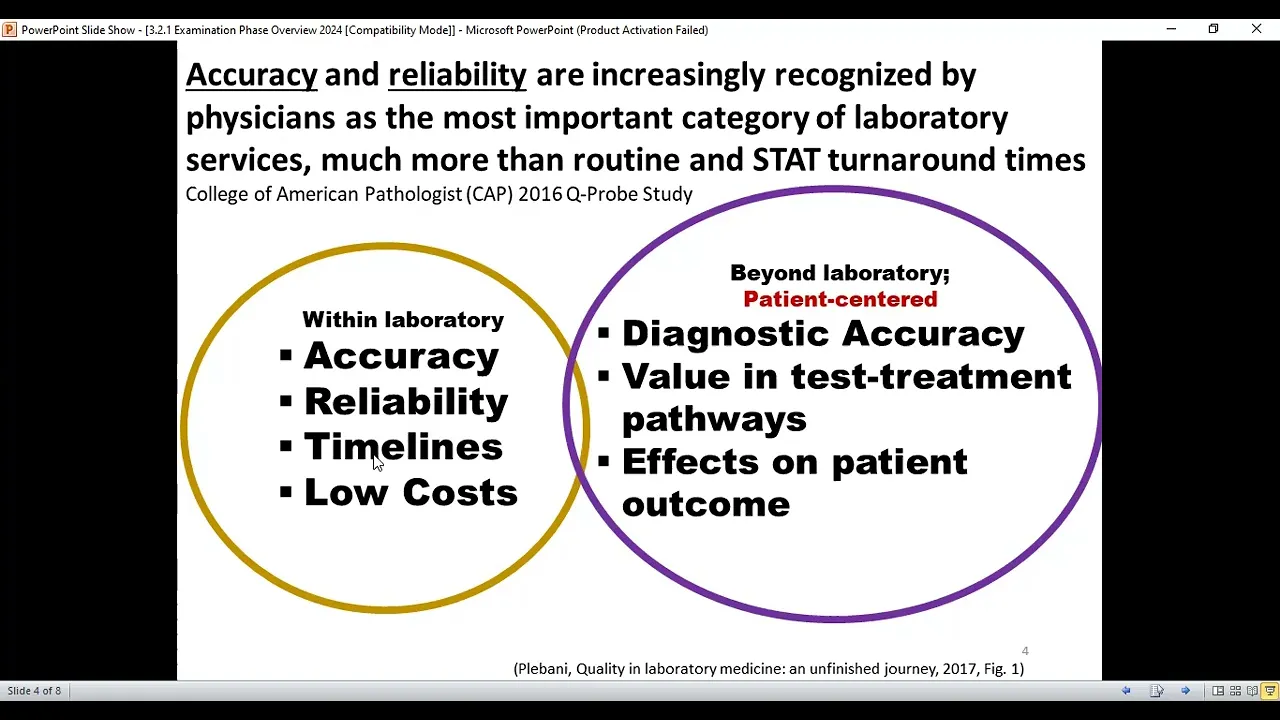
welcome once again everyone and we are proceeding to the next phase examination phase and we are exactly on the activity 3. 2. 1 overview of examination phase let me um quote what uh Jay Dawson said it is important to reinforce the reality that each specimen represent a person's life and every patient deserves the best possible care the role of the laboratory in the product real realization in this path of workflow is that the lab must ensure staff follows the proper processes and procedures each and every time for each type of examination conducted by the laboratory when assessing risk with respect to Patient harm two effects are possible well this isn't the first time that we have seen this we have reviewed this in that um job a understanding risk management um in the activity creating a fit forp purpose processes so when assessing risk with respect to Patient harm two effects are possible number one an incorrect or in erroneous labor laboratory results which may or may not lead to the health care provider or the clinicians making an incorrect medical decision the second one is a delayed result which may or may not affect patient care so here we're talking about diagnostic error and diagnostic error is defined as failure to establish an accurate and timely explanation of the patient's health problem or problems or a failure to communicate that explanation to the patient and Diagnostic and error may occur at any point along the path of workflow um the capap 2016 Q probe study um says accuracy and reliability are increasingly recognized by The Physicians as the most important category of laboratory services much more than the routine and short turnaround time times so in the laboratory within the laboratory we focus on accuracy reliability timel and lowering the cost of laboratory tests but beyond the laboratory in the patient centered care the focus is diagnostic accuracy value in test uh treatment Pathways and effects on patient outcome so the concept of quality in the laboratory medicine is hence evolving from the FOC focus on internal processes uh to the real impact of that laboratory information that we produce in patient care and or in assuring a healthy status to any individual and the whole population all right let's discuss this uh true positive uh true negative false positive false negative and this is um in relation to diagnostic sensitivity and diagnostic specificity well um let me also link this to the cost uh uh effectiveness of making the right diagnosis as a return on investment all right let's start with here the true positive all right so here it's dangerous and we call it dangerous it's a true positive so here uh it's necessary to use uh intensive test as well as treatments now there's also what we call true negative all right meaning it's safe or benign it's you call it a benign so here it's safe to not use intensive test and treatments all right so uh there is also a false positive what is that well it's not actually positive but false positive inappropriate overuse of intensive test and treatments right so this is benign but we call it dangerous now there's also what we call false negative now in this case inappropriate of what underuse of intensive test and treatments a dangerous we call benign so to improve this diagnosis a false negative to improve it it should be true positive and for a false positive it should improve to a true negative improved diagnosis will not only be what cost effective but will almost always produce higher quality care and cost Savings in situations where misdiagnosis are currently frequent when we improve diagnosis we realign the resour es that we use increasing value and that is what we call return on investment if the laboratory cannot produce a reliable measurement it becomes a liability and that includes financially Financial liability to the Health Care System all right in product or service realization from the request through the path work full workflow to uh converting that into a report and that information must be accurate reliable timely and interpretable so here the pertinent um is1 5189 requirements on the pre-exam is on 7.
2 examination where we're at is 7. 3 and the post exam 7. 4 well 6.
8. 0 is about referal Laboratories and Consultants which is uh part of the part uh path of workflow and 5. 3.
3 is advisory activities well don't forget that we also have 7. 5 part of the requirements for examination because 7. 5 talks about non-conforming work and in terms of fail your eqa failure in iqc that's a non-conforming work okay now all of these um activities happening in the path of workflow including the human resource the equipment reagents and consumos and everything must work together as a coherent and functional system so that that request can be converted into report that information must be accurate reliable timely and interpretable our Focus for this uh section is on examination so let's bring that down and in qm3 3.
2 examination phase we will be going through several activities and we are right now on overview examination phase this will be followed by 3. 2. 2 using sop standard operating procedures and then two activities with a question mark 3.
2. 3 is quality control that important and 3. 2.