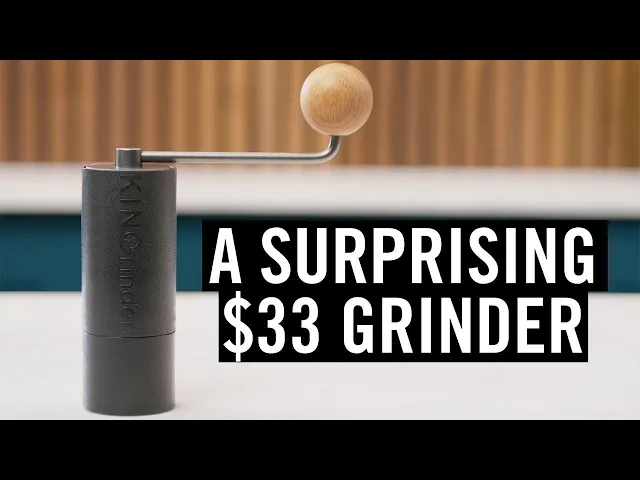
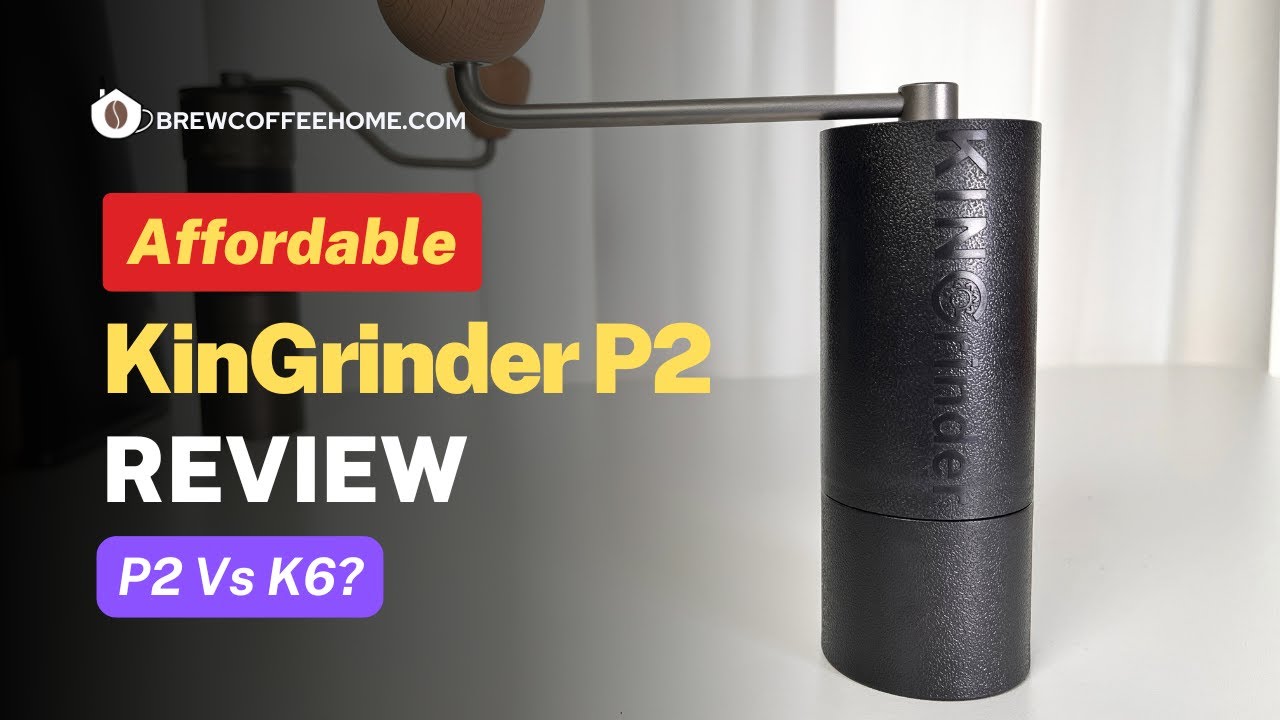
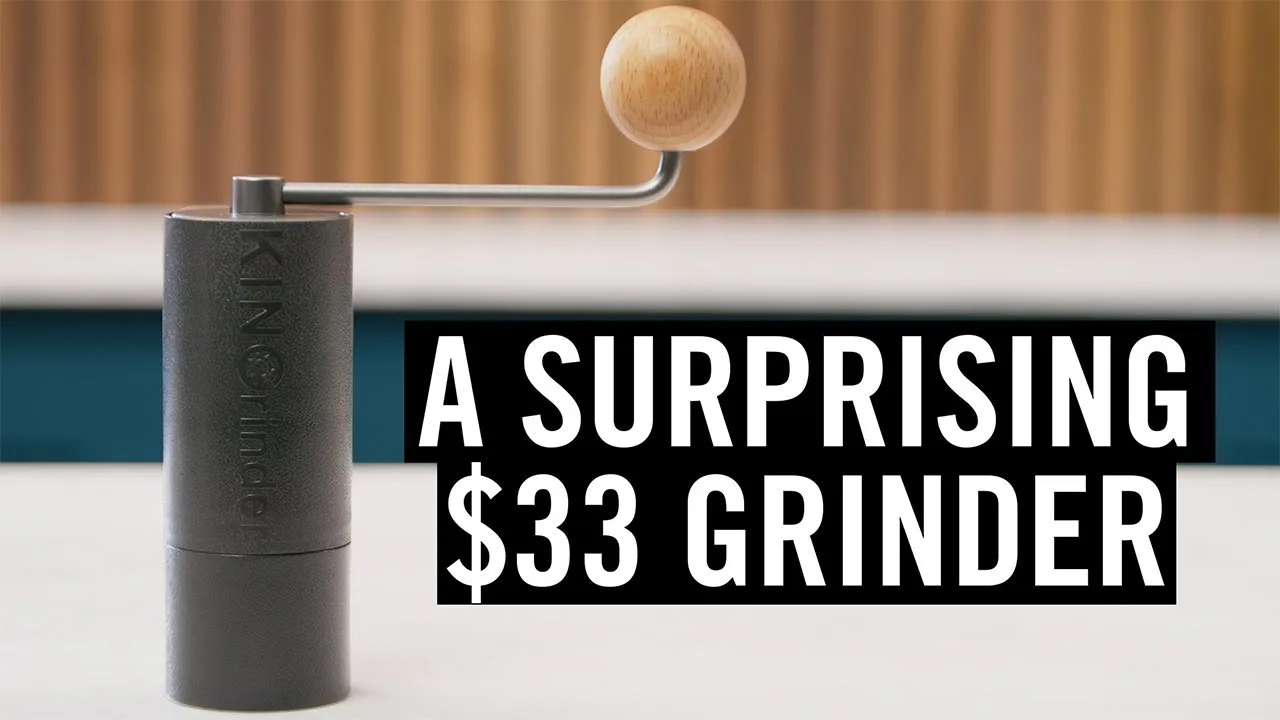
- Today we're gonna talk about this. It's a hand grinder from a company called KINGrinder. KINgrinder, I don't know, KINGrinder, called the P1.
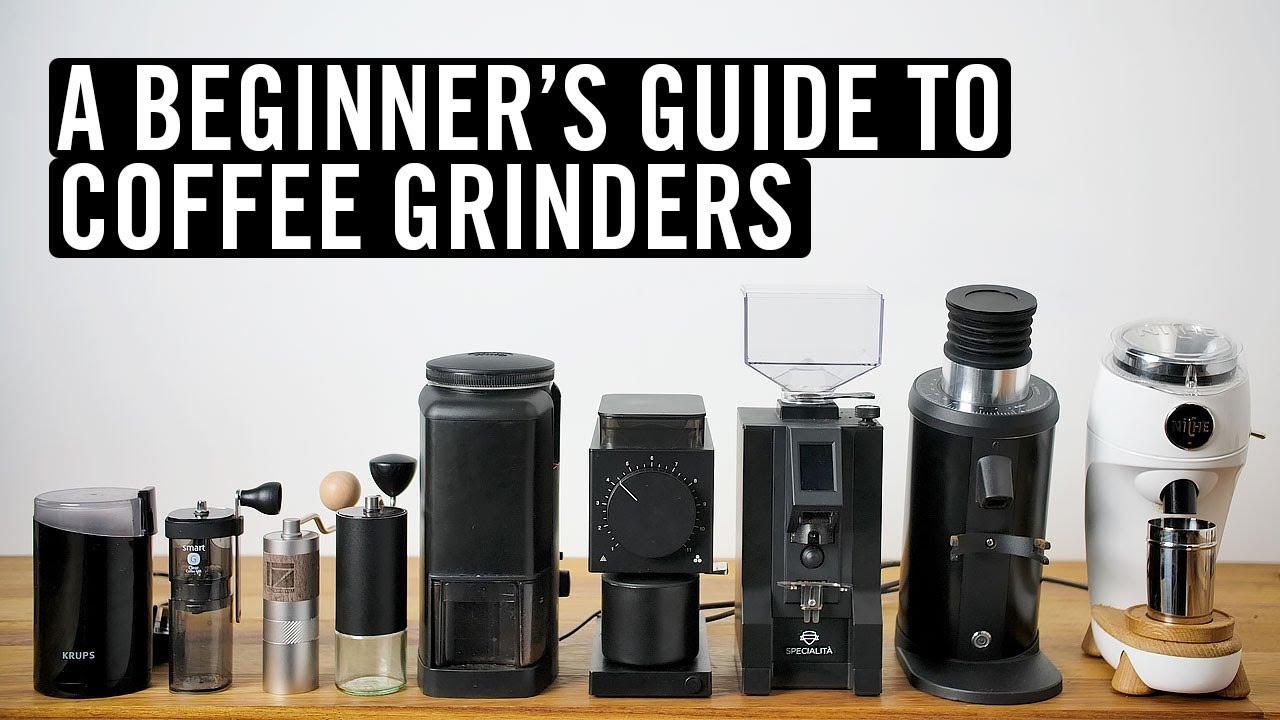
And it's a grinder that has me feeling a little bit excited in a funny sort of way. Now, to explain why I wanna talk about this grinder, I need to talk about a different grinder just quickly. This is the Hario Slim, the mini mill, whatever it is.
It's the cheapest hand grinder that was around for a really long time. I've worked in coffee for maybe 20 years. I've probably sold these for 15 years, let's say.
Sold a lot of them because they were about £30 and for someone who wanted to start grinding coffee, this was the cheapest way you could get grinding coffee at home, right? Like, with a burr grinder, not with like a blade grinder. Now these are cheap, £30 is not expensive.
They're not great though. It's a ceramic burr inside this. It's a conical ceramic burr.
And the sort of shaft through the middle from the handle down to the burr, there's a bit of play in that. So it's not well aligned and it moves around and it doesn't create a particularly good grind profile. Now hand grinders have gotten good, let's just say that, like there's lots of fancy hand grinders out there in the world.
You can easily spend a couple of hundred pounds on a hand grinder, which is a lot more than 30. Then I saw these. I was put onto a video by a guy called Dmitriy Yurchenko through my sort of Patreon-only Discord.
And he was talking about these grinders in a way that made me kind of interested because this grinder here is £33 on Jeffrey Bezos's website. We'll link to this down below, but it won't be an affiliate link. So, you know, feel free to click around down below.
Anyway, this is the P1. They do a P0, which is cheaper than this, a P1 and then they do a P2 and it's to do with the number of kind of cutting blades and the shape of the burr inside. So this is a sort of hexagonal burr.
They do a heptagonal burr for a little bit more money. And then a pentagonal burr, is that the word I want? Maybe it isn't, I don't know, five blades kind of thing.
It's a metal burr. The construction is polycarbonate. The handle is metal.
This nice little wood bit on the end feels nice. Now this arrived and immediately I was like, "Oh, this is nice. " This is nicer than I would expect for £33 where my benchmark is this at 30, because this doesn't, it doesn't feel great.
It turns beans into pieces of beans, but it isn't a great grinder. This seems to be symptomatic of something that gets me a little bit excited, which is coffee stuff has definitely gotten more expensive, right? Like, the most expensive grinders in the world right now are probably for the home, right?
This kind of boom in domestic coffee consumption has supported more expensive espresso machines, fancy grinders, all of the sort of fancy stuff, expensive stuff. But, the idea that this might be good at the same price point as this, that gets me excited in a very different way because if this is good, well, that's a great starting point for someone who wants to dip a toe. I feel okay saying spend £33 on a hand grinder, especially if it doesn't suck.
Now we're very fortunate here, downstairs in our sort of testing facility, not that you know that I'm upstairs, but it's downstairs, we have a particle size analyzer. And so straight away, I grabbed some coffee from this, from this and also from this, it's a Comandante. This though is a good benchmark of a good expensive hand grinder.
These are at least £200, which is a lot more than 33. And so it seemed an interesting comparison and that's where it got weird. That's where it was unexpected and honestly a little disappointing.
Particle size analysis, it's important to understand what it is. We have a machine that you feed in hundreds of thousands of coffee particles to it. It looks at the size and shape of them and it gives you a distribution of the size and shape.
When you are looking at particle size information and charts and distributions, know that this is that grinder on that setting that day with a particular coffee, right? Like, it's not a statement of truth about how a grinder works. It's a moment of comparison between two grinders or three grinders set to produce, let's say, similar extractions in a 1 cup V60.
It's important. And when I looked at the data, initially, I was like, "Oh. " Because this thing produces lots more fines.
If you look at the surface area, which you can do in the charting, a lot more surface area from the ground coffee is exposed from very fine pieces with the KINGrinder. You could see that the Comandante had less fines, had less big pieces too, sort of very large pieces, than either of these grinders. And so I was like, "That's disappointing.
Maybe it isn't any good. Maybe it's no better than this grinder here. " Then we did a taste test, which I'm gonna replicate next because in the taste test, well, it wasn't as clear cut anymore.
I was confused by what I tasted. So I'm gonna do it again, this time on camera. What we're gonna do is we'll make three 1 cup V60 with these, well, they're all set to produce about a 21.
3% extraction. It doesn't really matter. They all taste pretty good at that kind of extraction level typically.
That's a nice place to aim for if you're into the nerdy stuff, which we are. I'm gonna brew them one at a time and then put them in thermoses to try and mitigate the sort of the heat issue. Then we'll put them into cupping bowls.
We'll mix them up, I'll taste them blind and we'll see what the difference in taste is. So, as I grind each one of these, it's an interesting chance to talk about the sort of ergonomic differences in these different price points. (coffee grinding) The Hario is good and bad.
This slim body here does make it nicer to hold and to grip onto. This thing here, I'm not a big fan. (coffee grinding) Oh.
Miserable, like hard work. Now the capacity of this is obviously a lot less. This is fuller.
There's a smaller space for beans compared to this. But the idea that you might fill this grinder all seems alien to me considering how long it took me to grind 15 grams just then. (coffee grinding) Now you can hear it straight away that's a metal burr inside and it's quicker and easier.
We done? Wooden handle, nice to hold. Metal handle, nice to turn.
At basically the same price point, the experience ergonomically is massively different and, you know, this was when I started to get a little bit excited about this grinder. (coffee grinding) Does that sound better or worse? There's a question for you.
(coffee grinding) Feels a little bit easier to turn, but it also feels like the throughput is a little bit less. Honestly, I mean, the wooden handle piece on the metal thing doesn't feel any better or fancier or easier to grind with than this. I know it's got this little angle piece.
I don't really think I feel a. . .
Hmm, a bit more bonus coffee. I don't think I feel I'd necessarily benefit from that. You know, this is a metal construction, it feels fancier.
It feels heavier. Yeah, interesting. In terms of experience, if there's a sliding scale from cheap to expensive, this is much closer to expensive.
We're gonna be using the Better 1 cup V60 Technique that we published on this channel. There's a link to that video in the description. Interestingly, if you look at the Hario's bed at the end of the brewing, you can just see lots of large pieces, really quite big chunks of coffee, borderline coffee grounds, you know, to just pieces of coffee sat on the top and around the filter paper itself.
I think this is important. So with the KINGrinder bed, it looks a kind of muddier bed, which makes sense. It seems to have more fines, but there's less of the kind of crunchy granola pieces kind of lying around on top.
Again, worth noting. End bed: doesn't look as muddy as the KINGrinder. There's a few larger pieces but nothing like the chunky rocks from the Hario Slim.
So let's decant. And then Michael will come in, switch 'em around. I won't know what I'm tasting.
let's find out what's good. On first pass, it tastes the thinnest and the sort of most acidic and just astringent as well. My gut is that that's the Hario Slim.
I don't know why, but I just feel like it's just got the least going on. It's kind of comparably strong and therefore technically comparably extracted. But the nature of that extraction feels like there were bigger pieces at play in this cup than other ones.
This is a very balanced and very tasty cup. I don't really feel there's a lot to complain about here. Sweetness is nice.
The acidity is nice. That's a nice cup. If that's the Hario, this video is a waste of time.
(laughs) This cup is not bad, right? Like, I would say it's not as good as this cup, but it's not bad. It's much better than this cup.
Like, much better than this cup. I would say, this is my least favorite. This is my most favorite.
And this is just in second place. It's the Hario. Do you know I'm quite relieved?
I'm quite relieved. (laughing) He's giving me nothing off camera. Right, that's the Hario.
That's the Comandante. And this is the KING. And I would say, if we had a sliding scale of like not great to great and we have the Hario down this end at not great and the Comandante at great, this is much closer to the Comandante than it is to the Hario.
I think that's the thing, for three more pounds or five more dollars or whatever it's gonna be in the US, we will check that and put it on screen. Here's the thing I would think about. If you gave me £250, right?
I then might have, say I buy a Comandante and I've got 50 quid, £50 left for coffee spend. Or I could spend £33 on a grinder and have a lot more budget to buy better coffees. Because that's really, at this point here, what's gonna kind of truly elevate your morning coffee is the quality of what you put into it.
If you put good water and good ground coffee, ground fresh and reasonably well, into a V60, you can get very, very, very tasty coffee. And the gap in quality, it's not reflected by price. And that's really interesting to me.
This is a better grinder. There's no question about it whatsoever. And that's a relief really.
For £200, it better be a better grinder. It's better on the particle size analysis. I think that's a better cup of coffee.
But this, this makes me happy because it makes me feel like I could recommend something that's £33 and really someone could go and make a coffee that they would really enjoy at the end of it. Yeah, there's runway. You could go and you could improve it and you can tweak it and you can have a journey into coffee, down the rabbit hole, but you are starting so much further along than you would be with this.
And I think that's a really big deal. Now, this thing claims it can do espresso, but before we do that and test that and play with that, I should finish off my theory on particle size distribution and why this tastes better than it should on paper. If you recall, it produced way more fines than either of these two grinders, much more than this, but even more than the Slim, and yet I think it tastes considerably better than the Slim.
I think we get hung up on fines and in grinders like this at grind settings like this, that may be the wrong thing to think about. You can look at the data a whole host of different ways, and this is called a cumulative undersize chart, which shows you the percentage of coffee underneath a fixed size, right? And so with this grinder, pretty much everything is under 1,500 microns.
It's still making the odd single large piece. That kind of happens, that's fine. But if you compare it to say the Slim, only 86% of the coffee by volume, and therefore I think pretty much by weight, was underneath 1,500 microns, which meant that 14% of the coffee was in pieces bigger than 1,500 microns.
1,500 microns is a very large piece of coffee. That's a chunk of coffee. That's 1.
5 millimeters. That's a lot, and so applied to the 15 gram dose here, that's a significant weight of coffee that was simply too large a piece to properly contribute to the extraction. And I think that's where this falls down.
And that this produces less of those pieces, it still produces some, but then again, so does this, but less, but it's less boulders that are really the secret to I think a kind of better hand grinder. That's what I think anyway. I'm still surprised this tastes as good as it does with that many fines in the cup profile, but it tastes the way it tastes and, you know, I think it's always important to take particle size data with a grain of salt, especially in the absence of taste data.
And with the presence of taste data, well, my mind was changed. So, interesting. It's time to pull shots of espresso.
This claims it can do it, can it? We should talk about grind adjustment. It's one aspect of this grinder we haven't really discussed.
It works the way that almost all hand grinders like this work. There is underneath here a dial, you would twist it clockwise for finer and anti-clockwise for coarser. They give some guidance on the website.
They would say there's 30 clicks in a rotation and at around 30 clicks from zero is your espresso setting and your pour over might be say 40 to 60 clicks, somewhere there. I haven't checked my clicks to be honest. I wasn't paying attention, I was just trying to dial it in to where it tasted good and match the other grinders.
So now, for the first time, I'm gonna try and get it close to an espresso grind setting. Now I. .
. I don't like hand grinders, I've gotta be honest with you. I don't enjoy them.
I don't like grinding coffee by hand. That's just me. Other people do, that's okay.
It's not wrong to enjoy it. You can enjoy what you like. However, dialing in espresso with a hand grinder is a miserable task.
And so, for that, the trusty Makita is gonna help me out. It's not the perfect tool, I know it's not the perfect tool for this, but it's what I have to hand right now. And, well, you might be familiar with my opinions on Makita's coffee maker.
If you're not, well, check that link in the description. I did, earlier on, count the number of rotations I was doing in hand grinding. And then I got out a tachometer that we used for sort of checking grinder RPMs and then I checked the RPM of my drill usage to try and match it to hand grinding and then I realized there's something wrong with me.
And why am I confessing this to you? I should just grind the coffee. (grinder whirring) Yeah, I would say 18 grams, probably a max dose sensibly in here.
You might squeeze 20 in. (machine humming) I choked it! Too fine.
But can it be adjusted to the right flow? That's not the. .
. You know, can it go fine enough is one question, can I dial it in accurately to the flow rate that I want? That's the other question.
Let's go four clicks coarser. (drill whirring) (machine humming) So now we're close. That was too fast, that was a 22 second shot for the kind of ratio I'm looking for.
So one click finer. If this can do espresso, that would make a sensible change to the flow time. We get it close to like a 28, 30 second shot or we won't, we'll find out.
But this is the test. (machine humming) I don't know what I'm expecting here. Smells okay.
I'm curious, you could probably play with this a little bit. That's not the best espresso of my life. It's quite acidic.
It's not wonderfully extracted. It lacks a bit of sweetness, it lacks a bit of texture. I don't feel like espresso is gonna be this grinder's forte.
It's also 33 pounds. It's 33 pounds, so, you know, just calm myself down for a second. I could adjust it to get the flow rate that I wanted.
The steps were relatively small. I could get that flow rate. It didn't taste as good as I would want it to.
It may be a grinder that suffers terribly with channeling. There may be other issues. I don't really truly believe in diagnosing that much from a naked portafilter apart from obvious issues.
But we'll still show you a slow motion naked portafilter from this grinder. I'm gonna pull in the shots, why not? How times have changed.
I think back to several years ago when I made a video that was looking for the best grinder under £100 and this would've done really well in that category. This would've trounced something like the Porlex or the Hario or the kind of cheaper options there. It's a better grinder.
It's a more enjoyable grinder to use. It's a more capable grinder. For me, I wanted to buy something at the same kind of price point as the Hario, the little Mini Mill, the Slim, and wow, what a stark difference between the two.
How exciting that there is a grinder for £33 that I can comfortably recommend to people who wanna dip a toe in coffee, who wanna dip a toe in grinding their own coffee, get access to wholebean coffee which is a better experience. And you know, being able to buy what you want fresh, grind it fresh, what a delight. Grind it appropriately for your brew method, excellence happens that way.
I can't speak to the robustness of this. I don't know how it's gonna age and last. I don't know if it's gonna break.
There's lots of metal in here, there's lots of polycarbonate too. And it's not as good as a great hand grinder. It's not as good as a Comandante.
It's not gonna be as good as a bunch of decent hand grinders. But for the money, I am impressed and I'm excited. I want to see innovation happening at these kind of price points as much as I wanna see it up at the expensive end of things.
So, this is cool. I'm excited. Do you have one of these?
How's it been? How's the cups of coffee been? Share your experiences.
What did I miss? What could be better about these? How is the P2, if you have one?
Is it a big jump up? I'd love to hear from any and all of you down in the comments below. But for now, I will say thank you so much for watching and I hope you have a great day.