Have you ever woken up from a dream feeling like you've just lived an entire lifetime in what felt like mere moments? What if those dreams aren't just fleeting fragments of your imagination? What if they're portals to your deepest desires, hidden truths, and untapped potential?
Imagine harnessing the power of your sleep to manifest the life you've always envisioned. It might sound like something out of a fantasy, but it's not. It's a fascinating fusion of cutting-edge science, ancient spirituality, and centuries of hidden wisdom that reveals the extraordinary capabilities of your subconscious mind.
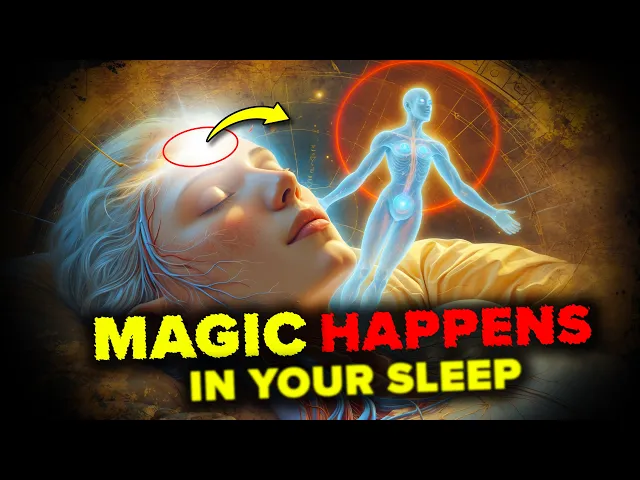
By the end of this video, you'll have insight on how to sleep for instant manifestation, unlocking possibilities faster than you ever thought possible. While your body sleeps, your mind ventures into realms that feel just as vivid and real as your waking world. Every night, as you close your eyes, you're stepping into a dimension where time bends, reality shifts, and your deepest desires begin to take shape.
Throughout history, some of the most brilliant minds, like Thomas Edison, Nikola Tesla, and Albert Einstein, used sleep as a hidden tool to ignite creativity, unravel complex challenges, and turn their boldest dreams into reality. Thomas Edison, the legendary inventor behind the light bulb and over 1,000 groundbreaking inventions, was no stranger to the hidden power of sleep. He didn't just sleep to rest.
Did you know Edison would nap with a steel ball in his hand? As he drifted into sleep, the moment his muscles relaxed, the ball would drop, waking him up with a burst of fresh ideas. Edison knew something most people don't: sleep isn't just downtime; it's a gateway to the subconscious mind where creativity flows freely, unbound by logic or doubt.
Edison's incredible legacy of innovation—those 1,000-plus inventions—wasn't just the result of hard work, but also the product of these brief, intentional moments of tapping into his subconscious. But how does this actually work? While you sleep, your brain cycles through different stages, but it's during REM sleep that the real magic unfolds.
REM stands for rapid eye movement. In this stage, your brain becomes almost as active as when you're awake, but your logical prefrontal cortex—the part of your brain that overanalyzes and doubts—takes a step back. This shift allows your subconscious mind to take the reins, free from the constraints of logic and skepticism.
It's in this state that your mind becomes a fertile ground for new ideas, creative solutions, and even vivid glimpses of the future you desire. Scientists have uncovered that during REM sleep, the brain releases a potent compound known as DMT (dimethyltryptamine), often called the spirit molecule. DMT is famous for triggering intense, otherworldly experiences that feel incredibly real.
Some researchers suggest that DMT could be the reason dreams feel so vivid and lifelike, and why they sometimes seem to predict future events or uncover hidden truths. Could this molecule be the bridge between our waking reality and the mysterious realms of our subconscious? The answer might just lie in the science of sleep.
This idea resonates deeply with mystical traditions that see dreams as portals to higher dimensions—realms where time and space function in ways beyond our everyday understanding. In spiritual practices like Tibetan dream yoga or shamanic journeying, sleep is considered a sacred time when the soul can break free from the physical body and explore infinite possibilities. These ancient teachings suggest that during sleep, you can connect with spiritual guides, receive profound messages, and even reprogram your subconscious mind to align with your deepest desires.
Picture this: you go to sleep with a question weighing on your mind, and when you wake up, the answer is right there, clear as day. This is the essence of dream incubation—an ancient practice used for thousands of years to manifest desires and solve problems. The solutions you've been searching for already lie within you, waiting to be unlocked.
Each night, as you dream, the ancient Egyptians saw dreams as sacred messages from the gods, offering guidance and glimpses of the future. They practiced dream incubation, sleeping in holy temples to seek divine visions that could solve their problems or reveal what was to come. Similarly, in ancient Greece, the Oracle of Delphi would enter a trance-like state to receive prophetic dreams, which guided kings and warriors in their most critical decisions.
Indigenous cultures, like the Aboriginal Australians, also held dreams in high regard. They spoke of dreamtime—a spiritual realm where the soul could travel during sleep, gathering knowledge and wisdom to bring back into the physical world. For them, dreams weren't just fleeting thoughts; they were a bridge to shaping reality itself.
Moving into the modern era, visionaries like Nikola Tesla harnessed the power of sleep for creativity and problem-solving. Tesla famously credited some of his most groundbreaking inventions to insights he gained in his dreams. Now, let's dive into the techniques you can use to harness the power of sleep for instant manifestation.
Think of your mind as a GPS. Just as you input a destination before starting a journey, setting an intention before sleep programs your subconscious to guide you toward your desired outcome. Albert Einstein once said, "Imagination is everything.
It is the preview of life's coming attractions. " Before you go to bed, take a few moments to set a clear intention. For example, if you're struggling with a decision, you might say, "I will wake up with clear guidance on what to do next.
" This isn't just wishful thinking; it's backed by science. During sleep, particularly in the REM stage, your brain processes and organizes information from the day. Studies have shown that the brain consolidates memories and solves problems during this phase, often leading to those "aha" moments upon waking.
By setting an intention, you're essentially giving your brain a specific task to work on while you sleep. Oprah Winfrey, for instance, used this method. To manifest her dream career, she would write down her goals and visualize them as if they were already achieved, planting those ideas deep in her subconscious.
By the time she woke up, her mind had already begun working on solutions. Think of it like planting a seed: before you sleep, you plant the seed of your intention in the fertile soil of your subconscious. While you rest, your mind nurtures that seed, helping it grow into clarity, inspiration, or even a full-blown plan.
By the time you wake up, this process is rooted in the brain's natural ability to problem-solve and create connections during sleep, making it a scientifically grounded method for manifestation. As you drift off to sleep, take a few moments to vividly visualize your desired outcome. Picture it in as much detail as possible; see it, feel it, and even hear it as if it's already happened.
This technique isn't just about daydreaming; it's about embedding that vision into your subconscious mind. Take Jim Carrey, for example. Long before he became a Hollywood superstar, he used this method to manifest his success.
Every night, he would imagine himself as a successful actor, feeling the emotions of already having achieved his dream. Within a few years, he landed his breakthrough role, which catapulted him to stardom. This practice works because your brain doesn't distinguish between real and imagined experiences.
When you visualize something intensely, your brain activates the same neural pathways as if it were actually happening. This primes your mind to recognize opportunities and take actions that align with your vision, making it a powerful tool for turning dreams into reality. Another powerful technique is to repeat affirmations or mantras.
These are positive, present-tense statements that help reprogram your subconscious mind. Think of them as gentle commands you're giving to your brain, guiding it toward the reality you want to create. Louise Hay, the pioneer of affirmations, famously used this method to heal herself of cancer.
Every night before bed, she would repeat affirmations like "I am healthy," "I am whole," and "I am healed. " Over time, her body began to respond to these positive messages, and she eventually made a full recovery. This practice works because your subconscious mind is highly receptive during the moments before sleep, a state known as the hypnagogic state.
When you repeat affirmations, you're essentially planting seeds of positivity and healing in your mind. Over time, these seeds grow, influencing your thoughts, emotions, and even your physical well-being. It's a simple yet profound way to align your mind with the reality you want to manifest.
Drams are often filled with symbols, insights, and even solutions to problems, but they can fade quickly upon waking. By writing them down, you capture these fleeting messages and give your subconscious a way to communicate more clearly with your waking mind. Take Mary Shelley, for example, the author of *Frankenstein*.
She famously drew inspiration from a vivid nightmare. She woke up and immediately wrote down the details of her dream, which became the foundation for one of the most iconic novels in history. Without that dream journal, her groundbreaking story might have been lost to the haze of sleep.
To start, keep a notebook or journal by your bed. As soon as you wake up, jot down everything you remember—images, emotions, conversations, or even just fragments of your dreams. Over time, you'll begin to notice patterns, recurring themes, or messages that can offer guidance in your waking life.
This practice not only helps you remember your dreams, but also strengthens your connection to your subconscious mind, making it a valuable tool for self-discovery and manifestation. Another transformative technique is lucid dreaming, the practice of becoming aware that you're dreaming while still in the dream itself. Once you realize you're in a dream, you can take control of the experience, shaping it to explore ideas, solve problems, or even rehearse real-life scenarios.
Elon Musk, for instance, has shared that some of his most innovative ideas for SpaceX and Tesla came to him in lucid dreams. In these dreams, he was able to visualize and experiment with concepts that later became groundbreaking realities. By consciously exploring these dream worlds, he tapped into a creative space where the boundaries of logic and physics didn't apply, allowing him to bring visionary ideas to life.
Lucid dreaming works because it bridges the gap between your conscious and subconscious mind. When you become aware in a dream, you're essentially waking up within your own mind, giving you access to a playground of infinite possibilities. To start, try reality checks during the day, like asking yourself, "Am I dreaming?
" and carry that awareness into your sleep. Over time, you'll train your mind to recognize when you're dreaming, opening the door to a world where you can consciously create and explore. It's not just a tool for creativity; it's a way to actively shape your reality even while you sleep.
Your sleep environment is more than just a place to rest; it's a sanctuary that can either enhance or hinder your ability to manifest during sleep. Creating a high-vibration sleep environment is key to aligning your space with your intentions and ensuring your mind and body are primed for deep, transformative rest. Deepak Chopra, a pioneer in mind-body healing, emphasizes the importance of a calming, high-vibration sleep space.
He recommends using elements like calming scents, such as lavender or sandalwood, to relax the mind and body. Soft, warm lighting helps signal to your brain that it's time to wind down, while soothing sounds, like gentle rain, ocean waves, or soft instrumental music, can create a peaceful atmosphere that encourages deeper sleep. The idea is to create an environment that supports your subconscious mind as it works to process and manifest your desires.
When your surroundings are calm and aligned with positive energy, your mind is free to focus on what truly matters: your dreams, your goals. And the life you're working to create, think of it as setting the stage for your subconscious to perform its best work while you sleep. Drams have long been a source of mystery.
Studies on precognitive dreams suggest that some dreams can provide accurate glimpses into future events. One well-known example is Abraham Lincoln, who reportedly dreamed of his own assassination just days before it occurred. Many people have experienced dreams that later unfolded in vivid detail in their waking lives.
This idea aligns with the Multiverse Theory from quantum physics, which proposes that infinite versions of reality exist simultaneously. Could dreaming be a way for our consciousness to momentarily shift into alternate versions of reality? While mainstream science hasn't fully proven this, the concept has been a part of human culture for centuries, appearing in spiritual traditions, ancient texts, and even modern-day anecdotes.
Drams, it seems, are far more than random brain activity; they may be a window into deeper layers of reality where time, space, and possibility intersect in ways we're only beginning to understand. Now it's your turn to put these techniques into action. Tonight, before you go to sleep, take a moment to set a clear intention and visualize your desired reality.
Whether it's clarity on a big decision, a creative breakthrough, or a step closer to your dream life, your subconscious mind is ready to work for you. Let me know in the comments what you're manifesting and how these techniques are working for you. Your experiences could inspire others on their own journeys.
If you found this video helpful, don't forget to like, subscribe, and hit the notification bell so you never miss out on more tips to unlock your full potential. Sweet dreams and happy manifesting!