Enthropic released Claude Mythus and according to Enthropic, it beats their current best Opus model by a large margin. The last time we saw a performance leap like this was back in September 2024 when OpenAI released their first reasoning model 01 that beat GBT40 by a huge margin. Now, for some reason, Anthropic chose to angle their release of Mythus around cyber security and really pressing on AI posing a national security risk, which is very similar to what we saw in 2019 when OpenAI said GBT2 is too dangerous to release.
So, is Cloud Myths really that good of a model and why is it such a big deal? Welcome to Gilbright's Code, where every second counts. Quick shout out to Zo.
More on them later. One thing I found strange is that Cloud Myths is actually a generalpurpose LLM just like any other models like Opus, Sonnet and Haiku. In other words, Cloud Myths is not a model specific for cyber security, but for general use cases, but Enthropic is putting a huge emphasis on cyber security instead.
And for that very reason, Enthropic chose to only release the model to a few partners where most of them are actually investors with stakes in Anthropic. For example, Microsoft was in series C and G. Nvidia also in series G.
JP Morgan a conventional loan in May 2025. Google in series C and E as well as convertible debt. Amazon in series D and E and Cisco in series E.
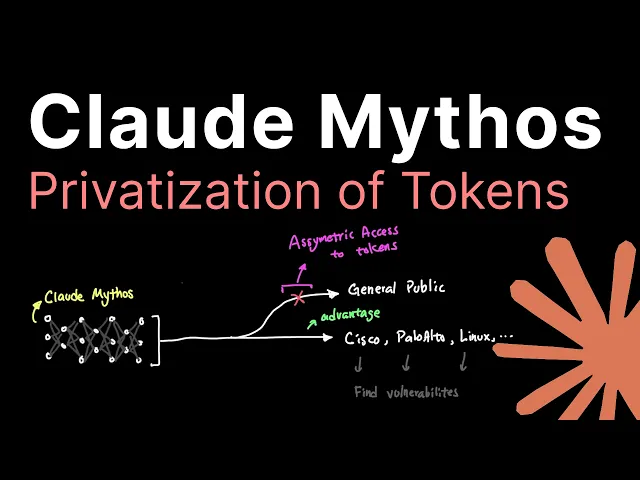
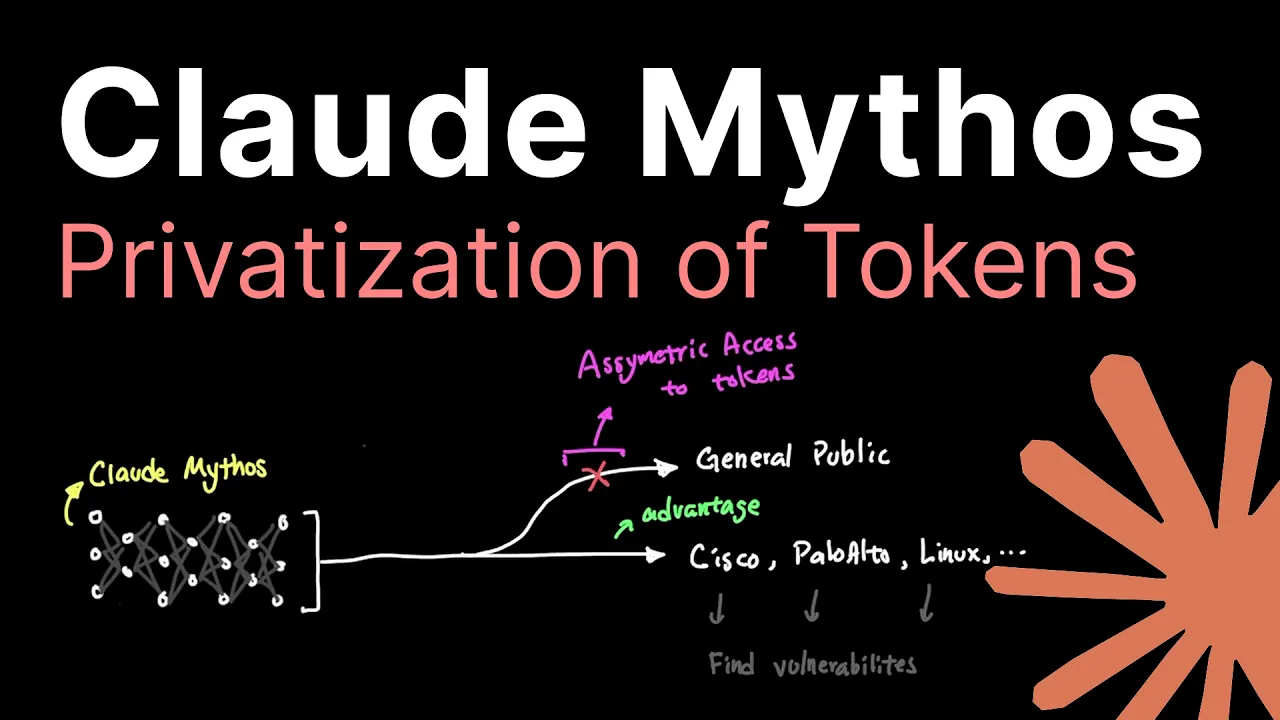
So in this case, what we're looking at is a privatization of tokens where access to higher level intelligence is limited down to few critical companies that Enthropic found necessary. Now this asymmetric access to tokens obviously creates an advantage for companies like Cisco, Palo Alto and Linux to find vulnerabilities when it comes down to cyber security. But it's really much bigger than cyber security itself.
For example, law firms that use a more intelligent model like Claude Mythus will find legal loopholes and litigation strategies that could undermine the law that protect entities. Other domains like finance and software development all share the same predicament. So what's really special about the release of models like claude mythus is not necessarily around cyber security per se but it's really the panic that we experience every time the model improves in IQ faster than our ability to adopt them.
Now when we look at it from the AI factory level anthropic does not own their stack when it comes down to token generation. In other words, Enthropic has the design to create intelligent tokens, but they still rely on their partners to actually generate these tokens through their hyperscalers. Back in 2025, Enthropic committed to spend up to $50 billion in data centers, one in Texas and one in New York are currently under construction.
But Anthropic still relies on Amazon, Google, and Microsoft for training and inference. And when we look at their press release around cloud myths, it shows that the model will eventually be available through cloud API, Amazon Bedrock, Google Cloud Vert. ex, and Microsoft Foundry.
So reading between the lines here, it's unlikely that Cloud Myths will be part of Enthropic's already subsidized plan like their Pro and Max plan. Enthropic is planning to release Cloud Myths at a price point of $125 per million output tokens. And the only thing that comes close to that price is OpenAI CBT 5.
4 4 Pro at $180. Now, the topic around pricing is really interesting since Anthropic has been drawing line in the sand in their terms and conditions and recently cracking down on their subscription, most notably for OpenClaw. Now, just for clarity, I'm only referring to the subsidized plan here since people can still use their API for OpenClaw, but it'll cost them a lot more, which means the problem you're trying to solve using OpenClaw is bound to the token budget you want to set.
In other words, no one in their right minds would spend the $125 per million alpha tokens in API to use cloud myths for openclaw unless the return on investment justifies reaching for the top shelf. So the real question comes down to who gets to think at the higher level intelligence which as of now the who are the ones who can spend the money to solve more complex problems and those who have access to privatized tokens. Now, speaking of Enthropic cracking down on subscription, here's a quick word from my sponsor, Zo, who isn't impacted and clot code still works great.
Let me tell you more. OpenClaw showed the world what a personal AI agent could look like. But if you actually try to set it up, it's actually not as easy to set it up properly.
Zo takes a different approach by turning your laptop into a server. Zo gives you your own computer in the cloud with AI builtin. It's fully isolated, so you're not one bad configuration away from exposing your whole machine.
Out of the box, you can integrate with Gmail, Google Drve, Stripe X, Spotify, and more. You can also build websites, set up automations that run while you sleep, and even code full projects right from chat. My favorite feature is texting Zo on iMessage or Telegram and talking to my agent.
Zo is always on, always yours without configs. Link in the description below. Now, looking at the benchmark, Cloud Methods is undoubtedly an impressive model.
Their coding ability which is sampled from their SWEBench pro is 77% compared to Opus which scored 53%. Same kind of leap in terminal bench which measures the model's ability to use their terminal. And this kind of huge leap is something we saw in waves before with the most recent one when OpenAI released 01 that introduced reasoning.
But given how fast DeepSync R1 was able to catch up only 5 months after in January 2025, this performance gap that Enthropic just created will likely be bridged sooner than later if history serves as a guide. However, there's one important aspect to consider, and that's AI adoption. Whenever the model's intelligence moves this fast, it creates half panic and half excitement, which is certainly how I felt reading about Claude Mythis.
But in light of AI adoption, the faster the model's intelligence moves, the more obvious it becomes between companies that adopt AI and companies that don't. Just like how we pay varying wages for human workforce for different tasks, the same principle applies to AI where tasks like triaging email, calendaring, and basic workflows don't need to be done by top tier models. I mean, why use big models when small models do trick?
But as we unlock new levels of intelligence, our ability to solve more complex problem grows. So companies that leverage these models faster and allocate intelligence for the right opportunity, they have that much more advantage. Now, when we take a step back and look at Anthropic's release of Claude Mythus, it aligns Anthropic in a pretty good spot as a target potential IPO possibly next year.
Enthropic recently surpassed OpenAI by garnering $30 billion in ARR. Now, for quick clarification, this isn't annual recurring revenue, which is typically used by subscription companies. Annual recurring revenue is a more conservative take on their revenue grounded by monthly or yearly fees that collect from users through subscription.
But in this case, we're looking at annualized run rate, which heavily biases towards recency, where if Enthropic is doing much better in the recent period, they can take a snapshot of that and project it out for the remainder of the period. And the difference here might seem trivial, but it certainly matters a lot when it comes down to valuation for potential IPO coming up and how much people are willing to pay per share judging by their growth. What do you think?
What do you think about Claude Mythis?