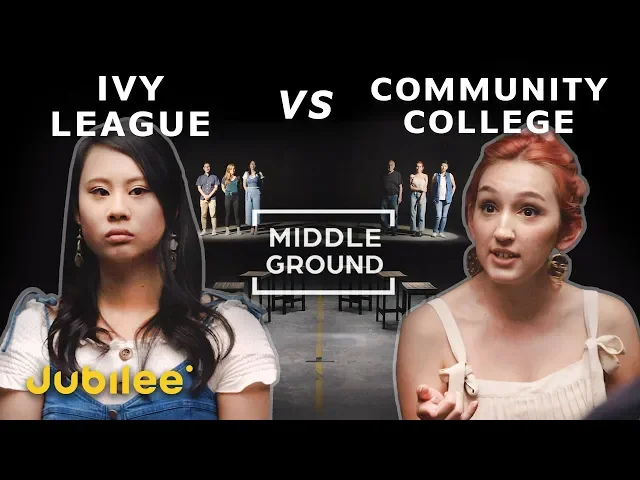
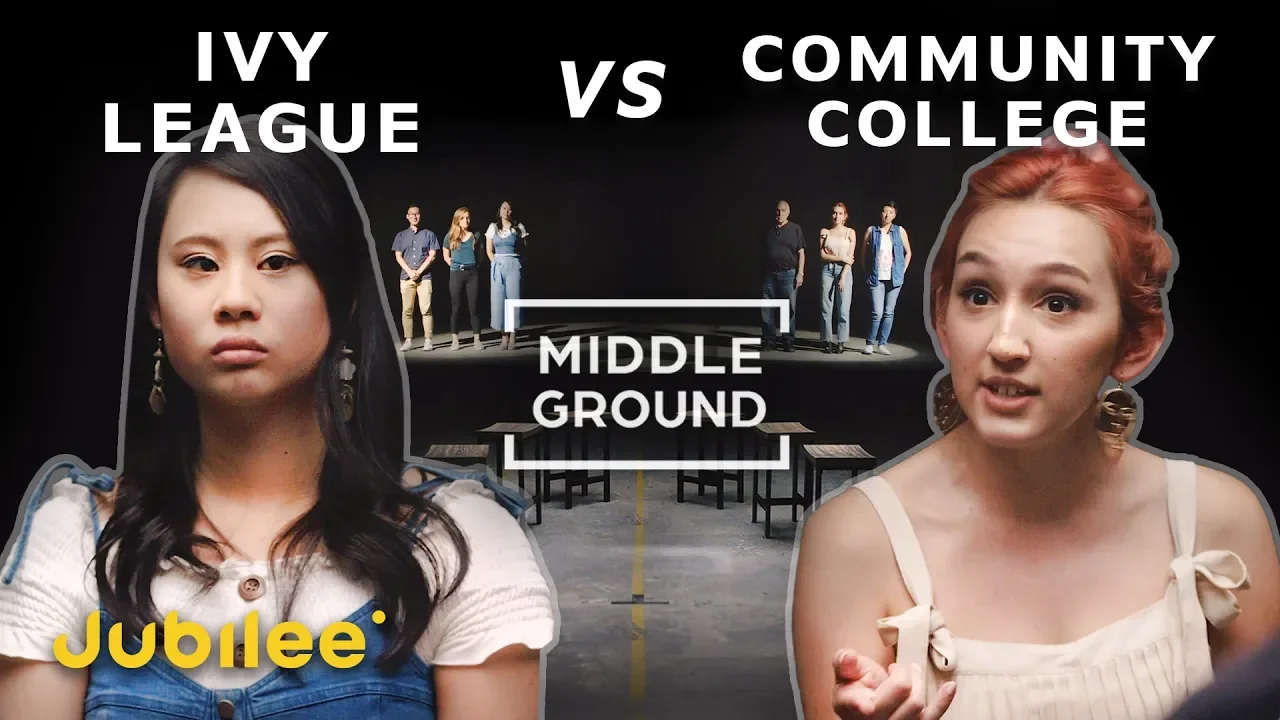
- Hey guys, thanks so much for tuning into another episode of "Middle Ground. " This episode focuses on education. - Speaking of education, a big thank you to our sponsor, Skillshare.
- For those of you who don't know, Skillshare is a super cool online community where you can take thousands of courses and learn creative skills and all these other different skills. - Stick around after the episode to learn a little bit more. - We'll see you after.
- But how much better is it for you when they say, oh, where do you go to school and you can go, I go to Yale, and then they go, oh my gosh, that's so cool. You must be so smart. For me, when I go, oh, I go to LBCC and they're like, oh.
(upbeat music) - [Interviewer] When you hear the words Ivy League, what comes to mind? - Immediately I feel like maybe of money. - The upper climbs of the East Coast.
There's as much of a need for Ivy League as there is for every university. - I did get into all eight Ivy League schools. - [Interviewer] Wow.
- People might think that it's really expensive, which it is. - I personally have respect for anybody who does something in their life to try to advance themselves, to make themselves succeed. - Going to Princeton is a big part of my identity right now and I hope that through this discussion, I can kind of break that a little bit.
- And I'm curious to know what it's like for them going to school, paying tuition. - I'm open for a bit of education about the Ivy League today. (upbeat music) - Hi, I'm Cassandra.
I'm a student at Yale. - Hi, I'm Cory and I also go to Yale. - I'm Emily, I go to Princeton.
- I'm Trinity, I go to LBCC. - I'm Saul, I graduated recently from Santa Monica Community College. - I'm Aiden and I currently attend Urban Valley College.
- [Interviewer] Can I get my Ivy League students on the left and my community college students on the right? If you agree, come to the middle. My school is a huge part of my identity.
- Yeah, so in high school, everybody knew me as the guy who wanted to go to Yale. I'm surrounded by people who all are affiliated with Yale, who lift me up, who support me in what do I do, who support me in my job search, who support me in my career, who support basically my entire life, so yeah, my life right now revolves around my school and I love it. - I love this question 'cause I struggled a lot with this going into Princeton.
I played soccer my whole life and I got recruited to play soccer at Princeton and then going into Princeton and being a really good soccer player for my hometown and then being on a team with girls who were all the best in their hometown is like, ooh, now who am I? I'm not the best anymore at this. Through Princeton, I've tried to reconstruct my identity and another part of that is that I am Christian and so combining my faith with being an Ivy League student has been incredible.
- Community college in itself feels very temporary. No one really has that comradery that you guys have. In like 30 years, you're gonna see somebody and you're like, oh you went to Yale and it's gonna be like, oh, I don't know what your mascot is, what is it?
- [Cassandra And Cory] Bulldogs. - Oh, Bulldogs. It's like this thing and for us, I'm like, oh Vikings, like whatever.
- But I don't even know my school mascot. When you have multiple identities, when you identify with a lot of different labels, you might not find that community at your school as a whole, but you might find it within that small subsection. - I'm queer, I'm trans and I found a small community of the LGBT club at my school.
Being able to find a community of some kind is still nice, even if, like you said, it is really temporary. - I've been around long enough to realize that there is nothing school service in the Army. None of these things I think define us.
They are a part of us, but what defines us is what we accomplish in life. Maybe that's some of the wisdom I've been able to pick up in 85 years, but that said, you are what you do, not necessarily what you attend. - I agree with what you're saying and I think it's very valid that you're defined by how you are as a person by your character, by what you do, but I also think that it's Yale that built my character, that makes me like the person I am.
- Yeah but Yale, you're the one who got into Yale. - Right. - It came from here and you.
Yale didn't put that into you. - [Interviewer] What are your thoughts about going to a community college? - It wasn't really a choice for me.
When I was in high school, my grades were really bad and just in general, the stigma against community college students and going to a community college. There's a level of resentment towards Ivy League schools just in general. I think it's also because I did used to want to go to one when I was younger.
- [Instructor] The college admission system is a fair system. (everyone laughing) - Don't everybody rush forward. When I first decided to go to Santa Monica Community College, I spent an hour on the campus just looking at who was there and I realized that there had to be something extremely fair about it because of the diversity I was seeing.
I was seeing people of every color, of every age, obviously. I was welcomed there. Nobody questioned my being too old for a college.
- I formulated an argument. - Yeah, I did my entire application process online. It took like 30 minutes for me to just send in my name, my information, and suddenly, hey congrats you're a student here.
Community colleges are really, really forgiving but comparatively universities, that's a whole other ballgame. - I think why I was so hesitant on my answer was because I was grappling between the system itself versus the results of the system. There are ways that people can help themselves get in.
You're a recruited athlete, a lot of people are children of donors, a lot of people have legacies. That is I guess inherently unfair because that doesn't put everybody on the same playing field. - [Interviewer] Did anybody bring up the college admissions scandal that broke earlier this year?
- I guess we can talk about that. - Yale was involved in it. - Yale was involved.
- The scandal was that there was this one guy who had this fake company and then he had certain relationships with certain coaches at schools and then he would have the coaches designate them as recruited athletes to get them in. Am I allowed to say this? Yeah, it's public, it's public.
(everyone laughing) So our soccer coach, he was involved in the scandal. I think that it is what it is. It is a shame that it happened but also the person who was involved in it, the family did not know about it.
This was an example of this guy taking advantage of people who didn't speak the language, who didn't know about the American admissions process. - You say it is what it is, but at the same time, that person who gets in because somebody paid a hundred thousand dollars under the table means somebody didn't get in who far more deserved it. - It definitely also makes you think of if this is just one Ivy League, how many more prestigious schools this is happening to and you're like, okay, well then how many students are really there because they deserve to be there.
- So I actually found out that I did know the girl who was ultimately kicked out and this led to a lot of discussions among me and my friends. Should Yale kick her out, should Yale not and also the USC students as well. I feel anger when I think about my friends who Yale was their dream school and they didn't get in and someone might have unfairly taken that away from them because of their privilege.
That just makes my blood boil, but then again, I feel really sad for this girl in particular because she didn't know. All she wanted to do was attend college. I think the college admission system in general is very unfair and a lot of it comes down to luck, right?
It depends who's reading your application that day. Are they in a good mood or are they in a bad mood? Did they have a really great lunch or was their lunch order late?
- [Interviewer] Do you feel that you got lucky 17 times? - I definitely did. If you calculate the percentages, so I applied for 17 schools, I got into all 17 schools and I think that certain things that I did in high school definitely helped me stand out maybe from like the sea of applicants, but it's not something that you're like if I do X, Y, and Z, I will certainly get in.
It doesn't work like that. - [Interviewer] What do you think people think of when they hear the term Ivy League? - I think a lot of times they can think brilliant, intelligent, sometimes privileged.
It's not always a positive connotation that goes along with Ivy League. - [Interviewer] I'm embarrassed to tell others where I go to college. - Yeah, that's how it's.
- That's just kind of how it is when you go to community college, especially nowadays. There's just such a stigma. - That makes me so sad.
I'm getting my education, I'm bettering myself. Why do I feel like I'm lesser than just because I don't have a fancy name school on my resume. You know what I mean?
- Yeah, exactly. - I think just like the stigma that you guys mentioned, I think there's a stigma in the opposite direction too where people who aren't in the Ivy League, they think, oh, they must think that they're better than us. I don't think we think like that.
I don't think like that. - If you are proud of the school you go to, I'd be proud to show that off even if other people look down upon you for that, people are gonna be like that, but I know and you probably know that the people in your life that care about you, the people in my life that care about me, they don't care where I went to school. They'll support me no matter what.
- But there's also family, which is a thing and especially because I think the only one in my family who is attending community college. When I go to family reunions they're like, how's school and I'm like, it's goin' great and they're like, are you transferring soon and I'm like, no. It's like at best it's awkward and at worst I feel like I'm the family embarrassment and that sucks.
- And you said that stigma around Ivy League students. I do believe there is one and I totally get it, but how much better is it for someone for when they say, oh, where do you go to school and you can go, I go to Yale and then they go, oh my gosh, that's so cool. How is it?
You must be so smart. For me when I go, oh I go to LBCC and they're like, oh, that's, that's cool. - I think you're incredibly well spoken and intelligent and if you think that your time going to community college is well worth it, then you should be really proud of that and not listen to what people are saying or speculating about you because of where you go to school.
- [Interviewer] What are your thoughts on community colleges? - Well, I think they're undervalued. I think they're known as the feeder to the universities, but I think one can get an excellent education at a community college.
- [Interviewer] My parents paid for my college tuition. - Well, my parents paid for my college tuition in 1952. - It's a lot cheaper back then.
- I was only 17, like maybe some of you were when it happened with you. - To know that I have parents who love and support me enough where they say, hey, if you wanna go to community college, we will help you and we will guide you and I know that I'm really, really lucky to have that 'cause I know not everybody who even goes to the same school as I do has that. - Growing up Asian American as a first generation, my parents came from China and same as your deal.
My mom very much emphasized education from a young age and when I got in Yale she was super, super excited and she wasn't super excited to pay for it, but she would happily pay for it because she knows that above all it is the best for me. - My community college pays for the first two years, so I don't have to pay tuition, which is great and I have five brothers and sisters, so it's like where do I fit? Who's gonna make the sacrifice to go to community college to pay for their own tuition, pay for their own expenses and that was always the option for me.
- [Interviewer] Why did you choose that school? - It was close, it was like five minutes away from where I live and it was financially just a really good option for me and I had a few friends that went there. - [Interviewer] My tuition is a fair price.
- Now at one point in American history, college was free or like practically nothing and in a lot of countries outside of the US, tuition is really, really low or you can attend college for free, but given the current circumstances of where our education system is now, the tuition that I have to pay is pretty low compared to some of my friends who are attending university and they have to pay thousands and thousands of dollars. - For me at Princeton, I'm very grateful for the financial aid that they do give me and they are very generous with my family and I. There were other schools that I was looking at that didn't offer financial aid and that wasn't a choice for me and my family, but for Princeton, they also offer students to have on-campus jobs, which I'm working three and that has been really helpful.
- I just paid my fall bill, it was about 36,000. - Okay, I think I gotta go now. - Every year it only goes higher and higher.
Granted we are at a great university with facilities and great, amazing professors who like win Pulitzer Prizes, but I'm not sure where every single aspect of that money is going to. That said, I think like you said earlier or at least Yale provides really great financial aid and definitely without that financial aid, I wouldn't have been able to afford it, but the tuition itself, what people who are not on financial aid have to pay I think is extremely high. - The purpose of a community college is to provide an education for those who can't afford it.
Frankly I couldn't afford it and they gave me a free ride for the year and a half that I spent there. I wouldn't have been able to go to school without it and that makes me very grateful. - [Interviewer] What career path do you hope to achieve?
- I think I want to go into the finance investment banking industry with a focus on tech, media, and entertainment. - [Interviewer] I worry about getting a job after school. - We were talking about it earlier, how it's like we both are interested in creative writing and it's like, I wanna be a novelist, I wanna be a writer and it's like that doesn't pay anything.
I'm gonna have no money, I'm gonna be so poor. - I hate to tell you, but you have a lot to worry about. I'm an author.
I've written half a dozen books and you may wonder what I'm doing here. Who would need a job at 85? Well you wanna know something?
I wouldn't mind a job. Anybody out there got one? - I realize I wanna change my mind.
(everyone laughing) - It was nice seeing you. - We bumped them. (everyone laughing) - I realize I'm not in as difficult as a position as you guys.
Finance is the most popular field that people from Yale and the Ivy League in general go into, so because of that, a lot of the stress that we have is self-imposed because we are competing against the best people for not a lotta jobs. There is a fear in me that I'm not going going to get the best job or the job that I want, but deep down, I know that I will end up with a job. - I was gonna say exactly what you were gonna say.
I was gonna call you two out. If the question was are you afraid that you'll get a job that you love, that's well paid, yes, I am afraid. Am I afraid I'm not gonna get a job?
No, I think I will get a job. There is a lot of fear that I won't meet the standards of where a Princeton student should be working after college. Mentioning to people that I potentially wanted to be a teacher or a social worker or work at a non-profit and they're like, you went to Princeton to be a teacher.
I'm like, hang on, that's not fair. So I do deal with that pressure a lot, but I do know I'm gonna get a job. Actually, I don't like saying that too much.
Please hire me, but. - [Interviewer] Why did you choose the school that you go to, Yale? - I think because of the community there.
Yale really lifts up its artists and I really wanted to be part of that community that isn't competitive or cutthroat, but rather comes together to support each other and collaborate. - [Interviewer] It's who you know more than what you know. - I've always said that when you pay for a school like Yale or Princeton or any school, you're not necessarily paying for the education.
I don't think our education is $70,000 worth more than your education, but I do think what we are paying for is the opportunities and the connections. - Yes, it really helps to know the right people. As an author, which I've been for 20 years, if I had the right agent and if I had the right publisher, then I would be farther along in my career as a writer.
You don't get a chance to network with the same people that you guys do. - A hundred percent. - And that makes a big difference, so it's where you network as well as networking.
- I hate the word networking. - I hate it too, I hate it too. - I think it's so utility.
You want something, that person knows you want something from them. So someone recently said to me, don't view it like networking. They said just go into the room and see who are the cool people there that you wanna be friends with?
It's not like, oh, I'm just talking to you because I want a job. It's like I'm genuinely interested. How did you get from point A to point B?
What do you do in your day to day and that's how you get to know those people. Another thing someone recently told me is that to be successful in this industry but also maybe others, you only have to be two out of three things. Be really, really good at what you do, be on time, or be very, very kind like a good person.
Only one of the three is about being good. The other two isn't based on how smart you are. I don't know, that kind of gives me hope.
- [Interviewer] All right, guys, that's a wrap. - Is that it? (group chattering) - So I'm gonna go to Yale just to like.
- Please, please, please. - Like, I'm a Yale student. - That was so amazing.
Saul is so inspirational and he just proves that you're never too old to learn something new. - A big thank you to our sponsor, Skillshare. - Skillshare is an amazing online community where you can take thousands of courses.
Jubilee loved the color grading for filmmaking course by Dandan Liu. - [Evan] It's a good build for working filmmakers looking to improve their color correction skills as well as for aspiring filmmakers who just wanna get the basics of the craft. Premium membership gives you unlimited access so you can join the classes and communities that are right for you.
- [Kendra] Skillshare is also incredibly affordable, especially when compared to pricey in-person classes and workshops. An annual subscription is less than $10 a month. - And because Skillshare sponsored this episode, you can get two months of premium free with the link in the description below.
- Oh my God, two months? I'm gonna be pro by then. - You already are a pro.
- Oh, thank you. Thank you so much to Skillshare and to you guys for watching this episode. Make sure to subscribe, follow us on Instagram, and we'll see you next time.