[Music] that was pla silk regarded as one of the weakest atome hobby 3D printing filaments you can get this is PPA carbon fiber probably one of the strongest and there's a whole slurry of filaments in between these ASAS ABS pets Pats and many more and today I want to figure out which filament is actually the best for uh cosplay hey guys welcome back to the channel my name is Frank and today we are covering or trying to cover the different types of filaments you can use for 3D printing all with the end goal of making
a new Iron Man suit if you guys have been following my channel for a while you know I am done with this Mark 85 I am rebuilding it fullon restoration from the ground up and instead of using the basic PLA and Pla pluses and even pgs that you know are normally used for cosplay I want to put my best foot forward but in order to do that I need to know what filament is actually best for making cosplay so I want to do some testing today now bamboo has sent me almost every single one of
their types of filament from their pla silks all the way up to their PPA carbon fiber and there is a drastic price difference in this where pla silks are 20 to $24 for 1 kog 750 G of this PPA 6 is $150 so for for a full roll of this stuff kilogram it's $200 that's a big difference in this material so I've gone and printed a bunch of little test pieces for each and every filament I printed a bunch of parts laying flat horizontally and I printed the same Parts vertically and if you understand 3D
printing and the way layers adhere we already know that the horizontal pieces are going to be much stronger than these vertical pieces also the differences in these pieces are the part here is 0% infin two walls three walls four walls five walls six walls they all have 0% infill same with the horizontal ones two walls all the way to six walls we know which one's going to be the strongest but just how much weight can we put on these until these start to snap I have a cool little science experiment set up here and uh
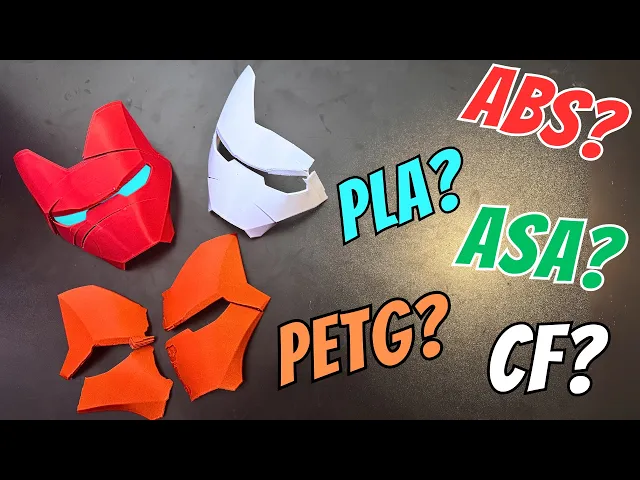
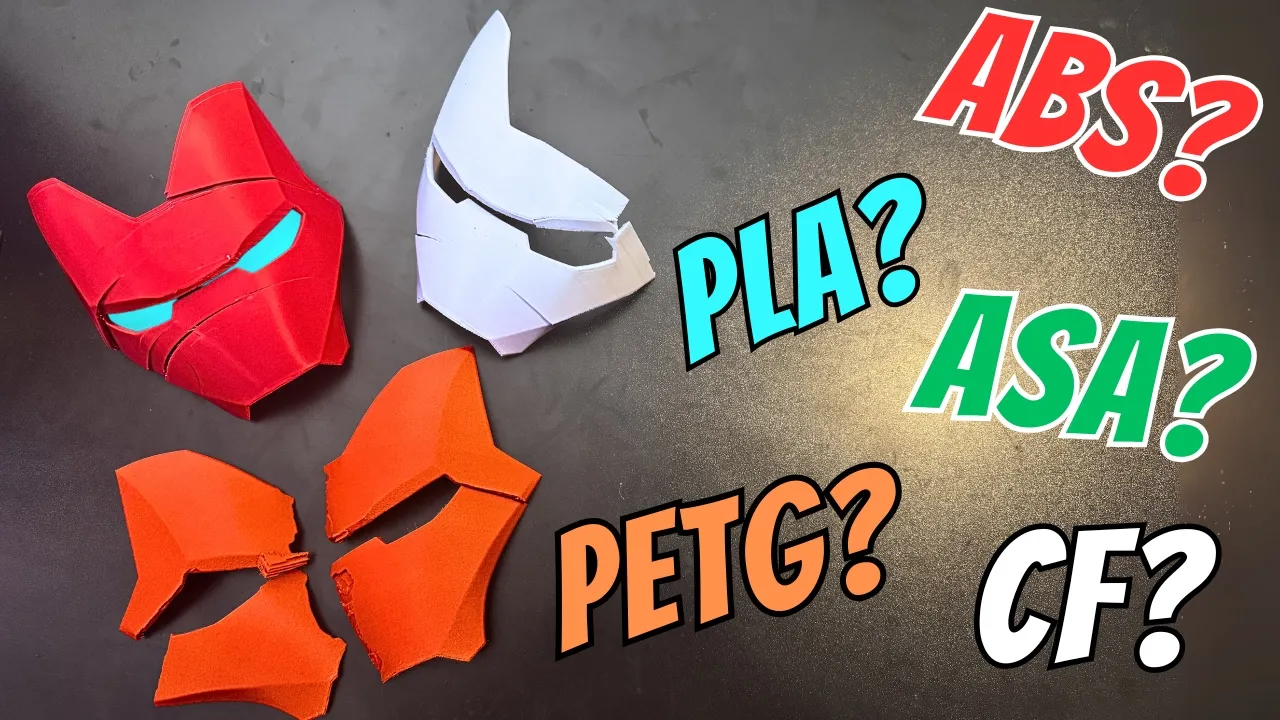
I also went and printed some other stuff I actually printed Iron Man face plates in every single one of these materials not only to evaluate how easy it was to print with them but the Finish quality and smoothness of the surface because not all filaments are going to give you the same you know nice quality and they just are a little bit more finicky to print so I went and did that and there's uh we're going to break these two yeah here are all the filaments I'm going to be using um you know what we're
just going to start from the front pla silk pla basic pla carbon fiber ABS ASA ASA carbon fiber ptg high flow PG carbon fiber paht carbon fiber P carbon fiber pa6 carbon fiber and pa6 glass fill and finally the PPA car carbon fiber and I've gone and printed all of these masks with the exact same settings um I have to check my computer but I'm pretty sure it's three walls 5% infill on all of them the only thing that changed with these prints are the temperatures and what's nice about using the bamboo printers and bamboo
filament all of these materials are automatically preloaded into the printers I didn't do any calibrations or flows I literally loaded the roll it read it it knew what material it was it adjusted the settings accordingly the temperatures build plate all of that and it just printed I only had issues with the normal ASA it did not want to stick to my Pei sheets I had to use like a sticky cool plate thing finally got it to work but that was more just like my build plate and me being stubborn but being able to swap through
so many different filaments effortlessly like this is incredible this is something I would have never had access to a few years ago this is just showing the advancements of 3D printing and I love it okay so before we get into the rest of the video I just want to say thank you to B labs for sponsoring this video if they weren't providing me with machines and filament to do projects like this I wouldn't be able to you guys already know what I think about them I've been using them more and more on the channel because
the printers are just reliable and I love it if you guys are interested in any of that definitely go check out the links down below and uh I I I think that that does it you get it you know they work um let's let's go break some stuff 15 lbs and that's the experiment we're just going to do that the clamp is holding each piece on exactly one inch onto the table so everything's nice and consistent and then I am using the end of this little suitcase luggage thingy which is has a nice little um
bit of grip to it and just put placing it right on the end again for consistency and where's pulling down and luckily this has a little uh needle on it that shows me exactly uh I'm on I'm not on autofocus should be about there exactly how much this weighs now I don't need to talk through all of this so it's just going to be time lapses of each material and then we'll just talk about the result bols at the end and uh yeah we're just going to we're going to burn through it I'm pretty sure
they're all going to snap in the same spot that little leverage point but it's how long does it take how much weight does it take us to get there so uh yeah let's keep going here you can see the differences in the wall thickness trying to get it to focus and stay there you got my you got the two walls right here or the thinner one and you have the six walls on the side 0% infill all the way through and that's what's going to be for the entire experiment goinging forward okay I'm realizing this
is going to take forever and also hindsight's 2020 right while filming and trying to do stuff um I don't need to do two walls like realistically do we we know we know the two walls is going to be super brittle super lightweight weight so what I think I'm going to do is I'm going to eliminate most of the testing um if you're doing cosplay if you're doing something like this you want to print for Quality right so that's going to print in your z-axis that's when you print up and down again that's going to give
you your most quality least strength now if you lay something down and you spread the layers across the X and Y that's going to give you your most strength but your quality is going to be your quality is going to be not great um so you wouldn't really print high quality cosplay parts flat now granted there's going to be certain Dimensions that are going to be stronger blah blah blah blah blah we don't really care about that take this sword for example this uh magic sword I am working on the soul soul sword um it's
pretty much primarily printed up and down and without the metal rod reinforcing it I would never be this would snap immediately it doesn't matter well it doesn't matter if I had like 20 walls in it maybe not but for Quality you're printing it upright so it comes out smoother but that's going to give you your weakest bit so obviously printing something flat down is going to give us the most strength I can already go over here to let's say Well since we're on the ABS actually no we'll use these these are the ones I just
tested this is the six wall PLA and this took 30 lbs to get that bend in it and this is should have taken more than 30 I can't this hurts this hurts a lot um so that's going to give you your REM moste strength right now as we move up the filaments that's going to get stronger and stronger stronger so I think what I'm going to do is divert this a little bit and only test the six walls on each of the vertical ones like the abss pla so the ones that are just standing up
and then we can kind of talk about the numbers of that what did it take to break a six wall vertical structure yeah I like that idea a little bit more maybe I printed too much stuff okay we're moving right along and uh this is definitely all going very differently than I thought it would um we are up to we did the pla um standard stuff the pla carbon fiber didn't prove much better at all uh 4 lbs at the two walls and 10 lb at the six walls um ABS the layer adhesion on it
wasn't great we got 7 lbs with six walls and the ASA was even weaker layer adhesion wise uh the two walls was three pounds it broke right as I pulled on it and then the uh six walls on the ASA was 8 lb now I just pulled out the what is this this is the the ASA carbon fiber and as I was trying to undo the tape literally as I was just twisting this to get the tape off the two walls broke so we're going to go with a pound and then we're going to do
the six wall right here 5 lb yeah the ASA carbon fiber really wow this this feels this feels weaker than the pla honestly huh that's interesting looks really good good material yeah oh my God that was three wall four wall that butter five wall this is Asa carbon fiber is not it now we're moving on to the pgs I'm actually pretty excited to see what these um what these do okay those are better results than I'm expecting so far the strongest um is the ptg high flow I got that to 13 lb with six walls
however and I might need to go and reprint and test it I got it to 17 lb on the pla so that's interesting I actually want to going to drop down to the five wall one real fast and see maybe I just maybe I had a bad pull I want to see how strong the yeah the the five wall is now 11 so that tracks if the six wall was 13 and the five wall is 11 that's not too bad at all the glassi PG was actually weaker than the high flow petg I only got
up to 11 lbs with the glass fill where the high flow um came up to 13 so that glass definitely made it a little bit more brittle I think now we're on to the PT I've never heard of this stuff until bamboo sent it to me um I have the two wall loaded right now it's it it feels like I'm this might not even register cuz that's how um it feels a full limsy so let's uh four pounds bottom stayed this is the two- wall right yeah it is two- wall that's interesting oh this stuff
flexes a lot ooh I did not know that that has a good amount of elastic o I like I like that you guys can see that right and it's deforming a little bit but it's oh that is that takes a lot that is huh really curious on what this six wall is going to that had a lot of elasticity in it that is a cool little result we got there I'm going to tape this on zeroed out wow wow wow wow wow wow 65 no way 65 PBS 65 lb wow wow okay p a h
t this is the five wall I can't break this by hand oh my God like look at that I cannot break this five wall I broke the four wall sue me all right pet carbon fiber we'll do the two wall um I didn't reset the scale that was like 5 lbs I'm sorry that that was that was bad that was bad science resetting the scale we are at zero and we're pulling 10 lb not bad but what about what about what about that finger feel honestly feels like pla doesn't feel much stronger than pla all
right now we're getting up to the expensive filaments now we are moving on to the pa6 carbon fiber and the pa6 glass fill and then after that we'll test the PPA carbon fiber so this is the pa6 carbon fiber here I'm for two wall I'm going to take an estimate we're going to take a guess 7 lb four uh yeah it's very brittle feels a lot like pla o six wall oo that's a good P 10 lb all right so the six walls basically doubled it all right you know what now that I can see
this this has it it has a little bit of flexibility just a little maybe I can do that again just a little bit of a little bit of flex before it gives so that's good that's good that's a good property to have you don't want it too yeah like here's here's the three wall so that has a a pretty good deflection oh that three wall that was that was pretty good actually that was this is the three wall right yeah it is weird this stuff wait till you see the Iron Man mask that this printed
in this might be the nicest looking material out of all of them it was beautiful ooh that flexed a lot 4 lb I'm getting good at this um that actually flexed down quite a bit yeah wow okay you guys should see this focus on my hand focus on my hand yeah here's the three wall that did I skip a layer that broke wow okay that would be bad for science four wall yeah has a has a has a good amount of flex too I know people use this on brackets for cars cuz it prints really
nicely and it's nice and smooth and it has a ow high temperature deflection thermal deflection so I can see why it has just a little little bit of flexibility to it um where I think the PPA the strongest stuff I have right now doesn't really have a lot of give to it but we are definitely going to run numbers on it six wall coming at you let's do this this is going to break immediately that hit 4 lb so oh this guys I made a terrible mistake and I'm now seeing it I don't know what
got messed up in the settings I guess I I guess I hit a button wrong oops all the pa6 glassville is all two wall I guess I forgot to do I don't know why this one printed like that but if we're going off with the glass fill for the PG the glass fill does make it a little more brittle that is absolutely Ed in the pa6 carbon fiber being at 4 lb and the pa6 glass fill being at 3 lb so the glass fill does make it a little more brittle but it was flexing just
as much as the carbon fiber and it has a nicer fit surf uh like a glittery surface finish this orange is really nice um I don't see a point in printing the six wall in that case okay this is what I've been waiting for this is the strongest material I have printed or that I can print on an at home printer this had to beint printed on my um my bamboo x1e Bamboo actually sent me an x1e just to print this stuff because of the higher um nozzle temperature needing about 300 um or over 300
what is on this box this is 280 to 310 none of the materials I have needed this high of a temperature where the normal X1 carbons only go up to 300° um the X1 C's go to 320 320 I was right so there's a big difference between running your nozzle at maximum temperature 300 ° than having that wiggle room or leeway of being able to go up to 320 but only maintaining 290 or 300 and that's what the X1 is good for also the heated chamber um so I while you probably could print this on
an x1c wouldn't recommend it cuz your your printer is going to be screaming and um I don't know I feel more comfortable when the printer is built for that now I went a little bit further on this test yeah not only did I print the two wall three wall four wall five wall six wall I printed a 10 wall which actually gave it um 100% infill it's it's it's solid I'm going to go through all of these I I I might as well it's this filament was expensive I owe it to that to all oh
this feels brittle this feels like pla 5 lb ooh that's oo that three wall 9 lb four wall 11 15 there we go okay okay okay 15 16 why didn't that jump up as much that's interesting all right here we have the six wall huh that's a result the six wall snapped at 10 lb so maybe just bad adhesion there that doesn't feel right but I can't retest it cuz the angle is now off from the other ones so it will break at a lower or higher weight because I have less leverage this should take
a lot more weight to break yeah I think I found a busted layer oh my God oh my God okay 20 lb solid shall we 10 10 10 15 20 25 but uh 25 lb on that that is and you can see how it broke kind of neat get it towards the light so you can see the tips of it cool yeah 14 kgs and it finally buckled I'm going to take this off people don't give pla enough credit guys that was ridiculous [Music] there's got to be a better way I didn't hit I didn't
hit record okay so we're changing tactics here guys um I tried with the boxes it didn't work this is devolving into less and less scientific but I think I'm on to something here I took a standard scale scale scale scale scale um and I put the face plight there and I stepped down slowly and we got up to 130 lb before it cracked it flexed well before that but 130 and this was the damage that it caused um this is going to have to do wow just I I I if I had plates of Weights
plates that that rhymes if I had those it'd be a little bit better we could do it but uh we're we're just going to do this and we're I'm just going to step on them and um don't be into this you know who you are [Music] [Music] [Music] Okay so that was a crazy result um the petg high flow all of the others up to this point the uh pla pla carbon fiber ABS even ASA and especially the ASA carbon fiber have shattered um the ASA carbon fiber literally exploded and they all got it it
looked like on the scale to about 70ish PBS um and then obviously once my foot went through it spiked up I'm going to really try to review the number right before failure um I just got put my full weight on this PG high flow and it just it it just Buckle it that's it it just warped out and warped right back in so can I let to see if I [Music] can all right so that's what it took so this this this failed very differently than the pla um way more tensile strength way more I
actually can't I can't I can't break the middle it's too strong right here um so that's yeah it only really failed at the weak points so let's keep going [Music] so that was the one I was waiting for that was the pet p aht PT carbon fiber while the surface finish on this one kind of sucks and I think I don't know if that's just the material of the printing this nylon um it got to about 120 lb very on par with the PG high flow but definitely the carbon fiber definitely made this brittle like
it's done with all the other materials where it's still so flexible like it's still so forgiving in terms of elasticity I can really Bend this stuff before it fails like that'd be a hard toss up um I got to look at the the temperature properties between the PG and the PT I I I'm pretty sure the PHT melts hotter so better thermal deflection but the surface finish isn't great so that means there'll be a lot more post-processing whereas the PG high flow prints just as smooth as pla or anything else and with a little bit
more dialing in and then a higher quality CU this is like 2 mm standard layer height I could obviously get more out so right now even though this did have more elasticity the nylon the PHT I'd still go with the p p petg high flow for cosplay but let's keep going we're not done yet um 120 lbs just break this that was that was that was something ooh [Music] m [Music] it's not breaking I'm hitting 140 lbs and it's laughing at me okay um I have to check the camera but that looked like it peaked
at over 150 I was actually not expecting the glass fill to be that strong wow look at that fail too it just split down the middle and that took that took a lot the um the pa6 carbon fiber shattered More Than This did the glass fill though wow cuz the glass PG didn't hold up that well but this what that that took some weight I was starting to get kind of worried and honestly that might have only failed cuz I flexed it a couple times in a row I stressed it it wasn't just one I
I I think it's split down the middle cuz I probably just stressed it in seccession over and over again cuz it like that is a really that is a really interesting split right there but you guys saw that I I had to put almost my full body weight on that thing let's finish off with the last face plate the PPA carbon fiber about 100 lb oddly enough though looking at it it failed in a similar fashion to the um yeah cuz the other ones were failing along the layer lines these weren't but about 100 lb
it looked like on the scale so the uh yeah the pa6 glass will so far absolutely the strongest um so yeah that's that's incredible um damn that was fun so what do we learn turn turns out a lot I'm going to be honest guys um as I was going through the stick test I was starting to lose hope on getting any tangible results cuz let's be honest that uh that could have gone better I overprepared underprepared I don't really know what I did but I did learn some things that definitely helped key me in on
the results of the face plate test and this really surprised me first up the pla uh like I said people don't give pla enough credit and even the ABS and ASA performed very interesting they the the the pla face plates they didn't shatter they split and fractured um pretty pretty much the exact same way now that I'm looking at it um even the ABS and ASA really kind of split the same way and I'm wondering if it's because all of these print around the same temperature and they have a good good amount of flexibility and
then they you know give up um people don't give pla enough credit it is very durable it just has a weak thermal deflection it prints at such low so low of a temperature that you can't use it in a lot of applications if you're standing out in the sun in the middle of Texas yeah it might warping you know hot car hot dashboard so that's where it's Pitfall is but if it's in its temperature range it's still pretty strong plastic it's it's good stuff but we're not worried about the cheaper stuff as we went through
the range I have four standouts four reasons for four standouts I have the ptg high flow which my god um impressive that that that took the most weight out of anything that took what I think I 150 um the piht which in the stick test was showing that it needed a lot to flex like this is one of those it's still really interesting stuff this is still the five and I can't break it um that's really great the glass fied that got way higher the pa6 glass field this stuff this surprised me I thought the
glass fi was going to make it more brittle based on the PG glass fill and this is like the standout and again as I was talking about before it didn't it didn't split on the layer lines it just shattered which I think is just a cool result and then obviously the PPA carbon fiber the most expensive um is theoretically the strongest in certain applications and has the highest thermal deflection and blah blah blah blah but it failed quicker than the glass fill and the PG high flow so more expensive doesn't mean more better in use
cases at least now where I'm sitting with this right now is I'm actually between the PG High flow which has a 230 to 260 melting point and then the uh PA pa6 glass field which is 260 to 290 it's not quite as hot as the PPA but still not bad the paht the nylon while had ridiculous flexibility like really good it's surface finish it's just it would be so much work to postprocess this this is something that's better left to just printing and no post-processing bra like I said brackets in your car um ual usable
things that you're not going to paint in sand or maybe you know if I did paint it I don't care about this little texture it kind of it's like fuzzy skin it kind of hides the layer lines and honestly like this looks pretty good but when comparing the ptg high flow and the um the glass fill I keep forgetting the pa6 glass fill the the surface on the PG is just wonderful like this is this was again no real dialing in the filament this was just bamboo stock settings and and this stuff is really really
smooth this came out just as good as the pla I like this stuff and if you were looking for something stronger than pla or ABS or ASA I would do this this was this printed super easy with those profiles and you saw how strong it was this stuff really exceeded my expectations the upper tier of this would absolutely be this pa6 glass fill it doesn't have as strong as a surface texture as the PHT it's definitely not as grainy um I'm really curious on how this stuff is going to sand I think going into the
next bits of this project I'm definitely going to print some parts I mean I guess I could just use these and sand these down right I I have them um so the postprocessing is definitely going to be interesting and then using power tools using power Sanders I can sit on this stuff oh my God I this stuff's not melting with a power sander this is 260 to 290 I'm good with this and even the PG sand it's going to sand a lot easier but yeah I um I really like this glass F stuff I'm curious
on what other colors it comes in so to close this up hey I have a working remote now this is kind of nice uh to close this up more testing is required but I think you guys knew that there wasn't going to be one definitive big answer like oh my God it's this material each of the materials has different properties as clearly shown by these four behind me I think if I was just going for a quick new suit and I wanted to upgrade from pla the ptg high flow hands down the the strength of
this was so much better than the pla we got way higher on the scale it's easier to print with and though I've disagreed at times people say PG is easier to sand than pla Danny swears by it I kind of don't but I haven't SED PG in a while so we're going to test this out um I I again I like the flexibility of the PHT but it's surface finish is just too much the post-processing on it would be a absolute nightmare um but man that flexibility was something um and the point of this new
suit this point of this new Iron Man suit I'm going to be making is to just go crazy with it like that's the point I want to that's what I want to do with this it's going to be Overkill I'm I'm not on a budget with this I have sponsors now like this is a dream come true that I get to do this type of stuff and I want to just make the ultimate Iron Man suit and you guys are going to see that in the series on how I'm going to approach this so maybe
using the P6 glassville if it postprocesses well again I need to test that and you will see that in the series and then I'll make my final decision when that video comes out but I'm I think if you watched this video you still got information about this you still saw the properties of some of it you still were able to figure out hey this one might be better for me or you know I'm okay with pla because it actually is kind of strong or I'm okay Switching to PG cuz wow look how much it performed
better than said PLA and then obviously the PPA PPA carbon fiber it as much as I want it to be the stuff I use its quality is subpar it does not print nice and smooth it has a rough uh finish and texture it's going to butcher the details and Printing With It on the x1e using a filament dry fire it's just a nightmare it is hard stuff to use I couldn't imagine doing a full suit in it though as cool as it would be it it wouldn't look good I want this to look good and
I think I think the uh the the pa6 glass fill might be it so yeah I hope that all made sense so definitely make sure you subscribe to the channel and keep an eye out for that new Iron Man Ultimate Iron Man video series coming out that's going to take up most of 2025 I am so excited for it I have a video call with veck and Walsh about um a new suit the files don't worry about it I said too much if you guys have any comments questions or concerns about anything you saw in
the video and I'm sure a lot of you have questions please drop them down below um I know the video kind of trailed off into being really professional and then now we're here but again I still think there was good information here but let me know what your comments are back and uh again if you want more information about these specific filaments the chemical properties the thermal properties all that stuff you can hop on Google actually Bamboo's website has a lot of information about each of the filaments the thermal deflections the properties the tensile strengths
and the XYZ blah blah blah there's a lot of science on the websites you can go read it it's really cool and one last big thank you to Bamboo labs for sponsoring this video and like this project and everything moving forward uh I would not be able to do this stuff without them it would be it' be very very difficult being able to do stuff like this now and bring you so much new information in 2025 I I have to say a big thank you to them because it it just wouldn't be possible without them
so uh yeah go check them out too but that's going to be wrap for this video guys it was probably already a long one thank you so much for watching you have a good day