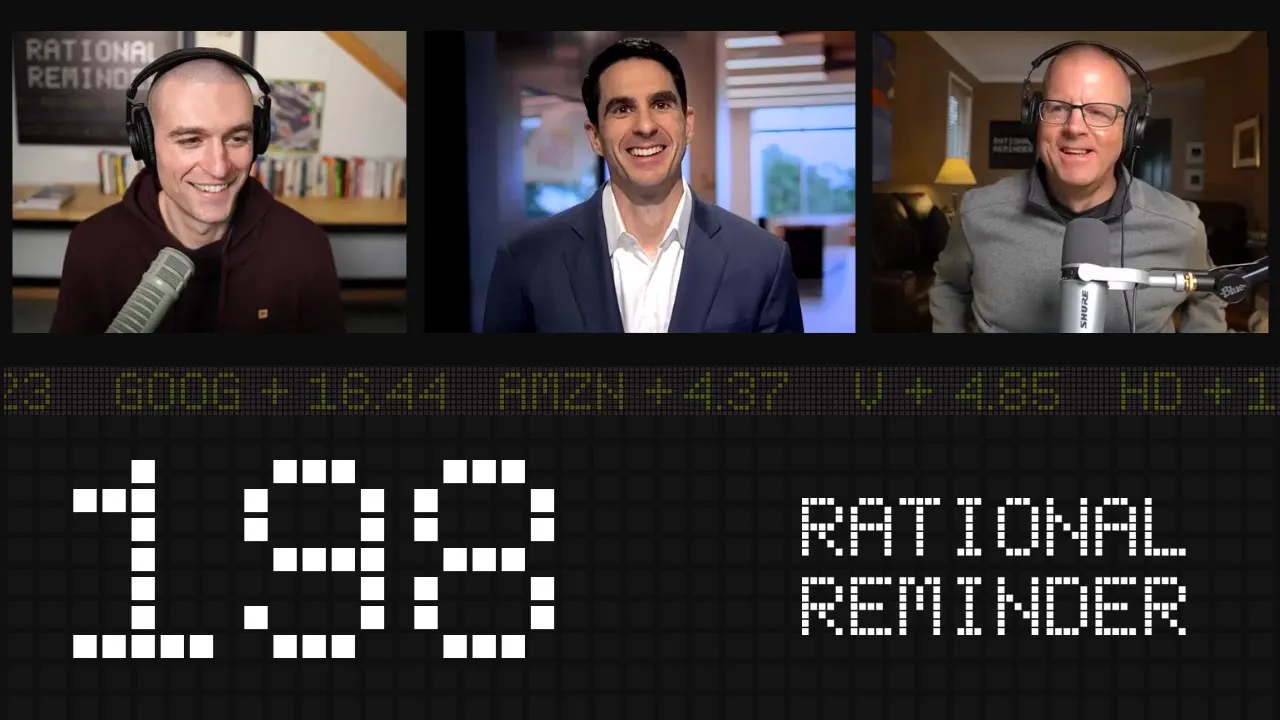
[Music] this is the rational reminder podcast a weekly reality check on sensible investing and financial decision making from two canadians we are hosted by me benjamin felix and cameron passmore portfolio managers at pwl capital welcome to episode 198 and this week another week another phenomenal guest we had gerard o'reilly join us and gerard is the Co-ceo of dimensional fund advisors the other co-ceo is dave butler who was our guest back in on episode 43. wow what a conversation and gerard was so generous with this time so we had a chance to ask lots of great
questions and some pretty in-depth questions too well i mean listen gerard's a co-ceo but he's deep in The research and the implementation of the research i mean he's right in there um and he has been through his career with dimensional so we really wanted to get into it and uh and we did we really got into it into some some uh pretty nitty gritty stuff and what's interesting about gerard i mean george's relatively young And you know as we learn from talking to robin wigglesworth and mac mcquown earlier this year dimension on the people behind
dimensional and the academics that have been involved with dimensional have been you know instrumental and a big part of this whole massive transformation that our industry has gone through with the you know the advent of index funds etc And it's interesting to see a guy like gerard who's got a phd in aeronautics and a masters in in science and applied mathematics to come into this industry without a formal background in finance or economics and to to become co-ceo and he's just such a brilliant communicator yeah i mean he talked about he talked about how how
the phd in aeronautics relates to Relates to asset management um and it basically said in a phd you learn how to solve problems think about stuff in new ways and that's clearly directly applicable to what dimensional does and stands for yeah and dimensional is a pretty big firm they manage around 850 billion dollars canadian i believe they've been in canada since 2003 but they were founded back in 1981 by david Booth and uh we've been lucky enough to be one of the initial firms when they came to canada to start working with them right out
of the gate back in 2003 so it's a it's a pretty good story yep all right well this was a great conversation it was it wide ranging but we also like i mentioned before went went really really deep into some some Pretty specific some pretty specific topics about portfolio management decisions that dimensional has made kind of stuff like you know you could do it this way why do you do it that way um on a whole bunch of things that that anyone that follows dimensional they've they've wondered well why does dimensional do it this way
and then and we got the uh we got the answers and we also talked About point does he nail the answer yeah yeah well he did absolutely he's a very good machine he's a very good communicator anyway so he joined us from his office in austin texas so anything else ben uh no i'm trying to think back if there's anything anything else i wanted to mention from the conversation i mean we may as well just go it was a fantastic conversation it's long we went for we went for a solid uh Two hours maybe a
little bit less after editing and stuff like that but it was uh worth worth the listen the time flew by for me all right so here's our conversation with dimensional's co-ceo and chief investment officer gerard o'reilly gerard o'reilly it is a great pleasure to welcome you to the rational reminder podcast cameron ben it's a pleasure to be here I've listened to quite a few of your podcasts and i always find them enjoyable entertaining fast paced so i'm excited all right well we have lots of questions for you and so let's get going so right off
the top most investors i think it's safe to say you're pretty familiar with market cap weighted passive strategies how do you articulate the difference between that and what dimensionals products represent Yeah i think that you're right most investors are familiar with the index approach and i'll take you back about 40 years 1981 when dimensional first began and david's idea was could you have a rules-based broadly diversified small cap strategy that would appeal to institutional investors and at that time there were no small cap indexes on which to base the strategy and so it basically started
with a blank sheet of paper and when you think about a small cap index Especially in the 80s and you're going to be as rigid as an index kind of the consensus was you would get killed by trading costs and you wouldn't be able to make money because the trading costs would be so high so when you start with a blank sheet of paper really you're not going to end with an index approach you're going to end with something that is looking every day implementing the rules on a daily basis Has some flexibility is going
to not have to buy every stock every day or weight every stock perfectly relative to its weight in the market but get that broad exposure that's what started started it all and then you go through time and academic research came out to identify areas of the market that offer higher returns like small caps like value like profitability momentum and so on so forth And so if you fast forward 40 years from that kind of beginning some of those essence from the beginning are still in play today and the way i describe what we do is
first off we start with what is it that the clients are looking for and then how do we deliver rules based higher expected return strategies to meet those needs and i a few things that are important there one is rules based we think that Where we work with mainly financial professionals so intermediaries we don't work with the end investor we work with intermediaries on a rules-based approach it's very good to work with intermediaries largely because we can communicate here's what to expect and then you can monitor you got what you what you thought you were
getting right so we think that that's a good approach but it has to have the right support the right Innovation the right pricing and we can get into all that in the webinar the other two things though that i think are are important to what we do and articulate our approach is one market prices are predictions of the future and you've got to know how to use that information to manage risk and increase expected returns but that leads you away from having a broad-based market index and number two optionality has value you got to be
able to capture it for your Clients and that also leads you away from wanting a rigid index based approach so the way i think about what we've done over time is kind of sensible id is well implemented is how we often describe it and it has a lot of benefits of what you mentioned these index based approaches but it doesn't suffer from the drawbacks so the benefits are transparency low cost you know what you're getting the drawbacks are lack of flexibility Rigidity you're not reacting to the latest research you're not building your rules for every
type of market environment and so those types of drawbacks we've left behind so bring the benefits but leave the drawbacks behind and then you start to deviate from those market cap weightings to improve returns and manage risk and i think that you end up with a good solution for investors i i'm going to follow that with a a Pretty theoretical question but it's a theoretical question that most of our listeners should be able to understand the basis of because we've covered this a lot in in recent episodes uh so risk factors as as of course
you know gerard are based on the uh intertemporal capital asset pricing model and that model suggests that the factors exist because lots of investors are unwilling or unable to take on the state Variable sensitivity that they represent so how do you think investors should assess whether they are suited to tilt toward those risks yeah that's a that's a big question and a technical one and let me back up a little bit on kind of two views on models there are some models where the model is the hero and there are some models where the data
are the hero And so i would call the intertemporary capitalized surprising model where the model is the hero you start off with assumptions and simplifications about how the world works and how the world looks and then from that you derive you know insights and and you try to understand okay if this model were reality what would it imply about you know how risks and rewards are are divvied up in the marketplace and you Get a spot on ben is just that there's these undiversifiable risks that everybody cares about and the securities that are more sensitive
to those tend to have higher expected returns and less sensitive lower expected returns because people want to hedge those risks and are willing to pay so that's the insight from the model the challenge with that theoretical model is that it doesn't tell you what The risks are it doesn't tell you what the state variables are it doesn't tell you what you should go and test to understand what those state variables are so you fast forward you go to the 90s and you get something like a three factor model or then it goes to the five
factor model and so on so forth and that's a model where the data are the hero because the model really exists to organize the data so you can gain Insights from the data so you're really interrogating the data but the model is a framework to help you do that in a kind of a logical fashion and what that allows you to do is it allows you to identify the types of variables that might be picking up sensitivities to these stage variables but you can't really ever prove it so you can't prove that value value stocks
are riskier are than the market you can demonstrate and provide lots of evidence they have Higher expected returns but you can't prove the risk here so my view on kind of who a tilted portfolio is appropriate for except in certain specific circumstances which i'll get to in a moment is that it's really driven by your sensitivity to deviations from the market if you're okay deviating from the market then a factor based or a tilted portfolio can be very appropriate for You because there will be times when returns are disappointing in an absolute sense in a
relative sense and unless you can stay the course and be a long-term investor through those disappointing times you won't be able to be around for when the returns are strong and make you very very happy and the reason that i say that it can be appropriate for a lot of investors is because when you think about real risk it's Uncertainty of lifetime consumption and if you read a recent blog post by ken he kind of has five things that he's learned in in finance and that's one of them it's uncertainty about lifetime consumption and investors
are risk averse so for a given level of risk they want more return in a factor-based portfolio i can't really tell you you're getting more risk you're getting similar turnover to the Market you're getting similar diversifications of market and silver volatility the market but you're getting higher expected returns that's a pretty good deal so now the question then becomes what about those other circumstances like when you think about lifetime consumption your labor wealth and your labor capital are also important so there may be instances where You work for a growth firm well then maybe a
stronger overweight to value is appropriate or you work for a value firm and grow overweight to growth is appropriate or you work in education where your compensation is very very stable and expects to be there for a long time then maybe you can take more exposure to equities than somebody who has more volatile compensation so i think there's those types of examples that that will will drive it but overall I think that it can be appropriate for a lot of people as long as they have the right support which is where the financial professional comes
in they're getting through those times when when results are disappointing so is a factor tilted portfolio more diversified than the cap weighted market portfolio you know it's an interesting question cameron because you know tell me how you measure diversification And you know different people approach it in different ways some folks and you probably are familiar with this like a hyphen dial index which basically looks like kind of squared weights and sums that all up and if you only had one stock in the market well then that would equal one and if everything was equal weighted
depending on the number of stocks you get a much smaller number so some people look on her from dell Indexes the higher the number the less diversified the lower the number the more diversified and in some respects that gives you insights but it's incomplete because an equal weighted portfolio in my view is certainly not more diversified than a market cap weighted portfolio because in an equal weighted portfolio you're overweighting microcrap stocks tremendously and so you're taking huge bets on tiny companies which doesn't improve your Diversification the whole notion then of expected return versus expected volatility
that's another way people look at it but there you're relying on the data and it can be data specific so my starting point for diversification is the market and take a globally you know market cap weighted portfolio and that gives you a good starting point on what diversification is at the Security level at the country level at the sector level because remember what we said prices are predictions of the future they're forward-looking prices are forward-looking so that really means is that when people are kind of buying and selling and assessing whether they want to hold
an investment they're making a trade-off the expected return of that investment versus this contribution to their overall portfolio So there's expected returns expected covariance matrices all built into market cap weights they update real time all the time so they're a pretty good starting point in my view for diversification and then if you're a little bit different than that you're probably equally diversified if you're a lot different than that then that may mean you're giving up some diversification However you want to measure diversification so we've touched a little bit on on factors and this idea that
there are differences differences in expected returns and that prices are predictions predictions of the future can you talk a little bit about what what uh criteria the variables that dimensional users need to meet before they're considered Dimensions of expected returns yeah one of the big ones for us of course is sensible would we expect this variable to be rated to differences in returns across stocks or across bonds before you even look at the data and that's that's an important one and so when you think about prices or predictions of the future that means they have
discount rates built into them What return do people demand for holding a security that's its expected return the price sets it to a level such as the demanded return equals the expected return and so when you when you think about it in that way you say well what tells me about lower price so people are willing to pay lower prices lower market caps lower price to book ratios lower price to earnings ratios whatever it may be what variables predict the cash flows That you might expect so higher profits are less retained earnings or less asset
growth whatever the case may be so all of those variables you would expect to be related to differences in returns because they're telling you something about cash flows are prices i.e discount rates the two of those you basically have price equals cash flow discounted back to today so you had those those three Things to play with and so when you think about things like company size value profitability tells you something about future profitability investment or asset growth that's how quickly a firm is growing its assets tells you something about how much cash flows are left
over for shareholders so for example if a firm is retaining a lot of earnings to produce a certain amount Of revenue well then less of those of that revenue is available for shareholders so that would predict lower cash flows higher asset growth lower expected cash flows so all of those things we would say we'd expect them and then when it comes to the data we say we want it to be robust in the data so we look across different regions across Different sectors we do the experiment in lots of different ways and we say is
this observation robust because you want to find out at number one is it a premium that you should worry about because if it's a tiny difference then maybe it's not worth considering in your overall investment portfolio if it's a meaningful difference like value stocks have outperformed growth stocks By three or four percentage points historically over the past 100 years in the u.s and elsewhere then you say oh that's a difference that's worth considering in the portfolio then you want to understand volatility so that is part of the communication how bad can it be that's always
what we do let's set expectations first how bad can it be and then let's talk about the upside and then finally you want to be assured That you can actually capture in a well diversified kind of reasonably low turnover portfolio there's things that you'll find in the data that maybe are very concentrated in particular parts of the market or result in very high turnover and that has to be considered as well before you go from the computer to the real world simulation so all of those things feed into How we think about what to include
when we're making uh kind of portfolio design decisions yeah so that's exactly where i want to go next when it comes to actual portfolio decisions and and implementation can you talk about the the sources of information the dimensional draws from yeah you know the way i often characterize it ben is that when you look back in the past 30 years of Academic research there's been three main data sources that have been used and academics have done two main things with those three data sources you have market prices you have income statement data so revenues cost
of goods sold selling general administrative and so on your balance sheet data assets liabilities and the two things that people have done with those three data sources is look at current Values so market cap take shares outstanding multiply by price that's a current price metric momentum look at changes in price over the past three months six months 12 months so you're looking at changes if you look at something like value take current price divided by current book value okay now you're using current values as it grows look at changes in balance sheet items look at
changes in in assets over time profitability look At current profits divided by current uh book value or current assets and then you can profitability growth are changes so there's basically six things there's 400 plus factors out there but they're basically six and so then the the question becomes how many of those six do we use and currently we use five out of the six and we're looking at profitability growth right now and that may be something in the future And then once you decide that you're going to use those then you say okay how do
i use them together so we use market cap company size so large versus small value versus growth high profitability versus low profitability high investment versus low investment and then we'll use momentum stocks that Have outperformed the market recently and stocks that have underperformed the market recently you say how do you use all those together so there we think about time scales size value profitability multi-years if a value if you have a value portfolio it's about 20 turnover per year that means when you buy a stock you expect to hold it for five years so that's
a something that tells you About expected returns over one two three four five years hence momentum when you buy a stock in a momentum portfolio you expect to hold it for about three months four months so that tells you that information is information about the next few months so we say let's let the long-term drivers drive the asset allocation so we use size value profitability to drive the asset allocation and then use the shorter term drivers like asset Growth tends to be a bit of a higher turnover one momentum a bit of a higher turnover
one use those to say how do i time to get to that asset allocation i want to own everything under that asset allocation but how i build weights up and decrease weights will be driven by some of these short-term drivers so like for example if i'm doing a little bit of portfolio Turnover every day i can say i only want to buy the stocks that are value small cap high profitability and they're in upper momentum today and i have that flexibility because tomorrow i'm going to look again and the next day i'm going to look
again the one other area i'd mentioned ben on that one is there are other markets with other prices that can be helpful like the sec lending market where you Get prices on how much people are willing to pay you to borrow a security so that's another market with prices and that actually also tends to give you information over the very very short term so those are the big drivers and how we consider them and how we put them all together a kind of at a high level it's long term short term intraday and then as
we're making decisions what we're Trying to do is increase our weight in the stocks on that day that look good under all of those metrics and decrease our weight in stocks on that day that look poor under all those metrics and we do that every day a little bit you know five basis points 10 basis points of turnover every day so a small amount of turnover every day to keep the strategy focused on where you want it to be so how does dimensional decide between Underweighting and or entirely excluding securities and portfolios yeah the the
there's a few inputs into the decision but one of the big ones is it depends on how the return pattern looks when you sort stocks on a particular variable and let me give you two examples so if i sort stocks on price to book so a value sort What you typically see is something that's about linear if i go let's say quartiles of growth over the value quartiles of market cap you get you get a pattern that's approximately linear as you go from the growthiest quartile to the next quartile to the next quartile to the
value quartile the returns gradually get bigger so it's monotonic and it looks somewhat linear when you have a pattern like that in the Data well then that tells you that's an overweight type of an approach you can take gradually away from the growth side and add gradually to the value side and you're going to exploit that linear pattern in the data now when you think about something like asset growth so that's firms that have grown their assets quite significantly over the past year Right so how how quickly are you growing your assets and you can
grow assets by issuing stock issuing debt uh retaining earnings there's all different ways that a firm can grow its assets but when you look at something like that and you sort firms and asset growth you don't actually find any spread in returns until you get to the really high acid growth where returns are way lower right so it's flat boom Low returns for high asset growth and so for that type of of an observation that lends itself more to an exclusion where you're not getting what all the spread comes from the high side underperforming none
of the spread comes from the low side outperforming right it all comes from the high side underperforming and so that would lead itself to be more of an exclusionary type approach The one extra wrinkle i'd put on there is something like momentum where the way that we approach that is we say let's generate a set of orders that we want to buy today maybe it's for you know they're in the value side of the market well let's assign a higher cost to purchasing those stocks that are in deep downward momentum And a lower cost to
purchase those stocks that are in upper momentum and so that's not really an in or out decision it's a timing decision but that's how we would use that it's more day-to-day and saying that we have a preference to buy stocks and upper momentum but the fact that they're in upper momentum is not the reason that we're buying them it's size value profitability investment Characteristics are the reason that we're buying or selling but then on top of that let's consider the momentum characteristics yeah that's all really interesting uh i i want to get into another fairly
technical implementation question we've seen some research suggesting that cash-based profitability which subtracts accruals from operating profits outperforms operating profitability which is what dimensional uses to to Measure profitability why does dimensional use operating and not cash-based profitability that's a technical question all right ben and i hope you have a couple of them so let's talk a little bit let's back it up a little bit let's start off with the cruels and accrual based accounting and try to keep that that simple so the the way that you think about accrual-based accounting is that and this is the
way The accountants think about it and the accounting rules are set up to do this is that on the income statement you're trying to match the revenues that you realize uh with the costs that were born to realize those revenues so let me give you an example let's suppose i run a shop and i buy some inventory so my cash account goes down and my inventory account goes up on my balance sheet But let's suppose i don't sell that inventory for a year right so i hold on to the inventory for a year so in
an accrual based method what would happen so operating profitability a year down the road let's imagine you the inventory cost you 100 bucks and you sold it for 150 you'd have revenues of 150 you'd have costs of goods sold of 100 and you'd have an operating profit of 50. very simple scenario now an accrual would say that as you increase revenue so you grow your assets accruals are highly related to asset growth by the way as you grow your assets you would have a net you would have a positive accrual so in that first year
when i increased my inventory by a hundred dollars i'd have a hundred dollar accrual and then when i sold that inventory it Will be a negative accrual it will go down a hundred dollars so accruals are often come from balance sheet changes changes in accounts payable accounts receivable inventory things like that so let's start a little bit with accruals and the history of accruals right so sloan he was an academic in the mid 90s 96 wrote a paper showing that if you sort firms on accruals those that have grown their inventory or their accounts payable
or and so on by a lot That those firms underperformed firms that had low accruals so very similar to the asset growth remember firms that grew their assets by a lot underperformed firms that that did not and so that research was uh has been around for you know about 30 years now the magnitude of the phenomenon has declined over time and so there were some papers in 2010 2015 in and around there that show the magnitude declining And when we look at dimensional data because we have global data sets that are very very comprehensive and
we can run these types of experiments the the kind of the casual observation if you will is that in large caps the data are mixed so you see uh high accrual firms underperforming low accrual firms in the u.s and emerging but not in developed outside the u.s and the spread Is not huge in small caps you find it particularly pervasive in the u.s non-u.s developed in emerging high accrual firms tend to underperform low accrual firms right and it's all that cliff-like pattern it's flat when you sort on accruals except you get to very high accruals
we also find the drop-off so pre-1990 small caps with high accruals underperformed by about six percent a Year post 1990 about two percent a year right give or take so a kind of a change there so that's the accrual part of it so now you say cash profitability so now we're getting even more complicated so let's go back to our simple example in the exam first example i gave you you in first year you cash account went down you bought 100 worth of inventory uh if you you didn't sell any of it so revenue is
zero But no cost of goods sold profits zero operating profit zero in the second year you sold it for 150 costs of goods sold 100 profits 50 operating profits 50. in a cash-based accounting what would happen is year one your accruals are plus 100 because your inventory went up by a hundred so zero revenue you subtract off accruals because the cash base profitability is operating minus the Accruals so minus a hundred dollars worth of cash profits in year two you sell 150 cost of goods sold is minus 100 but the accrual is now negative so
it adds plus 100 cash profitability 150. so it goes -100 plus 150 or 0.50 now our view is that the accrual based method is more informative of the true economic activities of a Firm because they're already lining up the timing of when the costs and the revenues are being realized so that you don't have to do that extra lineup and so we looked at this because the paper came out in 2014 2015 and ken and jean famine french sent us the paper and said you guys should look at this because we had been using operating
profits for about two or three years at That point and savina on the research team took the paper and she went through it and we went through the whole paper we connected with baladal they're the authors of the paper we said hey you've got a few little things that you probably should do differently because we've reproduced all your results and ken and jean actually wrote a paper in 2014 2015 where they used Cash-based profitability uh instead of operating profitability in their five-factor model so it was a choosing factors paper so that was in 2014-2015 and
when we arrived at that point was that up operating profitability was remained the way to go for a few different reasons one is that when you look at the ability of operating profits to predict future operating profits hands down it beats cash profitability and That's because cash profitability is much more volatile because it's minus 100 plus 150 0.50 right so it's much more volatile so it does a better job there when it comes to returns sorts when you look at large caps there's not much much going on but when you look at small caps in
the us cash-based profitability produces higher returns for a high profitability Portfolio in small caps than operating profitability outside the u.s no it's it's a push but in the u.s as soon as you kick out the high investment firms which we do in our portfolios all that goes away so our viewpoint was we like accrual-based accounting methods we think that it gives you a better representation as in fasbi you can read fasbee's rules and they will tell you this is why we Like accruals because it gives you a better kind of economic view of the firm
it performs when you're already considering size value profitability all those types of things it performs equally well it's more stable leads to lower turnover and so at that time we said let's keep on with operating profitability but we looked at that in 2014 2015 and then more recently as we've gotten Questions we wrote some papers about it and we we usually don't write papers about things that we find that we don't do and that doesn't work for us but when we get a lot of questions about it then then we will put something out there
that's pretty good answer let's shift to uh to goodwill so we've seen research suggesting that goodwill overstates book value when companies overpay for acquisitions Or if they don't overpay goodwill ends up being double counted in investment strategies that target value and profitability so in either case based on this research goodwill should be accounted for can you tell us how dimensional deals with goodwill yeah and another technical question cameron you guys are coming with the technical today so i'm going to back up a little bit and talk about assets and goodwill and uh i Think that
it's good could the level set up some some intuition every asset is worth something because it produces future cash flows that's the value of an asset if i have land why is land worth something to a company because it can produce some future cash flows for shareholders if i buy a piece of equipment why is it worth something because it translates into future values for companies And so when you when you think about all those assets assets themselves as do liabilities as do prices all have information about future cash flows that's why they're related to
returns because they have information about future cash flows all of them do not just goodwill all of them same with income statement variables that's why they have information about differences and returns because they Have information about future cash flows so when you think about goodwill well what kind of an asset is goodwill goodwill is an asset that gets generated as part of a of an m a activity so one company buys another and then they go through a very in-depth process and maybe a competitive bidding process as well and they assess here all the tangible
assets the land the property and all that and here's the value of those here Are all the intangible assets the patents the licenses the trademarks and they assign a value to those and let's say that those all together are 100 and then we're going to pay 110 that 10 our goodwill and you say well why would you pay more than the 100 which was the value of all the kind of identifiable tangible and intangible assets and that's down to the Whole synergy question so let me give you a couple examples in the u.s one company
can buy another and there's a couple of tax elections they can make one tax selection is where the company that's purchasing gets all the tax benefit i.e the company that's getting sold gets a step up when they get shares of the company that's acquiring they pay those shareholders pay the taxes right there and then And things move on another way is that the shareholders of the acquiring company in certain circumstances can [Music] not have just not have to have the step-up and basis and so the the company that's getting acquired gets all the tax benefit
right so there are two ways what you find is that when the Company that's doing the acquisition gets the tax benefit it'll pay more why because the goodwill that it pays has a tax value you can compute the tax value it can be depreciated over the next seven years it has value it's a very demonstrable value it's an asset and therefore should be reflected with the rest of your assets another beautiful example is disney when disney purchased lucasfilms they paid 4 billion 2 billion for the identifiable intangible assets and 2 billion in goodwill and you
say why well disney said in their release notes that they felt that the disney brand and the disney distribution with the lucas ip would be very very valuable to the company and could generate a lot of future revenue and it did generate a lot of revenue And so you say is that reflected in the historical profits of either company no it may be reflected in future profits but it's not reflected in the profits that you're using to predict future profits so that's kind of the concept of goodwill now where's dimensional's place in all this story
the first time i remember us doing stuff on goodwill was in 2009-2010 and at that time i was i'm still on the Investment research committee but i was the note taker on the investment research committee back then so i used to write up the minutes and um jim davis i don't know if you guys recall jim davis but he was a long-term uh researcher fantastic guy for your audience jim joined dimensional after he was a professor and one of the amazing things that he did was He hand collected book value data from the 20s to
the 60s so famine french's original research could be extended to a new out of sample period and then he joined dimensional so he he was running the numbers for the goodwill and i i actually i looked at my notes because brad had said you guys were going to mention the question so i went back and i got the minutes from from that meeting in 2010 and the data at that time Um the reason that we were looking at it is that there was a change in accounting practices around the year 2000 2001 where all companies
had to include goodwill on their book value in an acquisition and they didn't get a choice which we thought was a was a good thing and the data didn't tell you anything it was kind of like in the us the value prime was a little bit higher if you took out goodwill outside the us was a little bit Lower we've run those numbers many times since and if you take out goodwill value premiums tend to be a little bit lower uh with it with uh with the more recent data um so our view was it's
an asset you can't tell anything from the numbers it might make for a nice marketing story to say oh we're adjusting book value like x y z we're like um you know sometimes if you want to help Somebody you tell them the truth and if you want to help yourself you tell them what they want to hear and that's a kind of a good quote to keep in mind and we're like no this is this is not not worth doing but the thing i would mention there and sorry for going on for so long is
that when you look at what we do to financial variables we adjust to when we think they ought to be adjusted so let's take Book value we keep two book values for every company because a lot of companies will have minority interest in other companies and that won't be reflected in their price their market cap so it's taken off the minority interest is taken off from the book value but you add it back in because their operating profits will reflect All of the profits from from the companies they have a minority interest in so we
make that adjustment everywhere or we make adjustments on a case-by-case basis as we need to we make adjustments on thousands of companies each year we have a whole financial data working group because there are cases where you'd say i want to change that data a little bit somebody is is saying that this is an extraordinary expense but it's been on Their extraordinary expense line item for the past two years uh so maybe it's not an extraordinary expense it's northern expense now we should treat it as such so there's things that we do change so my
view is that when you're accounting for five or six variables you can't really tell anything from the historical data about which blend is better than the other blend if you're Doing the experiments fairly and then it really comes down to how do you have the expertise in implementation to catch those outliers and those issues that you're seeing real time in the marketplace and making adjustments real time in the marketplace rather than wholesale adjustments on some particular variable interesting so it sounds like with with goodwill Uh empirically if i understood correctly empirically adjusting for it doesn't
make much of a difference therefore it's not worth it extending that is there a downside to doing the adjustment systematically my view is that it's the wrong direction goodwill is an asset and therefore should be reflected as an asset you mentioned cameron double counting i Don't know what that means but it doesn't make any sense to me because assets all assets have information about future cash flows balance sheet items income statement items and prices so i don't know really what that means uh to double count the challenge with subtracting goodwill and actually the market has
gone in the opposite direction the challenge is that Whenever you're computing a ratio and either the numerator the denominator gets close to zero or goes negative in some cases that ratio becomes less informative and so in as much as you're subtracting off goodwill and it takes book value to be negative then you've made that ratio much less informative about how you can use it so that would be one uh potential downside I don't think it makes sense number one but that would be a potential downside and i say the market has gone the opposite direction
what i mean by that is that um there's and it makes more sense to me if you can figure out ways to include internally developed intangibles in your book value which would increase the book value that you will get a more accurate reflection of that company's assets and that company's fundamental Value so to speak so i've got a question about that too uh i i've also seen research suggesting that incorporating estimates of internally developed intangibles in value and profitability metrics for building for building strategies results in larger premiums how does dimensional address that yeah that
that research like the the cash profitability and the goodwill To me go in the wrong direction they don't they don't really gel with what i would find as here's the spirit of what we're trying to accomplish and here's how the accountants view this we always look back at the accounting releases when they make a change here's the rationale for the race does it make sense and does it make this variable less useful for what we're trying To use it for but when it comes to intangibles that's an area where i'd say that it makes sense
because let's let's back up so an intangible asset is something like a trademark or a brand or a patent or a license things of that nature you can't you can't grab them they're intangible and what happens when you develop intangible assets there's two ways to get them One is you buy them externally so for example in a merger and acquisition and sometimes it's put in goodwill sometimes it's put in intangibles you buy them externally and then it's reflected as an asset in fact about 25 of the assets on the balance sheet of us companies are
intangible assets that they've acquired through acquisition but when you develop them internally so You spend your research and development dollars or whatever the case may be you expense it you don't capitalize it and it would be lovely if you could say well those intangible assets that turned out to have value are the r d that was done that turned out to have value you could reflect as an asset outside the u.s there's some provision for that in the accounting rules but in the u.s not so Much and you see a little bit of internally developed
intangible assets outside the u.s on on companies balance sheets so then it goes back to okay how might i do that and can i come up with a with a good estimate and the academic research that we've looked at and we've reproduced um the estimates are far too noisy and what i mean by that is that you're making These herculean assumptions about research and development costs about selling general administrative and saying i'm not going to expense them i'm going to capitalize them and what that ends up doing is just making book value noisier in fact
and the way to demonstrate that we we wrote a paper recently and a really interesting one where we gathered data from 700 mergers and acquisitions So about two trillion dollars worth of mergers and acquisitions and in an emergency acquisition if there's an intangible asset it gets valued in a competitive bidding process or it's already demonstrated that it has value so you can assign a value to it much more clearly and then we said let's compute the internally developed intangible using the academic methods and see how well it predicts what actually happens to the value of
The intangible in the m a and the short answer is it's a lousy prediction and what i what i mean by that is like 25 of the examples that we looked at it understated it by about a half 25 percent of the examples it overstated it by the internal one oversighted by about 30 or 40 percent plus and so it's a really bad prediction so we'd like to include it if we could get A better assessment of it but we're not sure that you can get a better assessment of it the final point i'd make
on intangibles because we've looked at this extensively is that when you think about taking something off the income statement and putting it on the balance sheet taking the expense and capitalizing it you're changing profits and you're changing book So you're not just changing the price to book ratio you're also changing profitability and you have to consider the two together so when you look at the data what you find is that the value premiums when you control when you take out in uh when you add back in an estimate of intangibles tend to be a bit
higher a little bit higher but profitability premiums tend to be a little bit lower Now the question is why on the value side it's all a sector effect if you control for sectors then the intangible adjustment doesn't make a difference and when you consider value and profitability together and you look at the difference between those growth stocks with low profitability and value stocks with high profitability it doesn't matter whether you control or not for intangibles which i think is Comforting because the data that we use to inform our expectations has had intangibles in it for
hundreds of years disney let's go back to disney mickey mouse in the 1920s an intangible asset for disney we use those data the book value data and all of those data in doing our historical experiments and it never had though had that when you look at the estimates Of intangible assets actually two assets it hasn't changed in the past 60 years that fraction has been relatively constant so again it doesn't invalidate the old research the fact that intangibles are around and so on so forth but that's an area that we keep on looking at and
if we can come up with a better estimate i think then we will give serious consideration to making Adjustments to book value for the with those better estimates very interesting so it's a it's a valid idea but not currently implementable all right so we talked about goodwill and intangibles but more generally and this is a question that gets posed to us fairly often so what do you think about the idea that the world has changed a lot since fama and french's initial research and that their findings are no longer Valid yeah i i often answer
that question taking in a few different angles and the first angle is what is their research all about and the research is all about discount rate effects that there are differences in expected returns across stocks and what variables can you use to identify those stocks that either have been assigned a lower price by the Market for a given level of expected cash flows and unless you think that's gone out of style and suddenly investors don't demand different expected returns to hold different stocks so to hold a micro cap stock versus a mega cap stock they
don't exp they don't demand the higher return to hold the micro cap stock but then you should expect those differences forever going forward right because those Differences are driven by uncertainty there's always uncertainty about the outcome of the economy the outcome of a particular security and some stocks will have more uncertainty associated with them than others and so people will demand those differences in returns and so i think from that perspective that's something that's i would say somewhat kind of Invariant or perennial or should be here you should expect it for for a very long
time things do change accounting practices change market microstructures changes and so on and you have to adapt to those changes 100 i believe that but the underlying premise of what they were identifying i don't think goes away the other example that i point people to and i think this is actually In my view at least one of the most unique experiments in all of empirical finance so if you go back to the 90s and you go to 91 92 and when ken and jean were first writing their paper they took a data sample that went
from the 60s to the 90s and then they developed the methodology on that data sample on how do you form a factor and and how do you divide up the market and that methodology by the way Has been adopted by almost every academic uh since then and it's a very robust methodology but they developed it on that first data sample us 60's and 90's then jim davis comes along we talked a little bit about him he extended the data to the 20s to the 60s so then fama french davis took that methodology the same methodology
that they had tested on the first data set And applied it in almost identical fashion to the second data set and found a similar finding then developed market data came along and they took that methodology almost the same methodology and applied it to a brand new data set found a very similar finding then emerging market data came along uh we provided a lot of that to ken and gene and they took the same methodology and applied to that data set and found a Very similar finding that another 30 years passed and they took that same
methodology and applied it to that data set and found positive value premiums so now you have five independent data samples five one was used to build the methodology and then it was applied to four others with very little change that's very unique when it comes to empirical finance very unique experiment that took 30 years basically to make and in four of those five data samples you have value premiums that are reliably different than zero so the t stats are above two and in one of five you still have positive premiums but it's not reliably different
from zero that's the most recent one in the u.s and then you can't tell the difference between the value premium the realized one between any of the data samples like They're not statistically reliable from each other and so i think that's a really unique experiment in all of all of finance which tells you something about the robustness of their observations back from the early 90s and why that's still basically the benchmark factor model today is the fama french three factor five factor model still the benchmark 30 years down the road Dimensionally uses book value as
we've as we've been talking about to measure relative price one of the other things that we hear a lot is that it's better to combine multiple metrics to measure relative price why don't you guys do that there's a few different reasons one is that when you're considering market cap price to book profitability Asset growth momentum maybe in the future profitability growth adding in price to earnings our price to sales is not going to give you anything extra so when you're already considering all of this stuff adding in another couple of variables they're really not going
to give you anything extra the other reason uh two other reasons one and i don't know if if you guys recall This you may recall it from you know 2010 2011 time frame when we were using price tearings and price to cash flow along with price to book and so what we were doing in small caps at that time was we were sorting stocks on each of those variables and saying who looks like growth under each one of those variables and we call those extreme growth stocks and we drop them from our small cap Portfolios
it was around you know 2011 2012 when uh it was actually gene uh that said you guys are kind of shooting from the hip on that one here's a paper that i'm looking at and it's a paper by professor novi marks he says you guys should take a look at it and professor novi marks outlined the gross profitability so uh you know the other side of value paper and and we Looked at that and said okay that's very interesting let's reproduce the results uh let's decide how we want to use that observation and so then
we dropped using priced earnings and price to cash flow and started using profitability in its place because we thought that was a better approach and so that was kind of we we used it in the past and then and then we switched it to to profitability when we found a better way and then Subsequently we developed a relationship with robert and he's been on your show and that was a that was a really good uh a really good broadcast so um you know he's been wonderful wonderful to work with and so that's kind of another
example the last example though i would highlight is when you look at turnover so let's say you're just you're not going to consider all the variables you're going to consider them one at a time we don't do that in our strategies But let's just pretend we did one at a time you don't really see much of a difference in terms of the historical return premium generated by price to earnings versus price to book versus price to cash flow versus price in particular when you control for sectors as we do but what you do see are
differences in turnover and so you tend to have higher turnover from these other metrics than you do from the price to book so all of Those combined suggest that you know with all the variables that we're considering today we're well positioned to have a relatively complete view of differences in expected returns across stocks without needing to consider these other variables the last one ben sorry to go on is i just this came to mind is that one area where we were thinking that we might use it in the future As an active area of research
is that remember we talked about when either the top or the bottom goes to zero in a ratio or to negative what do you do with those firms well that's where like let's imagine using price to book and the book goes negative well then what we do with those firms today is we don't include them in a value strategy we include them in core strategies at market weights But let's say we did a price to earnings order a price to sales sort and replaced its rank on price to book with a price to earnings rank
that might be a place that you could do that and the reason that we've been looking at that recently is because there's been an increase of negative book values in the u.s and so it's historically been quite small but if that grows in the future then you want to have some way to account for a Bigger percentage of market cap in the future so that's one area where we have looked at may look at it again in the future you got to stop apologizing this is the last podcast where you would apologize for talking too
much about how to measure relative price now i gotta say i didn't know i didn't know that that dimensional was using uh multiple metrics pre profitability for the small cap growth Exclusion i knew there was an exclusion i didn't know that it was uh using multiple metrics that's interesting yeah yeah i mean when we find a better way to do something we do it and if that means that we change a variable or add a new variable in that's what we do but we have a very high bar about what's considered better right right when
we're confident then that's what we Do so how do you target value and profitability profitability together and is it done the same way for large and small caps so it's an interesting one over the years we've made them our focus especially in core type strategies much more similar so a similar emphasis on value and profitability and one way to illustrate that is just Think about the market and split it into four buckets so you have growth low profitability growth high profitability value low profitability value high profitability and so value high profitability giving you some profitability
premium value premium growth low some profitability no value value high high our value low some value no prof and growth low prof neither And so the way that we think about equal means that if we're taking some weight away from the growth low profitability bucket we give most of it to the value high profitability bucket and then we give equal amounts to each of the value low prof our growth high prof right so that's how you can think about similar that we're looking at them together we look at them simultaneously In a core type strategy
and we're saying we're overweighting those firms that have good value and good profitability characteristics by the most and that's how we do it in core strategies that are all cap in small caps we might do something a little bit differently if it's only small cap so there's no large caps at all and there we often don't do this over And under waiting because that can lead to some turnover in areas of the market that can be costly to turn over the portfolio we might do an exclusion so for example if it's a small value strategy
we will exclude some firms with the lowest profitability or if it's a small cap strategy then we're sorting firms simultaneously on value and profitability and excluding some firms that are growth low Profitability type firms so they're they're the ways that we generally think about it but in a core type strategy we think you should have about an equal equal mix of both what what are some of the other ways that they can be targeted together and why has dimensional decided not to implement those well you know there's different things that you could do like for
example you Could combine the metric so rather than do an independent sort on value in independent sort and grow on profitability and then look at the intersection of those independent sorts so whose value and high prof are and and so on uh you could then average the two ranks and come up with a single rank right that's another way to do it and it has its merits it has some pluses and some some minuses And i would say on the plus side it's kind of simpler to illustrate because once you have value company size and
profitability you're in a three-dimensional grid and it's kind of hard to show that on declines it becomes a little bit like but what are you showing me here and so that that can be a little bit challenging uh so that's where you know you would Have some benefits for uh for doing something where you blend all those together on the on the flip side i would say in my view you get a little bit less control because you're really understanding as you push weight away from market cap weight because we're going to take the market
and we're going to say i'm going to overweight these stocks and underweight these other stocks relatives to their weight in the market You end up with a little bit less control about how you're pushing to both uh are three or four of those premiums at the one time um and again that you know so it's both methods are reasonable i would say that there's not a massive wedge between them and and we've chosen that particular one uh because we feel that it just gives us a little bit more control interesting So dimensional started in small
and micro cap stocks you know back in 81 i guess so as you continue to grow now how do you think about capacity for the investment strategies in those those original you know small cap micro cap stocks cameron i'm sure you've heard this from brad many times it's all about the size of the room and the size of the door when it comes to Global equities and global bonds the size of the room is massive so like for example the global stock market right now is about 70 to 80 trillion us dollars it is a
big big room and when you look at something like a core strategy the size of the door is enormous right so why is it important to have a big room because as you grow in assets as an organization you start to purchase more and more of companies and there's Different types of restrictions that will apply when you become too big a shareholder of a particular company so that kind of puts an upper limit and when you have a very very big room like 70 to 80 trillion you can be a 560 billion dollar manager and
be a very small footprint in that very big room right so so that that's why people talk about the size of the room the size of the door is important because you want to keep a strategy Focused on its asset category that you're targeting so if you have a value strategy and you have so many assets in it that you have to let it drift to growth well then when the value premiums show up you're not there to capture them and you're not well positioned to capture them so the size of the door tells you
something about how can i implement the strategy That i'm promising to deliver to uh to our customers and we have no issues with the size of the door because of the way that we design strategies for a couple of reasons one we do a little bit of portfolio turnover every day so that means that we're taking let's say you have 20 turnover in the year 10 turnover in the year you're doing five basis points 10 basis points of turnover a day That means each day you're taking a tiny part of the overall liquidity in the
marketplace so you might be two percent three percent of the aggregate liquidity in the stocks that you want to trade and you're not trading all the stocks in the marketplace the way that we we talk about it is participate don't initiate we don't want to be the ones initiating the trades we want to be the ones Participating in the natural volume in the marketplace and that's the way that we've designed the strategies but when you look at years like last year or even this first quarter you know that really tells you like 2021 the first
quarter 2022 and you look at the relative performance of our strategies kind of collectively i mean we blew the socks off indices value indices market indices Whatever you want and that tells you that we've had no challenges implementing our strategies because we've been staying focused on value for value and high profit high prof and when those premiums showed up the investors in those portfolios got paid very very handsomely i mean the level of outperformance was massive we go to the first quarter of 2022 if you look at the major indices u.s large small non-us develop
large small Emerging markets all negative to the tune of five or ten percent if you look at our value strategies all in the positive territory to the tune of a couple of percentage points because they were there to capture uh those value premiums and you look at our trading cost analysis you know that hasn't declined our our advantage over our kind of market appears hasn't declined at all over time so we worry about it we think about it We factor it into how we design our strategies but my viewpoint is that we have a long
way to go before we need to adjust or close or any of those types of things that people sometimes do when capacity becomes a problem has the entry into the etf market changed any of that thinking or the way that you're thinking about it You know a little bit because in the etf market as you know at least here in the u.s what happens is when unlike a mutual fund in the mutual fund the mutual fund deals directly with the end customer so the end customer gives cash in and then takes cash out so they
they exchange for cash in an etf the etf deals with a limited set of what are Called authorized participants that are institutional type shareholders and outside of some countries in emerging markets what happens is they come in in kind what does that mean they deliver stocks to get shares of the etf and they go out in kind i.e they give shares of the etf back in exchange for stocks inside the etf and it's the same on the bond side they come in and kind and go out in kind And so what that means is that
some of your turnover now in the etf can be accomplished through that create and redeem that's what the process is called and so that alleviates or reduces some of the training that you have to do in the marketplace you still trade in an etf or at least our etfs because we're in what they're called non-index or active transparent type etfs so we still trade a little bit every day in those etfs but We also can use the create redeem where somebody else is doing the trading but we're getting closing prices so just that's what it
is there's no no real um trading benefit or disadvantage from the create redeem process interesting so gerard is there an expected premium for owning smaller stocks over larger ones and my view is yes but it's one of those Things that is a little bit nuanced in the sense of the premiums interact and that means that if you're a small cap stock and you're picking up some of the size premium but you have a very negative expo a negative value premium or negative profitability premium or negative investment premium then um that will more than offset whatever
you picked up from the size premium Right and so my view is that when you control for those things then small cap stocks on average have higher returns have higher returns than large cap stocks the other way that i often think about that question cameron is that when you look at different factor models almost all of them work better when you include small cap factors or small cap Stocks so when you're using factor models to explain the returns of very diversified portfolios uh if you don't have a small cap factor in there or include small
cap stocks in there and the the the portfolios that you're trying to explain include small cap stocks they don't work nearly as well so that is kind of another piece of evidence that they're an important aspect of the overall portfolio but regardless of what you Feel about small cap premiums they deserve a place in your portfolio they improve your diversification and they help you pursue the other premiums because you can do it more diversified and sometimes the spreads between value and growth and high profit low profit so on have been larger in small caps than
the large caps how important is sec lending security lending revenue to the expected returns of dimensional funds I think it's it's important and it comes under a broader category because then up until now we've been talking about what's your buy hold sell discipline more or less how do you decide what to buy what to hold what to sell but there's a second area of value add which is how do you improve the investor experience when you're holding the security and securities lending is one way that You can do that where if you have a process
that's optimized and integrated with your portfolio management process then you can loan out stocks you get all the collateral back so there's there is some risk but the risk can be well managed you can invest that collateral in a money market fund or something similar and then people will pay you Or pay the investors in the fund money uh in exchange for taking that security out on loan and i think that's an important area of value out it's not the first order it's second or third order but it's it's it's an important area of value-add
and something that we spend a lot of time on trying to improve and kind of increase the efficacy of the other thing about it is that it gives you information about the Securities lending market which tends to be opaque can we use that information in other areas of how we manage the portfolio the other aspects though i would mention on that that sometimes people worry about is well why is somebody borrowing your stock often to short it our view is that if you have enough information that you think that this stock is going To go
down that information is going to work its way into the price of the stock whether we loan it to you or not so we figure let's get our investors paid while that information works its way into the price of the stock and when people are willing to pay you a lot the amount of underperformance actually tots up to be about the same as the amount they're willing to pay you so it tends to be somewhat of a push uh for uh for The for the investors the other item i mentioned though there ben is kind
of adding value is stewardship when we purchase securities in the portfolios that we manage for clients we start to engage with the companies and our view is things like esg and all those risks are affected in company price If through our engagement we can improve governance you should get a higher price so how do you make the stocks work for you while you're in the portfolio there's stewardship there's securities lending there's how you vote on different types of corporate actions all of those things are in that kind of broad category of yeah we have a
great buy hold sell discipline but we can also add value for end investors While we hold the security really interesting so so is sec lending pretty much table stakes or do you have some sort of competitive advantage when we look and we benchmark our revenues and so on versus the industry on a stock by stock comparison we often are able to get higher fees and leave it out for for longer so get better revenues and that's in part because of what i mentioned so we've written kind Of different tools and built different tools such that
when we're selling a security we can time the pace of the recalls such that we can leave it out for longer if it's generating revenue or we have the flexibility that if we see a stock go on loan at a high fee in the marketplace we can jump into that because we don't we have flexibility we don't need to Sell that stock today or we can hold on to that stock for a period of time so we work with our lending agents to improve the revenue the other piece then is that we've developed technologies and
so on with our agents so that we can lend more efficiently in countries like taiwan where the lending revenue tends to be a lot higher so we get kind of that we we just have a different process that manages the risk that maybe not all Managers have that process to manage the risk and be comfortable so i would say that we do better than the industry and when you look at our morningstar averages relative to the industry we tend to outperform the typical industry by you know depending on the asset category as much as 10
basis points and that's meaningful right because that's the type of fee differentials that you'll see between us And index based approaches so if you can add that back in with the securities lending that's that's money in the pocket of of the of the shareholders of the funds how does dimensional deal with sector waits and and what's the as you've been giving us all along what's the thinking behind it yeah the thinking behind it it goes back to your earlier question on diversification And the market kind of provides you that snapshot of diversification the security level
at the sector level at the country level so we think about sector weights we say well we're going to deviate from the market but we don't want to take such a massive bet versus the market that we're giving up some form of diversification that we could otherwise manage and so what we do is we say we look at a Sector's weight in the market and we say we're not going to go over that weight by more than 10 percent and so what that inherently does it all it also is one of these tools that we
use like when people get into these arguments about different variables and so on all variables financial variables have warts when it comes to identifying stocks with higher expected returns they all do Earnings does book value they all do and so the way that you deal with those warts is you say well i'm going to use the variable but i'm not going to let it make me look so different in the market that i'm going to have on expectation a bad outcome if this premium doesn't show up over the next 10 years if it's zero over
the next 10 years and so in that way what we end up doing in a lot of our portfolios is we start off with a cross-sector comparisons on These various different financial variables and if some sectors want to be too heavy in their portfolio then we start doing within sector comparisons so that we can scale back the weights of those sectors so we do across and within sector comparisons of securities on these various different fundamental variables which also helps with the question you know that you had Earlier on about are you missing something by not
having earnings price and all that sort of thing in there when you consider the variables that we do plus how we control sector weights no there's there's no real improvement by putting those variables in in a broad sense very interesting all right i've got one more uh we have seen research suggesting question [Laughter] we we we've seen research showing that there's not a credit premium a premium for owning riskier bonds over safer bonds after you control for equity market factors so that would suggest that uh credit does not add an independent source of expected returns
how did dimensional assess that and decide to implement credit yeah i'm not familiar with that uh research but it may be Something like where people ran some factor models or things of that nature on the returns of of credit uh credit bonds there's a few i think simple ways to think about it and here's a simple question the correlation in the u.s of small cap stocks with large cap stocks has been about 0.9 so if i constructed a factor of large cap stock sony to explain the returns of small cap stocks i would explain some
of Their returns does that mean i shouldn't own small cap stocks no i probably should they improve diversification if i hold the stock of apple does that mean i shouldn't hold the bond of apple of course it can it can give me a different payoff or a different type of returns uh relative to uh relative to the stock when you look historically at the at the correlation whether it's Pairwise so you take the correlation let's say i control for issuers i only include issuers that have both stock and bonds so they're the only issuers that
i'm looking at and i look at the correlation of their stock and their bond returns and then i average that across issuers that tends to be close to zero for aaa bonds and about 0.2 or 0.3 for triple b bonds so it goes up a little bit as you go down the credit spectrum but that's a Very low correlation in terms in terms of adding diversification to the portfolio so when we looked at credit or in the early days so less pre-mid 2000s the market infrastructure for us wasn't quite there where we felt comfortable and
what i meant what i mean by that is the trading infrastructure and the pricing infrastructure and in the early 2000s what started to happen was we Started to get a lot more transparency in where bonds with lower credit quality were trading and that was what was called trace well recently we've added additional databases called tracks and emma and other types of databases that give us even more transparency when it comes to bond pricing and that was big for us because then what we could do is come with enhanced credit monitoring we could take information from
the credit rating Agencies we could take information from market prices we could take information from credit default swaps and we put all that information together and we come up with a real-time credit quality for each bond 15 000 of them updated every 15 minutes throughout the day now you're talking that we can do some real credit monitoring here the second part of the development is in how they trade And over time the efficiency by which they trade has really increased with peer-to-peer trading and all of these types of trading venues for for these for this
debt and so what that implies at least for us is that uh we're able to get very broadly diversified exposure in a very systematic way to To a set of bonds uh that can improve the overall return profile of a portfolio and we think that's a good thing the last part i'll mention you know i don't know if you guys do it in canada but down here in the u.s you know people look at the fed and what the fed's going to do all the time what's the fed funds rate doing is it going up
is it going down and that's fine but when you think about the Returns of a fixed income portfolio especially one that includes credit across triple a's down to maybe double b's instead of just the fed funds rate driving the returns of that portfolio you have returns across the entire maturity spectrum you have trends across lots of different issuers 10 to 15 different currencies and then you have returns across lots of different Credit qualities so you have about 600 different interest rates driving the return of your portfolio and that means that that portfolio can have positive
returns in time periods when the fed funds rates are zero or when the fed funds rate goes up a little bit or down a little bit and that to me is another enormous advantage of having those lower credit quality bonds in a portfolio in particular When you have portfolios where the blend is heavy equity because then you don't really change the volatility characteristics at all by having something that is all of investment grade if it's very low equity then putting in moving from just aaa down to all of investment grade will increase volatility but if
it's very heavy equity you hardly see a difference you see a difference in expected returns but you Don't see much of a difference in the volatility characteristics wow so what have been the biggest changes within dimensional portfolios say over the past decade i think that we've touched on quite a few of them cameron some of them profitability has certainly been one i think another one has been investments so that asset growth We've implemented that in the past few years so that's that's been a big one another big one i think has been the securities lending
that we talked about earlier on doing that globally so that exclusion when a stock goes on loan at a high fee we excluded for a short period of time from purchase we don't sell it we excluded from purchase i think they're they're among some of the big ones on the fixed income side it's it's you Know we've added to our fixed income lineup dramatically we've added double b's here in the us we've added some mortgage-backed type securities yeah so we've added a lot on the fixed income side and then the big elephant in the room
i would say and you mentioned it earlier on ben is the etfs and what we've done here in the smas over the past three four years we've Been working real hard on that so it looked effortless from the outside but i have to tell you it was a labor of love from the inside where we were in the media all the time in part because we were doing something so brand new so innovative and people couldn't understand how we made it look so simple something that was so complicated which was taking uh you know six
mutual funds with many billions of Assets and converting them into etfs and then the flows that we've had into our etfs have been just by pocket popping in the in the first you know 18 months we're about to become a top 10 etf manager here in the us about 18 months after starting and we made in my view we made it look effortless but it was really quite a lot of work uh going on on the on on on the you know kind of behind the Scenes and that was a big deal and that was
figuring out how do we take what we do in fun format and doing an etf format without losing things uh along the way so we can deliver the same value add that was a big deal and the last one i mentioned is the smas and that may come global we we were pretty close now to having a kind of a relatively complete solution here in The us but we dropped our sma minimum from 20 million to half a million here in the u.s right and we built the whole fintech solution to enable that and the
feedback has been amazing from the advisors that we work with so far and that indeed may be something that we can extend more broadly but that was also quite a significant undertaking is how do you take what we do with institutional size money And do it with a half a million dollars while giving the ability to customize on your values customizing your tax situation customize on your human capital i work for this company therefore i don't want to hold it in my portfolio and that was a big deal too so i've heard david booth in
the past talk about applying learnings from science to basically pick up pennies so i was wondering if you can Give us some examples of perhaps some really small things small adjustments you've made in portfolios that certainly people may not have heard of yeah there's a few uh in there cameron one was the was the the the one i mentioned um about the recall process of securities on loan that was a little project where we were when we wanted to sell a stock we said well is it on loan yes okay in order to be safe
that we can Settle this trade we're going to recall it all say hey that's leaving some money on the table so can we set up a process by which as we're selling the stock we have a very efficient way to recall just the amount that we need to settle the trades so that we manage that risk well and that you know is incremental but additive to the sec lending revenue that we can we can we can get for our clients Another one cameron is netting of fx trades so let's say one portfolio is buying euros
and another portfolio is selling euros well you can do it individually and one buys and one sells or you can set up a process whereby you only do the net so if one is buying a lot and one is selling a little then you subtract and you only do the difference right And that saves us and the shareholders of many of our funds a lot of trading in fx and paying potentially a bit offer spread because we can net that fx across some and we've reduced the amount of fx trading as a result quite significantly
to the june you know many billions uh over over the past few years things like tracks so that's a data set that we included recently that gives us even more information About intraday pricing for bonds and whether where they're pricing the marketplace here's one cameron that i bet you let me ask you a question you've been asking me all the questions how many esg data providers do you think we have i don't know five eight good guess but eight and uh we've been doing kind of sustainability portfolios now for about 15 years give or take
in the incoming side and in the separate account side for even longer but even that those processes to improve how you identify which one of the thousands of companies that we hold on behalf of clients to engage with then how do we uh kind of make esg type decisions all of those types of things are incremental improvements that people Really don't see but unless you're kind of in the middle of it working working working on it very interesting so we build cameron and i for our clients portfolios that follow the the dimensional core and vector
strategies and we combine those in in a certain way uh to get tilts toward the factors we've been talking about alternatively and We've we've played with this we've back tested it we could take a market cap weighted index fund and combine that with a small cap value etf for for different geographic regions and we can make that that uh combined portfolio look very similar to the current core and vector portfolios that we use similar in terms of characteristics in terms of regression coefficients in terms of back test Back test performance so it looks very similar
on the surface how would you compare those two approaches and i should add the the combined cap weighted and small cap value portfolio costs a bit less the fees are overall a little bit lower to do that so i can make these look very similar through the lenses that i that i mentioned how would you compare those two approaches and Why do you think how would you explain why the cost of the dimensional fund is the additional cost is worth it so let me let me take that question in two parts ben one on the
on the fees dimensional typically is kind of in the lowest decile or second decile around the world you know broadly when it comes to fees we're a little bit higher than indexing and we're much lower than traditional active management so that's where we sit So regardless of if it's a core portfolio or an asset category portfolio we think that all the things that we do with respect to implementation uh more than covers uh the fees that we charge and so you see that in our net returns right outperformance net up fees and expenses uh relative
to to to an index so that's one part of the question the second part of the question ben you're right that when you have the benefit of hindsight You can blend a small value and a market uh strategy to get a similar you know average return and the similar regression coefficients historically but you're not actually getting a similar asset allocation the asset location is different and it's different in a few meaningful ways one meaningful way is the integration of the premiums so The way that we think about excluding because of your asset growth characteristics are
your value and profitability characteristics together in small caps you can't reproduce that by blending a small value index in the market you just can so you can't get that when when you blend those two the way that we blend value and profitability you can't get that By uh taking a small value index and blending it with the market so you can actually reproduce the asset allocation and we think that asset allocation adds a lot of value the other aspect of it that i would highlight is that when it comes then to managing risks that an
integrated approach is very very much better so if you look at the amount of the portfolio that's overweight by a Certain factor relative to the market so let's say i say that how much of the portfolio is more than 10 times market cap weight how much of the portfolio is between five and ten how much of the portfolio is between one and five well in a core approach you'll find almost everything between one and five when you do as a category plus market you have this kind of everything at market and then This huge spike
for small value where it's like 10x market cap weight and you have a big chunk of the portfolio at of the overall portfolio at this very much overweight position relative to the market and that's i would say a less well-diversified asset allocation other things then would be things like turnover if you take a core portfolio And you replicate a turnover with uh you replicate it with a with asset category funds you'll find the turnover is about 10 to 15 higher because the asset category funds are buying and selling between them and the core portfolio doesn't
do that so there's a lot a lot of benefits we think of the integrated approach that you don't see from just the high level characteristics or the benefit of hindsight of if i take x percentage and This and y percentage in that i get a similar average return historically or similar regression coefficients and there's a lot more going on under the hood that we think more than make up for the fees through better risk management or higher expected returns you mentioned earlier how you know professors farm or french or others might send in academic papers
and your research group will take a look at Them do you have examples of you know papers that seemingly were pretty compelling that your research group has assessed and decided that it really wasn't for use in your portfolios yeah one that came in or a theme that came in that its premise and if it were true would be very compelling which is all the the volatility work where you sort stocks on volatility that you can have The same returns as the market but a lot less volatility that's pretty compelling research because at lower volatility in
the same return you have a higher compound return so you grow your wealth more quickly that's a compelling idea and so we took that very seriously we looked at it in depth uh professor novi marks also looked at it in depth and what we found is that volatility predicts future volatility but the reasons that the low volatility Stocks historically came in with market like returns was because of their value and profitability characteristics and not to do with the volatility characteristics themselves and so it was kind of one of those items where huh well um should
you expect those value and profitability characteristics from low vol stocks going forward and if you look back historically well on average they had those sometimes they look like Growth sometimes they look like value sometimes they look like high prof sometimes low prof and if you segmented them into time periods when they were only growth and low prof versus value and high prof then you see a big underperformance in the times when they were growth and low prof and a big outperformance in times when they were value and high prof so unless you really believe that
low vol should always be The same as value and high prof and that those two things work together then you know it's not clear that you will get that same return pattern going forward and you may have a lower return in the market and so our view at that point was well you can get that by blending some fixed income with some equity it's probably more robust it's probably more reliable so that's where we arrived at from that research That's a good one i like that you you all you mentioned the uh when we were
talking about accruals you mentioned a similar similar kind of story where you took in the research and yeah the the the capability that you guys have to do that is uh um i don't know fascinating yeah we have about a hundred people on the research team ben and We've developed databases over the years that i think some academics would be envious of having access to because we can run stuff more broadly more quickly more comprehensively than than many uh academics and also some of our our competitors now now on that you you dimensional only relatively
recently started publishing internal Research i mean we've we've as advisors been able to access it through the dimensional website for a long time but it was always behind a login screen how was the decision to start making that research public made well ben we listen to folks like you and you've been telling us for a long time get in the fight dimensional so we took a lot of feedback from clients And this happened about five years ago i would say ben where it wasn't just on the research side of things it was more overall the
public presence side of things where the financial professionals that we work with whether their advisors or their institutions and so on they all have their own constituencies people that they're appealing to so it's the mom and pop or the investment committee or Whoever it may be the board of trustees and the feedback that we were getting is that we know you we love you but the people that we're dealing with don't know you and don't know anything about you and we'd like them to know more about you not just through us so that when they
when we go to work with them they already have some understanding of dimensional so At that time we started to put more effort into it so we we hired a person called darcy keller and she's been fantastic in helping out with all different types of communications and she's built out a team there and we also decided that it would be appropriate to put out our research on on ssrn and that was kind of in part you know we would do the research and it would be academic quality in my view But we wouldn't write it
up as an academic paper because we've been client and investment-led for ever so if our clients don't care about it we don't care about it and if our clients know what we're doing we're happy we don't need other people to know what we're doing if our clients know what we're doing we're happy and so our clients weren't really Wanting academic style papers from us but then that kind of changed over time and so when we do a piece of research we write up as an academic paper we write it up as a shorter white paper
we write it up as a blog we may record a short video and so we get better use out of all of those media on how to translate those results into ways that clients find useful so over the past three years savina has done a great job there she's Had about not just her but the whole team probably around 15 papers put on ssrn of lots of different topics which i think that a lot of the advisors that we work with have appreciated and have enjoyed seeing those papers come up so it was really clients
were telling us that you got it we want more of you in the public domain and so we said okay let's figure out how to do that can you share what the next big thing is That research is working on if there is a next big thing there is a few and i don't know how big they will be but i mentioned profitability growth we've been working on that with professor novi marks as well as the internal research team and that kind of came from a paper that robert did a few years ago i think
it was like fundamentally momentum is fundamental momentum or something like that Where he was looking at earning surprise and how to explain momentum and that translated into well should we look at how profits have been growing and can that enhance our description of expected returns another one is on the very very short side of uh of return so returns over the past week are a few days and we kind of take that into account with how we trade uh but We're looking at are these very very short-term reversals something that we can potentially add into
as kind of that very short-term effect so in the timing of how we buy uh how we generate buy and sell orders so that's something that we're looking into and then we've done a bit of work in asset allocation over the past number of years uh whether it's kind of goals based Or whether it's kind of wealth-based or whether it's kind of more risk-based and i think that you'll see more write-ups and examples of asset allocation coming from dimensional that hopefully financial professionals find helpful as they kind of decide which is that is useful to
them uh to work with their clients on that is very that that'll be neat to read and i i do want to come back to my i i cap question but we'll i'm going to Save that uh i'm going to say that for the end i had a couple of follow-up questions that came to mind as we were talking uh so especially now that all of the research not all the research but a lot of the research is is being published where anybody can go and read it which is which is great um and even
beyond that a lot of the academic research that that uh the Thinking for dimensional stems from has been in the public domain for years if someone decided they wanted to set up a dimensional competitor given that all that information is out there what do you think is the most difficult part of the firm to replicate yeah you know ben we've been often imitated never replicated in my view and that doesn't mean that other people can't come with good solutions Because if you look at something like strategic beta in morningstar as a category that's about a
one and a half trillion dollar asset category now of investments when it was you know 100 billion about 10 years ago so people have looked at what we've done over time and done variants of it but if you truly want to create a new dimensional you have to take all of dimensional And that's it's as simple as that because when you think about i mentioned rules-based approach right that's what we that's what we try to employ and all rules are down to somebody's judgment when it's an index some index committee applies some judgment and creates
some rules and then they try to give that To ask the managers if it's traditional active that individual portfolio manager has some rules that they apply they may not be able to communicate them well and you may not know what to expect from them but they have some rules we have rules and the judgment that goes into informing our rules is being done by financial professionals that are familiar with research with portfolio management with trading With portfolio design over many decades and those rules have evolved over decades so they're kind of institutionalized knowledge at this
point that no one person at dimensional has complete knowledge of all that all the rules that drive and govern our portfolios but those rules have been battle tested as we go through a financial crisis like in 2008 2009 the rules evolve adapt and Improve so that for the next crisis we're better and so when you think about that in itself there's just so much knowledge encapsulated in the systems and the systems themselves are so evolved like i mentioned the eight esg data providers that takes some serious effort and some serious expertise to feed that into
your systems and then make informed decisions on it or all of the other data that we Do where we're adjusting company financials across thousands of companies each year to make them better fit for purpose for what we're trying to accomplish so i think that there's an important aspect there just on the investment side we remember at the start of the conversation we talked about a rules-based approach is a good approach in particular for when we're working With intermediaries like yourselves uh financial professionals uh with the right innovation evolution with the right support and when you
look at the support the dimensional has built over over the over the over the you know many many years that support is critical because it enables people to become long-term investors and go to time periods when returns are Disappointing and strong and remain committed to the long term and if you think about it in that sense that support is also a part of our value-add we have over 110 client communities globally and across those client communities we had something like i don't know 500 events last year in 2021 with about two and a half thousand
people and those client communities are emerging leader communities study groups women in wealth All different types of communities where clients can come together and we're kind of the central point and they all get better as a result of coming together when you look at the conference we did almost 100 webinars last year and we had almost 20 000 people come to those webinars all timely topics and it helps them stay the course so it's not just the investment part there's also this whole client support part that's integral The last example i use is the mutual
fund conversion to etfs that took operations legal compliance uh you name it finance and they all have to be familiar with what we do and and know what we do to make that happen the way i think about it we're one team one dream and everybody here at dimensional understands our investment approach and there's only one of us there's one Investment approach that we've been trying to perfect and get better at for 40 years we have that common language between us and that means that all the teams can coordinate communicate and that is really challenging
to replicate anywhere else you can do things that are similar and they can be fine and they can be great but they're not dimensional i have a back test question for you so It's not hard through back testing to find you know a product that may have beaten one of your products such as small cap value doesn't matter which one so what do people need to be aware of when they're comparing back tests yeah even you know you're never going to be showing a bad back test by a manager camera and that includes us we're
not going to show you a bad back test either But i think the tricky thing about backtests is that i think the folks who don't actually work with the data and get their hands really deep into the data don't understand the games you can play with data and that that's really important to to understand i'll give you an example for small value you bring up small value i could take a u.s small value Simulation and i'm going to do a base same definition of the of the asset category i'm just going to use price to
book i'm going to exclude some stocks and profitability so same definition across all the different simulations and then i'm going to change the rebalancing month or i'm going to add a momentum screen or i'm going to lag the price in the price to book ratio Like playing these little small games what do you think the spread and returns i can generate by playing these small games are for for this small value strategy are historically 100 basis points 100 to 200 basis points wow but the worst and the best i can get you almost two percent
now what the great thing is is that every one of the simulations shows a strong value premium so there's a Reliable value premise the value premium itself is robust to all the simulations but by playing these little tweaks and these games i can change the the historical return by one to two percent and so the way that i think about evaluating a back test is you don't compare back tests across managers because there's just too many different things that each manager can do that makes them uncomparable But when you're doing things like in showing an
enhancement and this is what we generally do is we say here's the existing approach here's if we add something like profitability or asset growth and that's the only thing we're changing everything else is identical that's the only thing that we're changing then you can really assess the benefit of that one change but if there's lots of things that are Different you can't assess the benefit of those changes because there's too much stuff going on to really have an informed view of if something is better or worse by comparing the back tests we talked a little
bit about dimensional competitors that may attempt to replicate is there anything you can tell me that you have learned From a competitor you know that's an interesting question i would say not so much directly from looking at the competitor from the outside but more from maybe hiring some folks that used to work at that that company and so you know whether it's a black rock or a vanguard or a state street or a schwab or whoever Um they come in with a different perspective on how to do things and they share that perspective about what
they thought worked well what they thought didn't work well and i think that helps us internally and it helps us improve it helps us adapt and say oh that's an interesting way we hadn't thought about doing it that way and can we change a process to to improve it and so that's where i would Say that you get some benefits looking at them from the outside it's very hard to know what a competitor is doing from the outside you kind of see their materials but unless you really work there you don't really know and even
if you have worked there after a few years your information becomes so stale it's you know it's just um it's you can get a sense of what they're doing but i don't think that you can really Use that information to inform your strategies all that all that well so you mentioned vanguard blackrock state street and when you put yourselves in that mix do you worry about the increasing concentration of assets in these firms and shareholder votes in the hands of you guys not massively and maybe i'm being a bit cavalier i'm not sure we have
looked at the research And the team has i'm not as familiar with that research as the uh research team is but the research that we've seen so far and it's been there's been papers that have come out over about the past five or ten years you know common ownership and has it reduced competitiveness in certain industries and i think that the research is is let's say it's in its infancy to be kind to it I don't think that you can draw some strong inferences there's probably pluses and minuses so i'll give you some of the
pluses like when dimensional is purchasing securities on behalf of the portfolios that we manage for clients well then those clients are getting professional stewardship professional engagement and it is more of a one-size-fits-all Engagement and we have a viewpoint that um the purpose of corporate governance is to set the firm up well to maximize shareholder value what is a professional viewpoint on how to engage with those companies to improve shareholder value and we don't believe that that reduces competitiveness between companies because there are plenty of laws and rules uh that prevent companies from Colluding collaborating and
and reducing competitiveness between companies so i'm not sure that it does but i think it's an ongoing area of research and one that i know the team keeps an eye on it's good to know that you guys are keeping an eye on it because like cameron said you're you're right in there with those with those huge uh huge asset managers that some people worry about uh so george you've got a phd in Aeronautics and applied mathematics which is pretty cool objectively pretty cool um but you work in asset management what what are the commonalities between
aeronautics and asset management i would say problem-solving and when you get a phd you know you're you're trying to solve something new you're trying to bring some new piece of research even if it's tiny uh better Understanding to a particular problem that hasn't been done before that's kind of the criteria this can't be something that's been done before it has to be new it has to be something innovative and in doing that you learn a way of thinking you get experience in a set of tools that help you develop your knowledge and improve your Knowledge
and asset management is no different you have to have a way of of thinking about a problem that's rational that goes piece by piece you have to have a way of learning from the data from your clients from your employees so that you can incrementally improve all of the time and then those tools translate over very Very well it's probably a bit fortunate in that the tools the mathematics that i do now actually i'm i'm i don't really do much maths anymore as co-ceo along with dave but that i was doing when i was here
was not nearly as in-depth or complicated as what i did during the phd so it was more i would say that the tools that i had to develop here were more Around communication around teamwork around collaboration and then how do you take some of those models and boil them down for real world application that can impact people here and now interesting i'd like to ask you uh same question we asked ken frenchman he was on do you have a financial advisor yourself Yes i do and they helped me tremendously not so much with my asset
allocation i i generally take care of that but there's so many other things that are part of a financial life and financial well-being and and that need to be need to be done that i find a financial advisor invaluable so i use one and they help us out with trusts and congrats and Uh all different types of things and um my daughter today is my daughter's birthday she's seven today and so certainly after she was born we took a different view of things my wife and i and and they've they've helped us tremendously in being
prepared and knowing that if something happens to us that she'll be okay but they even help us you know with our insurance needs with our Tax filings and reporting needs they just take all that stuff off your hands so you don't have to worry about it and focus on at least what my comparative advantage is which is working for an asset management firm all right i want to come back to the icap m and this isn't going to be polished because i haven't really thought through the questions i want to ask but but i i
I'll try and i'll try and talk through it so when i asked about that i i i think that your answer was that in some extreme cases investors should consider things like their labor income in deciding whether they should tilt but in general people can just think about whether they're comfortable with tracking air is that an accurate representation of what you said Okay so given that and maybe maybe i'm just thinking too too theoretically here but if that is the case if that's how all investors think in equilibrium for example why would we expect the
factor premiums to persist in equilibrium well so here's here's the uh the the crux of the situation you can go in and give a presentation And you can give a presentation about value and you can show the the volatility of returns and in that same presentation you'll have one person come up to you how can anybody stand that i have another person go up to you that deal seems too good to be true so i think that's the crooks i don't think that you will get all people to get into perfect agreement that Um they're
able to tolerate those deviations from the marketplace i don't think you'll get that and it's probably another way of saying that i don't think that you can get to a point where all stocks have the same expected return and people are totally indifferent as to which stocks they hold in their portfolio because they're all the same expected return i just don't think that's a plausible state of the World i think there will always be differences our disagreements and tastes and preferences and views on the world that will lead some stocks to have higher expected returns
and some stocks lower what i do think is that if you can't tolerate the tracking error and if you work with a financial professional then it's not a free lunch i'm not claiming there's a free lunch here what i'm saying is that If you the the tools that we have to really measure true risk are so imprecise that you can't really like it's lifetime consumption if you have a slight overweight to size value and profitability in your equity portfolio that's only a small fraction of all of your wealth your human capital and so on so
forth It would be hard for me to suggest that with respect to lifetime consumption you've massively increased your risk across across aspects so i'm not saying it's a free lunch let me be clear i'm not saying it's a free lunch but i think there are opportunities for those investors that can't stand and tolerate tracking air relative to the market hmm interesting Interesting track aaron i mean like you said it's not a free lunch but i i think i don't i think it's got to be more than more than tracking error because someone for example in
a well you mentioned in the extreme case of someone in a deep value industry maybe doesn't want to tilt value in that case they are taking some risk for the lifetime future consumption but i think what you're also saying is That it's probably not going to and this is kind of this is kind of where i've landed too i think in the theory it makes a lot of sense why do the premiums exist why is there a multi-factor structure of expected returns because people need to hedge outside income risks and and other things like that
but practically speaking if somebody is in a value industry and also owns a value portfolio it's probably not Going to make that much of a difference to their to their lifetime consumption is that is that kind of where you're going with it that's kind of where i'm going and and i don't know value industry it depends on on what you expect the volatility of their human capital to be but you have flexibility in life and that flexibility can be used to deal with uncertainty so examples would include i could decide to retire later So if
i don't get the draw that i want it's not the end of the world i will still be able to eat because i'll decide to retire three years later so it's that flexibility that allows you to deal with the uh with the uncertainty that means that it's it's not black it's not zero one it's not a zero one outcome if i have a value uh slight overweight to value i'm not saying extreme i'm saying in a core of a type of a strategy that uh that flexibility allows you to Bear that maybe additional risk maybe
additional uncertainty uh to capture those higher returns over time yeah okay that makes a lot of sense i'm glad we kind of hash that out because this is something that we've talked about icap i'm on the on the podcast quite a bit and we had a recent guest that talked about a bunch of empirical work that he's done on on asset pricing and how how it looks in the individual account Level uh but this is something our podcast communities have been discussing a lot lately like what do you actually do with that should people be
trying to reflect uh reflect their hedging needs in their portfolios and uh yeah i think maybe not is probably a pretty good answer if you could measure it accurately i think yes it all comes down to uh to er you remember jochi he was he he Retired a couple years ago but he had a saying which is um what is it you measure with a micrometer and then you cut with an axe and so i agree with you which is that the theory is beautiful it makes a lot of sense i think it really describes
reality quite well but then how do you get the information to translate that so precisely into a Portfolio given all the noise and uncertainty and unexpected outcomes that happen in the world and i think that's where where there's a kind of a gap yeah okay now that's that was that was great that was a really valuable insight to finish with good i'm glad i could i could provide some insights there were more than just that one all Right well this has been great gerard we we really appreciate you coming on the podcast and you've given
us a ton of time which has been fantastic uh well cameron ben appreciate all what you do have great respect for your podcast but also everything that you've done up there with brad and so on in canada so thank you for having me on and hope to see you again in person sometime soon you bet looking forward to it thanks Gerard [Music]