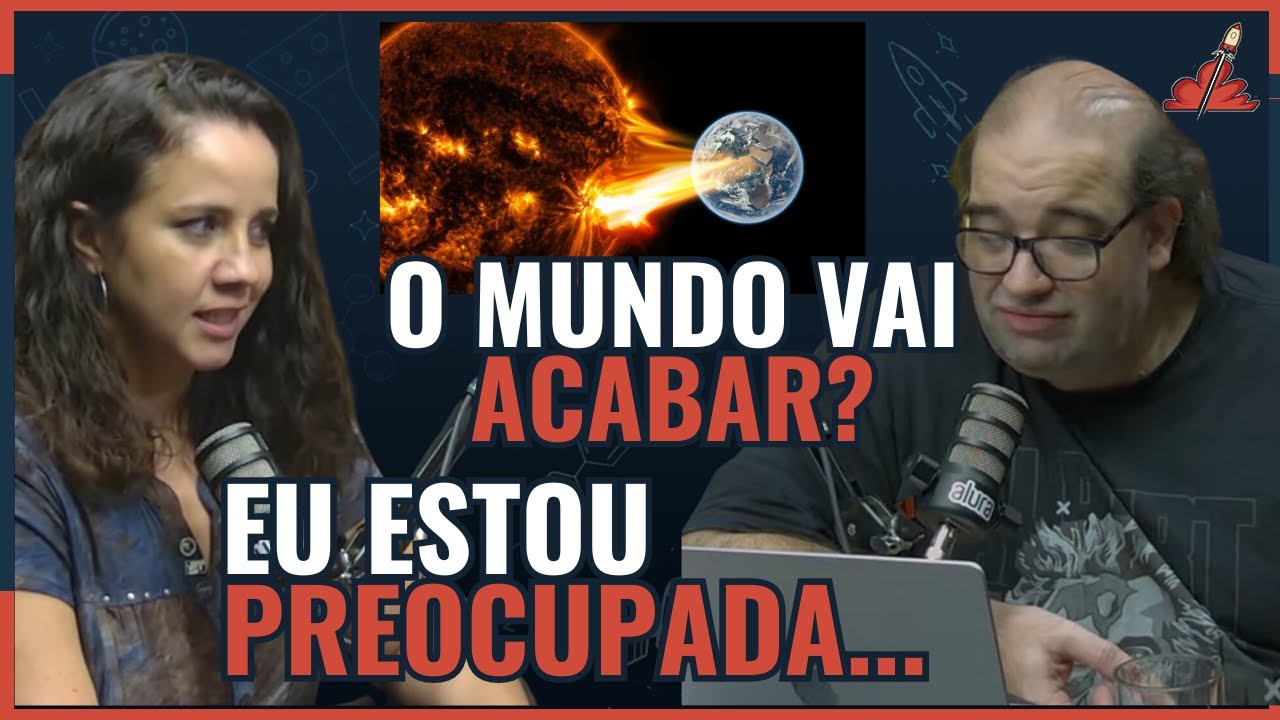
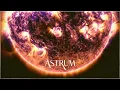
The Sun. A giant, bright, nuclear-powered celestial object . It releases billions of tons of electromagnetically charged plasma into space every day.
These violent eruptions, called Coronal Mass Ejections, fire in all directions in the Solar System, causing what we know as solar storms. These highly charged plasma particles shoot towards Earth at over a million kilometers an hour, and you might think that with the speed and intensity of these particles, we should all head for the bunkers when they arrive. However, the Earth has natural protections to prevent most of these particles from reaching us.
One of those protections is the Earth's powerful magnetic field, which pushes particles around the planet and towards its poles. Particles that reach the atmosphere are absorbed and provide the energy to drive the climate on our planet. In fact, the Sun is crucial to the maintenance of life on Earth.
It provides just the right amount of heat and light so that plants can photosynthesize the Sun's energy into usable carbohydrates. This energy runs down the food chain to us humans. We eat and convert food into energy for the maintenance of our bodies.
Almost all food energy can be traced back to the Sun, our life-giver, and the beginning of our food chain. But could the giant of the solar system also create a catastrophe? How big can these coronal mass ejections be?
What if the biggest solar storm ever hit Earth tomorrow? Could the Sun really destroy humanity? For a star our Sun is relatively stable, a type of star informally known as a yellow dwarf.
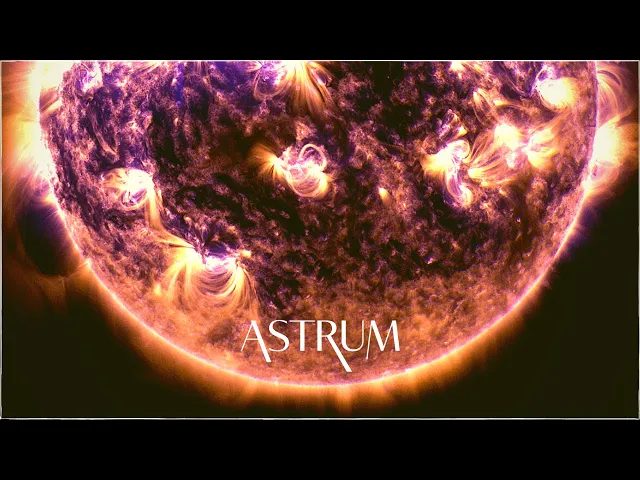
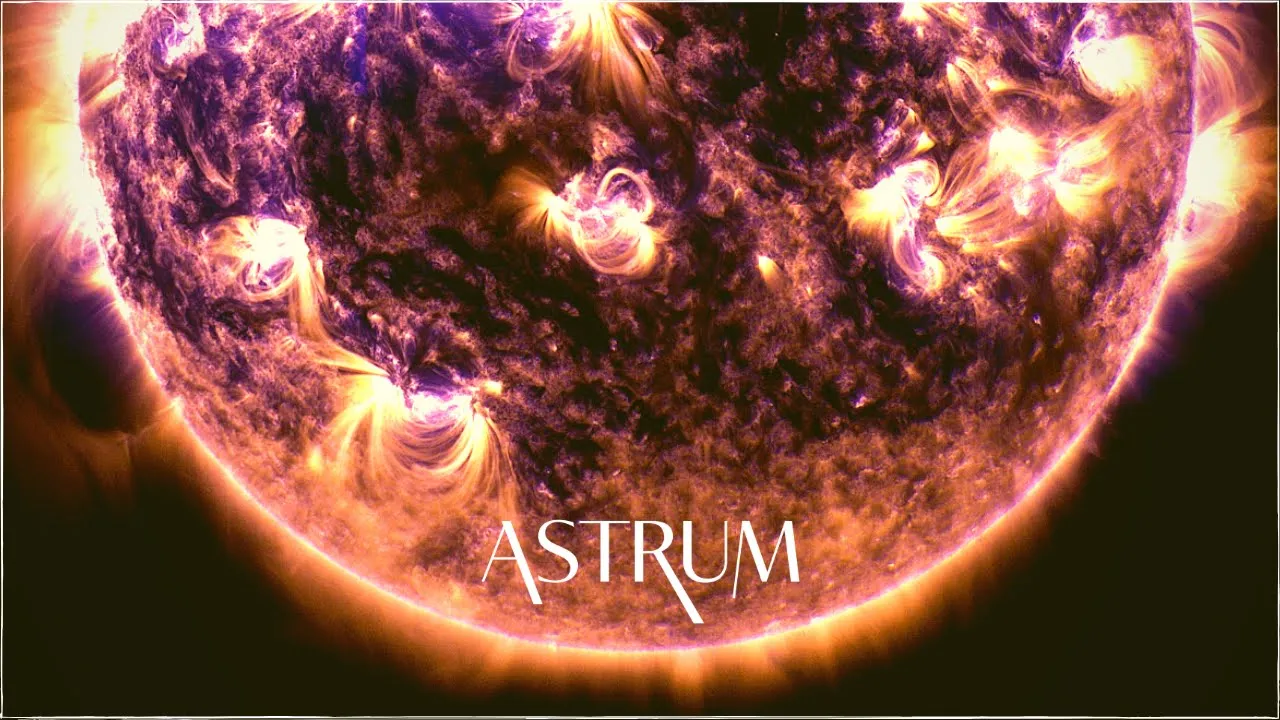
It's middle-aged and hasn't changed drastically in the last 4 billion years. We can be glad that our Sun is as stable as it is, because, unlike most other stars, the energy it emits is fairly constant. However, when looking at the images of the Sun taken by the Solar Dynamics Observatory, you can quickly see that even one of the most stable types of star has frenetic activity.
Spots, solar flares and coronal rings are present every day on the Sun's surface . We could say that the surface almost looks fluid, but the Sun is not solid, liquid or gas. It's a giant and almost perfect plasma sphere.
It is composed mainly of hydrogen and helium, and in its core, due to its enormous mass, nuclear fusion takes place. In the Sun's core, hydrogen atoms are fused under immense pressure to become helium. “The Sun itself, I mean, I tend to think of it as an onion, consisting of different layers.
So, right at the center of the Sun, that's essentially where nuclear fusion takes place. You have to think, essentially the sun is a huge ball of plasma, a soup of particles, ions, atoms, electrons, sort of all mixed up. On average, a photon takes something like 170,000 years to travel through the radiative zone.
I mean, yeah, I mean it's basically so dense. And from there, it reaches the Convection Zone. So everyone knows that warm air goes up and cold air goes down.
So what happens is the material is very hot at the bottom near the radiative zone and then it expands and rises to the surface. And that's the main heat transfer from that point forward. Obviously, so glowing from the surface like any hot material does.
” Plasma is an extremely good conductor of electricity and is also strongly affected by magnetic fields. “So sunspots are actually the superficial representation of the sun's magnetic fields. In fact, the magnetic fields get very entangled below the surface, so that between the radiative zone and the convective zone, the magnetic fields get tangled up.
They tend to appear in pairs, in groups. I mean, if you think of a magnet, it has positive polarity and negative polarity. I mean, this is normally what we see in sunspot pairs, you know, one would be positive and the other would be negative.
Typically, the strongest magnetic fields we observe are in sunspots. Sunspots can be from 15 km in size to about 160,000 km, that is, several times the size of Earth. ” Sunspots can often be seen at the base of several solar phenomena: coronal rings - large rings in the Sun's atmosphere.
Prominences - large, glowing, gaseous features that extend from the Sun's surface , reaching into space for thousands of kilometers. And solar flares - a sharp increase in the Sun's brightness and temperature. “Solar flares tend to occur in active regions.
Therefore, an active region is essentially groups of sunspots. So these are definitely the places where we see the strongest explosions. A reconnection event is essentially one that produces the energy that causes coronal mass eruptions and ejections.
As the convective zone is essentially very turbulent, many of the current simulations show that most of the magnetic field that rises through the convective zone is basically being destroyed, or diffused. It's more complicated; like twisted magnetic structures, like twisted magnetic fields, that tend to survive. And so you can imagine, especially over a large group of sunspots, we see very complex magnetic field configurations.
Magnetic fields that are twisted, basically creating these complicated geometric structures. And it is within these structures that magnetic fields and magnetic energy are stored. And what happens during a reconnection event: I tend to describe it if you think of the magnetic field as a rubber band.
So you twist and twist and basically at some point you pull too hard and it breaks. And that's essentially what we get in a reconnection event. And what happens during a reconnection event, essentially as the name suggests, is that the magnetic field lines reconnect.
And when that happens, you get a lot of energy being released. On the order of millions of nuclear weapons, nuclear bombs, all in an instant. And that energy will produce solar flares where large amounts of radiation are released and also potentially lead to large-scale movement of material suspended in the prominences, both towards and away from the Sun.
When this reconnection event happens, then again, the material that is suspended in these magnetic fields will normally move one way or the other. Much will move back to the Sun, often following these magnetic field lines and moving to the footprints, for example, to the sunspots if that's where the footprints are. Likewise, in the midst of these magnetic fields, often a blob of material is essentially ejected away from the sun.
So what you're going to end up with is millions of tons of loaded material flying off the Sun relatively quickly. On the order of hundreds of kilometers per second to thousands of kilometers per second. And this is what we call coronal mass ejections.
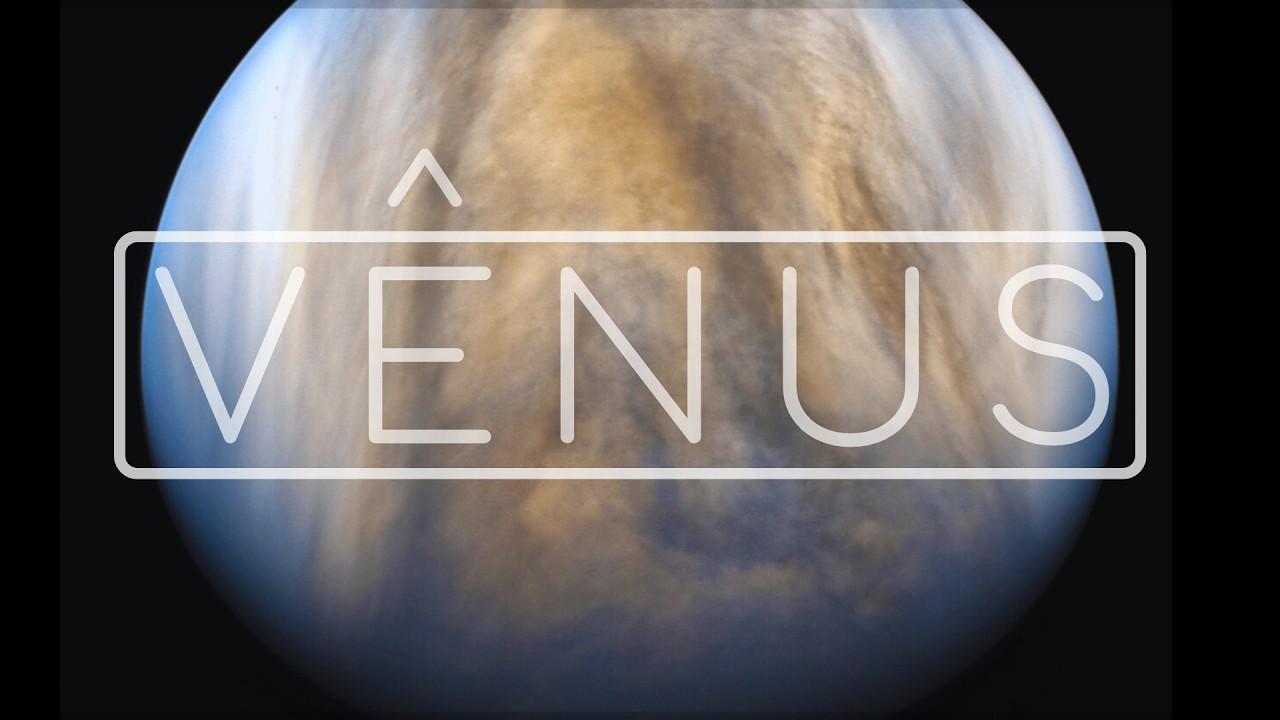
” These ejections are in contact with the planets all the time. Venus, when faced with a coronal mass ejection, has its lightest particles ripped out of the highest parts of its atmosphere by the force of the ejection. This leaves the planet with only the heaviest molecules, a toxic pollution that can not - as far as we know - sustain any kind of life.
If not for its relatively strong magnetic field, Earth would face a similar fate. Particles from a coronal mass ejection towards Earth are redirected around the planet because of the Earth's magnetosphere. Some particles are redirected to the poles, where charged particles hit the ionosphere, causing beautiful auroras.
Thanks to a combination of Earth's magnetosphere and atmosphere, we are completely protected from all kinds of particles coming from space. But to what extent? When the Earth is hit by a coronal mass ejection, we call it a 'geomagnetic' storm or 'solar' storm.
When a solar storm hits us, the Earth's magnetic field gets a little compressed by the force of the ejection. Normally, this is not a problem for us who live on the planet's surface. But what if the most powerful solar storm ever recorded hit Earth today.
. . To find what is believed to be the record of the most powerful coronal mass ejection, we have to go back to the year 1859, to a solar storm known as Carrington event.
From August 28 to September 2, 1859, many sunspots appeared on the Sun in one place. On August 29, auroras were observed in far north Queensland, Australia, indicating that a solar storm was taking place. Before noon on September 1, amateur astronomers Richard Carrington (who named the event) and Richard Hodgson separately saw and recorded an extremely bright solar flare.
Carrington and Hodgson independently wrote reports, which were later published in scientific journals. The explosion was connected to a large coronal mass ejection that traveled directly to Earth, taking 17. 6 hours to make the 150 million kilometer journey, much faster than the expected speed for these ejections.
Typically, a coronal mass ejection takes several days to reach Earth. The high speed of this ejection was attributed to a previous ejection event, perhaps the cause of the great aurora event on August 29 in Australia, which cleared any ambient solar wind plasma for the Carrington event, like a giant whirlwind. With the vortex in place, the path was set for the largest coronal mass ejection event known to man.
From September 1-2, 1859, the largest geomagnetic storm on record occurred. Auroras have been seen around the world, across the northern hemisphere to the southern and Caribbean. The dawns over the Rocky Mountains in the United States of America were such a bright green glow that it woke up the local gold miners, who promptly began preparing breakfast as they believed it to be dawn.
It was reported that because the dawn was so bright, people in the northeastern United States of America could even read a newspaper. The aurora was visible far away from the poles, as in Sub-Saharan Africa, Mexico, Australia, Cuba, Hawaii, and even in the lower latitudes very close to the equator, as in Colombia. It was an unprecedented event, as normally auroras are not visible at mid- latitudes.
On September 3, the dawn in the sky was considered the clearest and brightest ever. However, while this storm was beautiful, it also brought unforeseen problems. One consequence of the geomagnetic storm was that electrically charged particles from the Sun overloaded telegraph systems across Europe and North America, causing all systems to fail, even in some cases causing electrical shocks to the people operating the telegraph equipment.
The telegraph poles threw sparks from the charged atmosphere. Surprisingly, some telegraph operators could still continue to send and receive messages even with their power supplies completely turned off. The storm was comparable to an electromagnetic pulse bomb, quite harmless to humans but extremely harmful to electronic equipment.
The force of the coronal mass ejection in 1859 was so great that it compressed the magnetic field throughout the Earth's atmosphere. Due to the fact that North America and Europe were facing the Sun, they became the most affected areas in the world by the first particles of this powerful coronal mass ejection. In retrospect, some of the geomagnetic storms since the 1850s have indeed been powerful, but not that devastating.
For example, in March 1989, a coronal mass ejection hit Earth, rendering satellites unusable for several hours and congesting radio stations in Europe. Some people mistakenly thought it was a Soviet attack, and that the glow in the sky was the result of nuclear bombs. Fortunately, however, this solar storm, and many others like it, did no permanent damage .
Today, if a coronal mass ejection the size of the Carrington Event or larger were to hit Earth, the consequences would be far more disastrous than they were for mankind in the 19th century. Technological development was in its infancy at that time, whereas today we have satellites in space, computers, telecommunications, power plants and much more that would be severely damaged in a similar event. Due to the range of a solar storm, it would have a large impact on equipment over a large area, and the most susceptible technologies would be grid and telecommunications, which have cables running over great distances.
Without the proper protections in place, mains transformers could be damaged, and millions of people would be without power for an extended period of time. With substantial damage to transformers, it would take years to replace them, as they take years to manufacture. Often these transformers are tailored to the specific need and are not mass produced.
Without power, refrigerators would not be able to prevent food from spoiling, and since the transport system would also be inactive, as gas stations need electricity to pump, replacing that food would be problematic. Electronic payment systems would not work. Without power, we wouldn't have Internet access, and battery-powered devices would quickly run out.
Radio and TV stations would be stopped. Hospitals would struggle when standby generators ran out of fuel. We would be completely isolated from the outside world.
The world is just so dependent on technology, especially electricity, that we may have lost the ability to function as a society without it. And our entire electricity grid is the most vulnerable to a major solar storm. An independent initiative has estimated the cost of damage to the US alone at $2.
6 trillion, which would ultimately destroy the US economy. And that doesn't cover the potential social impact of such a devastating event. As is often the case in natural disasters, some people will no doubt resort to more primitive instincts, with attitudes like 'every man for himself'.
Chaos, looting and lawlessness can occur. And this could get worse over time, if the population decided to ignore the government or authoritative organizations. While this is a possible scenario, hopefully, in such a situation, the good of humanity would prevail.
This independent initiative calculated the estimated recovery time to repair damage from a powerful coronal mass ejection; from 4 to 10 years! And he estimated that two-thirds of the population of the United States of America could die of hunger, disease and chaos during that period. We just need a few examples to understand the gravity of the situation.
In 1989, Quebec City experienced a massive solar storm that caused the power grid to fail in just 90 seconds. This problem was compounded by the fact that it was winter, where the temperature could drop to negative levels, which left vulnerable people in an already potentially bad situation. Power was restored just nine hours later, and the total cost of the outage was estimated to be around C$2 billion.
From a social perspective, imagine the damage in Puerto Rico, which was still without electricity for 45 days for more than 80% of its population, after being hit by Hurricane Maria. This means that more than a million people have been left without access to safe drinking water, with nearly 6,000 people being left homeless. If a solar storm hits us, it wouldn't just be an island that would become powerless; it would be an entire hemisphere.
And at times, we come very close to taking the full charge of such a devastating event . An event the size of Carrington could have been a reality in 2012, when a massive coronal mass ejection was expelled by the sun. This was the largest ejection ever recorded with modern technology and directly hit one of the STEREO satellites observing solar activity.
It is the charged particles that caused this distortion effect right after the solar flare . Had it hit Earth, this hypothetical disaster scenario could have become a reality. Due to the lack of historical evidence, we have no way of predicting when a new and devastating ejection might hit Earth.
As far as we know, an even bigger ejection than the Carrington event could hit us tomorrow, or the next could be in a few thousand years. But what mitigation plans does the world have in the event of such an event? Since 1995, NASA has placed a space telescope in orbit that constantly monitors the Sun for coronal mass ejections.
Since light travels much faster than the speed of an ejection, this would give us about 17 hours of warning before we were hit. If everyone acts fast enough, it could be enough time to shut down some plants, thus protecting the electricity grids. It's called the 'sunshield' program and, surprisingly, the United States is currently one of the few countries to have a similar program in place.
Other countries are also working on the development of transformers for temporary use with shorter production times. In addition, countries across the western world are currently in the process of proposing upgrades to power grids that would not allow an electricity spike caused by a geomagnetic storm to destroy the grid. This process, however, is time consuming and mired in bureaucracy.
It appears that countries are in no hurry to foot the bill to upgrade infrastructure. These measures to protect the electrical network are NOT yet in effect worldwide. It also appears that most people are not aware of coronal mass ejections, but fear less likely scenarios such as asteroids hitting Earth or alien invasion .
Humanity as a whole is shockingly unprepared for a natural disaster caused by a super solar storm. George H. Baker, Professor Emeritus at James Madison University, spoke before the House National Security Committee of the United States and gave the following explanation for the progress that is not being made: He said: "To a large extent, the lack of progress in protecting our infrastructure from [solar storms] is that the responsibility is distributed.
There is no single point of responsibility for developing and implementing a national protection plan . No one is in charge. ” When asked the US Electrical Reliability Corporation about protecting electromagnetic pulses, they replied, "We don't deal with that.
This is a DOD issue. ” The DOD responded, “The protection of civil infrastructure against electromagnetic pulses is a responsibility of the Department of Homeland Security. ” The Department of Homeland Security responded that the responsibility for protecting the power grid Power is in the care of the Department of Energy, as they are the designated Sector Specific Agency for energy infrastructure.
” And that unfortunately comes from one of the most progressive countries on the subject. And until humanity is prepared for a coronal mass ejection event, we really are at the mercy of our life-giving star.