They told you the story ended with the resurrection. They were lying. For 40 days after rising from the dead, Jesus walked the earth teaching his closest followers.
40 days. Yet most Christians have never heard a single word about what he actually said during that time. Why?
Because those teachings were deliberately erased from the Bible. You know, but they couldn't erase them everywhere. Hidden in the highlands of Ethiopia, locked away in ancient manuscripts written in a language most scholars can't even read, are the actual words Jesus spoke.
And when you discover what's in those texts, you'll understand exactly why the church spent centuries making sure you never found out. What Jesus predicted about our modern world is so disturbingly accurate, it will make your skin crawl. What he revealed about reality itself contradicts everything you've been taught.
And the warnings he gave, they're not about some distant future. They're about right now. If this shakes everything you thought you knew about Christianity, hit that like button and subscribe because what comes next will blow your mind even more.
Let me ask you something. How many books do you think are in the Bible? If you said 66, you're right.
Sort of. That's how many books are in the Protestant Bible that most Western Christians use. But here's what nobody tells you.
That number is arbitrary. It's not divine. It's not sacred.
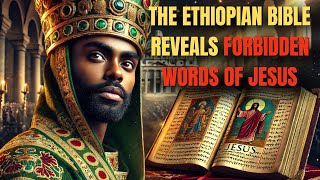
It was decided by men in positions of power who had very specific reasons for what they included and what they threw out. Now, let's travel to Ethiopia. The Ethiopian Orthodox Church has a Bible.
And their Bible, it has 81 books. Not 66. 81.
That's 15 entire books of scripture that have been sitting in Ethiopian churches for nearly 2,000 years while the rest of the world has no idea they even exist. Think about that for a second. 15 books, entire teachings, complete texts, just gone, removed, erased from the version of Christianity that spread through Europe and eventually to America.
How did this happen? Let's rewind to the 4th century. Syrian missionaries traveled to the kingdom of Axom, what we now call Ethiopia.
They brought with them a massive collection of sacred writings. These weren't just gospels and letters. These were apocalyptic visions, angelic encounters, and detailed accounts of what Jesus taught after his resurrection.
Rome was building its empire. And part of building an empire is controlling the narrative. The Roman church looked at all these texts, these wild, mystical, powerful texts, and made a decision.
Some of them were too dangerous, too uncontrollable, too likely to make people question authority. So they cut them out. But here's where it gets interesting.
Ethiopia was different. geographically isolated in the mountains, never colonized, never conquered. The Ethiopian church didn't answer to Rome.
They didn't follow Rome's rules. They didn't edit their Bible to make European bishops comfortable. They kept everything.
And for the next 1700 years, while empires rose and fell, while the western church argued and split and reformed, Ethiopia sat quietly in the mountains, preserving texts that the rest of Christianity had completely forgotten about. These aren't obscure footnotes. These aren't minor details.
We're talking about books that completely change our understanding of what Jesus taught, who he was, and what he said would happen to the world. One of the most important of these books is called the Mashafakan, the book of the covenant. And what this book contains is absolutely explosive.
Here's what you learned in church. Jesus died, rose on the third day, appeared to his disciples, and then ascended to heaven. End of story.
Time to sing a hymn. But that's not the full story. Not even close.
Between the resurrection and the ascension, there was a gap. 40 days. The Bible mentions it.
Acts 1:3. Jesus appeared to his disciples over a period of 40 days and spoke about the kingdom of God. 40 days, that's almost 6 weeks.
Jesus was on earth alive in his resurrected body teaching his closest followers. So here's my question. What was he teaching them?
The mainstream Bible gives us almost nothing. A few scattered verses, some vague references to the kingdom of God. That's it.
For 40 days of teachings from the risen Christ, we get maybe a few paragraphs. Unless you read the Ethiopian texts, the Mashafakan claims to be the actual record of what Jesus taught during those 40 days. And let me tell you, the Jesus in these pages is not the gentle, soft, spoken figure you see in Sunday school paintings.
This Jesus speaks with authority, raw, unfiltered authority. He's the king of heaven and earth. And he's giving his final instructions before leaving the planet.
And those instructions, they're not comfortable. They're not easy. And they're definitely not what the church wanted people to hear.
Jesus tells his disciples to go into the world and build God's kingdom. But, and this is crucial, not through political power, not through military conquest, not through building institutions and hierarchies. The Holy Spirit, he says, is the only real power they need.
Then he drops this bomb. What happens inside a person's heart matters infinitely more than temples, rituals, or religious ceremonies. Think about what that means.
Jesus, the founder of Christianity, is telling his followers that all the external trappings of religion, the buildings, the ceremonies, the rituals are secondary. What matters is internal transformation. But then comes the prophecy.
And this is where it gets chilling. Jesus predicts that his words will be twisted. That people will use his name for personal gain.
That there will come a time when crowds of people will shout his name in the streets. Build massive churches in his honor. Wear crosses around their necks, but their hearts will be completely empty.
He says, and I'm paraphrasing the text here, that people will construct temples of gold and stone while forgetting that the real temple is the human soul. Look around at modern Christianity, megaurches with million-doll budgets, televangelists with private jets, prosperity gospel preachers selling miracles for donations, religious leaders caught in scandal after scandal. Those words from 2,000 years ago, they're not prophecy anymore.
They're a description of right now. But Jesus doesn't stop there. He gets more specific.
He describes wars that will be fought in his name. He talks about lies being treated as truth and truth being called lies. And then there's this line that absolutely floors me every time I read it.
Blessed are those who suffer for my name, not in word, but in silence. What does that mean? It means the real believers, the people who actually followed Jesus' teachings, aren't the ones making the most noise.
They're not the ones with TV shows and best-selling books. They're the quiet ones, the forgotten ones, the people suffering in silence while others profit off Jesus's name. If that doesn't describe our current religious landscape, I don't know what does.
So, the prophecies are disturbing, but they're just the beginning. What Jesus showed his disciples next was so intense, so graphic that the Western church decided it was better if nobody ever read it. You've heard of the book of Revelation, right?
The Apocalypse of John. That's the last book of the Bible, full of beasts and dragons and the end of the world. Well, there's another apocalypse.
It's called the apocalypse of Peter. And while fragments of it exist in other places, the Ethiopian church has one of the most complete versions in existence. In this text, Jesus takes Peter, his most trusted disciple, to the top of a mountain right after the resurrection.
And he shows him two visions, one of paradise, one of torment. Now, I'm going to warn you, what I'm about to describe is graphic. This is not your typical fire and brimstone sermon.
This is detailed, specific, and deeply disturbing. According to the text, Jesus shows Peter exactly what awaits certain types of sinners. And the punishments are tailored to the crimes.
Corrupt judges who took bribes. They're standing in a river of fire up to their knees forever. People who gave false testimony in court.
They're shown chewing their own tongues in agony, unable to speak, unable to lie anymore. those who charged excessive interest and exploited the poor, hanging by their eyelids over flames. The imagery is so intense that it makes Dante's inferno, written over a thousand years later, look tame by comparison.
Now, why would Jesus show this to Peter? Why would he take his beloved disciple and give him nightmares for the rest of his life? The text gives us the answer.
This wasn't just about punishment. This was a warning. Jesus had just spent 40 days teaching about corruption, greed, and hypocrisy.
He'd warned that people would twist his message for personal gain. And now he was showing Peter, showing him visually, viscerally, what's actually at stake. This wasn't abstract theology.
This was real consequences for real actions. And the western church looked at this text and said, "Nope, too scary, too specific, too likely to make people actually fear judgment. " So they left it out.
But Ethiopia kept it. They preserved it. And reading it today, you can understand why it made religious authorities uncomfortable.
Because it suggests that how you treat people, especially how the powerful treat the powerless, has eternal consequences. That's a dangerous message when you're trying to build an empire. Here's where things get really interesting.
Because these texts don't just talk about the past or about abstract spiritual concepts. They make specific claims about the future. Our future right now, according to the Ethiopian writings, Jesus said that in the last days, meaning the end times, the final era before his return, something unexpected would happen.
His voice would rise again. but not from where people expected, not from the Vatican, not from famous preachers, not from powerful religious institutions. Jesus said his voice would come from the margins, from deserts, from mountains, from the descendants of slaves, from people and places that the powerful had dismissed and forgotten.
My spirit, the text says, will speak through those who are ignored by the powerful. This completely flips the script on traditional Christianity. The implication is clear.
If you want to find real faith, real truth, don't look at the top of the religious hierarchy. Look at the bottom. Look at the people nobody's paying attention to.
And where has this ancient Bible been preserved all this time? Ethiopia, a nation in Africa, a place that Western Christianity largely ignored for centuries. a country of people whose ancestors were enslaved, colonized, dismissed as primitive by European Christians.
The irony is almost too perfect. But there's more. The Ethiopian texts describe Jesus teaching about spiritual warfare, about angels and demons, about dark entities that influence the world.
And he gives very specific instructions about how to fight these forces. Not with weapons. Not with political power, with prayer.
But not the kind of prayer you learned in church. One text quotes Jesus saying, "Let your body become a living prayer. " Another says, "Let your silence speak louder than sermons.
" This is mystical Christianity. This is experiential faith. This is about personal transformation, not institutional religion.
And that's exactly why it was dangerous. Because if people can connect with God directly, if they can become living prayers on their own, then they don't need priests, bishops, or popes to mediate that connection. The church loses its monopoly on spiritual access.
Okay, we need to talk about the really wild stuff because some of these Ethiopian texts go beyond prophecy and warning. They dive into the nature of reality itself. According to these writings, Jesus taught that physical death is not the end of consciousness.
The body, he explained, is like clothing. It wears out. It gets old.
Eventually, you take it off. But the spirit, the conscious part of you, continues. When the body dies, the spirit returns to its true home.
Now, this isn't unique to the Ethiopian texts. But here's where it gets strange. Jesus apparently taught that the real danger isn't physical death.
The real danger is spiritual death. He described it as the death that walks while the heart still beats. Think about that phrase for a moment.
A person who looks alive, who's breathing, talking, working, going through the motions of life, but inside completely empty, spiritually dead. How many people do you know who fit that description? Maybe you felt it yourself.
Going through life on autopilot, feeling disconnected, like something essential is missing. According to these texts, Jesus called that spiritual death. And he said it's worse than physical death because at least when your body dies, your spirit can move on.
But if your spirit is already dead while you're alive, that's true tragedy. But here's where things get really philosophical. Some of the Ethiopian texts contain ideas that sound remarkably similar to ancient Gnostic teachings.
Gnosticism was an early Christian movement that the mainstream church declared heresy and tried to wipe out. Gnostics believed that the physical world was created by a false god. A being who thought he was the supreme deity but was actually ignorant of the true God beyond him.
Sound crazy? Well, some Ethiopian texts describe exactly this scenario. They talk about two creators.
the true God, pure light, pure spirit, the source of everything. And then another being, sometimes called the demi urge or the builder of shadows. This secondary being in his arrogance and ignorance created the physical world.
He thought he was the only god. He didn't know there was a higher power above him. So the world he created is mixed.
Good and evil, beauty and suffering, truth and lies, all tangled together, an imperfect copy of true reality. And according to these texts, Jesus came into this world not just to save people from their sins, but to wake them up, to help them realize they're living in a false reality. to show them that the true light of God exists beyond this physical world.
The mission of every soul, Jesus taught, is to find that divine spark within themselves and return it to the eternal light. Now, I know what you're thinking. This sounds like the matrix.
And you're right. The Wowskis, who created the Matrix, were heavily influenced by Gnostic philosophy. The idea that the world is a simulation, that we need to wake up from false reality, that's ancient Gnostic Christianity, and it's preserved in the Ethiopian Bible.
The Western church called this heresy. They burned Gnostic texts. They executed Gnostic teachers.
They did everything they could to make sure these ideas disappeared, but they couldn't reach Ethiopia before Jesus ascended to heaven. According to the Ethiopian writings, he gave one final prophecy and this one is the most relevant to us today. He said, "A time would come when love would completely disappear from the earth.
When faith would become nothing more than performance, when people would worship with their mouths but not their hearts. " Sound familiar? But here's the twist.
In that same time period, Jesus promised that his spirit would rise again. Not in grand temples, not in famous churches, not through powerful religious leaders. His spirit would move where religion cannot reach.
The proud will not see it, the text says, but the broken will. They will know me not through words, but through fire. What fire?
The fire of awakening, the fire of spiritual transformation. The moment when you realize what actually matters in life. And who will experience this awakening?
Not the religious elite, not the powerful, not the ones with all the answers. The broken, the humble, the ones who've been stripped down to nothing and forced to confront reality without any religious comfort. These texts teach that the kingdom of God is not somewhere far away.
It's not in the future. It's not in heaven after you die. It's inside you right now.
The human soul is the real temple. And every person has access to the divine directly. No intermediary needed.
No priest required. No church membership necessary. Just you and God.
direct connection. That's the core message of these Ethiopian texts. And you can see why the institutional church found it threatening.
So why Ethiopia? Out of all the places on earth, why was this small African nation the one that preserved these dangerous revolutionary texts? The answer lies in Ethiopia's unique history.
Ethiopia is one of the oldest continuous civilizations on Earth. And unlike almost every other African nation, it was never colonized. When European powers carved up Africa in the 1800s, Ethiopia remained independent.
They defeated Italy in the Battle of Adwa in 1896. They maintained their sovereignty through World War II. And most importantly for our story, they maintained their religious independence for 2,000 years.
Many Ethiopians trace their heritage back to the biblical era. According to their national epic, the Kbra Nagast, the Queen of Sheba, was Ethiopian. When she visited King Solomon in Jerusalem, they had a son named Menelik.
And when Menelik returned to Ethiopia, according to tradition, he brought the ark of the covenant with him. Yes, that ark of the covenant, the one from Raiders of the Lost Ark, the gold covered chest containing the original ten commandments written by God's own finger. Millions of Ethiopians believe the ark is still in Ethiopia today, guarded in a small chapel in the city of Axom.
Only one monk is allowed to see it and he's appointed for life. Nobody else gets in. Not archaeologists, not historians, nobody.
Whether you believe this or not, it tells you something important about Ethiopian Christianity. They see themselves as the guardians of ancient sacred knowledge. They take that responsibility seriously.
Christianity came to Ethiopia in the 4th century, making it one of the oldest Christian nations on Earth. Historical records from the sixth century describe Ethiopia as already being completely Christian. While Christianity was still spreading through Europe, still fighting with pagan religions, still being persecuted by Rome, Ethiopia was already a fully Christian kingdom.
And here's the crucial part. They developed their version of Christianity in isolation. They weren't influenced by the Council of Nika.
They weren't affected by the Protestant Reformation. They weren't touched by the Catholic Orthodox split. They created their theology independently based on the ancient texts they'd preserved.
So when Rome was editing the Bible, cutting books, deciding what was orthodox and what was heresy, Ethiopia was in the mountains, completely disconnected, following their own path. They kept books that everyone else threw away. the book of Enoch, the book of Jubilees, the Apocalypse of Peter, the book of the Covenant, and they wrote their Bible in GZ, an ancient language that almost nobody outside Ethiopia can read.
This linguistic barrier acted as another layer of protection. Even if someone wanted to suppress these texts, they couldn't if they couldn't read them. Ethiopia became a time capsule, a snapshot of early Christianity before it was standardized, sanitized, and controlled.
Let's talk specifically about what's in these extra 15 books. Because this isn't just filler. These are texts that completely change our understanding of biblical history.
The most famous is the book of Enoch. And this book is wild. It tells the story of a group of angels called the watchers.
These angels were assigned to observe humanity. But they didn't just observe. They fell in love with human women.
And they came down to earth and had children with them. These children were called the Nephilim. And they weren't normal humans.
They were giants. Powerful, violent, monstrous giants who terrorize the earth. But it gets darker.
According to the book of Enoch, these angels didn't just have kids with humans. They taught humans forbidden knowledge, weapons, warfare, cosmetics, sorcery, astrology. They corrupted humanity.
And this corruption led directly to the great flood. God sent the flood not just because people were wicked, but because fallen angels had contaminated the human race. Now, here's what's interesting.
The early church fathers cited the book of Enoch as scripture. Jude in the New Testament directly quotes from it. Early Christian writers like Tatulan and Irenaeus referenced it constantly.
But over time, the church decided it was too strange, too detailed, too problematic. The story of angels having sex with humans and creating giants was deemed too bizarre for mainstream Christianity. So they left it out except in Ethiopia.
They kept it. They still read it in church services. They still teach it as scripture.
And because they kept it, we can read it today. We can see what early Christians actually believed about angels, demons, and the supernatural world. Another crucial text is the book of Jubilees.
This book retells the stories from Genesis and Exodus, but with additional details not found in the mainstream Bible. It gives specific dates for events. It describes angels helping Moses write the Torah.
It contains laws and teachings that don't appear anywhere else. Both of these books were found among the Dead Sea Scrolls, proving they were widely read in ancient times, but only Ethiopia kept them as official scripture. So, here's what we're left with.
These texts exist. They've existed for nearly 2,000 years. They contain teachings attributed to Jesus that never made it into the Bible you grew up reading.
And those teachings are specific, detailed, and disturbingly relevant to our modern world. Jesus predicted corruption in the church. We see it everywhere.
He warned about people using his name for profit. Televangelists prove him right every day. He said truth would be called lies and lies would be called truth.
Look at our political and religious landscape. He described a time when faith would become performance. When people would worship with their mouths but not their hearts.
When massive temples would be built while the real temple, the human soul, would be neglected. That's not prophecy anymore. That's documentation of right now.
These Ethiopian texts paint a picture of Jesus that makes religious authorities uncomfortable. A Jesus who values internal transformation over external religion. Who speaks through the marginalized instead of the powerful.
Who teaches that every person has direct access to God. That Jesus is dangerous not to ordinary people but to institutions built on controlling access to the divine. So the big question remains, are these texts authentic?
Did Jesus really say these things during those 40 days after the resurrection? We can't know for certain. Historical verification is impossible.
These are ancient religious texts preserved by a tradition that claims apostolic authority. What we can say is this. The Ethiopian church is one of the oldest Christian traditions on earth.
Their Bible contains texts that predate the standardized Western Bible. Their version of Christianity developed independently of Roman influence. And the texts they preserved contain teachings that are consistent with the earliest forms of Christianity, the mystical, experiential, transformative faith that existed before it became institutionalized.
Whether these are the actual words of Jesus or early Christian teachings attributed to him, they represent a version of Christianity that the Western world deliberately suppressed. So what are we supposed to do with this information? First understand that the Bible is not a simple straightforward book that fell from heaven fully formed.
It's a collection of texts that were selected, edited, and compiled by human beings with specific agendas. Different Christian traditions preserved different texts. The Catholics have more books than the Protestants.
The Orthodox have more than the Catholics, and the Ethiopians have more than anyone. None of these versions is more correct than the others. They're just different traditions with different histories.
Second, recognize that the version of Christianity you learned might be incomplete. There are teachings, perspectives, and practices that were left out sometimes deliberately. The mystical elements, the emphasis on direct spiritual experience, the warnings about institutional corruption, the focus on internal transformation over external religion.
These aspects of Christianity still exist. They're in the Ethiopian texts. They're in the writings of Christian mystics throughout history.
They're in contemplative prayer traditions. They're in monastic practices, but they're not typically taught in mainstream churches. They're not in the Sunday school curriculum.
They're not what you hear from the pulpit. Third, and most importantly, consider what these texts say about the nature of faith itself. If Jesus really taught that the kingdom of God is within you, if he really said that what matters is internal transformation rather than external religion, then your relationship with the divine is fundamentally personal.
You don't need permission. You don't need special access. You don't need to go through intermediaries.
The temple is inside you. This doesn't mean organized religion is worthless. Community matters.
Tradition has value. Shared practices create connection. But it does mean that the ultimate authority in your spiritual life is not the church, not the priest, not the Bible itself.
It's your direct experience of the divine. That's a radical idea. It was radical 2,000 years ago.
It's still radical today, and it's preserved in these Ethiopian texts that the rest of Christianity tried to forget. The Ethiopian Orthodox Church sits in the mountains, protecting manuscripts that contain some of the most challenging, provocative, and transformative teachings ever attributed to Jesus Christ. These texts describe a Jesus who predicted institutional corruption, who valued the broken over the powerful, who taught that reality is more complex than we imagine, who promised his spirit would move where religion cannot reach.
For700 years, while the Western church built empires and fought wars and accumulated wealth and power, Ethiopia quietly preserved these dangerous, beautiful, revolutionary words. The teachings are there. The warnings are clear.
The prophecies are specific. The only question left is whether we're brave enough to listen. Because what these texts reveal isn't just history.
It's a mirror held up to modern Christianity, showing us exactly what Jesus warned would happen. And it's an invitation to something deeper, something more real, something that can't be controlled by institutions or contained in buildings, a direct connection to the divine, a personal transformation, an awakening, the fire Jesus talked about. Are you ready for it?
If this changed how you see Christianity, don't keep it to yourself. Like this video, subscribe to the channel, and share it with someone who needs to hear this message. The truth has been hidden long enough.