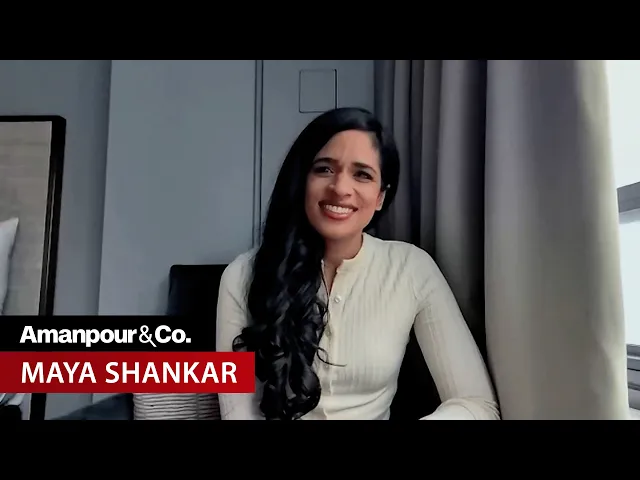
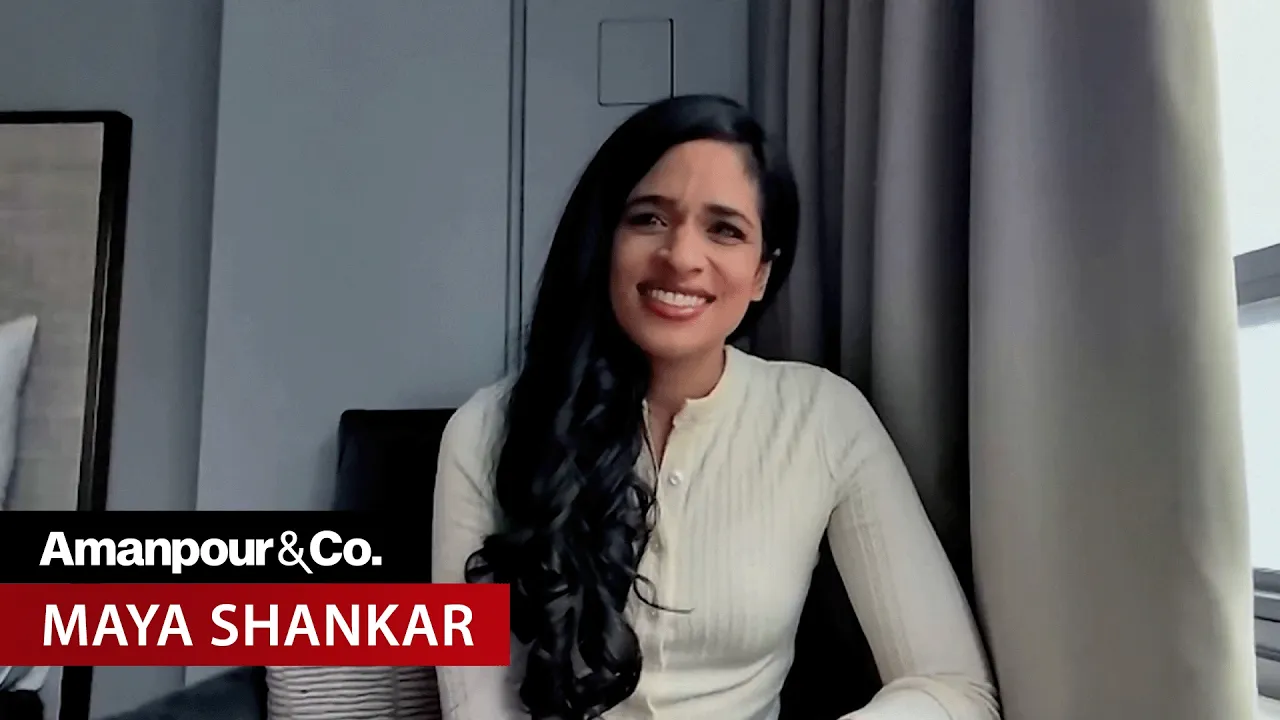
From global conflicts to the climate crisis and the growing threat of artificial intelligence, it's easy to feel overwhelmed by the uncertain times we're living in. But how can we best navigate it all? Maya Shanker is a cognitive scientist and former senior adviser in the Obama administration.
Her new book, The Other Side of Change, offers some guidance on ways to deal with the unexpected as she discusses with Hari Serina Vasan. >> Biana, thanks. Maya Shanker, thanks so much for joining us.
You have a book out called The Other Side of Change: Who We Become When Life Makes Other Plans. You've also had a very successful podcast for a number of years uh called The Slight Change of Plans. What made you want to talk about these things to write this book about change?
>> I think it's because I feel like I'm really terrible at navigating the unexpected changes in life and I find it really scary and really destabilizing. Um, for one, I don't love uncertainty. And it turns out that most of us, our brains are not wired to enjoy uncertainty.
One of my favorite studies shows that we are actually more stressed when we're told we have a 50% chance of receiving an electric shock than when we're told we have a 100% chance. So, we would rather be certain, hurry, that a negative thing is going to happen than to have to grapple with any uncertainty. And of course, a big unexpected change in our lives is accompanied by so much uncertainty.
And then there's also the loss of identity and and many other um very discomforting elements to the change process. And so I was so eager to figure out how can we all do change better, right? How it's going to come for all of us whether we like it or not.
And so as a cognitive scientist, I wanted to put on that that hat and explore this space further. >> Yeah. Yeah.
So tell me, I mean, is this the full gamut of changes, whether it's a new job, a new city, a divorce. I mean, what kinds of changes? >> The kind of change I'm most interested in is the one that is wildly unexpected.
The moments in life in which the anvil falls from the clear blue sky and we feel so unprepared and uncertain about how to move forward. It's so interesting because I think in these tough moments in my life, I've heard this mantra that while we can't control what happens to us, we can control our reaction to what happens. And it's meant to be an empowering mantra.
It's rooted in ancient wisdom. But in those moments, honestly, it is really felt hollow. It is rung hollow.
>> And that's because I haven't actually known how to change the way that I respond. um it's not like there's a a switch in my brain that I can just flip on that will suddenly make me feel more peaceful or more hopeful or more certain about the future. And so my goal in writing the other side of change was actually to give people a manual to pair powerful stories of change with the science of human behavior to help us understand how we can actually think and feel differently about these moments of disruption in life.
One of the quotes you have is what if we saw the hardest moments in our lives as a chance to reimagine ourselves rather than as something to just endure? What potential could change unlock within us? So how do we take that thing that feels like this heavy anvil and turn it into a potential for revelation?
>> So when a negative thing happens in our lives, it can feel like a personal apocalypse. Like the world that we knew and grew so comfortable with is no longer available to us. And one of the fascinating things that I discovered when doing research for the book is that apocalypse comes from the Greek word apocalypsis.
And this actually means revelation. And so that etmology is quite instructive. Basically what it's saying is yes, change can offend us, but it can also reveal things to us in these moments where we are thrust into a new reality.
the demands and stresses of our new situation can reveal things to us about who we are that were previously hidden from view. So things like our attitudes and beliefs about the world and ourselves um new capabilities, new ways of seeing the world. And I felt very heartened that we can at least have this to look forward to.
You know, I would say by and large out of the people that I interviewed for the book, they're not necessarily happy that they had to go through the change they went through, which makes a lot of sense, right? Who would welcome illness or heartbreak into their lives. Um, but what they were really grateful for was who they became as a result of the change they went through.
They were grateful for the newfound confidence or freedom they tapped into, the renewed relationship they had with their family, um the new possibilities that they envisioned for their future. All of that was an unexpected gift that came from the hardest moments of their lives. >> You write about a woman who suffers a stroke and has a very rare outcome, which is that she's really locked into her body and all she can control is the ability for her to blink.
And in that chapter, you write, "Our attachment to a specific identity can stand in the way of accepting our new reality. " Tell us a little bit about this woman and how she managed to deal with the most significant change we could ever imagine. >> Yeah, it was such a harrowing change.
And one thing that I've learned over the years is a primary reason change can feel so scary and so intimidating and so griefilled is that it can challenge our fundamental sense of self, our self-identity. And for Olivia, the woman in the book who has a massive brain stem stroke in her early 20s, she is left with what's called locked in syndrome. So, as you mentioned, when you have locked in syndrome, you cannot voluntarily move any of the muscles in your body except for the muscles controlling your eyes.
So, blinking is your only portal for communicating with the world around you. And one thing that I was so intent on doing with this book is to capture extraordinary stories, but ones that also had universal lessons, very relatable lessons that lay within them. And so it turns out that one of Olivia's biggest barriers is that she was by nature a people pleaser.
She really wanted to win the approval of others in her life. And what becoming locked in did is it limited her ability to curate an image of herself to be the kind of person that she thought would be palatable to those around her. And so it's an extraordinary story of someone having to reckon with really confronting their true self because she had no other option and learning to actually embrace that self and to learn how to love uh and accept herself fully.
And what I found so wonderful about Olivia's story is that it shows that our sense of selfidentity truly is valuable. I had a personal experience with change when I was a teenager in which I'd been an aspiring concert violinist. I was studying at Giuliard under the renowned violinist Pearlman and an injury ended those dreams overnight and I also felt this profound loss of identity.
I didn't realize until I lost the violin how much it had come to define me. And learning about Olivia's unbelievable experience of change, which of course um is so much more significant than anything I went through was so instructive for me. I learned that it can be precarious to anchor our identities too much to these precarious sources.
In my case, to what I did and that's because life can take away your what in a moment. And so I learned that actually one lesson for all of us is to instead anchor our identity to why we do the things we do. And when you identify what your why is, whether it's a commitment to service or having a creative outlet or improving at a skill, that why will be a stable force that serves as a compass to guide you towards your next steps.
>> You know, you write also about u denial in a way that I haven't seen before. And I wonder in these kind of moments of change, are we also sort of mourning a loss of a past? I mean, why are we in denial of what seems obvious to us when it hits us?
>> We can think of denial as a psychological immune response. So, in other words, researchers have said that denial is nature's way of letting in only as much as we can handle. And what's so interesting is that research has shown that in the short term, denial is not actually problematic.
It can actually be quite adaptive. And that's because it gives us a boost of resilience and much needed optimism and it allows us to believe that maybe there is a more promising path forward. Now of course denial in the longer term is problematic but I think we can be very intolerant when we sense that we are in denial or other people are in denial in the acute stages of grief but it's a very healthy part of the grieving process to experience this and it it might for many be a necessary stage.
There are so many different types of changes that we are collectively facing right now that I think at times people want to just check out and say I I can't control any of this. Uh or they get into this doom loop and they ruminate and they keep having negative thoughts over and over again. How do we how do we break out of that cycle?
>> So the first thing I'll say is that when a big change happens to us, it can also lead to lasting change within us. We fall prey to an illusion called the end of history illusion. And what this says is that while we fully acknowledge we've changed considerably in the past, we fail to appreciate that we're going to change moving forward.
And so researchers say that we falsely believe that the present moment represents this watershed moment in time in which we have become the person we will be for the rest of our lives. But of course that's not true. We're always changing and a big change can actually accelerate these internal transformations.
So when you're feeling very daunted at the outset of a change, right, whether you're anxious about your job and the role of AI, whether you're anxious about some other change that might happen within your family, just remember that there's a little bit of hope there because the person that you are right now will not be the person who's actually navigating the full experience. that person will be different armed with new values and new capabilities and new perspectives and new ways of tackling the challenge. The other thing I would say is that you can use a bunch of different effective anti-rumination strategies.
One of my favorite it's called affect labeling and this is when you simply give a label to the negative emotions that you're feeling. So in the aftermath of change you might feel that your brain is just spiraling in negativity but actually identifying what you're feeling. So maybe it's frustration, maybe it's anger, maybe it's grief.
Um that can help you shift your focus away from being the emotion towards simply having the emotion. And when you simply have an emotion, it breeds psychological distance between you and your current preoccupations and allows you to see your problem with more clarity and objectivity. >> You know, one of the things that you also mention is sort of the power of awe.
And I know we can't all sort of go and stand on the edge of the Grand Canyon every day, but what are ways where we can inject kind of awe into our lives that might help break these negative doom loop cycles? >> Awe is one of my favorite anti-rumination strategies and that's because it really is available to all of us. Now, naturally, when we think about awe, we think about things like music and art.
But there are other kinds of awe that I think is underrecognized is called moral beauty. And this is when we actually just witness other people's extraordinary actions or behaviors. That might be their kindness or self-sacrifice or courage or resilience or ability to forgive another person.
And that truly is everywhere. It might be at the supermarket when you watch someone be extra kind to an elderly shopper or at the playground when you witness a little kid stand up to the bully. Um, and what's really important to understand about awe is that when we are in the presence of something vast that transcends our understanding of the world, this is the definition of awe.
It really does change our brains. And that's because it will dampen the activity in the default mode network in the parts of our brains that are associated with self immersion. And so by doing that, it allows us to step outside of our individual wants and needs and anxieties and to see ourselves as part of a larger whole and again to be able to see our problems with a bit more distance and a greater sense of wonder and possibility.
>> You write about uh an individual named Reginald Dwayne Betts and his story. At the age of 16, he was sentenced to 9 years in prison for an armed carjacking. And he said that with one guilty plea, quote, "The list of possibilities has been reduced to no possibilities.
" And since leaving prison, he is, you know, won several awards for his poetry. He's gone to law school. He's a a prison reform advocate.
From his story, how did he create kind of these alternate possibilities for who he could be? I think we're all familiar with that feeling we have when life makes other plans for us and we see all of these doors closing around us. What research shows is that when we try to pick up the pieces and reimagine who we can be in our new circumstances, our imaginations can really restrict us.
And that's because we can carry unfounded assumptions about the kinds of futures that are available to someone who's facing our new situation. So, for example, someone who's just lost their job or is now a full-time caregiver or is navigating an illness or like Dwayne is incarcerated. And one of my favorite strategies for cracking open our imagination for seeing that there are actually more expansive possibilities for us is moral elevation.
So, we talked a little bit about moral beauty, right? As a form of awe. Well, what is moral elevation?
It's that warm fuzzy feeling that we get in our chest when we witness someone else's extraordinary behaviors. And what happens is when we experience someone else defying our understanding of what humans are capable of, in this case, in the best way possible because they've shown us the best of humanity. It can actually crack open our own imagination about what we are capable of.
And what Dwayne shares is that it was actually an encounter with a fellow prisoner, a guy who showed such deep care and kindness to the younger men in prison. He helped teach them how to box to protect them from the threat of violence that inspired Dwayne to realize, oh, he could use his voice to actually protect the young men in prison. And he ended up deciding to become a poet, to use words to dignify the experience of men of color within the prison system.
And as you mentioned, he's just had an incredible um path and and so much success. And I just love that it was a moment of moral elevation that led him to this point. You share very vulnerably on your first on your podcast and now on the book your own journey with miscarriage and surrogacy and you know you write I was going to be a violinist and then I was going to be a mother and now I find myself conceiving of a future in which I am neither.
Unexpectedly I'm more hopeful than I've ever been. How did you get to this place of hopefulness? So, long story short, my husband and I had been trying to start a family for at this point about six or seven years.
And I still remember the night we found out that our surrogate had miscarried for a second time and that we had lost identical twin girls. And I was just devastated, Harvey, because the day had been a total emotional roller coaster. We had seen healthy beating hearts in the afternoon and then we get greeted with this really tragic news that uh the pregnancy was not going to work.
And I remember just being under the covers just, you know, feeling really, really miserable and very despondent and like all the color from my future had been drained, that it had been turned to grayscale because one of the earliest dreams I ever had was to become a mom. And I remember my husband Jimmy came into the room and he said, >> Maya, let's do a quick gratitude exercise. >> And let me tell you, in that moment, I was not having it.
I was like, Jimmy, >> you go do your toxic positivity thing in the corner. I'm not doing this. I'm staying under the covers.
>> But there was something so earnest about his request. And so I thought, okay, let me just try this. And by the way, what he was having me engage in unknowingly was called by psychologists a self-affirmation exercise.
And this is when you list all the things that bring you meaning in your life, that give your life purpose that are not threatened by the change you're going through. And so I engaged in this self-affirmation exercise and I just started to rattle off some items. I said, "Well, you know, first and foremost, I'm grateful for you, Jimmy.
Um, I'm also grateful to be an aunt to my six nieces and nephews. I'm grateful that I get to go into the little uh closet in my apartment and record my podcast, The Slight Change of Plans, where I get to hear extraordinary stories of people from all over the world. " And it was so incredible because as I was doing this exercise, I feel like something magical happened, which was that for the first time in years, I zoomed out on my life, I let go of the tunnel vision that I developed when I was so intently focused on achieving this goal of mine of trying to be a mom.
And I saw that my life was still so rich and multi-dimensional. There were so many other identities that I still found so much meaning and value in. And so I would encourage people whether they're in the throws of change or not to do this quick exercise.
Take five minutes to write down all of the things that bring your life meaning. And it will just help you to see your life as a whole and to not feel that every fiber of your being is being threatened when something you know doesn't go according to plan. >> The book is called the other side of change.
The podcast is called a slight change of plans. Maya Shanker, thanks so much for joining us. >> Thank you so much for having me.
Sorry.