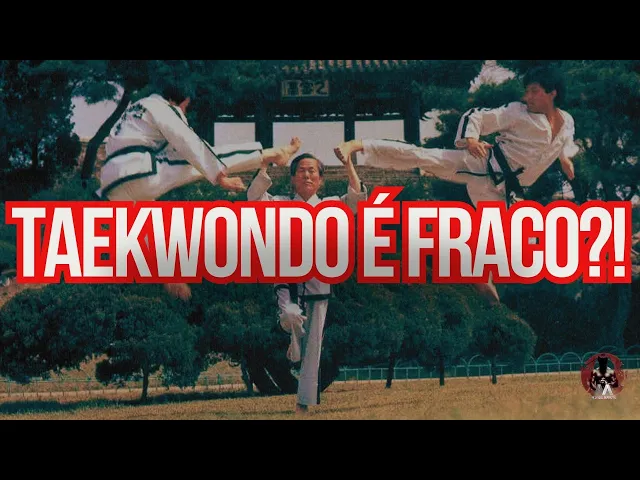
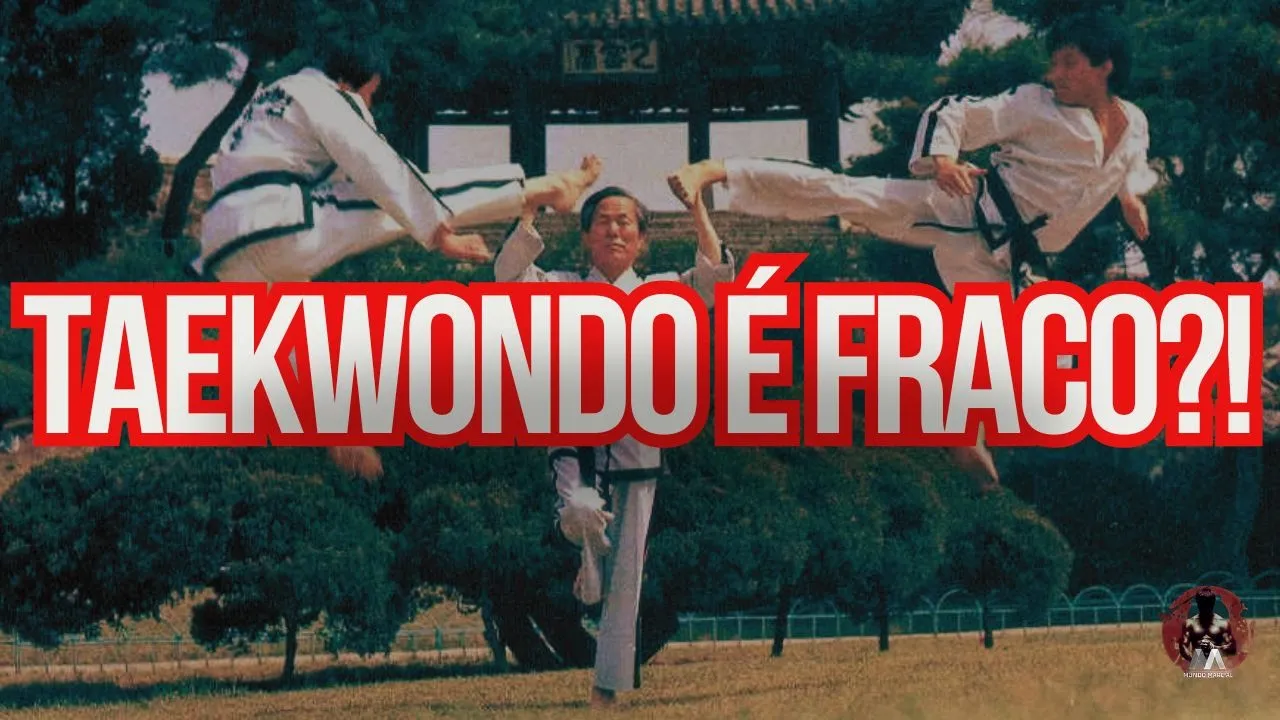
Welcome to Martial World, today we are going to delve into a topic that has generated a lot of debate in the world of martial arts: the bad reputation of Taekwondo. Once considered a versatile and effective system of self-defense, modern Taekwondo has increasingly been associated with one-dimensional sporting and technical competitions. But what caused this Korean martial art to lose part of its prestige.
In this video, we will explore the reasons behind Taekwondo's bad reputation. Get ready for an in-depth analysis of the current state of this martial art that has conquered the world, but which today faces challenges in maintaining its relevance. Taekwondo emerged in the 1950s as a military combat system rooted in self-defense.
The early traditional style was a comprehensive system designed to cover most combat scenarios a person might face in self-defense situations. Students used to learn to strike with: Kicks, Punches, Elbows, Forms and Sparring. Aerobic and anaerobic training, Grappling basics (throws, holds and takedowns) Self-defense tactics.
Later, Taekwondo would split into different organizations due to internal disagreements between the different Taekwondo organizations. The problem was that each of these Taekwondo organizations would create their own variation of the system, teaching methods, and rules. And that's when the problems started to arise.
In the following decades, the sporting variation of Taekwondo would become increasingly popular. Not just in Korea, but all over the world. So much so that in 1988, Taekwondo was given the chance to appear in the Summer Olympics as a demonstration sport and would be accepted as an official Olympic sport in 2000.
Taekwondo's growth exploded, with more and more gyms shifting their focus from self-defense to sporting competition. In a way, these sporting rules shaped and limited the entire concept of Taekwondo. To make matters worse, people began to recognize it as a popular sport rather than a self-defense martial art.
A versatile system that used to teach people how to fight in real life has become nothing more than a contact sport. So when people talk about the problems with modern Taekwondo, they are usually referring to the sporting variation of the system. This is important because you need to differentiate between traditional and modern practices to understand why Taekwondo has gained a bad reputation.
The reasons for its poor reputation stem from these factors: One-Dimensional Approach Traditional Taekwondo was a comprehensive system when it was founded in the 1950s. Although the emphasis has always been on kicking techniques, students also learned other strikes. They were taught to box, grappling, and apply proven self-defense tactics.
Modern Taekwondo, however, mainly revolves around direct kicks and punches. It is much more one-dimensional compared to the traditional variation. Students rarely do self-defense exercises or fight simulations that they might encounter in real life, other than direct blows to the body.
And grappling has been left out of the learning curriculum for a long time. The reason is simple: kicks are the most efficient way to score points in Taekwondo competitions, and modern Taekwondo schools today are mainly focused on achieving success in sports competitions. Therefore, modern Taekwondo schools believe that there is no point in teaching anything that will not improve your performance in tournaments, as they no longer prioritize self-defense situations.
The system has not evolved much over the years Overall, Taekwondo has not evolved much over time in terms of expanding the arsenal or creating more efficient variations of each movement. Some aspects have certainly evolved, but in the wrong direction. Students follow practically the same program and learn the same techniques and principles.
They rarely, if ever, get the chance to explore new ideas and techniques and implement them into their game. Not very popular among adults and teenagers In modern times, Taekwondo is much less popular among teenagers and adults than conceptually similar arts. Unfortunately, Taekwondo schools tend to focus more on classes for children and don't try too hard to attract adult students, even if they aren't very popular with adults.
Most of the adults you might see in a Taekwondo dojo are black belts who have been training for years. Rarely do you see a person in their late teens or early 20s joining a Taekwondo gym for the first time. Instead, most of them choose similar arts such as kickboxing, muay thai or boxing.
The main reason for this is that many adults are not interested in learning all aspects of Taekwondo. Adults place more importance on practical training than on the theoretical philosophy, practice of forms and use of uniforms, which are often associated with Taekwondo. Typically, adults look for hands-on training that can improve their self-defense skills quickly, without much interest in learning anything else.
However, it is interesting to note that what adults may find uninteresting in Taekwondo is actually valued by parents when it comes to their children. Parents greatly value the disciplined classroom environment that Taekwondo provides for their children. It plays a crucial role in your growth and encourages the development of positive personality traits.
As a result, taekwondo has become one of the most popular martial arts among children, especially in the Western world. For this reason, Taekwondo is often perceived negatively by adults as a martial art for children. Overemphasis on Competition Most modern Taekwondo schools emphasize competition over the self-defense aspect of training.
As a result, teaching methods and techniques are aligned with official competition rules. Instead of learning to fight, students learn to represent their schools and win matches. These point fighting rules greatly impact the overall effectiveness of the system because point fighting has very little in common with real fighting.
Taekwondo also receives criticism from other martial arts communities due to its emphasis on competition, leading them to view modern Taekwondo more as a sport than a traditional martial art. Defending Yourself Using Taekwondo The answer to this question varies depending on whether you are learning the traditional or modern style of taekwondo. Traditional taekwondo differs from modern schools in that it focuses on self-defense.
Students are taught how to use all limbs as weapons, basic grappling techniques, and self-defense exercises to protect themselves. Students practice sparring and mock fights regularly to prepare for most scenarios they may encounter on the streets. But in today's world, many Taekwondo schools have moved away from traditional teaching methods and are emphasizing sporting competition.
Although they may claim to teach self-defense, most of these schools focus on competitive techniques. Instead of learning to defend themselves, students are taught strategies for scoring points in sporting competitions against an opponent. Although modern Taekwondo teaching has its flaws due to differences between the rules of point fighting and actual combat, some learned skills can still be useful in combat situations.
Taekwondo teaches practical kicking, punching and footwork techniques that can be applied in real self-defense scenarios. This training is undoubtedly more useful than knowing nothing in combat situations. As we have seen, the excessive focus on sporting competitions and the neglect of aspects such as self-defense and grappling techniques have transformed this martial art into a system more focused on sport than on real combat.
However, it is important to remember that traditional Taekwondo still maintains its value as a complete martial art, and some of its elements, such as precise kicks and agile footwork, can be useful even in modern settings. If you are thinking about practicing Taekwondo, do your research and choose a school that aligns with your goals, whether for competition, self-defense or personal development. And you, what do you think of modern Taekwondo?
Do you believe he can still reinvent himself or is he doomed to be seen just as a sport. Leave your opinion in the comments and don't forget to like, share and subscribe to the Mundo Marcial channel for more content like this. Until next time.