Hello everybody. My name is Casey Cavell, founder of the Subdivide Guys, and today we're going to talk about survey hacks and subdivides, how to unlock hidden value in land. So, first, what is a subdivide?
Well, it's anytime you take one piece of property and divide it into more parcels. So, let's say you had a 10acre piece of land and you went through the process and you went to the county and you got a serve and you said, "Hey, I want to take this one 10acre piece of land and turn it into three different 3. 3 acre pieces of land.
" Each of those pieces of land gets its new tax ID. It has its own taxes. It could have its owner and so on and so forth.
Same thing, you have a 50 acre piece of land. You then go through the process and divide that up say five different ways into five 10 acre tracks and you can sell those off individually two different people typically for more money per acre than what you bought it for. Survey hack very similar where you are taking a piece of land and surveying it off of an existing piece of land that that owner may or may not keep.
So let's say there is a 100 acre piece of land and that owner just wants to sell you 50 acres. You would then say, "Hey owner, keep your 50 acres. I'm going to subdivide off 50 acres and keep the 50 acres and you keep your 50 acres.
" That is a survey hack. We've also done that and you're going to learn today in this presentation. You can do this off a home.
You could have a home on 50 acres and say, "Hey owner, you want to keep the home? Great. you keep the home in 20 acres, I'm going to go and take 30 acres and then inside of that 30 acres, you could then subdivide that depending on the regulations into three 10acre tracks or six 5 acre tracks.
And is this right for you? I think any real estate investor, any land investor should have the subdivide or survey hack as part of their arsenal. And I would say the part of your strategy should be subdivides and survey hacks because for me it's all about how do you add value to land.
I'm not big on offering somebody pennies on the dollar for their land and going after super distressed sellers. I would rather make somebody a fair priced offer and figure out how do I raise the value of that land so that way everybody wins. And that's what I like to do.
Creating win-win relationships. So jumping into module one, choosing a market. That's what we first have to do is go after the right market.
And for me, first the right market is all about the right property. For in my strategy, I typically focus on land deals that are 20 acres or more because I like to ultimately get paid based on the time I spend, not just the deals I get done. Because for me, if I can do more deals in less time and make more profit per deal, that's what I want to do.
So, when I first got started in this business, hey, do I want to buy a 2acre property for 40,000 and try to sell it for 80? Yeah, maybe. But I'd rather buy a property that's 20 acres and subdivide it off and pay 200,000 and make 200,000 on top of that because for me, it's big deals take the same amount of time as small deals, but you make a lot more money.
So for me, 20 acres and above is what I like or a home with 30 plus acres because ultimately our model is taking a property, let's say it's 20 acres and dividing it four ways into four, five acre lots or a home on 30 acres and letting the homeowner keep 10 acres, but we take 20 acres off. So that's ultimately what we like to do. And a lot of these properties, you have to have a certain amount of road frontage.
When somebody owns a home, they kind of want to have it near or pretty easily accessible to a main road. So, when I'm looking for properties, I like to find if I'm looking for a 15 to 30 acre property, at least 500 ft of road frontage because oftentimes you need 150, 200, 250 ft of road frontage to have a lot depending on the county. So, that's where we kind of came up with those numbers.
So, if I'm trying to find a 50 acre parcel, I got to probably have 750 ft of road frontage for me to get excited about it. It's more valuable the more amount of road frontage that it has. And then wetlands, you know, obviously you want the majority of your property to be buildable.
So, you know, we kind of throw in some uh percentages there on wetlands. Like I want less than 25% wetlands if it's a 15 or 30 acre lot because basically that's unbuildable, unusable area, per se. Okay, now let's go into the county.
So now you're clear on the property. Let's go into the county. Ideally, I'm trying to find a county that will let me at least split a parcel of land at least three times.
Typically, I want to understand the road frontage rules as well. I'm liking counties that let you do it with 150 200 feet of road frontage as well and counties that will potentially let you do some flag lots with some easements. An easement is basically um a ability for one owner to give access to another owner through property they own to access their property.
So, you're going to see flag lots and some examples here that I'm going to show and how we've been able to create those on deals. But yeah, ideally I like counties that will let me do flag lots, let me do easements, at least split properties three plus times. And the more flexible a county is, and the easier they are to work with, uh, even the better.
But I wouldn't rule out counties that aren't easy to work with because they're going to probably have a lot less competition. And then you also want to understand the zoning and land use. Can you put a mobile home on it?
Can you not? Um, right? Can you build a stick bill?
Can you not? because really you got to figure out when you're going and doing subdivides, who's going to buy this land from you? What are they going to use it for?
And you want to make sure counties are easy to work with. And the last thing I would say on county regulations is there's a minor subdivide and a major subdivide. Now, these are two really important things to understand.
A major subdivide typically makes you go in front of the county. It makes you go and get approvals. It makes you go and potentially reszone a property or get some kind of special use permit which takes time, energy, and money.
We focus on counties that will let us do minor subdivides. All we need to do is probably just have a surveyor come in, put together a plan for how we're going to divide this property, send it over to the county to get them to sign it, stamp it, and approve it, rather than having to go through all of the different hoops that a lot of these major subdivides do. Now, what I'll say is the more hoops you go through, the longer it takes, potentially more profit on the back end.
But I like properties that are simple and easy to subdivide, simple and easy to sell, that take a little bit of time. And a lot of times these counties, they'll have a subdivision ordinance or a zoning regulation that if you dig in, you'll really understand what is and is not permissible. Also, additional requirements when you're looking at properties and land.
Is there water? Does it have access to public water or do you need to put in a well on these properties which is an additional cost? Is there sewer access or will you need to put in a septic tank?
Most properties are septic. Some do have water. Um and then we already talked about the plat approval process.
I typically like to talk to local surveyors as well before I'm even um looking at properties to really see what all the hoops are because talking to the county and their officials is one thing, but the surveyors oftentimes will work with the county for you. So talking to surveyors to get a good idea is um is good as well. All right.
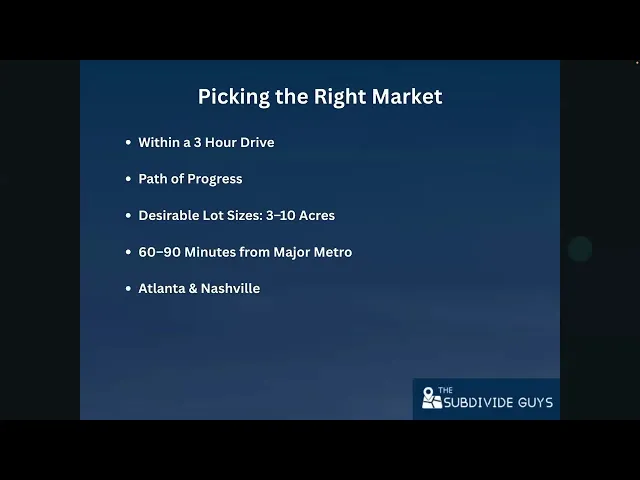
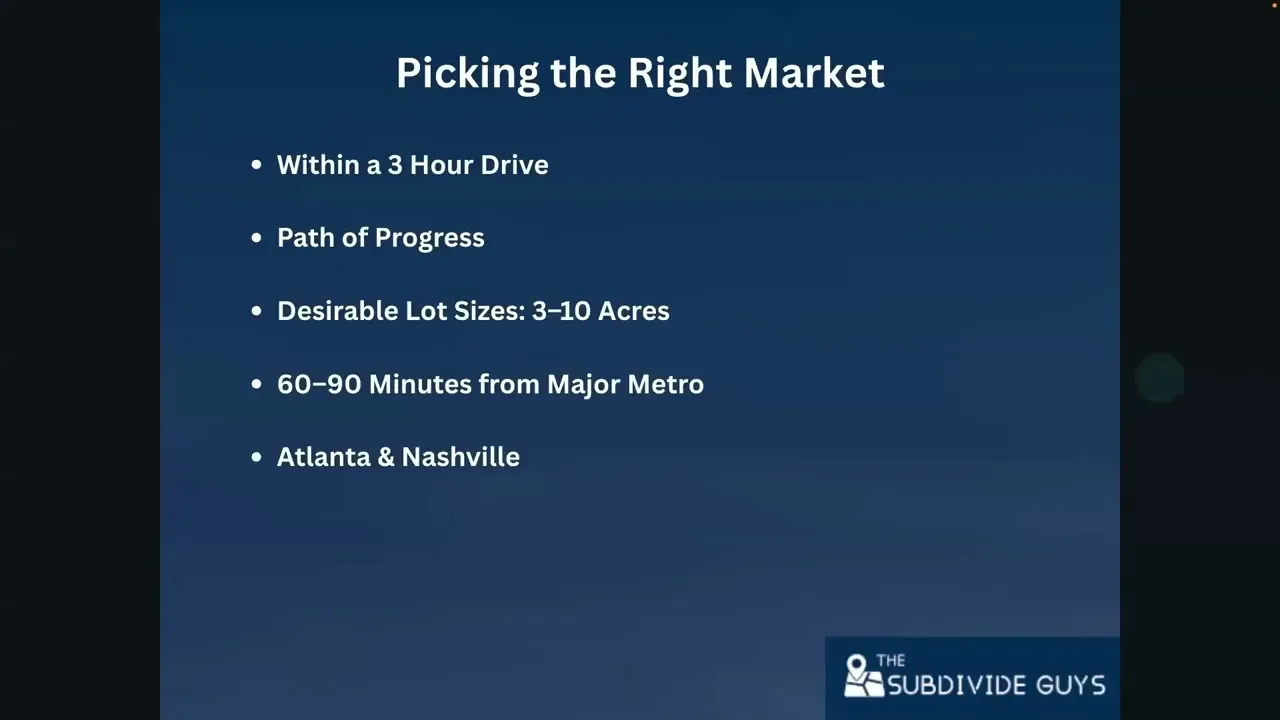
Now, we've talked about the right property, we've talked about the right uh county, now it's the right market for you. Ideally, if you're going after subdivides, you're going after these six figure type of deals where they're six figure in profit. I like to have something within a three-hour drive of wherever you live.
I want to know about these counties. I want to feel it. I want to be able to go drive a property if I need to.
And you're trying to find some counties that are within a three-hour drive that, you know, people are wanting to move to or they're desirable. You see that people are wanting to own a three acres and build a house. you're seeing that somebody wants to own 10 acres and build a homestead or or something like that on there.
And what I have found is a lot of time these are 60 minutes ideally, maybe 90 minutes max to a major metro area like in Atlanta or in Nashville. That's really where you want to be because you have people that could live there but then work in the city. And now more than ever, people might not have to go to the office four days a week or five days a week.
They might be able to go in one or two days a week, but you know, if it's 60 minutes, that's no problem. If it's 90 minutes, that's tough. So, I like to look 60 minutes really, no longer than that, outside a major metro area or a place of work where people want to go.
And you're going to know, hey, wow, look at all these homes in this county or this area inside of the county because it's not just counties, it's areas inside of counties. like the north part of a county might be different than the south part of a county and you really want to make sure you know where you're going. And inside of these counties, like I just mentioned, zip codes and school districts are really important.
You might be in north, call it Monroe County, Georgia. Well, that's a lot better than South Monroe County in Georgia. And that's because of certain landmarks or it's closer to grocery stores or restaurants.
You know, people if they're really going to raise a family on five acres or 10 acres, they probably want to be in a decent school district. They they probably want to be close to some restaurants or 15 minutes away from a grocery store. I was looking one county in Georgia, the north part of the county, 5 acre lots, were going for 50,000 an acre.
South part 10,000 an acre. So that's why I say find an area, find a county, and really research that county so you know exactly what you're getting into. Now, sales activity, how do you know it's good?
So, let's say we're going to go and buy a 40 acre piece of land and we're going to subdivide it eight different ways into eight five acre parcels. Well, now you got to sell eight different lots. That's a lot of properties that you have to sell.
So, the question is, how many of those type of properties have sold within the last 90 days? Well, if you have eight to sell and there's only three that have sold in the last 90 days, it's probably going to take you longer than 90 days to sell. Well, that's kind of okay, right?
I mean, if you're buying it, right, and there's a lot of profit here, you can do a subdivide. That might take you six months, 12 months, 18 months to sell, depending. You just want to make sure there is demand for that.
So, if I'm about to go and subdivide a property into four parcels, I probably want to see that there's four similarsiz parcels that are similar, that are all selling within 90 days of being listed, that are reasonably priced. And reasonably reasonably priced really means that um you know they're not overpriced which basically says if you're going to price a property at market or below market it's going to sell within 90 days. And if you can confidently say hey I'm buying 20 acres.
I'm going to make it four or five acre lots. Well I see other five acre lots are all selling within 30 days or 60 days or 90 days. And you know that price point.
then you can probably know, hey, I might be able to get in and out of this in three to six months, which is ultimately the goal from my perspective. And you can call some local agents and see kind of what they're seeing out there and so on and so forth. So that is module one.