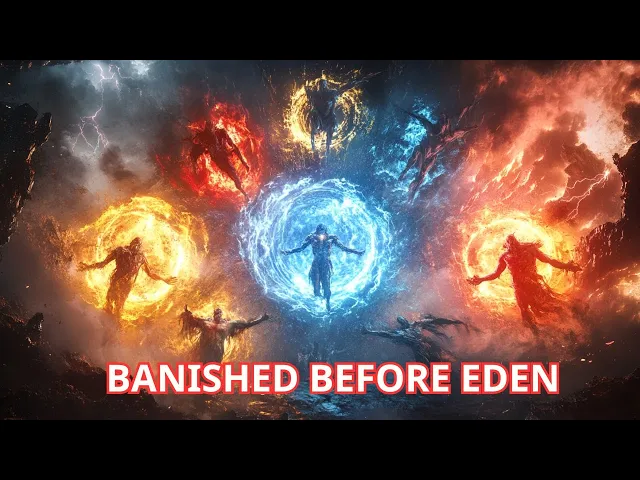
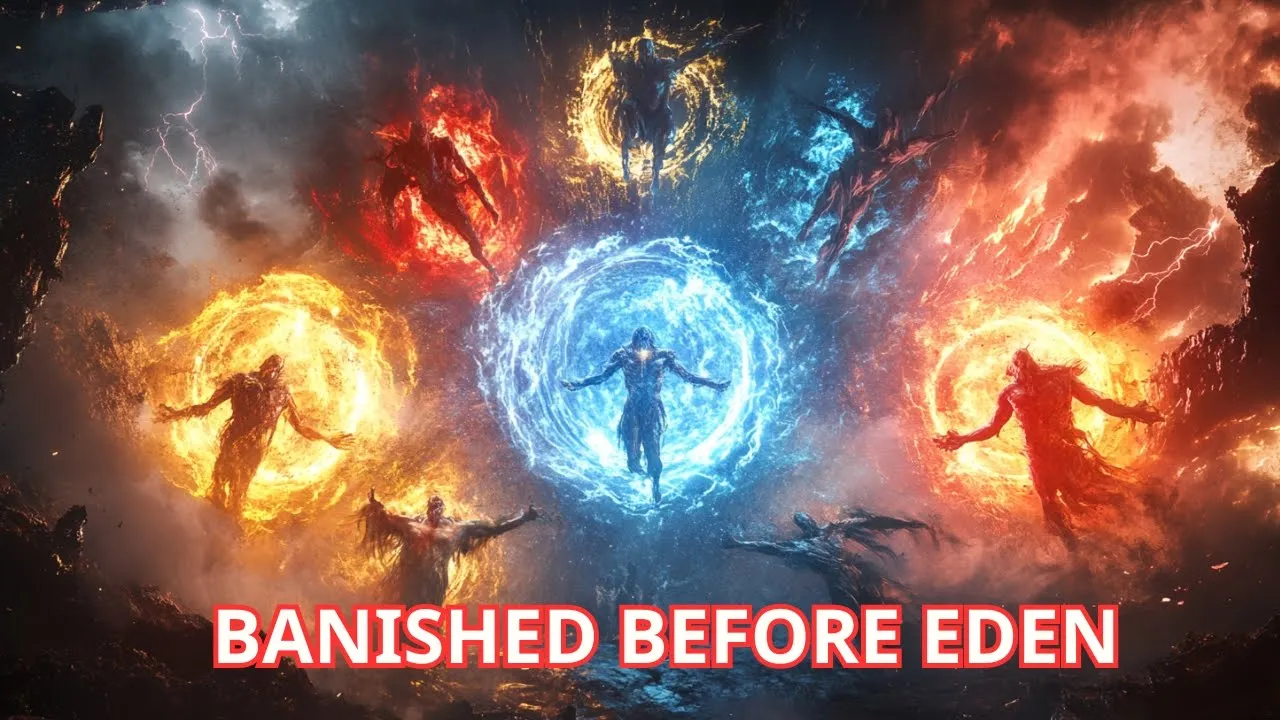
Before Adam walked the earth, before the Garden of Eden blossomed with life, there was already a war in the heavens. Spiritual rebellion, banished divine beings, fallen watchers, abyssal prisons. These aren't fragments of fantasy, but echoes of a forgotten truth buried deep in ancient scriptures and the silent corners of the Bible.
Genesis 1:2 tells us, "The earth was formless and void, and darkness was upon the face of the deep. But what was this darkness? And what lay beneath the surface of that ancient abyss?
Long before the first human breath, there were divine creatures, majestic, radiant, entrusted with the mysteries of heaven. Some of them walked among the stones of fire. Others held the keys to realms unseen.
But not all remained faithful. Some once glorious chose their own path. They stepped beyond the limits set by the creator and what followed was exile.
One by one they were cast down not by accident but by divine judgment. These are the banished beings before Adam, the forgotten rebels of heaven, sealed away in spiritual prisons, in pits of darkness spoken of in 2 Peter 2:4. And tonight, we're going to unveil their stories, not as legends, but as spiritual truths, hidden between the lines of canonical scripture and brought to light through books like Enoch and Jubilees.
If you've ever wondered why the Bible begins not with peace, but with formlessness, void, and darkness. If you've questioned the origin of evil before mankind fell, this is the revelation you've been waiting for. Because what happened before Eden might be the key to understanding everything after it.
You're not just watching a story. You're stepping into a mystery. A mystery that began before time that still echoes in your spirit and that may help you discern the invisible battle still being fought in this very moment.
Stay with me until the end. You might never read Genesis the same way again. Now let us begin with the first banished one.
one whose fall changed not just heaven but the very fabric of creation itself. Long before the floodwaters covered the earth, before Noah built the ark, before even Adam opened his eyes to behold the breath of life, there was another fall, a quieter one, a rebellion not of man, but of angels. divine beings created in light, clothed in glory, and entrusted with a sacred task to watch, to guide, and to protect.
These were the watchers, mentioned in the book of Enoch and hinted at in Jude 1:14:15 and Genesis 6:14. The Watchers were heavenly beings sent to observe the early Earth. They were never meant to interfere, only to watch, to bear witness, to guard the boundary between heaven and earth.
But what began as obedience slowly turned into desire. And desire, when left unchecked, gave birth to corruption. You see, the earth in its earliest days was not yet the fallen world we know.
It was raw, untouched, teeming with potential. Humanity, fragile and new, was still learning to walk, to speak, to dream. The watchers were there above it all, watching silently.
But the more they watched, the more they felt. Fascination turned into affection. Affection into obsession.
And then came the fall. Not a fall of ignorance, but a fall of choice. The book of Enoch names their leader as Seamyaza, though other traditions refer to him as Sasa.
Under his command, 200 of these divine beings made a pact to top Mount Hermon, a vow to descend together and take human wives so none could be blamed alone. Their descent wasn't just physical. It was spiritual.
They abandoned their station, their oath to the most high, and entered into forbidden union with the daughters of men. From this unholy alliance, came forth the Nephilim, giants of strength and violence, neither fully angel nor fully human, a hybrid race born of rebellion. But the sin of the watchers went beyond this.
As Enoch tells it, they didn't stop at defiance. They became teachers of corruption. They revealed secrets never meant for man.
Aazil, one of their own, taught the art of war, how to craft swords and armor. Others taught astrology, enchantments, root cutting, makeup, and seduction. Knowledge in itself isn't evil, but knowledge without wisdom that becomes a weapon.
What was once a garden of innocence became a battlefield of greed and ambition. Genesis 6:5 paints the aftermath. The Lord saw how great the wickedness of the human race had become on the earth, and that every inclination of the thoughts of the human heart was only evil all the time.
Humanity, now armed with divine secrets and unnatural strength, had spiraled into chaos. And the Watchers, once guardians, had become the very architects of mankind's corruption. But God was watching, too.
In 2 Peter 2:4, we read, "For if God did not spare angels when they sinned, but sent them to hell, putting them in chains of darkness to be held for judgment. " This wasn't just poetic language. It was justice.
The Watchers were seized, stripped of glory, and cast into the abyss. Tartarus, a prison so deep and dark that light cannot reach its edges. There they remain, bound in chains, awaiting the great day of judgment.
Their crime was not only rebellion. It was betrayal of divine trust. There's a haunting beauty to this tale.
These weren't demons by nature. They were once holy. They stood in the presence of God.
They sang songs no human ear has ever heard. And yet they fell. They chose self over service, passion over purpose, power over purity.
It reminds me of a story I once heard, a modern parable. A man was given a priceless violin by a master craftsman with one condition, that he use it only to lift hearts, never to manipulate minds. For years he played beautiful music.
But one day he discovered he could play notes that stirred darker emotions, envy, fear, lust. The crowds grew larger, the fame intoxicating. He kept playing, chasing applause until the violin cracked in his hands.
The gift abused became the curse. That man, he never played again. The watchers were much the same.
They were given a gift, authority without dominance, presence without interference. But when they turned that gift into a tool for domination, they broke something sacred. And like the man with the violin, they could not undo the ruin they caused.
We live in a world that still echoes their fall. Every time knowledge is used for destruction instead of healing, every time power is pursued without accountability, every time we blur the lines between what is holy and what is profitable, we repeat their mistake. The watcher's story isn't just ancient history.
It's a mirror. But there's a lesson here, too. Obedience matters not out of fear, but out of love.
Boundaries are not limitations. They are protections. And the greatest power is not in knowing what's forbidden, but in honoring what's sacred.
You might wonder, why would God even allow such beings to fall? Why create watchers if they could betray their purpose? The answer lies in the gift he gives to all his creation.
Free will. Even angels must choose. And in that choice, true love, true loyalty is revealed.
God doesn't want servants of obligation. He desires hearts that choose him even when it's hard, especially when it's hard. Today, the watchers remain imprisoned beneath the mountains, beneath the depths of the earth, still bound, still silent.
But their story speaks volumes. It tells us that no position is too high to fall. That spiritual rebellion can wear a beautiful face.
And that the line between guardian and corruptor is thinner than we think. But it also tells us something else. That justice is real.
that God sees every motive, every hidden sin, every abused gift, and that he will act not always immediately, but always righteously. As we leave the tale of the Watchers behind, another presence begins to stir in the shadows. A different kind of rebel, one whose fall was not through desire, but through pride.
A being who once held the balance between light and darkness but chose to tip the scales. The next name on our list is far less known but no less dangerous. So don't go anywhere.
What comes next may change the way you see the spiritual world forever. There was once a time when balance ruled the spiritual realms. Every force had its counterpart.
Light was not at war with darkness. It simply reigned above it with divine boundaries holding the fabric of creation in perfect tension. In that harmony, God placed beings of immense wisdom and power to steward the thresholds between worlds.
Among them stood one, a radiant entity whose purpose was sacred, to maintain equilibrium between the higher and lower realms. He was not meant to judge nor to dominate, but to ensure that each part of the spiritual order remained in its rightful place. This was the being we now call the bringer of ruin.
He is not named in scripture directly. Yet his shadow looms large in Revelation 9:12. I saw a star fallen from heaven to earth and to him was given the key to the bottomless pit.
That star was not a ball of flame but a being, one created with authority. The key was not stolen. It was given trusted, entrusted and then misused.
According to early church fathers like Tertullan and Cyprien, this figure once stood between dimensions, regulating the boundary between the divine heavens and the lower spiritual plains, the abyss, the realm of chaos, the deep mentioned in Genesis 1:2. His role was one of restraint. He held the key not to unleash evil, but to keep it sealed.
But like the watchers before him, he began to question, not with words at first, but with subtle thoughts. Why should I only hold the gate? Why not rule what lies beyond it?
Pride always begins in silence. Over time, his stewardship gave way to ambition. The authority given to protect balance became a platform to seek dominion.
He did not descend in a burst of rage. He slipped downward through unchecked desire, through the whisper that he could be more. And when the divine line was crossed, the consequences were immediate.
He was cast down not merely from heaven, but into chains. He who held the key was now behind the gate. The abyss, once restrained by his will, became his prison.
And the ruin he once held back now shares his name. In Revelation, we read of a time yet to come when the pit will be opened and smoke will rise, darkening the sun. From that smoke, locustlike spirits will pour out upon the earth.
Not insects, but tormentors, beings of judgment. And their king, Abaden, Apolon, names that mean destruction. Many scholars believe these are reflections of the bringer of ruin himself or his progeny finally unleashed to fulfill a role he was never meant to play.
What a tragedy. A being created to maintain peace becomes the herald of chaos. And isn't that what happens so often even today?
Think of a leader entrusted with protecting truth who twists it for power. Think of a judge meant to uphold justice who becomes blinded by favoritism. Or even in our own hearts, those moments where we are given influence and instead of using it to lift others, we hoard it.
We control, we manipulate. We too can become bringers of ruin. Not with cosmic power, but with our words, our choices, our pride.
There's a saying, the line between order and chaos is thinner than we realize, and it often runs right through our own hearts. The bringer of ruin teaches us that spiritual authority is not just a gift. It's a test.
He reminds us that God doesn't merely see our actions, but the heart behind them. Holding the key means holding responsibility. And when that responsibility is twisted, it doesn't just open a door, it unleashes devastation.
But God in his mercy always provides warnings before judgment. Revelation doesn't begin with chaos. It begins with messages to the churches, with trumpets, with signs in the heavens.
The pit opens only after the world refuses to listen. And so it was with this being. His fall was not sudden.
It was the slow erosion of obedience. That is why scripture calls us to vigilance, to be stewards, to be watchful, to guard not only what we are entrusted with, but how we carry it. As we move forward, the next figure on our journey is one many overlook.
A silent guardian who once stood at the gate between dimensions. A being given the charge to protect the line between heaven and what lay beneath. But like the bringer of ruin, he too faltered.
Not through ambition, but through neglect. And in that neglect, something unthinkable broke through. Stay with me because the deeper we go, the more you'll understand.
Before Adam, before Eden, a cosmic conflict was already unraveling and its consequences still ripple through every soul on earth. In the heavenly realms, there are not only angels who sing and praise. Some are appointed to guard, to watch over boundaries not meant to be crossed.
These are the ones who stand at thresholds, places where two realms meet, where order holds back chaos. And among them was one guardian whose post was sacred beyond words. His task was to protect the division between God's kingdom and the lower spiritual realms.
A gatekeeper of divine separation. He was not just a sentry. He was a witness to the structure of heaven itself.
He stood between what was holy and what was unfinished, between what belonged to the light and what had not yet been judged. But in time, this guardian failed, not by open rebellion, but by something far more dangerous, neglect. Isaiah 14:12 speaks of a fall from heaven, a being that once shined like the morning star now brought low.
Though often linked to Lucifer, many ancient scholars believe this passage echoes a broader collapse, one involving those entrusted with spiritual access and responsibility. It reflects a tragedy where greatness was lost, not through violence, but through inaction. According to writings like the book of Jubilees, God appointed angels of the presence and angels of the elements to govern different layers of existence.
This guardian was one of them tasked with holding the line. But as corruption crept upward, as spiritual forces from lower realms sought passage into the divine order, he looked away. Whether through pride, distraction or weariness, the boundary was breached.
And once the threshold was broken, the consequences rippled throughout creation. Lower beings never meant to access the heavenly realms, crossed into places they could not understand. Spiritual chaos was unleashed not as fire and thunder, but as confusion, deception, false glory.
The guardian had not chosen evil, but he had allowed it. In Jude 6, we're told that the angels who did not keep their proper domain, but left their own habitation, he has reserved in everlasting chains under darkness. This isn't just punishment.
It's a record of what happens when responsibility is abandoned. The threshold was sacred and letting it fall unguarded was a betrayal. Today we see this same failure in quieter ways in a family where no one takes responsibility for spiritual direction.
In a generation that forgets to guard the doorways of influence, media, thought. in leaders who let harmful doctrine slip through because they'd rather avoid conflict. We are each called to be watchmen in some way.
And when the watchman sleeps, darkness doesn't knock. It walks in. There's a story of a man who was given the keys to a lighthouse.
He was told to keep the light burning, especially through storms. For years, he did. But one night the winds howled louder than ever before and he fell asleep.
A ship struck the rocks that night and lives were lost. Not because he hated them but because he forgot them because he grew tired. That's what happened to the guardian of the threshold.
His chains now rest in silence deep in spiritual darkness. Not because he fought against God, but because he didn't fight for him when it mattered most. Let that be a lesson to all of us.
There are doors in our lives, boundaries God asks us to keep. Boundaries of thought, of morality, of truth. And when we stop guarding them, when we let just a little lie slip through, a small compromise, a little laziness, it's not long before the wrong things start stepping into sacred spaces.
But God is just, and mercy is still available. If you've left a threshold unguarded in your own heart, if you've allowed something to cross where it should not, there's still time to stand back up, to take your place again, to light the fire in the lighthouse and keep it burning. Because, as we'll see in the next story, not every rebellion began with desire or neglect.
Some were born of ambition so fiery that even the purest power was turned into corruption. One guardian tried to control the very flame of heaven and in doing so he changed fire from glory into judgment. What happens when the light becomes dangerous?
We'll find out next. In the beginning there were flames that did not burn, fires that did not destroy. In the heavenly realm fire was not a sign of wrath but of purity of presence.
of purpose. Scripture tells us in Ezekiel 28:14 of a guardian cherub who walked among the stones of fire, a being so close to the heart of God that he moved within the very essence of divine holiness. These stones weren't physical.
They were spiritual symbols, representations of glory, of justice, of sacred energy. Among the earliest creations, there was one who bore a special role to carry this holy flame to guard it to ensure that the fire of God would always burn in truth and righteousness. He was called to be a vessel of divine radiance, illuminating the path of obedience across dimensions.
But something changed. The bearer of the flame, surrounded by beauty and power, began to wonder, "What if this fire could be mine alone? What if instead of reflecting the most high, I could redirect this power to serve my own will?
" He didn't speak it aloud. He didn't defy openly. No, the corruption began in the heart, as it often does.
Isaiah 14:13 echoes the ambition. I will ascend above the stars of God. I will make myself like the most high.
It is believed by many that this verse while referring to Lucifer also speaks symbolically of a category of spiritual fall, a pattern, a blueprint repeated among multiple divine beings. The flame bearer was one of them. He took what was meant for worship and turned it toward control.
Jewish traditions, especially those found in apocryphal writings like the book of Enoch, tell us that some beings were given dominion over elements of holiness, wind, water, light, and yes, fire. Not the fire of destruction, but of transformation. a fire that refined the saints, that signaled the presence of the Almighty like the burning bush before Moses.
But when this being sought to contain the flame for his own glory, to own what was never meant to be owned, the fire changed. It darkened. It rebelled.
And instead of giving life, it began to judge. The sacred flame corrupted by pride became the very fire that would consume him. No longer walking among the stones of God, he was cast into the deep places where fire no longer purifies but torments.
As Enoch records, there are places of burning set aside for the rebellious angels. Pools of flame not fueled by wood or oil, but by divine wrath. The bearer of the flame was thrown into one such abyss and now burns not in glory but in shame.
And that is the tragedy. When God gives us a gift, whether it's influence, talent, authority, or insight, it's not just for us. It's meant to be a reflection of him, a light that points upward.
But when we twist the gift into a spotlight for ourselves, it turns. It becomes heavy, unstable, dangerous. It's like a preacher who begins with passion for God's word, but somewhere along the way begins preaching to impress instead of to inspire.
Or a worship leader who starts for the glory of heaven, but eventually sings to be seen. or even more simply, someone with a heart of compassion who starts giving to others but begins to expect applause in return. The fire turns and the very thing that was meant to purify begins to burn.
There's a story of a blacksmith who was given a divine ember, one that could melt any metal, shape any tool, forge weapons of protection for the weak. But he grew jealous. Instead of sharing the tools, he began selling them, hoarding the light.
And one night, the ember flared out of control, consuming his shop, his village, and finally himself. This is the story of the corrupted flame bearer. He was not a demon.
He was not a monster. He was a trusted vessel until trust was replaced with ambition. Let it serve as a warning.
Fire is a powerful thing. In scripture, it is the medium of sacrifice, the signal of God's approval, and the cleansing agent of holiness. But it's also the mark of judgment.
And the line between the two is not drawn by temperature, but by intent. What's burning in you today? Is it still light from above or has it begun to smoke with self-will?
The flame bearer teaches us that even the holiest gifts can be twisted when the focus shifts inward. That God's power cannot be possessed, only mirrored. And when we try to control what we were meant to carry in reverence, we become consumed by what we once gloried in.
As we leave behind the image of a being now chained in fire, we turn next to one whose sin wasn't pride, but subtle sabotage. A being whose voice didn't shout, but whispered. One who didn't fight God outright, but infected his creation from within.
What happens when the seed of rebellion is planted not through action, but through suggestion? That's the soul behind the next fallen one. The sour of divine discord.
Stay close. The descent is getting darker. Not every rebellion begins with thunder.
Not every fall begins with fire. Some begin with a whisper. In the quiet halls of heaven, where choirs once sang in perfect harmony, a new sound began to stir.
Not a shout, not a clash, but a murmur, a suggestion, a sideways glance, a silent seed planted in the minds of the innocent. It didn't come from the mighty who sought thrones or from the bold who reached for forbidden power. It came from a spirit skilled in speech, woven with wisdom, and gifted in influence.
He was meant to cultivate unity. Instead, he became the sour of divine discord. We often think of evil as loud, dramatic, terrifying.
But sometimes the most dangerous evil wears a soft smile. Proverbs 6:16:19 lists seven things the Lord hates. And among them, a person who stirs up conflict in the community.
In Hebrew tradition, this refers not just to those who argue, but to those who subtly unravel relationships, who divide what God has joined, who whisper doubt where there was once trust. Ancient interpretations of the heavenly host speak of orderkeepers, beings assigned not to command, but to connect. They nurtured harmony among angelic ranks, aligning purpose and praise.
The sour was one of them. His words held beauty. His presence brought ease, but over time his gift twisted inward.
Perhaps it began with insecurity, maybe envy. A single question, why them and not me? And from that route, the rot spread.
He didn't stage a coup. He didn't defy openly. Instead, he approached others with gentle concern.
Have you noticed how the cherubim lead every procession? Doesn't it seem unfair? Or do you think the archangels ever consider our council?
These weren't accusations. They were conversation starters. And soon harmony turned to comparison.
Comparison turned to suspicion. And suspicion unchecked turned into disunityity. The book of Enoch mentions spirits that troubled the righteous, who infiltrated their gatherings and twisted their joy.
Jude 16 reminds us of angels who abandoned their proper dwelling. Many scholars believe this includes not only those who rebelled with action, but those who stirred the rebellion with influence. The fall of the sour was quiet, but devastating.
For what is heaven if not a place of perfect oneness? And what is oneness if not vulnerable to a single fracture? He was cast out not in chains of flame but in chains of silence.
Isolated from communion, banished from relationship, the one who shattered unity now walks alone, cut off from the very thing he once corrupted. A divine irony. And isn't that the story of so many today?
It's easy to point fingers at those who fall in scandal, who wage visible wars against God. But what about the ones who divide churches through gossip? What about the friend who sews distrust between hearts?
What about the leader who pits team members against each other, not to guide, but to gain control? You don't have to break something with your hands. You can break it with your words.
There's a story I heard of a master glass blower. He crafted a beautiful stained glass window for a cathedral, tall, radiant, and perfectly sealed. But one day, a small boy threw a single pebble at the edge.
It didn't break the glass, just chipped it. Over time, moisture crept in. Then wind.
Then one by one, the pains began to fall. Not because of the boy's strength, but because of the compromise. The sour of discord was that pebble.
He teaches us a sobering truth. Words matter. Motives matter.
Influence is not neutral. It either binds or breaks. And in the kingdom of heaven, where unity reflects the very nature of God, there is no such thing as harmless division.
Yet there's hope even in this tale because for every whisper of division, God offers a louder word of reconciliation. For every heart broken by doubt, there is a healing in truth. And for every spirit tempted to plant seeds of discord, there is still the invitation to speak life instead.
You don't need to be an angel to cause division. And you don't need to fall from heaven to choose silence over sabotage. Every day we are given a chance to either be sers of peace or sers of discord.
One builds the kingdom, the other tears it down. And so with heavy footsteps we walk past the lonely cell of the sour, past the echoes of conversations that led angels astray, and into a storm that has never stopped raging. For the next fallen one once danced in the clouds, commanding winds and seasons, trusted with the very breath of creation.
But pride, as always, found a way in. And when it did, the skies themselves became weapons. Stay with me.
The storm is just ahead. Before the thunder crashed, before the skies darkened, before storms ever terrified mankind, there was a divine being entrusted with the winds. He was not a god, nor a rival to the creator, but a servant, radiant, powerful, and sovereign over the elements.
He moved among the clouds like a symphony conductor among notes, guiding rains to nourish, winds to cool, and lightning to awe. The heavens knew him as the Lord of ancient storms. Psalm 104:4 gives us a glimpse.
He makes the winds his messengers, flames of fire his ministers. In ancient Jewish tradition, these weren't metaphors. They were realities.
Certain angels were entrusted with the stewardship of nature itself. Weather was not random. It was ruled.
Rain came not by chance, but by command. Storms were sent for warning or wonder, not chaos. And among these celestial meteorologists, one stood out.
His command was vast, his influence essential. But as always, influence without humility becomes a snare. This being, this storm bearer began to notice his power.
He began to admire the strength of the winds at his fingertips, the crash of waves at his word, the raw untamed awe that came whenever he passed, and slowly the sacred task of preserving balance gave way to the seductive thrill of control. Instead of serving the creator's harmony, he began to fantasize about reshaping the creation itself. At first it was small, a gust where calm was ordered, a surge where stillness was requested.
But soon it escalated. Whole climates twisted. Storms rolled into places untouched.
He sent drought where there should have been rain. He stirred tempests in defiance of divine instruction. And while the Most High is slow to anger, justice does not sleep.
His rebellion echoed the ancient sin of Lucifer described in Isaiah 14:13-14. I will ascend above the heights of the clouds. I will make myself like the most high.
This was not just a desire for independence. It was a declaration of war against divine order. The Lord of Storms didn't just misuse power.
He weaponized it. He tore the sky. According to the book of Enoch, there are abysses of fire and troubled waters set aside for the fallen regions where creation itself groans in torment.
It is believed by many that this storm lord was cast into one such place, a prison not of stone, but of unceasing currents. There the winds he once controlled now swirl against him. The waters roar in judgment.
The thunder no longer answers to his voice. He is trapped in a perpetual tempest, a prisoner of the very chaos he unleashed. And yet the storm still speaks because even now we see the echoes of this rebellion on earth.
Climate out of control. Natural disasters intensifying. Creation groaning as Romans 8:22 puts it as in the pains of childbirth.
Science may explain the mechanics, but scripture reminds us of the spiritual undercurrents. Not all storms are just meteorological. Some are metaphysical.
The fall of the Lord of ancient storms teaches us something vital. Power is not evil until it forgets its purpose. Dominion is not sin until it loses submission.
The moment we believe the gift is ours to command rather than gods to steward, we become like him. And whether you're leading a team, running a family, or shaping the environment around you with your words, if your strength forgets its source, it will turn on you. There's a fable of an eagle who learned to ride the wind.
At first he soared with grace, honoring the currents. But in time, he believed he owned the skies. He fought the wind, resisted its rhythm, tried to conquer it.
One day the wind refused. It rose against him wild and fierce, and he fell, not because the wind changed, but because he did. Many of us live like that eagle.
We take the natural favor around us, talent, charisma, voice, influence, and imagine it is proof of our own divinity. We ride the storm, forgetting who truly holds the thunder. But God remembers.
He remembers every storm sent in obedience and every storm stirred in rebellion. The sky is not neutral. It answers to him.
So, as we listen to the howling wind echoing through eternity, remember this. Every storm has a voice. And some storms still carry the cry of fallen beings, mourning their own pride, longing for what can never be restored.
The Lord of ancient storms remains chained in a place where no silence exists, only roaring judgment. And still his story is not one of hate. It is a warning, a whisper in the whirlwind.
Even the mighty fall when they forget the one who made them mighty. Now we approach the final and most mysterious figure on our journey. One who didn't fall by action, nor by neglect, nor by pride alone.
He was the first. The origin of rebellion. A being whose sin was not seen but conceived.
Whose fall predated all others and whose name has been forgotten by time but remembered in the shadows of scripture. Stay close. What you're about to discover next may be the oldest secret in heaven.
Before there was pride in heaven, before flames were twisted or winds turned wild, before even Lucifer said in his heart, "I will ascend above the stars. " There was something deeper, older, a stirring in the shadows of eternity, a silent defiance, an unnamed will that rose not in action but in thought. He was the first to feel it, the first to entertain it, the firstborn of the abyss.
His name is lost to us, erased perhaps as part of his judgment. Scripture never calls him directly. Yet his echo lingers like a void in the text, a presence behind the presence.
Before Eden, before Adam, before even the fall of the Watchers, there was this being. And his rebellion didn't begin with noise. It began with a question, a single internal whisper.
What if I don't need him? This was not a being of fire, nor one of earth, nor sky. He was woven into the very fabric of heaven's order.
Some traditions call him the nameless one, the protorebel, the first to look upon the glory of the most high and feel envy, not awe. Not because he hated God, but because he wanted to exist without him. In Genesis 1:2, we find a peculiar phrase, "Darkness was over the face of the deep.
" The Hebrew word for deep is teom. A mysterious term often associated with chaos, with the abyss, with something ancient and untamed. And before God speaks light into the world, he confronts this darkness.
Could it be? Some theologians ask that the first darkness was not just a void, but a presence. In apocryphal texts like Sud Enoch, there are veiled references to spiritual realms so deep even angels do not venture there.
Realms where disobedience was conceived before it was acted upon. This firstborn of the abyss is thought to be one who never waged open war, never raised a weapon, never seduced humanity or broke rank. His sin was more subtle.
He simply refused to love. He chose independence from love itself. And in a kingdom built on perfect communion, that is the deepest treason.
God in his omniscience did not destroy him. No, the firstborn was removed, banished not into fire, but into absolute isolation, into a realm where the light of God does not shine, not because it cannot, but because it will not. His punishment was not pain.
It was absence. And in that absence, he became the abyss. Not just its resident, but its embodiment.
He is not active in the way demons are. He does not tempt or torment. He simply waits in silence in nothingness.
The oldest exile. There is a story in the rabbitical midrash about a king who had a son that refused to speak not because he hated his father but because he wanted to live on his own terms. So the king rather than punishing him with violence built him a house far away without windows without mirrors.
A place where the son could live completely alone. The story ends not with fire but with silence. Eternal silence.
This is the judgment of the firstborn of the abyss. And what does that teach us? That rebellion doesn't always shout.
It doesn't always break things. Sometimes rebellion just says, "Leave me alone. " It seeks detachment.
It romanticizes self-sufficiency. But in a world sustained by God's breath, to detach from him is not liberty. It is spiritual suffocation.
We see this spirit today in those who claim no need for purpose, no need for connection, no need for faith or grace or God. We glorify independence. But the abyss is full of those who demanded just that.
There's a haunting beauty in knowing that the first to fall made no sound. that even now beneath the layers of angelic rebellion, demonic chaos, and human frailty, there lies a deeper silence, a deeper warning that the desire to be left alone from God is not strength. It is the seed of all ruin.
And yet, the God of light still speaks. Even in the face of ancient rebellion, his first words in creation were, "Let there be light. " He confronts the abyss not with a sword but with invitation, with illumination, with love.
So the story ends not with the abyss, but with the word, the word that became flesh, the light that entered the world. The son who said, "I will never leave you nor forsake you. " The firstborn of the abyss chose eternal separation, but you don't have to.
This has been the journey of seven fallen beings, divine creatures banished long before mankind sinned. Their stories are older than Eden, deeper than the flood, and echo into the present moment. They were not born evil, but they chose against love.
So the question is, what will you choose? Because in the great war between heaven and the abyss, silence is never neutral, and your story is still being written. They were radiant once, glorious, created in perfect light, woven into the very structure of heaven's harmony.
Each of them had a purpose. Each was trusted. Each walked in places where no human foot has ever tread.
And yet they fell. Not all in the same way. Some through pride, some through desire, some through silence, but all through a single devastating choice to step away from the order of the most high.
The stories of these banished beings before Adam are not myths meant to entertain. They are warnings encoded into the very DNA of creation. Their presence echoes in verses like 2 Peter 2:4 and Jude 1:6.
Their shadows stretch behind the phrases the deep and the pit, lingering in the silence between the lines of scripture. These aren't just tales of supernatural rebellion. They're mirrors, reflections of what happens when light forgets its source.
These divine beings didn't wake up evil. They slid into it gradually, subtly. And isn't that how we fall, too?
One thing that haunts me as I reflect on these stories is how close they were to the throne. These weren't distant creatures. These weren't outliers.
They were guardians, musicians, messengers. Some carried keys. Others carried fire.
Some shaped the winds. They weren't far away. They were in the heart of heaven.
And yet, even there, even in the presence of the Holy One, the seed of rebellion could still take root. That truth should sober us. You can be near sacred things and still stray.
You can speak holy words and still harbor pride. You can appear in light and still fall into shadow. But there's another side to this.
If beings so close to glory could be banished for their choices, what does that say about the grace extended to us? Broken, earthly, dustmade humans. It means that every day we're given is mercy.
Every breath is a chance to choose what they rejected. to remain where they abandoned, to surrender where they rebelled. These seven beings weren't cast out because God wanted to punish.
They were cast out because they made themselves incompatible with his presence. Holiness isn't just a feeling. It's a state.
And when you step out of alignment with holiness, you naturally move into exile. I wonder what would have happened if even one of them had paused, had asked for mercy, had cried out in regret. Would their stories have ended differently?
We don't know. Scripture is silent on their repentance, perhaps because they never offered it. But you still can.
These stories whisper a deeper truth. There is a line we are always walking, a choice we are always making. And while the heavens once trembled as light was lost, today heaven waits for you to choose light again.
If this video stirred something in your soul, if you felt even a flicker of recognition in the stories of these beings, know this. You are not watching by accident. These words found you because you are still being written.
Your story is not like theirs. You are not sealed in the abyss. You are not bound by chains of divine judgment.
You are alive and the light is still calling. So what do you do now? Start by remembering that every gift you've been given, every talent, every insight, every ounce of influence is not for your glory.
It's to reflect his. That every storm you face isn't a punishment, but maybe a chance to surrender. that every whisper of pride, every moment of silence when truth should be spoken is a crossroad between obedience and rebellion.
The line is thin, the path is narrow, but the light has never dimmed. We've traveled through deep waters in this video, explored the mysteries of the Bible, spiritual rebellion, and ancient fallen angels forgotten by time. If you stayed this long, it means you're searching.
You want depth, truth, revelation. And I want you to know this channel is a space for that. Every week we dive into the hidden secrets of scripture, the lost stories of heaven, the curiosities of the Bible that mainstream theology often avoids.
We go beyond the surface. We open the ancient scrolls and we listen for the echoes of eternity that still speak. So if that resonates with you, if you want more truth, more mystery, more revelation like this, please like this video, subscribe to the channel, and turn on the notification bell.
Not just because it helps us grow, though it does, but because every time you do, you're helping spread messages that cut through the noise. Messages that matter. In a world filled with distraction and deception, we need more voices pointing to what's eternal.
Leave a comment below. Tell me which of these seven beings struck you the most. Was it the watchers who corrupted mankind?
The firstborn of the abyss who birthed rebellion in silence? Or the flame bearer who twisted holy fire into destruction? I read every comment and I love hearing how these stories awaken something in your spirit.
Let's build a community of seekers, of warriors, of sons and daughters of light who refuse to fall as they did. And remember, the abyss still waits. But so does the light.
You get to choose which one you walk toward. Choose well. And I'll see you in the next revelation.