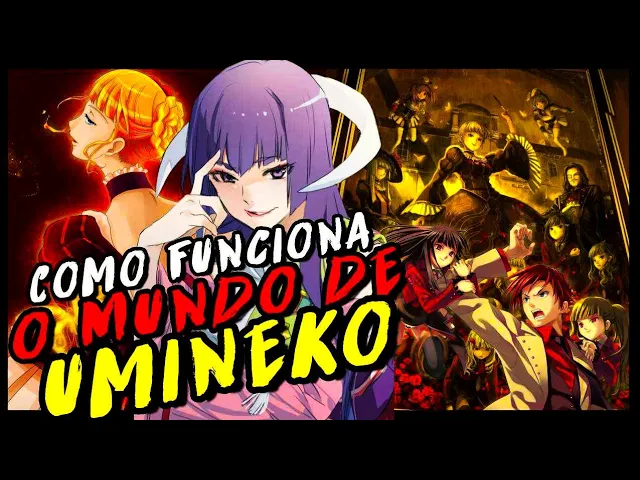
Hail people! As many people asked in Umineko's last video for me to explain the cosmology of the work (since many make up stories or take things out of context), here I am to explain the functioning of this incredible universe, which covers not only Umineko, but also Higurashi. If you liked the content, I ask you to leave a like to help and subscribe to the channel.
Before starting the explanation, I will use a little Powerscaling/Tier System. I know that a lot of people don't like this, and I also find it a bit boring, but as I want to make a complete analysis that everyone will enjoy, I will use this element of analysis. Without further ado, let's do it!
Let's start by explaining witches: WHAT ARE WITCHES: In short, witches are users of magic/miracles, being transcendental and metaphysical beings, not having a physical form, but rather an abstract form, according to Lambdadelta when she appeared for the first time for Beatrice. Yes, this scan is Lambdadelta and not the Creator, as countless people wrongly spread on the internet. There are three levels of witches, which are as follows: Terriority Lord: This is the weakest type of witch who is bound by territoriality.
Their life lasts as long as they don't lose their will. Battler and Beatrice are this type of witch/wizard. Voyagers: Voyagers are witches who are not bound by terriority and can travel the Sea of Shards to complete their journey as Voyager witches.
Bernkastel and Lambdadelta are this type of witch. The Voyagers are also able to grant others the ability to travel through the sea of fragments. Lambdadelta demonstrated this when he gave Battler and Ange a candy that allowed them to travel freely through the sea of shards.
Creators: The highest type of witches who are above everything in verse. To a Creator, the entirety of Umineko is no more than a single book. The difference in power between the Voyagers and the Creators is like the difference between the Humans and the Voyagers.
Featherine is just the only witch at that level of power. This monstrous difference in power between a Voyager and a Breeder was shown when Featherine effortlessly defeated Lambdadelta . Featherine killed Lambdadelta and then brought her back to life.
In short, witches who transcend the realm of witches become creators, being on a level above the Voyagers. Making one thing clear, creator witches have no relationship with the Creator or his domain. Transcendental beings, like witches, cannot be resurrected, and I will explain why: When a witch dies or gives up the game she is involved in, her existence as a player/transcendental is erased, as happened to Beatrice after giving up her game against Battler, losing hope of victory.
When this occurs, not even the Golden Land can resurrect her, nor can any other witch (with the exception of Featherine and Ange). The only way to "resurrect" this witch is to create a new version of her, as Battler did when creating a new Beatrice. - This was explained by Featherine, in chapter 6.
This does not apply to Featherine and Ange. Featherine revived Lambdadelta, while Ange brought Beatrice back to life after being killed by Erika. Bernkastel and Lambdadelta were destroying universes in their fight.
The battle between the two demonstrates how the Voyager witches are capable of destroying entire universes. Witches, at the very least, would reach the 5-D level due to being beyond space-time and the concept of distance. Consequently, they would also have immeasurable speed.
DEMONS: As the name suggests, these entities are demons that live in purgatory and have magical abilities. In Umineko, demons are, in a way, servants of witches, practically all of whom are women. They are invoked to assist in some witches' mission or task.
The main ones are as follows: Lucifer, the eldest sister of the Seven Sisters of Purgatory, is summoned by Beatrice to help with her ceremony. Its container is a set of ceremonial stakes that Kinzo purchased. Lucifer is the most powerful and respected among her sisters, representing the sin of pride.
Her presence and power are incomparable, being considered Beatrice's main helper. From an anti-fantasy perspective, Lucifer can be seen as a mythical figure created by Beatrice, inspired by powerful servant archetypes such as Lunon. In addition to Lucifer, we have the other six sisters who command hell/purgatory, the strongest demons.
Lucifer is the oldest, followed by his sisters: Leviathan, Satan, Belphegor, Mammon, Beelzebub and Asmodeus. Each of them represents a cardinal sin and has specific abilities that contribute to the collective power of the group. Another important demon in the story is Gaap, one of the 72 Great Demons.
She is also friends with Beatrice. When a magician demands it, she grants the instantaneous movement ability. Gaap is known for her ability to manipulate space and time, using her power to play tricks and deceive her enemies.
His specialty is hiding keys and bags during busy mornings. However, in mysteries involving closed rooms, this power becomes an ultimate weapon that can easily deal a finishing blow. Her space manipulation attacks like "queen bees" can pierce any detective and force them to surrender before her supernatural ability.
To conclude, purgatory is not a higher dimension as some claim, it is just a Universal dimension. THE TRUTHS: BLUE, RED and GOLD: The truths in Umineko represent detective powers, which transform into magical attacks to defeat the debating opponent. There are three truths: the Blue Truth, which is used to assume something; the Red Truth, used to affirm something, with several levels of red truth.
For example, Ange manages to deny any red truth from the Voyagers witches at the end of the manga, as she has a greater truth than theirs. Because of this, Ange defeated Bernkastel. Finally, we have the Golden Truth, which represents an empirical, irrefutable and immutable fact.
The golden truth is divine, the three truths are also conceptual. In Umineko, the truths of reality are treated as physical constants; they can be particles, wave functions, and conflicting shapes at the same time. These are all abstract theories that can only be disproved when you open the cat's box.
A very simple way to understand this is that the work reveals the one true truth between two or more infinite assumptions that conflict. When a logical error occurs in the use of truths, the person who made the error is punished, becoming trapped in an infinite cycle of repetition in the game they were playing, and their player board, which represents the witch or wizard, is broken. .
HUMAN DOMAIN: There are several magical dimensions in Umineko. The lower "side" of these limits is the Human Domain, where humans are seen as playthings of Fate, considered stupid, helpless, and incapable of creating anything meaningful. However, unlike the world of witches, the Human Domain offers a firm foundation that does not betray those who make mistakes on their journey.
In short, the Human Domain in Umineko represents our real world, a place without magic and mystery. WITCHES' DOMAIN: The Witches' Domain, or the world of witches, is the second domain and lies between the two extremes. Unlike the Human World, the world of witches creates destiny and plays with it, enjoying this freedom.
However, there are certain limits and restrictions, as the world of witches is composed only of thoughts, and the beings that inhabit this domain are purely abstract. If they lose their sense of existence, they fall into the depths of Oblivion. In short, it is a conceptual world with metafictional elements.
I will refute a fallacy that spreads about the witches' domain; claim that there would be an infinite hierarchy that would represent higher dimensions present in the domain of witches or in the domain of the Creator, this is a lie. - Would Umineko have infinite higher dimensions? To be short and blunt, NO.
Many people use this description of the Creator's plan, where there would be infinite steps on an infinite ladder that leads to the Creator's kingdom, and it is possible to climb these steps with effort. The kingdom, however, transcends these steps. However, this has nothing to do with dimensionality, but rather with a level of power, in addition to being related to metafiction.
So a lot of people don't interpret this correctly, and I would explain that. This ladder of hierarchy, where one climbs with "effort", has to do with the pieces managing to "transcend", thus no longer being tied to the stories of a witch. The steps represent The Hierarchy of witches; As shown, there are witches stronger than others, with Featherine at their peak.
This is so true that there are three types of witches, as I explained previously, each occupying specific levels, namely: Territory Lords, Voyagers and Creators. Reinforcing again, these step levels refer to the witches' power and are not related to dimensionality. As shown in Higurashi, Lambdadelta and Bernkastel were once pieces of a witch, but they managed to transcend and became witches, no longer being pieces of that witch, and acquiring a certain free will.
However, they are still below Featherine, who is the highest ranking witch (Featherine is only below the Creator). This is how this "witches' ladder" works, which involves a hierarchy of power between witches and non-dimensionality. The only thing that involves dimensionality is the fact that the pieces transcend and become witches or wizards, no longer being seen as fiction by most witches.
They also reach a metafictional plane , being 4D or, at most, 5D, as they see humans and universes as pieces in a game of chess, nothing more. According to Ange's words about dimensionality, witches would have an existence, at most, 4D or 5D. This is the only reference to dimensionality in the entire work, including Higurashi.
It's impressive how they confuse a quote about hierarchy of position or power with dimensional hierarchy. Lack of interpretation mixed with bad faith. META-WORLD: The Meta-World, or Meta Sekai, is a metaphysical dimension separate from known physical reality.
It is often portrayed as a space where the Game Master and Witches, such as Beatrice, organize and conduct their games, alternating between controlling the board and interacting with the players. In this space, events and scenarios that occur in Rokkenjima's game are revealed and examined. Additional entities may appear in the Meta-World, provided they have the ability to travel there or are summoned.
They interact freely between games, but, during a game, usually only those directly involved or who have some connection with the participants appear in the living room. In short, the Meta-World is the space where the Game Master and the Witches play their games, using boards and manipulating their pieces. Their true forms exist in the Meta-World, while creating representations of the characters as pawns on the game board.
These pawns, which represent the players in the game, are seen as fictions by those who play in the Meta-World. This is one of the several elements of Metafiction present in Umineko. An example of this can be seen in the game between Battler and Beatrice in parts 1-5 of the story.
On the board, Battler should deny that his family's deaths were caused by magic and argue that they were caused by human methods. Beatrice, on the other hand, would try to get Battler to admit that the deaths were caused by magic. The "Battler" and "Beatrice" playing in the Meta-World were manipulating and interacting with these fictional versions, and the events on the board were, in fact, just one layer of the larger game taking place in the Meta-World.
A second example of how the Meta-World works occurs in the battle between Bernkastel and Battler and Beatrice in part 8 of the story, in the manga Umineko WHEN THEY CRY Episode 8: Twilight of the Golden Witch, in chapters 11, pages 5-6. Finally, games usually have a judge/witness so that there is no doubt about the result. KAKERAS (FRAGMENTS): These are prisms that represent parallel universes with different possibilities.
The Sea of Shards is filled with an infinite number of them and thus represents a kind of multiverse. The different decisions made by the characters, the circumstances, the environment and several other variables allow the story to unfold in particular ways in different Fragments (as in the Many Worlds theory). Fragments play distinct roles in Higurashi no Naku Koro ni and Umineko no Naku Koro ni, but they have fairly consistent uses.
All these books are fragments in every possible form: parallel fragments (universes), territorial fragments (territories of witches, nobles, heroes, etc. ). Representing worlds of higher layers than those that make up the world of infinite layers of witches), which are archived in the city only as books.
However, there are stories that do not become books; the best tales have their protagonists selected by the great Auaurora, and they are transformed into "Cat Overlords", who are Featherine's personal guard. However, these cat protagonists cannot interfere or affect another protagonist, as happened when they tried to attack Battler. BEATRICE'S SEA OF FRAGMENTS: In short, it is an infinite multiverse that Beatrice created together with her dimension and her Cat Box, she infinitely repeats the events of October 4-5, creating infinite fragments/universes that she controls, we can say it would be your Multiverse.
She uses a kind of roulette wheel to create new worlds of events. This happened in the manga Umineko WHEN THEY CRY Episode 8: Twilight of the Golden Witch, chapter 24. 4 pages 16-17.
BERNKASTEL SEA OF FRAGMENTS: This Sea of Fragments is larger than the first, as it serves as the background for the entire Bernkastel Cat's Box. Upon leaving the Witches' Theater, Lion found an incomprehensible world of darkness, a place that resembles a sea of stars, or perhaps it could be described as the bottom of the ocean with stars scattered around it. Although it resembles Beatrice's multiverse, the Sea of Fragments goes further as it represents an infinite space that contains not only alternative realities, but all existing and non-existent possibilities.
In this sense, he is a fundamental concept in Bernkastel's control, giving him unlimited access to any timeline or universe within these infinite possibilities. In Higurashi, there is also a statement that the fragments in the Bernkastel sea of fragments are infinite. UNDERWORLD: Is the world that the island of Rokkenjima always goes to when it is isolated from the human world by Beatrice.
This universe is a world parallel to the physical world. PARADISE: Realm of residence of celestial beings such as the Eiserne Jungfrau and SSVD. GOLDEN LAND: In the Golden Land, all people who have ever died can be resurrected.
From what is understood, even the souls of people who have been erased can be brought back in the Golden Land. WHAT CAT BOXES ARE: Some people say that Cat Boxes are Platonic concepts that state that, because of this, Witches would be beyond any spatial dimensions, but this is not quite the case; I will explain. The Cat Box is inspired by the Schrödinger Box thought experiment.
Each witch has her own box; Bernkastel's, for example, transcends Beatrice's Cat Box. Cat Boxes are used to store universes, concepts, people and truths. When something is placed inside a box, it becomes practically impossible to remove it without the witch's consent.
From what I have observed so far, there is no relationship with Platonic concepts. Bernkastel's Cat Box appears in Umineko Manga 7, Chapter 1. The Schrödinger Box, often simply called the Cat Box, is a reasoning technique that asserts that multiple truths about an event can exist in parallel when the event itself was not observed.
It is a metaphorical application of the quantum physics thought experiment, Schrödinger's Cat. In Umineko, the Schrödinger Box is used to describe the state of Rokkenjima between October 4 and 5 , 1986. The physics of the original experiment have little relevance to its application as a metaphor; what is important is the idea of an unobserved entity with multiple possible states.
We can say that the Cat Box is a particular dimension belonging to your witch. There is no evidence that proves that it has some link with Platonism, therefore, it goes beyond the concept of spatial dimensions. Anyone who says otherwise doesn't know Umineko or Higurashi.
BEATRICE'S CAT BOX: A conceptual box, as I explained, is used to store abstract concepts, people/pawns or universes. Beatrice's Cat Box is one of the most powerful, it was infinite as stated by Bernkastel. BERNKASTEL CAT BOX (BERNKASTEL CHAPEL AND THEATER): This is the cat box that was created at the request of Featherine Augustus Aurora at the Witches Tea Party from episode 6 to 7 game, where Bern was supposed to be the game master and show the truth about Beatrice's witch delusion without hiding, concealing, or deceiving.
Unlike previous plans, it is a much larger world than Beatrice's cat box, and it is necessary to sew together several kakeras to place certain pieces, such as Lion Ushiromiya. Bernkastel's Cat Box is bigger and more powerful than Beatrice's, she can also hide concepts or truths in her box. OBLIVION: Oblivion is an eternal void that encompasses the domain of Witches.
Featherine implies that this place is like a witches' cemetery, where they rest eternally after death. It is also used to seal or imprison universes and Witches, as happened with Erika. FIFTH DIMENSION: As its name suggests, it is a higher 5-D dimension.
In fact, this is one of the few quotes from higher dimensions present in Umineko/Higurashi. Apart from this direct statement of a 5-D plane, we only have vague things, like Ange explaining the Dimensional theory and the greater Infinities (it's not something specific but a loose explanation she gave to make fun of Beatrice). THE SENATE: The Senate is the highest reality of the Witch World, and this realm provides a sacred barrier that prevents all non-Senate witches from entering the City of Books.
CITY OF BOOKS (LIBRARY): There are books that are both reminders of the events of the games and entire universes, when you open a book, an entire world/universe is opened. The open book turns into a universe, this was stated and explained by Bernkastel and Erika in part 8 of the story, in the manga this explanation happened in part 8 of the manga Umineko WHEN THEY CRY Episode 8: Twilight of the Golden Witch, chapter 22 pages 27-28. The City of Books belongs to Featherine.
Featherine views the witches and their games as fiction, considering them books in her library. She keeps these 'files' in book format, in a summarized form. The Library of stories/universes is connected to Golden Earth.
Ange wanted to find out the truth behind the Ushiromiyas' death and opened a portal to the golden Earth and accessed the library to see the book/story of the Ushiromiyas' death. This implies that the library is connected with the golden land. Or was she taken to the library by Bernkastel?
Since he wanted to find out the truth behind the Ushiromiyas' death and end the games, they would be taken to the golden land/heaven. Then, she opened the portal to the golden land, ending the game, but did not access the library through that portal. Instead, it was taken there by Bernkastel.
Both of these possibilities are valid. From what I understand, it wasn't explained very well, so it's possible to understand that the golden land is connected to the library. AURORA'S STUDIO: We can summarize it as Featherine's writing studio, where she creates her stories.
It is the first step into the world of Gods and Creators, being the place to which Featherine returned after reaching the heights of a creator, to preserve her sense of identity. The Studio, as mentioned by Erika about the High Witch world, is a higher reality, completely external to the Witch Domain. All tales within the Domain are merely fragments of this reality, presented in the form of books or scripts.
Featherine is a Creator Witch, but she is not on the same level as the Creator. Although this is a bit vague from Ryuukishi's interviews, he claims that Featherine is the strongest witch: 1st Interview: Interviewer: Since Featherine has the ability to make what she writes come true, is it possible to interpret that the entire story of "Ep 08" was written by Featherine? Ryūkishi07: That's one way to think about it.
She is the closest thing to a god in that world, the author of the world. Therefore, there is no doubt that she is the strongest of all the characters. At the same time, it's quite embarrassing.
I feel embarrassed when I stand in my work and say, "I'm so strong~! " (laughter). It's like a fantasy novel with the author as the strongest protagonist.
2nd Interview: Interviewer: After all, what kind of existence is Featherine? Ryūkishi07: In the Episode 6 hints, it was mentioned that Featherine 'repeated cycles of life and death'. This is because, when she was still a play, she realized that he was also a character being written by someone, which made her realize that the free will she believed in was nothing more than an illusion.
This discovery led to his death. However, Featherine returned as a writer, and without shame or concern for her reputation, by portraying herself within her own work, she finally gained true free will. She may now be in a collaborative manga-like world where she writes her own characters but everything else is written by different writers.
She is described as the majestic Witch of Theater, Drma and Spectatorship, who, after a thousand years, has grown tired of life and constantly repeats a cycle of life and death. Once, she was a legend, but her memories have faded, preserved only in the medal she carries. Although the title of Creator is given to witches who have overcome the Witch Kingdom, as Lambdadelta and Beatrice state, there still exists the ultimate Creator.
Witches like Featherine have the power to manipulate destiny/plot and create their own stories, free from any limitations, Beatrice states that Maria has the potential to reach this level of Creator Witch. In Japanese, Beatrice implies that the Creator's Kingdom exists and that whoever touches the "throne of the Creator of beings" becomes a Creator Witch. This "Creator" is described as the supreme God in the universe of Umineko and Higurashi, residing on the highest plane of the hierarchy.
Creator Witches can manipulate Umineko's storyline and create their own universes. Featherine defeated Lambdadelta without difficulty, writing her death and then resurrecting her. Featherine has avatars, like Hanyuu and Eua in Higurashi.
Although Featherine is extremely powerful, due to her limitation imposed by the crown, which, if destroyed, causes her to lose her memory and her existence in check, she does not seem to be on the same level as the supreme Creator. She is the strongest Witch, holding the position of Creator. Finally, this plane is a higher dimension above the 5th Dimension and Umineko's other universes.
Therefore, Featherine and other characters who achieved this plane would take a Level 6-D through 8-D. DOMAIN OF THE CREATOR: The Kingdom of the Creator would be a superior dimension, representing the Void that is above all things, being the kingdom of God. As already mentioned, witches who manage to touch this realm become Creators.
Such a realm is the pinnacle of Umineko/Higurashi, reaching a level 8-9D. From what is understood, in the Kingdom of the Creator would reside the Creator God of everything: the Creator, or The Creator. Most dimensional hierarchies have no direct correlation with dimensionality.
In the case of a higher dimension, this is quite clear in the explanation of cosmology that I have just presented. In terms of powerscaling, this 5th Dimension would be below the domain of the witches, which, in turn, would be below the Studio of Aurora, which would be below the domain of the Creator. Thus, cosmology would reach an 8-D (Low Complex Multiversal) level, being able to force a 9-D by arguing that the 5th Dimension would be transcended by the Territory Lords witches, who would be transcended by the Voyagers, and so on until reaching the domain of the Creator .
Although Umineko is strong, many must have realized that the work is not everything it says and spreads on the internet. In terms of cosmology through Powerscaling, Umineko would achieve, at most, a low complex multiversal 8-9D level, not even approaching being outerversal or having infinite higher dimensions, as many claim. It's curious that many people who exalt this universe too much probably haven't read it; They are usually based only on wikis or websites.
Because of this, Umineko ends up being a little "overrated", so to speak. Although I really like the work, I prefer to be honest in my analyses. Having explained Cosmology, now I will refute the idea that Rewrite is canonical to Umineko, Higurashi or any other work from the 7th Expansion.
First, I will show the argument used to support this: To begin with, we must understand that Rewrite is a collaborative work written by three people: Ryukishi07, Romeo Tanaka and Tonokawa Yuuto, the same trio that wrote Trianthology, one of the works of the Seventh Expansion. The cosmological concepts presented in the When They Cry series are present in Rewrite, specifically in the Route of the Moon. And although it was not Ryukishi who wrote this route, the truth is that all the routes in the novel are closely interconnected and all the authors worked and jointly supervise the script.
Therefore, when we see Romeo Tanaka use the concepts of Trianthology in Route of the Moon, we know that this is influenced by Ryukishi's ideas. This is logical, because the project president literally wanted to merge Key studio's ideas with Ryukishi's ideas. Other than that, Rewrite is directly listed on the Seventh Expansion page, in the other works category.
To know what is canonical in the Seventh Expansion, we just need to look at things that make reference to other things, or that are directly linked; some examples might include character connections, like Rika Furude and Frederica Bernkastel, or recurring concepts, like shards, witches, layers, et cetera. The character Okonogi is one of these examples, being present not only in Higurashi, Umineko and Ciconia, but also in Rewrite. And it is worth highlighting that he is not even a character in Rota da Lucia, which confirms that Ryukishi has an influence on the work as a whole.
Despite the slight difference in the name, the Seventh Expansion website itself via Twitter indirectly stated that the Okonogi from Higurashi and Rewrite are the same person, presumably alternative versions of the character from other universes, which automatically places Rewrite in the same universe as the Seventh Expansion. The tweet also shows that Ryukishi uses the star system of the influential mangaka Osamu Tezuka, something that he himself confirms in an interview, demonstrating that his characters and works are connected from different works in a kind of Theatrical Multiverse. The concepts used in Rota da Lua in Rewrite are not related to the ideas of Romeo Tanaka or the Key studio, they are characteristics and ideas of Ryukishi, therefore, it is valid to use Rewrite to scale the cosmology of When They Cry as it is literally the same author's vision.
Since all of this was created with the direct participation and supervision of Ryukishi, we can conclude that its use is valid. To refute the argument that Rewrite is canon for the 07th Expansion, we need to closely examine some misconceptions, fallacies, and misinformation in the assumptions presented. Let's address the main flaws: 1.
Fallacy of Assumption of Authoritarian Intent. The argument assumes that Ryukishi07 shares exactly the same vision as Romeo Tanaka and Tonokawa Yuuto on Rewrite, based on the idea that the three collaborated on Trianthology, and that such collaboration would automatically validate Rewrite as canon for the 07th Expansion. However , it is a logical error to take a partnership on a specific project as proof of canon unification among the authors' other works.
Collaborations in Trianthology do not imply that Ryukishi's concepts are entirely valid in Rewrite, as each author may have their own intentions and narrative constraints when working on different projects. 2. Mistake in the Interpretation of Supervision and Interconnection of Routes.
The argument states that since all Rewrite routes are interconnected and supervised, Romeo Tanaka's Moon route reflects Ryukishi's ideas, which is why When They Cry's cosmology applies. This assumption is problematic because: Supervision or collaboration on a project does not mean canonical integration with each author's individual work. Ryukishi can supervise without transferring canonicity to the 07th Expansion universe.
The presence of similar elements does not automatically mean that they are the same concepts or that they occur in the same universe. 3. Misinterpretation of Tezuka's Theatrical Multiverse.
The concept of Osamu Tezuka's Star System, mentioned in the argument, allows an author to reuse "characters" and themes from one work to another without implying that they all share the same narrative universe. In interviews, Ryukishi demonstrated that he uses the concept for recurring characters, such as Okonogi, but not as proof that these characters coexist in the same canonical continuity. This approach is more of a stylistic choice than a fusion of narrative realities.
4. Inappropriate Use of Recurring Characters to Prove Canonicity. Okonogi's presence in Rewrite is used to argue that the universes are interconnected, but this represents a fallacy.
Many authors use similar characters or references in different works as a form of homage or creative reuse, but this does not imply that these characters exist in the same universe. In Higurashi, Umineko, and Ciconia, the reuse of characters and themes is part of the 7th Expansion and is documented as part of its multiverse. In Rewrite, this presence seems more like an Easter egg or homage, which is a common practice in the field, and not a proof of canonicity.
Many anime and animations make references to other works, usually as homages between author friends or fans, but this does not mean that they share the same universe. An example is the reference between Rick and Morty and Gravity Falls, where items sucked through a portal in one series appear in the other. These details are just tributes and do not make the works canonical from each other.
5. Undue Generalization of Twitter as Canonical Evidence. The aforementioned tweet that suggests the relationship between the Okonogi characters from Rewrite and 07th Expansion does not confirm a shared canonicity.
Instead, he acknowledges the existence of stylistic references and influences, without ever stating that Rewrite takes place in the same universe as the 07th Expansion works. This is a case of misinterpretation of a public statement, where a reference was not clearly defined as canonical. 6.
When They Cry Cosmology and Ryukishi Concepts. Finally, the argument errs in assuming that Ryukishi's concepts, such as "fragments" and "witches", are exclusive or specific to the point of making any mention or similarity in Rewrite an extension of the When They Cry universe. Although similar concepts can be applied, they are general and can be reinterpreted depending on the context and narrative intention of each work, especially in collaborations between different creators.
In short, the argument presents fallacies by assuming that collaboration and supervision mean canonicity and by interpreting stylistic references as evidence of shared universes. Rewrite is not officially considered canon to the 07th Expansion and should be viewed as a collaboration that does not necessarily share the same universe with When They Cry. The presence of Okonogi and references to similar concepts is stylistic, not canonical, in the style of Tezuka's Star System, but without implying direct narrative continuity.
TO FINALIZE: The 07th Expansion Wiki does not consider Rewrite to be one of the works in this universe. The copyright for Rewrite does not belong to 07th Expansion; they belong to VisualArt's and the Key studio. – Finally, let's introduce the final nail in the coffin: the official Japanese Wiki of 07th Expansion does not consider Rewrite as one of its main works that are part of its universe.
On the Wiki, Rewrite is among the secondary works in which some members of the 07th Expansion participated, including Ryukishi07 himself, but which do not belong to the 07th universe. These works are clearly separate from the main ones, which make up the 07th Expansion canon. It doesn't take a genius to understand the reason for this separation: it is clear that it serves to distinguish studio productions of which some employees, like Ryukishi07, only participated in specific aspects of the creation or helped in the development, but which are not part of the 07th Expansion universe.
It is unbearable to take a work that belongs to another company and studio and blatantly state that it belongs to a company that does not own its copyright, just to magnify a fictitious work. Hahahaha. People who do such a thing probably don't even know that it constitutes the crime of copyright infringement.
I hope you enjoyed the video, guys! If you liked it, leave a like to help and subscribe to encourage me to bring more videos in the future. A hug to everyone and see you next time!