No! Yes! No!
Yes! Hello, dear viewers! Good thing you tuned in again today because in this video, you will learn how to express your opinion in German and how to have a really good discussion with arguments, suggestions and solutions.
This is not only important when speaking, but of course also when writing, especially if you have an exam. Today you will learn the nine most important categories that you can use in a conversation or in a written exam. I got this from the Goethe Institute.
You can find the link to the PDF in the description. In order to make the whole thing as authentic as possible, we use the means of speech in a concrete situation. As an example, I considered the following question, which you can all discuss: Is e-learning better than traditional classroom teaching?
So can you learn better with digital media than with a real teacher? This question is of course very vague, because what does better mean anyway? Do you learn faster with it?
You get better results in the exam or is it just more fun? You can decide for yourself and I look forward to a lively discussion with you! In my examples, I will demonstrate the advantages of e-learning over classroom learning.
Are you ready? Then let's go! 1.
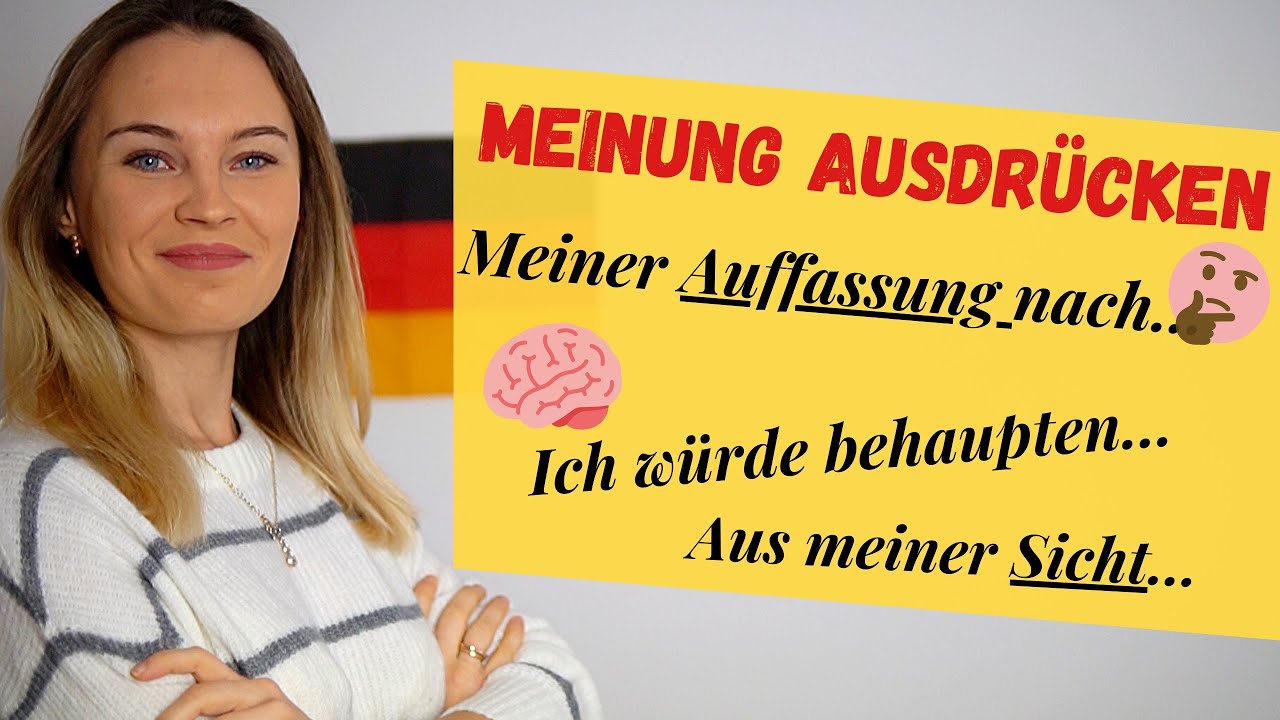
Express thoughts and opinions You certainly know the classic: I think that e-learning is better. I think a real classroom is better. This is mainly used when speaking.
But what about any other forms of speech? In my opinion, e-learning is the learning model of the future. (and of course the present) Alternatively, you can say: Regarding e-learning, I would say that it is the learning model of the future.
I firmly believe that e-learning is the learning model of the future. And finally: I take the position that e-learning is the learning model of the future. That sounds very nice, especially when writing.
2. Use arguments Now of course, we also want to say why e-learning is the learning model of the future. I think e-learning is particularly important because you can learn anywhere .
. . if you have a computer, a smartphone and an internet connection.
If you consider that you can learn anywhere, then e-learning is the learning model of the future. You should definitely take into account that thanks to e-learning you can learn anywhere. 3.
Agree to others' arguments If you have a discussion, you have a conversation partner. And if you have the same opinion as your interlocutor, you can say the following: You probably already know that: I think so, too. I think so.
I think so, too. Or simply: yes, exactly! We use them especially when we speak.
You can also say: Of course, you are right. You are right, of course (this is the polite form. ) I agree with you.
or: I agree with you. This is stylistically a very elegant phrase: That is really a strong argument. That means it's a really, really good argument.
Or: Your argument makes sense to me. That means it's a logical argument. On the other hand, you can of course have a different opinion than the interlocutor and with that we get to point 4 - reject an argument: You can simply say: I don't think so.
or: I don't think so. We use that especially when speaking. Alternatively, there are many others options: I have a completely different opinion because the best way to learn is with a teacher in the classroom.
The word view is synonymous with opinion. I have a completely different view because it is best to learn with a teacher in the classroom. Or: I cannot understand that at all because the best way to learn is with a teacher in the classroom.
I can't agree with that at all, because the best way to learn is with a teacher in the classroom. Here, I used the word "because" for a change. Warning: the verb is in position 2.
The following speeches, which we use especially when speaking, are a bit more extreme: It's not true! This is not right! Learners need a teacher and a classroom!
You're wrong! You're wrong! With such statements, one should but be careful, because they can sound rude quickly.
If you have an opinion on a topic, whether it's positive or negative, then that's one thing. But what if you are unsure? If you do not really know whether to agree to an argument or whether to reject it?
Then you can express doubts or uncertainties, which brings us to nr. 5. Is e-learning better than classroom teaching?
I'm not sure. Well, I do not know. or: I don't really know.
I can't believe that. I don't really think so. Of course, you can also answer your counterpart with a question: Are you sure?
Are you sure? Do you know that very well? Do you know that very well?
You can also ask critical questions: Can you prove that? Do you have evidence of this? In science, we often ask: can you prove that?
For example with a study or an article from a newspaper How can you react if someone has doubts about your statement? I say e-learning is the learning model of the future. You say I don't think so!
Can you prove that? And with that we are at 6. - answer doubts I am quite sure of that because e-learning offers much more options than traditional classroom teaching.
There are many studies by well-known scientists on this subject! Believe me, because e-learning offers much more options than traditional classroom teaching. The polite form is: Believe me, because e-learning offers much more options than traditional classroom teaching.
I know that because e-learning offers a lot more options than traditional classroom teaching. So now we have discussed a lot and you can drag and drop a discussion forever, but at some point you have to get to the goal and that's why we are trying to meet in the middle and come to a solution. That is why we make a proposal in 7.
We could close all schools and every teacher would only do online classes. What do you think if we close all schools and every teacher only teaches online? The polite version is: What do you make of it when we close all schools and every teacher only does online classes?
If you want to be more active, you can use the following: I am in favor of all schools being closed and each teacher only taking online classes. I suggest that all schools close and every teacher only teaches online. How do you like the idea of closing all schools and doing everything online?
Maybe we can meet in the middle and find a compromise. I would like to make another suggestion. I have another idea!
By the way, you can use the subjunctive here because it sounds a bit more polite and indirect. But you can also say: I have a different / better idea! What do you think of the following compromise: / What do you think of it: / What do you think of it: We combine e-learning and classroom learning.
Or: how about combining e-learning and classroom learning? Not a bad idea, is it? Incidentally, this is an opinion that I share with many scientists.
The concept is called Blendend Learning and is a mixture of online lessons and traditional classroom instruction with a teacher. With the last point, we agree and look for a solution now. If you weigh the advantages and disadvantages, you come to the conclusion that blended learning is the best way to learn quickly and effectively.
All in all, it turns out that blended learning is the best way to learn quickly and effectively. After a lengthy discussion, we agreed on blended learning. After a long discussion, we agreed that blended learning is the best way to learn quickly and effectively.
Yes, there are some really good ways to discuss a topic both verbally and in writing. As I said at the beginning of the video, I cordially invite you to discuss this topic with the phrases you learned in this video. If you know other means of speech, you can, of course, use them as well and share them in the comments, then we can all learn from it.
So: e-learning or traditional classroom teaching? Or would you prefer blended learning? Of course, as always, I'll try to correct as many comments as possible!
And that's it for today! If you liked the video and you learned something, subscribe to my channel now and follow me on Instagram and TikTok, then you can learn German even better! I say goodbye until the next video!