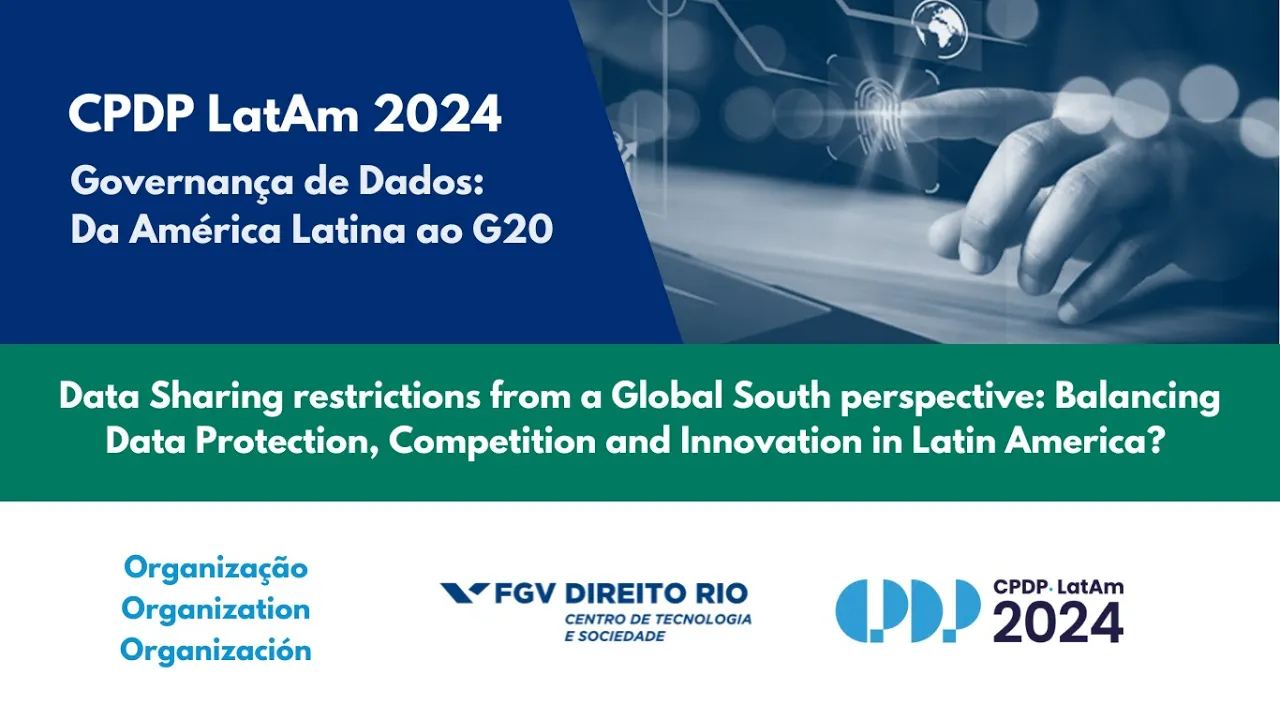
Good morning my name is Isabella I work at vados UH which is a law firm based in s Paulo specialized in data protection and competition matters while I have the privilege of uh moderating this panel today on data sharing restrictions from a global self perspective balancing data protection competition and innovation in Latin America and of course Global C countries more Generally uh I also have the privilege of counting uh with amazing experts with me today so first we have Andre codon Lopez um he is a PhD candidate at pon univ cathol law school he has
an llm at the University of y a bachelor's degree from Pon univ catholica Peru school where he's professor of competition law and constitutional law he's a judge for the competition tribunal at IND copy Peru national competition Authority he's also a visiting researcher with the Center for technology and Society at fgv Rio associate researcher for the center for studies in freedom of expression and information access at univers palmo in Argentina and a member of the academic advisor committee for the Cent the competencia of the University adul bz in Chile we also have with us uh remotely
uh magnaball she is the director of AIA Center a new Deli based technology policy focused Think Tank she's a lawyer by training with deep experience in Media and emerging technology the isia center is the only think tank in India that has explored the implications of exente digital competition regulations empirically and magn knowledged their work on this front before Asia she worked on legal and policy strategy at the Vault Disney company and before Disney she set up and led the India office for consensus the world's largest blockchain technology company she regularly writes opinions for leading Publications
and recently Co offered the Dazzle of the digital a book published by RL that delves into digital Technologies inextricable linkage with part progress and modernity in India finally we we have Professor Juliano marinel he is professor at the University of s Paulo Lo school he's also the director of the legal grounds Institute and logorithm and the chair of the International Conference on artificial intelligence and law of 2025 he is lawyer and partner of M and Menat so our proposal and the idea of this panel today will be to address legal challenges of complying with International
regulations while exploring the impact of data sharing in global cell countries from a competition privacy and also Innovation artificial intelligence perspectives more specifically to investigate possible impacts of data sharing restrictions in objectives of development and inclusion And whether data sharing could somehow increase consumer welfare in diverse economic and social contexts our goal is also to discuss development strategies and Regulatory models that best meet the needs and economic realities of the global South including as regards the development of innovative and emerging Technologies like AI which usually benefit from data sharing uh so our panel will be
divided in four phases the first phase will uh Be a first round of individual interventions uh where the panelists will be provided 5 minutes or so to provide their considerations about specific questions then we'll have a second round of individual interventions uh we will open then for questions from the audience and then you can raise your hand and I'll bring the mic to you and finally they will have some additional time for providing their final Considerations so as a quick start to our panel I will direct the first question to Andress so how does the
interplay between competition and data protection occur and more specifically how does data sharing relate to both competition and privacy laws okay Whata okay this is as far as my Portuguese reach now I switch to to English um first of all I I have to make the disclaimer I don't know if if it's Still used to but um since I was a appointed a couple of weeks ago as a judge for the tribunal of competition Authority in Peru now I have to make the a typical legal disca that that everything that I'm going to say right
now represents only my view and does not necessarily coincides with the uh positions of the authority um luckily ER at least for for the purpose of this panel the peran competition Authority has not uh dealt with cases regarding The interplay between competition law and privacy so I'm not um um not making I'm sure that that I won't be making any statements regarding H the specific Peruan experience in that area ER although I I I do plan on making some more General remarks about the this um this relation H with regard to uh the global South
as a as a region or more specifically probably maybe the global s is too ambitious but some of the South American Countries um so um when we deal with with the interplay between competition law and data protection legislation we actually are dealing with a topic that has been widely discussed er um um in many countries and also by um multilateral organizations like the oecd um and unad and others which is the interplay between competition legislation and other sector legislation so I I I would think that for most of er Academics practitioners and competition authorities um
we could simplify the the possible solutions into uh three Alternatives uh the prevalence of competition law the prevalence of the sector regulation both are application of the specialis principle or the application of both Corpus H which ER of course ER could be the result of an a specific um er statement or mandate to to apply both H regulations in separate areas or could be also the result of Just Silence by the legislature in which case h every um legislation and every um competent Authority cannot um neglect their um their enforcement duties and they have to
apply the laws and they they would have to decide how to do so um the application of both uh legislations H now getting into the field of of the specific interplay between competition law and privacy laws or data protection laws um does not necessarily prevent some uh problems Like H contradictory decisions um some in some other cases it could lead to redundant decisions and depending of of the ER type of enforcement that it's entrusted to those bodies it could also lead to H cases with u what uh some would consider double Jey or for instance
from from the more civil law tradition we would call it vising EDM right so um those two uh that last scenario where both laws are appli um with no prevalence of any of them I Think it's the most actually is the most frequent scenario H specifically when we are dealing with competition law and and data protection data protection laws are relatively younger than competition laws um at least in in in the South American context and I I would think that most of the those legislations following some of the the example of their European experience they
do not specifically address either competition issues deal With um Market powered it's not a an specific concern of those legislations and um and they do not th those those legislation they they do not address specifically the issue of h a possible redundant or complementary um enforcement of those legislations um this is why this third scenario I think is the most common one and in some other cases such as for instance what what Isen happening right now with the ER European specific Legislation dig dealing with Market power such as the dma um the law specifically takes
this third route establishing that it would be applicable without prejudice to the ER data protection legislation in this case in the European case the the gdpr um as a result um when applying um er comp competition law rules or specific Market power legislation such As the TMA um the law should not um or the application of the law should not ER affect uh personal data protection so the idea is that we could conceive an ideal a scenario where competition fairness contestability would be Foster and also data protection personal data protection would be protected H however
the like that is the the the ideal Scenario but as as we can see that won't always be the case um to make a a one or or at least two a final to share two final ideas before wrapping up this first uh intervention um er we can see we can foresee at least that H some H specific issues may arise um such as data protection authorities H making decisions that affect competition or reduce dynamism or innovation in some markets or we can have competition authorities making decisions that Include the application of data protection rules
which however ER may not be in line with the DPA criteria ER and even if it aligns with the DPA criteria er do not necessarily the DP the data protection legislation Foster competition goals so I I I addressed this topic in in in a in a paper that that I wrote that it was published last year in the in the Virginia law of U Law Journal it's Virginia BL Virginia Law Journal of Technology or something like that um of Law and Technology H that um the goals of data protection legislation even if it Fosters uh
users or or data subject autonomy for instance like in The Meta case in the famous um meta case ER brought to by the bondes celam in Germany ER even when it says that the data protection legislation protects consumer Choice consumer Choice might not coincide with uh consumer welfare it could be the the case but but But not that does not necessarily entail the the the same goal and um and if if we take a look at some of the principles and some of the the the rules that are established by data protection legislation such as
the free prior and informed consent those rules might not necessarily be the same threshold that competition authorities look to uh protect or or to Foster um so just to to Leave it like in in that point I I I would say that one of the main issues would be to try to try to reconcile the different goals that both legislations might be um trying to protect even though the legislators that enacted those different Corpus did not have in mind that ER the those two goals or those more than two goals would actually H be equivalent
or be a um following the same direction perfect thank you so much Andes and uh I think considering uh the synergies and also the challenges that you have mentioned especially as regards like this uh intrinsic relationship between uh the matters uh Magna I wanted to ask you uh what are some of the current data sharing restrictions imposed uh globally from both a competition and privacy perspectives and what are the risks uh negative impacts regarding data sharing restrictions and finally can data sharing be Beneficial right thank you very much um for having me here and um
hello to all the panelists and hello to the audience um so let me begin I think an's uh prefaced what I'm going to say really well he mentioned um the consent provision that is in the uh digital markets act article 52 which is essentially a somewhat of a replica of the um remedies that the bundes cartum prescribed in its decision uh against meta uh and essentially what it is is It's a restriction on data usage in different forms so processing combining and cross using um by Gatekeepers and in India uh we have a our own
version of the dma uh which is currently in draft in the draft stage it's called the digital competition Bill where we have imported that provision with a few uh uh with a few tweaks so in India um um Gatekeepers or as we call them systemically significant digital Enterprises are forbidden from um Essentially either intermixing which means combining or cross using data across different different businesses of the SSD and they're also forbidden from um sharing that data with any third party without the consent of both the business user as well as the end user so the
business user let's say on an e-commerce platform would be a seller and the end user would be know a customer like you or me um now there's multiple problems with this from a Doctrinal perspective it creates a privacy right in a legal person uh which doesn't stand constitutionally in India where uh privacy is essentially an individual right um it also I think conflicts with um multiple IB doctrines uh but I won't get into that right now um essentially the um I'd like to focus on the second part of your question which is what are the
risks and what are the challenges essentially uh the problem with um xanic competition Regulations like the dma and the DCB uh which is the digital competition bill in India is that they consider competition U they they consider competition in a very narrow frame and essentially they consider the relationship between business users or sellers on a platform uh and the platform in the narrow frame of being competitors with one another without really considering the synergies so coming back to the data usage restrictions essentially what they would Have the effect of doing and article um recital 37
of the dma is explicit about this um they would have the effect of reducing the efficacy of targeted advertising on these platforms now everyone might celebrate and say say oh that's great targeted advertising it's such an intrusion on my privacy it's so creepy etc etc um I apologize my my dog also has to chime in I apologize for that she felt very Strongly about what I was saying clearly um so um where was I so yeah so uh it considers this narrow d Dynamic of competition between business users and platforms without considering the synergies so
we con uh we conducted a study um on the impact such a provision would have on uh micro small and medium Enterprises in India and essentially what we discovered is that they are overwhelmingly dependent on targeted advertising for customer acquisition for Revenue generation for cost savings for time saving for even foreign customer acquisition so there is like a deep dependency of these services on on these platforms for I mean and particularly on targeted advertising now when you take that away which is something we asked them as well you know what would be the impact if
let's say the targeting on these platforms that you depend on was uh reduced or uh the efficacy of the targeting was redu U reduced and they And they uh and a majority of them indicated that they would be negatively impacted so a majority of businesses majority of people on the produce producer side would be negatively impacted and we wanted to understand the consumer side as well because of course there are two sides of a market um and I'm really heartened to hear Andes talk about the consumer uh talk about consumer welfare because that seems to
be um a term that is moving further and Further away from the Lexicon of uh competition authorities um definitely in in in the European Union somewhat in the um in in the US and so of uh in India as well uh which is quite disappointing because I think and um I hope I do hope that most people would agree with me that any competition regulation must rest on the plinth of benefiting and doing right by consumers um so again we uh surveyed 2,000 consumers in India um who shop online basically e-commerce Consumers and we ask
them you know what or how they benefit from uh Target advertising if at all whether they do find it helpful only 2% of the consumers uh that we surveyed indicated that they do not find find it helpful uh they said that it reduced their surge cost it said it it helped them with product Discovery um so multiple efficiency is again coming up there um so I I think from that standpoint when we consider that this law stands to negatively impact or I mean these Provisions specifically and we can I mean go wider but since we're
talking only about uh data sharing and data usage restrictions um that this law stands to uh negatively impact both the producer side as well as the consumer side then I think we have to take pause um and consider what that means uh or what what the purpose of such a law is particularly when a law is looking to reduce uh the efficiencies on Platforms in order to make markets more Competitive really what purpose are you serving and um you know is it an optimal form of uh optimal kind of uh legislation um another thing that
I'd like to uh like to bring up since we spoke about conflicts a little bit you know there are data sharing uh Provisions as well where um essentially um intermediate um sorry Gatekeepers or large digital platforms have to make data available or they are restricted Again from using non-public uh data in competition with um with business users and that's particularly in India um and that again conflicts with um data Protection Law right because they would be required to share well the data of business users with with uh with businesses um there's no definition of what
that is and how do you define that because most of that data that data cannot be generated without the platform um and you cannot And of course there's a legal conflict there as well because you cannot have um any rights over raw data so I mean there are multiple legal conflicts that come up a lot from IP and some definitely uh from data protection as well but the larger point is that what are we really trying to solve for when we're uh instituting data protection doctrines in competition uh and that question is not been answered
un unequivocally really it seems to be that it's just an attempt to Add friction and I think some some additional context is necessary here particularly uh in light of the dma the dma was introduced to Res resolve a market failure created by the gdpr in the in the European Union where the gdpr was brought in it hammered all uh many small uh startups and data Reliant businesses and essentially had the effect of entrenching the position of large technology platforms because they were able to move to Um uh uh to um compliance friendly jurisdictions like Ireland
uh and this has been documented by multiple Scholars there so really why at least in the context of India why are we following uh the European Union down this path of Regulation market failure then market failure created by regulation then again trying to rectify that and now we're already seeing multiple market failures emerging from the uh from from the implementation of the DM even though It's only been 3 months so I'll stop there but yeah I think it's I think it's questionable for the global South to be following the the EU I mean the EU
down this path uh really when it's so early and when already there are so many adverse effects coming to there perfect thank you so much Magna this was super super interesting and I think it helps to Enlighten or panel in general uh I will ask the next question to Jud professor Jano uh going more uh from a artificial intelligence perspective what are the main challenges for emerging Technologies as regards data sharing restrictions as mentioned by Magna uh and is data sharing within the context of AI compatible with competition and privacy requirements thank you very much
Isabella for your um question and um I also I I use heads today I'm using the head of the legal grounds Institute as a Pleasure to um be part of this panel and to organize this um panel with v um with uh vmca um law firm with which we have uh so many um uh collaborations and cooperations since uh not only in the field of the data protection but but also in the field of competi ition law and U this questions is this really interest to bring uh AI into the this context because AI really
challenges the way we we see and it's bringing very difficult questions to deal with within The tools of data protection and within the tools offered by competition law I I even would change your question in in terms of perspective as you you're questioning what are how the restrictions on data sharing um May hinder the development of AI so this question leads to a thought that data protection is given and how it is going to hinder AI but maybe uh AI is a social transformation that may lead us to Think given AI how can we handle
and reinterpret data protection and I think there is a it is um there is a very recent up toate discussion nowadays regarding the um use of data by um the developers of generative AI actually the discussion was race since meta changed its uh policy and informed that it's going to use the information or personal data uh or personal post or content Produced by its user in its platforms to develop it's meta AI but it's something that other developers of generative AI are doing already and but the initiative by both um data protection authorities and competition
authorities establishing measures to hinder or to suspend the development of the technology raises an alarm for us to think what's happening given that uh we are facing a Big transformation in digital Technologies and and with the social impacts that are important and are beneficial so um first um The Challenge to data protection if we take the very famous the landmark of data protection in the world which is the census case in by the Constitutional Court in Germany um everyone makes reference to this decision as uh the the landmark of uh autod determin self-determination and Etc
and Etc but actually if we take this case uh the use of personal data and there was very uh sensitive data that were requested by by the sensus organism uh by the state and the problem in that case was not the use for developing public policies because this use the purpose of this utilization of data was um anonymized it does it according to the court it didn't Impact individuals or personalities the problem was with the transfer of this data to um municipalities was one particular article of the legislation on sensus that transferred the D data
to municipalities in order to organize um um um [Music] the the division or um how um uh children were which school children Would uh um frequent or other Municipal programs that would um benefit from that information that was forbidden because the use was personalized then we all know the the development of of the legislation um on this subject and of course it comes to definition of strict rules defining conditions for the use or the the treatment of that data and that became um an analysis of strict conditions and we lost reference To what is the
purpose in the end of the use of this data does it hinder individuals or personalities does it does does it affect because if you take the decision the preliminary injunction by the Brazilian Authority it says there is a um irreversible a risk of irreversible damages to individuals and that's simply not true regard regarding the development of um generative AI systems because um uh in The development of this AI for it very nature it detects static statistically patterns for large amount of data where naturally the personal information is going to be lost is uh only patterns
on um um cultural traces of communication of wordings Etc the personal aspect is going to be lost for the very procedure of the technology one may say but the author say but the data which are uh is collected it's reversible because After the the um the AI is built you cannot retrieve the SCE and actually you cannot retrieve in those large mod models any SCE at all but it's exactly because you cannot retrieve personal information to extract from the model because uh the general PS are Incorporated in the logic in the in the knowledge it
is exactly because you cannot retrieve that personalities are not being affected it's it's a natural process of Anonymization so how how we can we handle this because of course there are strict rules regarding retention or changing the purpose of utilization of data that is um given in the in the data protection legislation how can we interpret uh um this in a different perspective um looking to the effects or the purpose of the utilization even the principle of um um purpose control that is basis of the data protection legislation is um challenged also uh Because it
it has a strict stct reading on every different purpose must be um previously established authorized by some thata some legal bases and Etc but what happens when we have the development of a general AI of general purpose how can you anticipate what is the purpose I cannot say for instance even with those capabilities of those systems that are not um um previously um predicted like you can use chat chat GPT to play chess Should we anticipate that they are going to use this data to develop uh chess games so there is something wrong that must
be adjusted and re considered um in the interpretation of data Protection Law um in order to enable the development of uh of this technology and this this will mean we have to re interpret it maybe we should um really bring data protection uh concerns within a broader view of data Ethics are these systems handling data ethically and this not does not only concern privacy it concerned many other principle and uh interests that are not only individualistic but also Collective take for instance I say this think for instance the difficulties for instance in in Germany This
was um um a very polemic discussion that many systems of AI were intended to be used uh to um to Fight the pandemics but there was limitations given by by data protection so the discussion is uh should privacy be the um guiding principle in the determination of this um public health programs or should we include or consider data ethics in a broader sense that involve public interests and Collective concerns so this is uh regarding data protection regarding competition I I'll be very brief um uh in the in the opening panel there Was um um a
provocation regarding AI systems that it could also hinder competition boats coming from uh lucab belli um given concentration and also from um Andrea from Global that uh this is really these are really uh um present demands that we have to think but when you we come to competition um does the development of General AI models hinder competition does Competition should hinder then the development of the of eii models if we think of course all the claims are legitimate um given that the use of data produced by through traditional media um became um um there is
a crisis in in in this field um but because this um data this information this content is used uh to train those models is there compensation for this how can we handle this but it It it is raised as a problem of competition and also cardi Brazilian competition author is challenging also this case in in by by meta but is this is this really a competition problem does CH GPT competes with uh um the services by traditional media I'm not really sure of course they compete for the attention for advertising but these are different Services
if you deploy a um um antitrust Methodologies they would never be considered competit competing services or substitutes in the sense of an trust analysis so how how should we handle it because um is there a risk for democracy is there a risk for uh the the um the business model of traditional Med yes these risks are present this may affect democracy uh but how can we really translate this in terms of individual protection of author or uh or copyrights can we Translate this as protection of personalities of individuals maybe we have some public concerns here
that cannot be translated into Data protection or uh the protection of competition of or the protection of authorship so this is the the the challenge that I made pa um um in the previous panel luuka has said we or or I think Nico has said I I'm not sure that these tools must be combined but maybe the compination is Insufficient may we are handling something um that changes the our very conception of law in the FI in the field of data ethics or the regulation of AI the subject meor of General etics is brought about
um they make claim regarding copyright and and in in the development of General AI is this is unfair because we produce the content but the um um digital platforms have the pro profit or the AI models have the profit we are discussing fairness is This ethical or not so it's difficult to put all that in the boxes of a traditional regulation of competition of copyright or data protection perfect thank you so much julo uh so to go for the second round of the individual interventions we'll now try to focus a little bit more on global
sou needs and parities about all of this uh so the first question goes to Andres uh how to make data sharing compatible with both privacy and competition laws Requirements and also uh from this Innovation perspective too while continuing to develop and support a robust digital economy through data sharing especially considering Global self needs and specificities yes um thank you sa um I would think that uh when we address uh the global Global South needs and particularities uh I'm going to address first the particularities H we have to take into Consideration that um the capabilities of
the enforcement of competition law but more specifically or more importantly the capabilities of enforcement of data protection rules are different in the global south or in in some of South American countries that What er we may found we may find I'm sorry in Europe for instance um Chile Where I'm studying um they do have a a legislation a quite old legislation on data Protection that that that do not have the H typical ER rights they don't have a DPA so enforcement over there of of data protection rules and some of the ER measures of data
sharing that might that are currently being discussed in ER in in in the context of data protection in some Er in some jurisdictions might not work um Peru for instance they er we do have a a DPA we do have a data protection legislation but as I mentioned in my previous H Intervention we don't have uh data sharing obligations coming from the h data Protection Law ER in the current draft that it's being discussed for the data protection regulation regulation to the law ER there is this article um regarding data portability ER but H do
not have as many specifications as we would probably want in order to have a a coherent application of both privacy or that protection goals and competition law U Goals as well um then um we can also mention for instance Colombia which may may be in a good position to to address both topics and and Rec reconcile both goals in as much as their Authority their competition Authority is also the data protection authority well they they do have separate bodies but within the umbrella of the superintenden industri Ecommerce um but still they they I I I
believe that they do not have J the Experience of addressing issues ER regarding ER data sharing so that's regarding particularities I think the the institutional arrangements are probably the most important challenges that from the global South we would need to address um H for this ER application of of of both type of rules ER regarding the Necessities I I would think that um when when I think of of of of the companies of or the services that are provided that that that are Quite important for for for end users and also for the development of
economies of of um medium small Enterprises as for instance I I think mea address in in their empirical report that that they made and which I found very interesting because we need also to to to address the effects that those rules may have on those particular economies I I would probably think that um a rules that make great restrictions or Or great limitations on on on data sharing ER might hinder ER economic dynamism and competitive markets in a countries where um we do not have uh or or at least a we we don't have the
same type of concerns with a large platforms and that that have L great Market power in other countries and in which a possible ER impact on privacy might be something of um great concern for the common individuals and or or Small and medium Enterprises um nevertheless that that's obviously not to to make a claim that we should have lesser data protection enforcement not but when we deal with a case that in may involve uh data sharing and um or or restrictions to to data sharing I I I would think that um some of the particular
needs of of our countries H might include The Practical ER implementation of of set obligations H for instance I'm just going to mention two or three er H topics that that I think do not have a legislative solution when we need to deal with this type of case for instance H if we are giving or recognizing the the the power of decision of the data subject in order to ask for either H getting access to all their data in a specific format such as the a mandate of data portability we would need to um Solve
the question of what's the data H that it's applicable to to that H that R of portability is it data provided by the individual is it data observed by the data controller or the data Bank owner or is it data inferred by the company right this is a discussion that that that has been addressing in other jurisdictions and when you see the law and experience of a um data protection authorities in South American countries or even competition law authorities Probably those questions have not been answered yet ER when we are dealing with data interoperability um
obviously this also implies um important logistic costs for the inter interoperating organizations ER in as much as one specific format or of or structure of interoperability or API scheme might not fit for every situation and also because normally when interoperability is mandated the main Concern of the authority mandating interoperability is focus on the obligations for the giv party but they do not address the obligations for the receiving party so in the case of the receiving party for instance that would be probably a concern for data protection authorities obviously because they do would not want that
an organization receives personal information ER that do not have in place ER all the security measures and do not Have restrictions for the and for new types of of res sharing or or a dissemination of the information but if that ER obligation is mandated by the competition Authority we would need to H for the competition authority to be um clear regarding the obligations H for both parties the the the giving and the receiving party of personal data um also I I think that that that one case that that might arise and I probably here in
Brazil you you may have more Experience with with that is H regarding the ER concerns by the giv party of the validity of the ER of the consent by the data subject of the the the authorization and concerns regarding um data management security um which from the competition law perspective it might seem like a hidden a refusal to deal no or something like that refusal to to share the information but from the h data protection authority it it could be uh ER it could Be the the a good reason to reject H the authorization or
or the sharing of of that information so um taking into account the particularities of a global South countries the needs the the the the size of the companies that that may be required to H fulfill this obligations or the lack still lack of of great experience when dealing with this er er er two legislations that may sometimes post some conflicts I think that Clarity In the interpretation of the law or or if possible Clarity in the scope and reach of those obligations would be especially appreciated uh by uh the administrative Parties by by by the
the subjects that are obliged to comply with those regulations perfect thank you so much andas uh now Magna how does the context of global South countries affect could affect or should affect the development of strategies and Regulatory models on Data sharing within the region including to better accommodate the Region's needs and economic realities and which factors should be taken into consideration I think it's a really uh there's a really simple way of looking at it um uh our access to information is cross subsidized by advertising and it has been for a long time not only
in the digital age all your newspapers most of your newspapers um buing the Sub Sub subscription only Publications follow that same principle where there are advertisers who pay to be in the in the newspaper that brings the cost of newspaper down for the consumer similarly for in the digital space you able to access uh different services for free in exchange for your data um uh and my problem with these narratives you know I mean I've heard people go as far as saying that they wish that all on online advertising was banned um is that It's
an extremely elitist narrative and it uh really does come from um tends to emanate from the global north um and is unfortunately emed in some parts of the global South without understanding understanding the ram ifications of what that means uh in essence it means moving to a subscription model for online services now uh when we consider you know uh the base of digital revolutions and how they've taken flight not across the Global South right uh in terms of access to the internet of course there are problems in terms of you know equality of quality of
service and connectivity etc etc those CS aside um but fundamentally it has also been the democratization and the accessibility of different Services because they are no no to low cost uh for the majority of people par I mean in my country definitely um so when you're speaking about restricting access to data you're Essentially you're automatically saying that there is in some way shape or form the cost of this product is going to go up and typically it is not the company that bears the cost they might bear the compliance cost to some extent um but
and if there is any other cost of uh cost uh that comes into providing the service that cost is defrayed by users on either side and we're seeing that with the dma and the thing is that if you want to consider development Strategies for the global sou um then I guess you have to consider you know what what is it that we want to emulate uh the European Union is I wouldn't say good but tends to focus a lot on regulatory Innovation where they come out with these experimental Frameworks um and they are pretty gungho
about implementing them but they're very far behind in terms of innovation um you know companies are I mean now large companies are also doing it but for a Long time there's um you know companies have started refraining from launching products in the European Union because of the state of Regulation uh and the regulatory uncertainty within that uh within that continent or within that jurisdiction um and so from that standpoint um you know what is it again that we're trying to achieve when I keep coming back to this question I know but because I don't see
a not well a normative nor normative basis uh for Digital competition law or exan dat restrictions in the name of competition um I think that it's a very thin to no normative basis but even from an economic standpoint uh there is absolutely no justification for it um you all you are doing is reducing accessibility um widening the digital divide uh because not only are not only will the cost of um Services go up they also become more difficult to use right uh so Choice screens are um I would say Incredibly unfair on let's say someone
who is not digitally Savvy uh but yet they are widely propounded as you know really empowering the user they are not empowering the user at all they are um they are taking time away from the user they are making these products harder to access and harder to use and they also creating vulnerabilities for the user as well right because um at the end of the day let's say in your choice scen though to some extent I would imagine they Would be verified uh there are apps that have malware on them etc etc and you don't
know um a from B you know that you like let's say you're looking at different uh location apps you like Google Maps and maybe you want to download one more as well on your choice screen and you know it turns out to have malware on it so you're creating a vulnerability there as well you basically turned your digital dividend into a vulnerability um so from that Stand I mean it makes absolutely no sense we're already seeing that um you know in in in the European Union I mean this is more related to self- referencing uh
which is slightly away from the uh from the scope of this discussion but uh the organic search traffic uh for hotels has gone down and the dependency on um ads uh on online travel aggregators has increased because of the European Union's restriction on uh self preferencing primarily on Google So Google cannot can no longer put its um search tool or it's travel comparison tool up and that was uh prompting a lot of organic search results for hotels that would directly go to their website but now that that's gone their dependency on online travel aggregators is
incre increased so there are a lot of unintended consequences we are seeing the cost of products go up um and like I like I said it is a very elitist notion to say that um um you know uh Do away with do away with all kinds of data sharing uh privacy must be Paramount I agree that privacy must be Paramount but I feel like there are a lot of um Concepts that are muddled in the name of privacy um for instance the data leaks in the EU uh serve as a testament to the fact that
it is not that the gdpr is not an excellent data Protection Law and um really I mean the I think the overemphasis on consent even though Uh many scholars agree that consent is kind of a failed model yes it gives you some sense of agency over you know what your data um what is being done with your data but not really right in in uh if when you think of the reality of it do you or do do I do any of us really whenever we go to a website do we read the entire notice
uh the Privacy notice that is put there do we need read the Privacy policies no we do not and there is Empirical research that has been done On this as well where it would take the average user to about 200 hours to read the Privacy policies of every website that they visit so it's a absurd notion um and it's unfortunately being pushed and um pushed in all in all sorts of Corners where it doesn't belong including competition regulation and I think from coming back to what I was saying from an economic standpoint it makes absolutely
no sense yeah close that Thank you Magna uh now uh jul should the development of innovative and emerging Technologies like AI which usually benefit from data sharing have an impact in privacy and competition regulations within the context of global South countries and I think this goes uh what you said before a little bit about how AI should maybe um have a role uh play a role in this discussion right yeah when we are thinking about global Health the main concern is how uh the Particularities of uh countries in the global South um will have their
particularities respected not only in terms of cultural aspects or economical aspects also normative aspects oh it's um legal order and be um considered in the uh development of these policies that are Global in a global digitalized world and um one of the issues is is related to to AI Since U um for again in our case of generative AI um the main um impulse is to apply Those restrictions that I strictly read from the from the data Protection Law which was somehow transplanted from Europe for instance if it's the case in Brazil legislation is quite
similar um but then we have um an issue that uh training locally those General AI systems is important to avoid some bias regarding cultural aspects of uh of a particular country if you get a um system of General eii train it only with uh um North American content if you ask uh um the I to picture um Mexican CEO probably there will be a man with a mustache some things like that so uh to avoid those kinds of bias and to respect local aspects of language or our cultural traits it's very important to train those
G General AI systems with with local compact but this is completely out of the discussion if you if you if you read for instance the material by the Brazilian data protection authority those more General concern regarding the ethics of AI bias are not being balanced if you look everything only with the eyes of um data protection and this may be an effect of transplanting an importing legislation from abroad particular from Europe and I'm mentioning here the so-called Brussels effect this is happening also uh regarding competition we have a a draft bill that um Is particularly
inspired by the um European digital markets act but what um concern with respect with respect to um adequate use of data or data sharing there is a restriction in dma but if you check the the um Brazilian antitrust Authority precedents the interventions by uh the European authorities within subject matters of of comp competition applier To data protection were based on the comp on the concept of exploitative abuse the Brazilian um Anti-Trust Authority explicitly rejects this concept how so how can you make this transplantation compatible or adequate to our um uh legal order so what I
believe that things has to be [Music] Um more reflected um with what are concer what are the real problems before trying to apply those boxes that were are already there in the legislation so Andre uh called attention to the property of of data of personal data the data given the data observed or the data inferred I think that's the real issue regarding the training of generative AI systems it's not about protection of Personalities because those systems completely abstract from personalities but maybe the problem is well are these systems using my data or the work I
produce when they produce content who is the owner of it someone is making profit of out of it and it is if you take a look there is this um um incredible um work the the the great transformation by Pani where he observes the the Industrial Revolution and the transformation of sa Society in The industrial revolution and he points out how work has been commoditized and the law um the work was Tred as property but it was then commoditized and workers couldn't handle it in in in contrast with the power of organizations or or companies
so then a new Feud of law was um brought about we are maybe we are watching something like the commoditization of personal data something that is going that is Part of the chain of uh value of production and and and Etc and so maybe the solution is not to will not be um based on a concern on impacts on personalities because there is no impact at all in personalities but it's a matter of well there is a commoditization companies are having profit with that this is a problem of uh property of Engagement in um the
production of systems that are globally used and how Can we be fair about this cont is it a problem of competition certainly not we are not by producing content disputing attention with GPT or meta AI or Etc there is nothing to do also with competition and I think by the same reason the problem with traditional Med media is not exactly on competition but maybe we have new issues uh to to cons how to um enhance and Empower individuals regarding the content they produce and um and the fact That this content is used to pro to
to uh to bring about new products new Services how can we uh also handle the problem of traditional media given that it's the content it's it produces is crucial and is important to the development of these uh generative AI tools so the the questions are quite different and importing legislation may may be not the the right answer to the to the global South for instance um the the all the dma Legislation um does not quite consider the impact of AI within the Dynamics of competition of digital Market if we take a first look um of
course the the dma is wholly inspired on the decisions of the um European Commission on practices by by the Big Tex so it's based on this experience but now new players are appearing open AI Was not a big Tech and appear with a very competitive product of course was then uh invested by by Microsoft and Etc there are con we are um um there is a testimony of a present transformation of the Dynamics of competition in in the market what are the lessons we have to learn uh because we cannot adopt a a um a
legislation which is based on um uh an enforcement experience by European antitrust authorities which are not congenial in many aspects To the enforcement of the Brazilian Anti-Trust Authority so we cannot import it um in a moment where all these markets are being challenged by new players within the advantage Advent of generative AI of course we have also concerns with con concentration and competition within AI markets I think this is the main subject that um authorities Regulators should be concerned with but um considering Um local aspects how it is uh how is the dynamic of markets
of digital markets of AI markets in this country how then should this be uh how should competition be enhanced we have um a concern of concentration within AI markets AI markets are disrupting and provoking a movement of Investments and rivalry in the digital markets so we have to understand what are the potentials of these AI markets to be competitive or to Be um or to induce concentration or or Market power and and I think this is a an important analysis that can that must be thought locally also considering the the global aspects because we are
handling with uh we are dealing with um um global companies but um the point is that we have to be attentive to this um particular aspects before importing solutions that may be from Europe that may be uncongenial to to local countries Of the the global s I make a quick reaction to to some of the comments of of Juliano because I I find it very interesting that that you address the the issue of ownership of data that ER that it's used uh to ER the the Geren of AI tools and that um ownership rules either
the ones existing or or maybe new ones could be the actual topic of of solution of of the upcoming controversies for instance Between um news media and and H those digital companies that are developing H generative AI if we take a look for instance at the complaint that the New York Times file against Microsoft an opening eye even though there is a small language regarding competitive damages it it is not a comp an antitrust lawsuit um and and I would think that they were very cautious and not following that path because probably there wouldn't be
current evidence of a Significative er er harm to competition er that can be sustained right now so but they do want some compensation from from open and and Microsoft and I don't know if if if you know there's a Latin American case competition case that that has been brought by um a Chilean newspaper the second largest Chile newspaper called laa against Google and one of the claims involves the use of gen Ai and as a possible uh source of Market harm to uh The company basically the the same theory that could be um posed in
the case of the of the New York Times but when reading the complaint you wouldn't find ER any evidence of competitive harm there's no economic evidence of of the harm being made to to to Lera which is not to say that they are not harm in a way but probably not relevant for competition law enforcement um so this probably just me um sharing some Thoughts because I I want to see the reaction of the people on that topic but but but I do think that that that even companies that are complaining of the competitive harm
generated caused by by gener generative AI may be conscious that um competition law enforcement at least would not be uh an ideal solution to the actual ER harm or or issue that they are dealing with and some other type of rule maybe ownership propietary rules I don't I'm not sure that Copyright law current copyright law would also be necessarily the solution but maybe new type of of of legal tools might better it they they might be better suited for addressing um the the current difficulties that they are facing say somebody I may say later if
if you prefer to okay I I think we can open now uh for one or two questions from the audience see if you have uh anything else that you would like to React the provocations to yeah okay I may be the provocation um some things um on a lot of the arguments I heard so far very similar arguments within Europe interestingly because we have like you know for example when it comes to financing of stuff it's different in Romania the income levels than in Luxembourg so Europe is not one monolith either so it's it's quite
interesting that some of these narratives come in a different frame Here again but I'm wondering how much they get us to solution so just of a couple of examples um that I noted down during during the debate um um so for example with the market failure because of the gdpr that we heard in the first round then theoretically in the US there is no gdpr then they would have had perfect competition with hundreds of competitors they don't so I wonder if the gdpr for example is the reason why the competition is not working in Europe
I think we have 100 other problems why the competition is not working but I wonder sometimes if that is let's say too simple as an answer to really come to the problem that we have or um we also heard on the matter we had exactly the same debate on localization of llm so they told us we need as meta all the European data because otherwise the llm does not speak perfect Austrian German which it doesn't do anyways um but um the interesting part there was that um Some of that can be done for example through
an opt-in system so for me for example in a meta discussion and how to train llms the question was not necessarily do we want that or not but do I have a choice if my data goes in and if for example meta asks for opt in and I would assume 20 or 30% of the people say yes I think lmms are cool I want to give my data to it that would still be enough data to train for local information well enough without taking The data of everybody without asking anybody so I think we need
to go a bit more into these details in in actually overcoming these things and they may then be different in different jurisdictions wonderful example in Europe is usually older Scandinavians don't give a about a lot of these things and it's about you know as transparent as possible so it's it's a bit more complex I think sometimes than than um we had so far um one other thing Um that I also wanted to mention because we actually work on it it's super interesting is for example the question of financing things um through advertisement that that we
heard from from the colleague from India um and we had exactly this problem with PK for example where meta now changed in Europe to say if you don't agree give us I think € 10 a month now um if you calculate that for 36 apps which an average European has installed um per Year that would be more than the average income in the European Union to pay for no one can afford that either um so if you look at the economics it's we have to go a bit more deeper um for example um when it
comes to online advertisement they make shitload of of money per person in the US way less in Europe meta publishes this data I think it's don't don't um quote me on that but it's like 20 to$ 30 per month in the US per User it's five or six dollars in the US in Europe so five times lower already um and then they usually have Asia and then rest of the world which includes anything from Australia to Latin America and there the income level from advertisement is also very low so the question of how much do
they actually make with that may actually correlate to a certain extent and may not be as different um and is definitely different in the us than for example in the rest of the world and even in Europe the UK Is much higher than all the other countries so we need to go a bit deeper there to see what is really the difference where do we from from for example an advertisement model do we have a price difference that um is specific to a jurisdiction even within the EU it's in Austria we make I think1 60
per month in the Czech Republic which usually is a little bit lower income they make five EUR they make more money from you know so if we really dig into That per jurisdiction and so on then we can get good answers and and see where difference is that is is is material or or maybe even not um so I just wanted to probably look at more of these Dynamics to um to get to an answer that is useful for everybody thank you uh so I have a couple of reaction to what has been said um
Juliano you said about um the fact that a lot of the theories that are used in Europe to uh merge privacy and Competition are about exploitation and not exclusion couldn't we frame things from an exclusion perspective in the end you don't need to prove that actual exclusion happens so you could argue that through data accumulation data collection in a way that doesn't respect the gdpr there they are taking advantage of this and excluding competitors from from the market so that could be a solution and the other thing that you Said about uh not being able
to predict the the uses to which data are going to be put uh in the gdpr there is a um a an exception to to the purpose limitation principle uh when it is done for research purposes H so you can do as many secondary uses as you want as long as you comply with certain principles ER in the context of Brazil uh could the sandbox that the um data protection authority has created for AI be a way to um maybe collect the consent for Secondary uses or you know find mechanisms that guarantee that those secondary
uses are in line with the um with the lgpd uh so these are the two points for you uh the point on for Andress uh you mentioned this issue about uh training with data and whether competition can be their solution for that I mean I have um question about the fact that um maybe uh the solution that is used for remuneration of Journalism um that is Based on mandatory arbitration over uh you know what is the fee that needs to be paid maybe could be imported into this field H and if you think about it
that one was done by a competition Authority in Australia so it competition could provide the solution in that sense I wonder what you think about it then finally for um Magna she mentioned I mean some of the things have been addressed already but one thing that you said about the use of non-public data uh I think uh the decision in the uh dma and also the Amazon commitments are about the fact that the E ecosystem orchestrator like Amazon cannot get access to this nonpublic data and not that it needs to share them with third parties
that would be a suggestion uh for something that is more like looking into industrial policy for data where you oblige them to share them with third parties of the ecosystem uh it's a choice that could be done uh maybe in Connection with the box to facilitate that there is a proper information to individuals that are concerned and they give the consent or or the avability to opt out but also many of these data are not personal uh you know I mean at least they are business data are not about the the final consumers so I
wonder if you could react also to this point uh and then I think there is a last question here also we spoke too much right are you Sure thank you no just more out of curiosity um how with these issues of of of competition but also opportunity for competitiveness how do you also see opportunities with regards to the the use of of Open Source models as well what could be Pathways forward in that direction um I think mecna could could address probably the the first question by I'm sorry what was your name Max yeah Happy
you can go ahead and then I we can jump after I'll take both questions um so just to respond to you there's a lot of um empirical evidence from the European Union that has emerged over the last few years assessing the costs um um of the gdpr on Innovation on particularly small businesses I'll give one example there's a study uh by scholars in NBR and I'm happy to share the link over here uh if the conference organizers want to share it onwards that Consider the costs of gdpr in the entry and exit of apps and
foregone Innovations so essentially the authors collected data on 4.1 million apps between uh July 2016 and October 19 along with measures of their usage based on both the volume of user ratings as well as cumulative installations um now the authors found that the gdpr induced the exit of about a third of available apps and in the quarters following its implementation The entry of new apps fell by half so I understand that there are many problems in the European Union of course you know um uh we have limited time in panels so all nuances cannot be
covered and I'm sorry for doing for not you know uh I I would say um being as nuanced as I should be but um there is a lot of data supporting the fact that the gdpr did create a market failure and it's not me saying it it's I mean there I me like I said it's it's I mean I'm quoting uh Empirical evidence on this um I don't remember the second part of your question but uh I think uh yeah you were talking about um basically the cost of the cost of data and I mean
essentially what I said about you know subscriptions being the alternative again I guess I was speaking in hyperboy uh but it's not only subscriptions right or it's not only the restriction on the usage of data uh that has to be considered um there are multiple other Provisions uh That uh within uh these exante competition regulations that would necessarily make um uh products if not more expensive then as I mentioned inaccessible in multiple ways um whether it be just in adding friction um you know where you have to keep opting in for something um and I'm
speaking from the standpoint of um many Indians who are digitally illiterate many people who are maybe not digitally Savvy um um you know and I understand That of course there's a heterogeneous uh context in in Europe and I appreciate you uh and I and I appreciate that and I'm and I'm not saying that it is you know this kind of monolith of rich people uh but again I can only really speak to the context of my country and then um and over here I don't think that based on the studies that we've done based on
the empirical evidence we've collected none of the practices that are prescribed um are um are found To be um anti-omp not anti-competitive but um you know welfare reducing either on the producer side or on the consumer side so again when we come back to this I understand that everyone wants to do something about big comp these companies because they are so big and they are you know I mean they are creating a lot of social Havoc the question is whether um antitrust is the correct Doctrine to be doing that and I feel like in Europe
antitrust is used um as a salvo or in Place of a lot of I mean to to solve for a lot of different issues which antit should not be solving for you know like there's this emerging um standard um standard of preserving democracy which is emerging in antit trust which I think is absolutely uh does not have a place there and actually just uh coming to AI um you know Andre mentioned that there's a case uh that has been um that has been uh that has been filed in South America where there's an anti test
component by A publisher will the French competition Authority recently just enforced um um copyright laws uh uh against open AI the pro and my point here is that moving away from your questions I'm sorry about that my point here is that this doctrinal confusion that is being created where these lines are being blurred and basically you have a competition Authority enforcing uh rules in uh in other domains where does it stop then what does what happens to The basis or the fundamental basis of comp of competition you know again uh um speaking about consumer welfare
there is this push to move away from consumer welfare um and towards fairness and contestability but these terms have not even been defined and I don't and the way they are kind of trans they the way they have been translated by regulation in the European Union and in India um uh it really seems to be that let's let's impair the ability of these large Players to operate uh so that we can enable others to compete without considering that these uh these things don't play out in a vacuum and there are multiple consequences that are obviously
not foreseen which are now coming to Bear coming to respond to the other question um I didn't say sorry that the non-public data uh provision was about sharing um I'm sorry if um I created some confusion we have a similar provision in our um draft digital Competition bill which is somewhat an import of uh somewhat an imported version of the digital markets act um and essentially there is within that provision um another subsection that speaks about you know basically ensuring data portability uh for both business users and um and um and end users so I
think I may might have created some uh confusion there the point there is though however that um I mean the point I was making Over there it's not really a data protection competition intersection point but in the context of non-public data um yes I understand where you're coming from in the in the context of um business user data but like I said that would only be raw data any kind of analytics that is drawn from that necessarily uh would be the property of the platform because the platform has made the effort uh and you Know
I mean has made the effort has applied its mind Etc to create that information to create those databases so that would be their data and there can be under trips um uh um under the trips agreement as well as under our copyright law there can be no property right over raw data so essentially this provision conflicts with both those considerations as well as I mean with the doctrine of TR Trade Secrets though we don't have a trade secret law in our country again I'm speaking very specifically to the Indian context um which says that essentially
which would which says that essentially if you're saying it's non-public data you're trying to treat it like a trade secret uh and the co-creator of that trade secret would NE necessarily be the platform and the co-creator of that secret or the co-owner of that trade secret cannot be excluded from that data um so all I mean all those considerations side I don't Know if I answer your question but uh essentially I wasn't talking about that being a data sharing provision but there is a subsection within that broader section on data usage restrictions within our draft
law that talks about data sharing that's why I was referring to thank you I'll try to be very brief in addressing each of the questions the comment I would like to make is the first sentence of the New York Times Claim uh in the document against open AI is um traditional journalism is crucial for democracy that's the real issue of the claim how these models are impacting democracy because they undermine the sustainability of the the traditional media so it's a it's a problem of sustainability and then the effort to translate it into violation of of
copyright of violation of competition is really difficult to um to sustain Because it's there is a transformative use it's a different use the services are different is there really competition it's not easy to put on the in within these boxes and um regarding I also do not agree that we can make General statements like um Europe is not anymore uh with the same um um strength in digital markets because of the general data protection rule I think it's this is too General things have to be um Better um scrutinized for instance your counter example is
a good one let us stud maybe in Easter countries there was already no um um there was already some fragilities to develop uh um competition so I think everything must be scrutinized but from the local perspective there are also those that defend that um gdpr is an opportunity for European companies to um develop their um language models uh with uh lating Lang languages Are German language Etc because so it's a um the general data protection will be a trade Protection Law to give these opportunities so but then if we think about Brazil uh should we
use the the same strategy if this is an strategy to create a a market protection well maybe not because um we have uh for Brazil has the opportunity to be a global provider of llms in Portuguese we have in our courts and in public administration everything is digitalized in public have huge amount of that data so maybe the strategies in Brazil are um um regulations that um give in provide incentives for the government to cooperate with companies to make um uh these data open in public in machine readable format which which is uh um not
quite difficult to make so for each country there may be a different solution uh in terms of Inclusion of the country in this Global uh digital economy facing the power of those uh leading companies and um so also um uh considering this this local perspective I I like your your approach instead of making a transplant in in um I think in the next month the legal grounds is going to publish um uh impact analysis of the um transplant of the dma to the uh to the Brazilian antitrust presidents to cardi Presidents and it's a huge
uh impact I like better the the the alternative where we try to interpret the Brazilian legislation to face the problems that these um concentration in digital markets are bringing in Stand instead of applying um a foreign and an extraneous concept like exploitative abuse yes that given that there is exclusion and um it is an aspect of qu or impact on consumers the the degree of privacy friendl of friendly of of this Of this um of these uh companies um maybe we can find uh a different balance between the consideration of those quality aspects in the
evaluation of the um anti-competitive impact of the there are alternatives so regarding the interpretation of Brazilian data Protection Law to uh find an exception to uh the development of General AI um generative AI systems I'm not sure if This is um a solution regarding uh research or uh but maybe um my proposal is try to to provide a different reading of the whole legislation not as um block condition or strict conditions that authorize read legal basis in a different way not the the procedures to evaluate each procedure of the treatment of data but take a
look on the purpose of the treatment of data is the purpose of the treatment of of of data affecting personalities individual Personalities so this is another way to interpret maybe maybe better than try to find a particular um Clause of of the law and regarding the these um open models this is an important consideration before um before regulation competition in digital markets as I said let us try to understand what are the impacts of these a AI generative models within the Dynamics of Competition of um um of digital markets before regulating before importing regulation let
us study and check uh what are the perspective what is going to happen what is going to happen in in the Dynamics of competition in this country and then the um the main question is will the um AI Market be competitive given that we are already glimpsing that there are there is concentration Etc but there is the the the alternative or The um or the possibility of open models and we have already available open models of generative AI uh that may um bring counter reasons to these conclusion that there will be concentration there will be
Market power maybe there are experien of using this open models that are quite um interesting and competitive uh we have to better understand what what is going to happen before um um Legislating uh on that so I think it's important to to understand that and maybe the uh discussion should be more sophisticated to check well what kind of open models are more are better to enhance competition so maybe a regulation on um um or open data open models for AI system would be uh much more effective to Foster competition than um then um um an
enforcement on antitrust law that is based on um on the European context For instance okay a quick comment so we can all get launch um I I think if I'm not mistaken that the Australian bargaining news bargaining code was approved in 2021 after the market study that the A C conduct regarding the news Market the news online market and probably the the response of approving a specific act to address this Issue shows also of the consciousness of the limitations of the regular H antitrust of competition law enforcement by The Authority so I I wouldn't rule
out that type of solution which I would think probably would be better suited to address a new pressing concern ER however that also poses a new challenge specific especially for Global South countries which is whether uh those large players would abide by a new specific legislation and wouldn't take Some also a measure of pressure such as the one that they have H put forward in Australia or in Canada and obviously for instance if if we think of Peru Chile Colombia maybe we don't have that economic strength as those countries so that that is also something
to to take into consideration thank you nice thank you so much I think this has been uh amazing so in benefit of time and lunchtime I'll just wrap this up um a little bit I just wanted to give A special thanks to all the panelists for your time and your insightful uh information that you have shared with us thank you so much and uh to everyone here that have attended to this panel and that have provided so many intriguing questions too thank you for making this more Dynamic and to cbdp Laton for all the organization
the opportunity and space that we have uh for discussing uh this amazing uh and complex topic so thank you so much have A great lunch and a great day and see you there byebye for









![Data Modeling for Power BI [Full Course] 📊](https://img.youtube.com/vi/MrLnibFTtbA/maxresdefault.jpg)



![Power Automate Tutorial ⚡ Beginner To Pro [Full Course]](https://img.youtube.com/vi/KsgxDz-nY_I/maxresdefault.jpg)