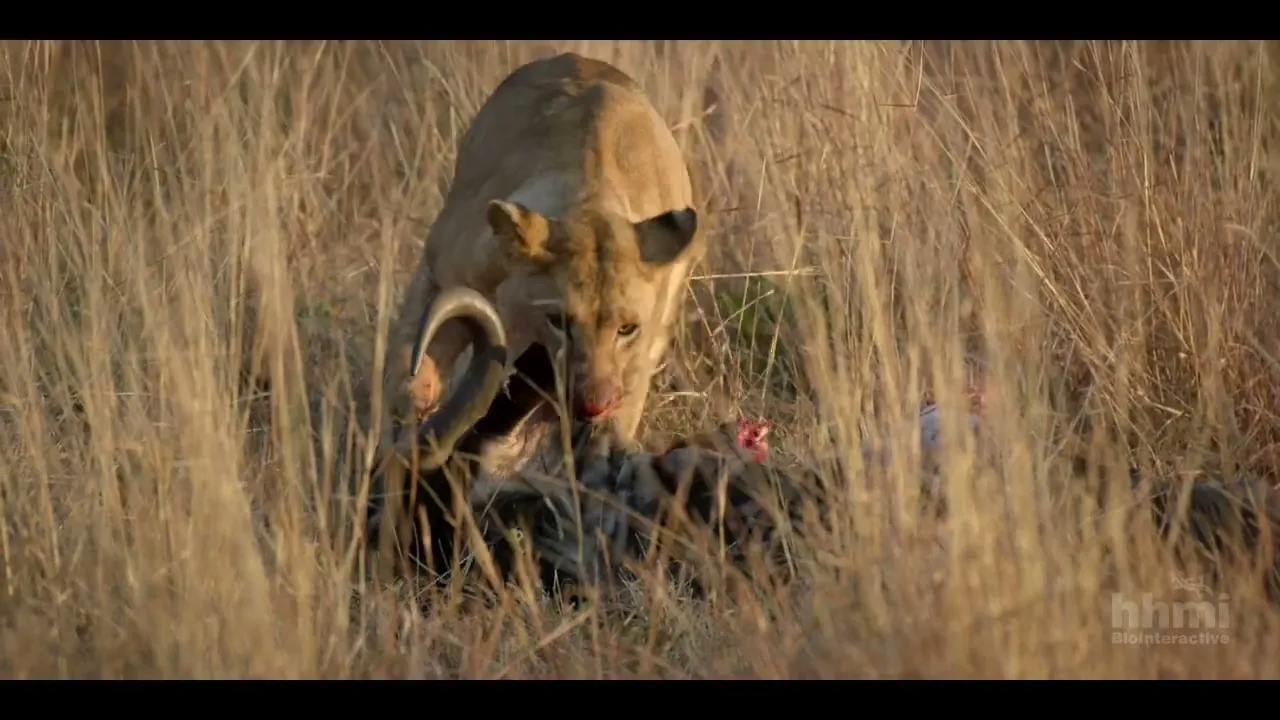
To figure out how the wildebeest population was regulated, Simon and Tony needed, of all things, dead animals. They began examining hundreds of dead wildebeest to determine the most common cause of death — predators or lack of food. [SIMON:] Okay, definitely here I see a wildebeest carcass.
And if it were hyenas, all the limbs would have been scattered around. So this is predation. Lions, most likely.
Age, you have to look at the tooth wear. Well there we go. This is adult.
And looking at the horn shape, this is a male, an old male. So some of them will be dying from predation, but also some individuals could be dying out of starvation. For an animal which died from starvation, because of lack of food, the animal starts using its body reserves, stored fat in the body.
When conditions are good, most of the fat reserves are stored around the stomach of the animal. But we cannot use that because they are eaten by predators. Scavengers also go for the fat around the belly, everything will be gone.
Because of that we have to look at what is left behind. Luckily, the very last fat reserves that are used are bone marrow from the long bones. Very few scavengers will go into it.
So this is what you'll find most of the time. And I'll crack it open. Yeah, so there we go, and there is the bone marrow.
The bone marrow will tell you the condition of the animal at the time of death. For three years, I recorded not less than 300 carcasses. In the early years, I would see these type of kills and normally I would think, "Well, for sure, predators, given their numbers, they would be regulating the wildebeest population.
" So that was my first thought. But after three years of studying, you look at the data and to my surprise, that was not the case. During the wet season, when there's lots of food to eat, there were very few deaths which were recorded.
And when you look at the bone marrow, it was solid, fatty, and whitish, indicating that the animals died in good health. But then, during the dry season, we recorded more deaths, and animals were in poor condition, with their bone marrow being translucent and gelatinous. This research tells us that wildebeest are regulated by availability of food.
During the dry season, there's much less food resource for the animals to feed on and that regulates the wildebeest population.