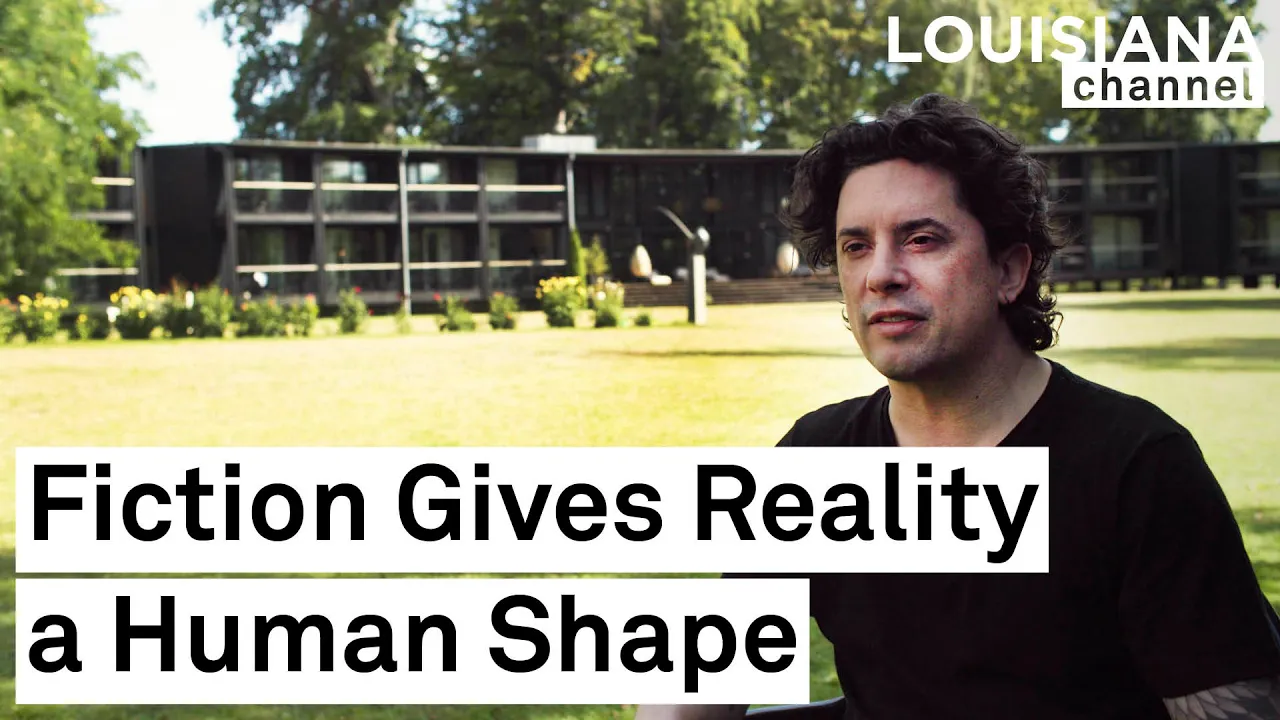
anything that comes out of a writer is fiction I think that we have pretenses that add non-fiction that are really kind of naive I think our fiction is is something that is not appreciated for what it really is it's not it's not the making up of stories it doesn't have to do with imagination that's not its main point fiction is is a tool it's a human tool that we have kind of developed to to give reality a human shape to understand what is presented to us and that goes on at all levels it's part of
perception there's a large part of fiction in perception itself it's not just thoughts it's not just stories it goes on all the time we just don't notice that it's going on my process is is really driven by in research I I don't worry much about the shapes of the stories I really it's all about research I try to find things to me to find some other person's phrase is more important than to come up with it myself it's the parts that I enjoy in that sense writing has really become more akin to walking and picking
stuff up off the ground that's really what it is to me and while I'm researching it it will determine many things not just I'm not just looking for I'm not just looking for for data I'm looking for the shape of the story and that has got to do with what is available for example if in certain texts there are scraps of information lesser-known characters people who really left no mark on history at all and then and then I have to make up things I have to create a fiction around but the heart of the story
is is really something that comes out of the research so to me it it's more akin to to looking at the world than thinking about it a Fascination to me is is just the key to all of this you know and not just I think that's really what writing should should aspire to at its best no Fascination which the Latin root is is comes from fascinos which is a male sexual organ it's to be aroused no I think that is something that art does in a very special way it's an arousal it's a it's an
excitement it's not just it's not entertainment it should touch you very deeply you should be moved by what you are investigating now you should be moved by the world and to transmit that by some ways is what writers should really aspire to just to that feeling that you get when you when you perceive or when or when you bump into something that is hard to believe or that is so beautiful and it's hard to put into words so Fascination lies at the root of everything that I try to do and if you manage to transmit
that and people feel that feeling of excited arousal it to me it's not it's very important because it does we're constantly being I feel that the world is becoming so that it it's very hard to feel fascinated we're dulled down we're we're people are always teetering on despair nowadays so Fascination and all are are the only remedies that I that I know to face the crueler realities that we have to deal with the world inspires on it also inspires Terror those are the those are the two extremes but but we mostly live in the Middle
where we feel none of those no we go through life actively avoiding anything that is gonna put us off center no I think it's I think boredom is is the prevailing sentiment and literature should be an antidote to boredom and most of it is boredom inducing most books I find just plain boring not even bad which is which is worse there's a there's a couple of authors who can only be described as exciting when you read books by Roberto volano or Pascal quinard or WG sabled they're who can be a bit boring quite boring but
still there's this general feeling of excitement you you're you're being shown things about the world that make it seem like a better place than it is so I have many many literary Heroes but they're all dead or they're not working anymore but I think I I think the first one that really made me feel that I could write was Roberto when his books came out I I there was a sense of speed just a different speed like when you watch old time football players where they would just kind of Trot along the pitch and this
this man just was running you know at full speed but then there's also the opposite of that you know people like like sabled where where the care and the time and the complexity of what he does is just beyond me I don't know how you can I realized one of the tricks he did was he he would steal from his favorite authors and weave them through the text these quotes where you could never tell apart what was his style and what was the voices of others that you were listening to or there's the French writer
called Pascal quinard who who I don't I don't know if he's from this world he he seems to be mentally inhabiting a former time period and that is one of the things that those are the type of books that I'm attracted to the ones that either show us a future that's yet to come like Philip K dick or people who rescue like forgotten parts of the past and there's others like contemporary writers like Elliot Weinberger who does things with the essay that you really shouldn't be able to do it's it's it's not just poetic prose
it is the essay form with a poet's Sensibility and he's in that ear for for style and for beauty is something that's very rare and then there's for me there was a man who taught me how to write and he was a poet he was a Chilean poet and he died he died without um publishing a single one of his poems and that had a very an outsized influence on me because it's not it's not only that writing has nothing to do with with publishing or with being read it was literature as a as a
way of life it was like a monastic calling and it and it's not the regular Silence of the person who like Juan rule for no who publishes two books and then disappears this is something where the value of the writing itself died with this man and he was my my teacher Samir was someone without whom I would have never written a single word I think theft is is a better part of writing because it has to do with this attitude where it doesn't all come from you it's it's that's very important if you find your
writing in the writing of others whether it be literary or non-literary I think it creates a different relationship between you and your and your work where you really feel that you're discovering things not inventing them and that changes your your attitude to writing it changes your attitude to to your work you become fascinated by others and the capacity to be fascinated by the other is is something that is very hard to develop but once you have it writing stops being a a means of self-expression and it becomes something very different and to me if I
hadn't been lucky enough to have gone through a crisis that left me unable to write unable to read even and that changed my relationship to what I was doing if I hadn't done that I I think I would have lost my health and my reason I wouldn't have been able to keep on going on going because I really feel that when you scratch the surface of yourself like like some writing does you're hurting yourself no well I now I find myself in in others in in research in academic papers in in in shitty blog posts
written by obsessives that's it's a wealth of material that you cannot find inside yourself at least I cannot find that inside myself I was very responsible at a certain time in my life because because I met an amazing woman who who I ended up bearing we've been together for more than a decade and she was very far ahead of me in every respect and I felt braver than I'd ever felt before so I tried out everything everything that I could do to elicit the type of change that I thought was necessary to write because I
always I've always had this very naive belief that you cannot be a normal person if you want to be a writer like William Burroughs has a phrase that says um a magician must be in some way inhuman and I think that that also applies to writers writers have to be at least in some way inhuman and so I took it upon myself to experiment wildly and sort of irresponsibly so it was a it was a self -propelled crisis and it was a big one it was the biggest one I've had but I did come out
of it a changed person and um I would never put myself through anything like that again but I'm really glad now that it happened because it did change me and it did change my relationship to what I do there are certain people who do things that I don't understand how they're able to do it and so because there's no rational explanation to this sort of talent I developed my own kind of suspicions about how it works I think that you have to open yourself up to possession you have to develop some sort of Communication channel
between the front part and the back part of your brain and that happens naturally in some people no how is it that you can get something bigger than yourself to come through that's a big question in in writing and in art in general and the only way that I've um answered the question is that you have to become porous you have to become you have to let the world in and it comes before writing it comes long before right and if you don't do it you're just pouring yourself out and we all know how poor
we are right we all know how uncreative how boring we are right and yet to become fascinated and to become to become not a channel because but to be invaded by something even if only for a short while to me I think that's absolutely necessary I don't know uh I don't I think that most people who create art of any kind know that there's a couple of pages in a book where you weren't really there I'm not sure what's there instead of you but I I know that those are the moments that I you write
the entire book just for those couple of pages I think we're lost in search of ourselves no I I'd rather I think we're a species that is haunted by itself I think we need to develop a different relationship with that because selfish expression is an answer to anything it's not an answer to anything no I think that's not the way I think it's part of our part of the mechanisms by which we suffer self-expression is is not the answer nor is it identity no there is there is something to be said for art that does
not that is not born of that that is not born of just the need to express yourself and that is comes from admiration be it be it an excitement about the natural world or or the work of others those are the types of books that I enjoy the most when the author is so caught up by his object like there's a English writer called J.A Baker and he wrote a book called the Peregrine and in that book he doesn't just describe the Peregrine he he becomes the hawk he he becomes the animal that he's stalking
and you almost don't notice that it's happening and suddenly the writer is not there and you're looking at the world from the eyes of a peregrine falcon it's it's a magical it's a magical experience and he only wrote that one book and I think that's kind of the price that you have to pay if you come into literature from a different perspective you come at it like with a more Pious perspective were you actually have this shameful belief that it is important that it is sacred that writing is a sacred endeavor you see things differently
now you're not looking to express yourself you're trying to find something that is like like a French mathematician said that is is very big and yet it's very delicate at the same time I think fiction is one of the few tools that we have to construct meaning meaning is not something that is in the world it's something that comes from us and stories has always been stories literature one of the best tools because it doesn't because it lets us at once look at the outside world and and at our deranged inner landscapes and it's very
special it's it's we have forgotten the power that lies behind it fiction is not something that writers do we're just professionals at it no and so much so much art nowadays and so many books they've lost their connection to the spirit they've lost the connection to something that is bigger and that is not something neutral that actually strips meaning from the world it's a corrosive influence when you when you write something that has lost all contact to something bigger you're not just writing a bad book you're actually hurting us because that is something that only
fiction can do like a layer of meaning that we put on things and it today almost everybody is aware of this we all know that things don't come with their meaning and yet we've sort of given up right where I think that Fiction's job is to create bigger faster darker and More Beautiful meanings all the time even knowing that it that it might be pointless and it might just be a game I think we have to think about God a lot more than we do not believe belief is the death of thought now as soon
as you start believing in something you believe the grass is green and that's it no you're not involved with it but I do think that we have to spend more time thinking about the Gods in general not just that one no we these are some of the most important things that we've come up with as a species and then we kind of got power mad and drunk on the fact that we realized that it was just us but that doesn't take anything away from their beauty their importance so I think that to to quote a
bad poet I think we have to reinvent the gods all the myths of the ages I think that literature should become more ritualistic we should not only write in that Spirit but actually Aspire or work to have a little bit of that we need a connection to these things or or we'll just become impoverished like desperately impoverished