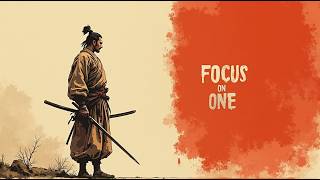
Kyoto, Japan. A young samurai named Teeshi collapsed during training, not from physical exhaustion, but from something deeper. His master, Yamamoto Sensei, looked down at him.
You're tired, not because your body is weak, but because your spirit is heavy. Teeshi didn't understand. He trained harder than anyone.
Slept less, pushed more. Yet, he felt empty, drained, burned out. Meanwhile, across Japan, Miiamoto Mousashi, the legendary swordsman, fought duel after duel, trained relentlessly, created art, wrote philosophy, meditated for days, and never showed exhaustion.
Over 60 life or death duels, never lost, never burned out. How? Here's what nobody tells you.
Your exhaustion doesn't come from what you do. It comes from why you do it. Mousashi understood something modern people have forgotten.
Energy doesn't come from effort. It comes from alignment. The question isn't how to rest more.
The question is, are you walking a straight path or are you running in circles, draining your spirit with every confused step. Chapter 1, the awakening. The moment energy dies.
Osaka, 1,64. Teshi was 19 when he arrived at Master Yamamoto's dojo, eager to become a great samurai. He had talent, discipline, ambition, but within 6 months, he was exhausted in a way he'd never experienced.
Not physical tiredness he could handle that. This was different, heavier. A weight in his chest that no amount of sleep relieved.
He'd wake up tired, train tired, eat tired, sleep tired. Why am I like this? he asked his training partner, Kenji.
Kenji shrugged. You're not the first. Many students arrive with fire and leave as ash.
That evening, after a particularly brutal sparring session where Teeshi had been defeated by a student half his skill level, Master Yamamoto approached. Walk with me. They walked in silence to a quiet garden behind the dojo.
The sun was setting, casting long shadows. Tell me, Teeshi, why did you come here? To become a great samurai master.
Why? Teeshi paused. Nobody had asked that before.
To bring honor to my family. To prove myself, to be recognized as, "Stop. " Yamamoto's voice was gentle but [music] firm.
You came here to prove something, to gain approval, to be seen. Teeshi felt exposed. That, Yamamoto continued, is why you're exhausted.
You're not training to master yourself. You're performing for an audience that isn't even watching. The words [music] hit like a physical blow.
Yamamoto picked up a small stone, placed it in Teeshi's palm. Every time you train for approval, you add a stone. Every time you compare yourself, another stone.
Every time you overthink, [music] hesitate, try to impress. Stone, stone, stone. He placed imaginary stones in Teeshi's hands until the weight became real in his mind.
You're not tired from training. You're tired from carrying stones that serve no purpose. Teeshi looked at his empty hands but felt the weight anyway.
Miiamoto Mousashi, Yamamoto said, fought over 60 jewels, many to the death. Yet he lived to old age and never burned out. Do you know why?
Teeshi shook his head. Because he fought to understand himself, not to prove himself. He carried no stones.
His energy came from walking a straight path. His path not running in circles [music] chasing validation. That night, Teeshi couldn't sleep.
He realized he'd been exhausted his entire life, not just the past [music] 6 months. Every effort in school to be top student, every social interaction to [music] be liked, every achievement to be impressive. He'd never done anything simply [music] because it was his path.
[snorts] The next morning, Yamamoto announced, "Teshi, you will spend one year learning Mousashi's method, not sword technique, energy alignment, the practice of Dudo, the way of walking alone. But master, I came here to learn to fight. And you will never master fighting while your spirit leaks [music] energy like a broken vessel.
First, we seal the cracks, then we fill the vessel. " Teeshi bowed. He had no idea this decision would transform not just his training but his entire life.
Chapter 2. The principle Dudo. The way of walking alone.
The next morning, Master Yamamoto led Teeshi to a storage room. Inside, mountains of equipment, clothes, scrolls, [music] weapons, everything a samurai might need. Take what you need for one year in the mountains.
Teeshi began gathering items. [music] extra clothes, spare sword, writing materials, cooking supplies, blankets, books, tools. After 20 minutes, [music] he'd assembled a massive pile.
Yamamoto watched silently. Then now remove everything of no use. Teeshi looked at his pile.
But master, I might need. Miiamoto Mousashi wrote, "Do nothing which is of no use. Every possession is a weight.
Every attachment is a chain. Remove what you might need. Keep only what you must have.
Teeshi reluctantly removed items. Half the pile gone. More.
Another quarter. More. Finally, Teeshi was left with one sword, one set of clothes, one blanket, one bowl.
This, Yamamoto said, is the first principle of inexhaustible energy. Remove everything of no use. They walked to a quiet grove.
Yamamoto sat, gestured for [music] Teeshi to sit across from him. Mousashi lived like a ghost. He slept on floors, traveled barefoot, often went without even a change of clothes.
People thought him strange, but he understood something they didn't. Energy doesn't come from having more. It comes from carrying less.
Yamamoto drew in the dirt. A man carrying a massive boulder, hunched, exhausted. Next to it, a man walking [music] freely, straightbacked, carrying nothing.
Modern people, even now in Edo period, carry invisible boulders, mental baggage. They carry every [music] insult, every comparison, every worry, every obligation that doesn't matter. And they wonder why they're tired.
You came here carrying stones. He listed them. Proving yourself to your father, comparing yourself to other students, worrying about what people think, perfectionism that serves no purpose, seeking validation from every action.
Each one felt heavy in Teeshi's chest. Mousashi removed all stones. He asked of every thought, every possession, every commitment.
Is this useful to my path? If no, he discarded it without hesitation. This is dudo dudo.
The way of walking alone, not lonely, alone. Walking your path without the weight of others expectations. Teeshi felt something shift.
But master, how do you know what's useful? Yamamoto smiled. That's what you'll discover.
But first, you must understand something crucial. And this truth [music] extends beyond this dojo, beyond this time. His voice took on a quality that made Teaeshi feel the words reached beyond him.
Throughout history, [music] warriors have discovered this principle. That energy doesn't come from effort, but from alignment. That exhaustion comes from carrying weight that serves no purpose.
And today, in times you cannot imagine [music] in places far from this mountain, others will face the same burden you face now. scattered energy, divided focus, spirit crushed under stones they don't need to carry. Yamamoto looked directly at Teaeshi, but his words seem to speak through time itself.
Those who discovered Dudo who learned to walk their path alone, unburdened by useless weight. [music] They find what you're seeking, not techniques to push harder, wisdom to walk straighter. At presence and purpose, we keep this warrior discipline alive, not as history, but as practice.
The ancient method of energy through alignment, not effort. The samurai path of removing stones instead of building strength [music] to carry them. He stood gestured for Teeshi to rise.
If you feel called to this path, if you recognize yourself crushed under invisible weights, walk with us. This training isn't locked in the past. The principle is eternal.
Join others who choose alignment over exhaustion, clarity over chaos, straight path over circular running. Because Mousashi's secret isn't hidden in scrolls. It's in the choice to remove what's of no use.
Teeshi bowed, feeling something he'd never felt like he was joining something larger than himself. A lineage of warriors who understood that true strength comes from simplicity. Yamamoto smiled.
Good. Now, let's begin removing your stones. Chapter 3, the test.
Removing the stones. Week one, the weight reveals itself. Yamamoto gave Teeshi a simple practice for 7 days.
Notice every time you do something for validation, comparison, or [music] approval, don't judge it, just notice. By day three, Teeshi was horrified. Every sword form thinking, "Am I doing this better than Kenji?
" Every meditation wondering, "Does master notice my discipline? " Every meal rushing because others might think him slow. Everything contaminated by seeking approval he didn't even realize he craved.
This Yamamoto explained on day [music] seven is why you're exhausted. Your mind splits into two. The one doing [music] the action and the one performing for an audience.
That split drains energy faster than any physical effort. Mousashi understood this at 13. After winning his first duel against Arma Kihei, he didn't celebrate.
He went home alone. Not for modesty, for integrity. He fought to test himself, not impress others.
That clarity gave him [music] endless energy. Week two, simplifying action. This week, Yamamoto said, "You will practice singleointed action.
When you train, only train. When you eat, only eat. [music] When you rest, only rest.
No thoughts of what comes next. No comparisons, no performing, just pure action. Teeshi tried, failed [music] immediately, training his sword form.
His mind wandered. Is my stance right? What will master say?
Am I improving fast enough? Yamamoto stopped him. Your body is here.
Your mind is elsewhere. That split is the energy leak. He demonstrated [music] a simple sword strike.
No wasted movement, no tension, just pure present action. When Mousashi fought, he was only fighting, not thinking about reputation, not planning his next move during current movement, not performing, just striking. That's why he never tired in battle.
You tire because you're fighting yourself as much as your opponent. Teeshi practiced this for hours, days. Slowly, glimpses of it emerged.
moments where his mind and body unified, where action flowed without internal commentary. Those moments felt [music] effortless, like tapping into an infinite well. Week three, the comparison trap.
During sparring, Teeshi noticed his energy plummeted when training with students better than him. Against weaker students, he felt energized. Yamamoto noticed, "What happened?
I don't know. I just feel drained [music] against Hiroshi because you're comparing against better students you feel inadequate stone against weaker students you feel superior another stone different weight Mashi never compared he once [music] wrote there is nothing outside of yourself that can ever enable you to get better stronger richer quicker or smarter everything is within when you compare you give your energy to someone else's path you abandon and your own. Yamamoto made Teeshi practice blindfolded sparring.
You can't see who you're fighting. You can only respond to what is without visual comparison. Teeshi's energy stabilized.
He moved freely without the weight of judgment. Week four, the first lightness. [music] By week four, something shifted.
Teeshi woke up one morning and realized he felt light. not physically different, but the heaviness in his chest had lessened. He trained that day with singular focus, no internal commentary, no comparison, no performance, just movement, just presence.
After training, Yamamoto approached, "You're beginning to understand. This is what Mousashi called Hosin Pingchan, ordinary mind, the mind that doesn't add weight to action. But this is just the beginning.
Removing stones is the first step. Now we must learn why to walk at all. Chapter 4.
Warrior psychology. The science of alignment. Month two.
Yamamoto gathered all students for a teaching session. Teeshi sat in front, mind clearer than it had been in years. Today, Yamamoto began.
I'll explain why Mousashi never burned out. While other warriors, more talented, sometimes stronger, fell to exhaustion. The neuroscience of energy drain.
Your body has limited physical energy. [music] But your spirit's energy is different. It renews when aligned, depletes when divided.
Modern understanding, which you'll learn about in centuries to come, will explain this through something called cognitive load. When your mind splits attention doing one thing while thinking about another, it consumes massive energy. When your actions don't align with your values, doing things for approval instead of purpose, it drains your [music] spirit.
Mousashi aligned everything. His actions served his path, nothing else. That alignment created effortless energy.
Mousashi's wisdom. Do nothing of no use. Yamamoto read from a scroll Mousashi's words from the book of five rings.
Do nothing which is of no use. Simple words, profound practice. Mousashi removed everything thoughts, actions, possessions that didn't serve his path.
He didn't do this to be noble. He did it to survive. In battle, every extra thought is death.
[music] Every unnecessary movement is weakness. But he applied this to life, not just combat. That's the secret.
[music] The Stoic parallel. The ancient Stoics philosophers from Rome you'll learn about understood this [music] too. Marcus Aurelius wrote, "You have power over your mind, not outside events.
Energy comes from controlling what you can, your perception, your choices, your path. Energy drains when you fight what you can't control, others opinions, outcomes, external validation. " Mousashi mastered this completely.
That's why he could fight 60 jewels without fear consuming him. The psychological mechanism, attachment and depletion. Why does seeking validation drain [music] energy?
Because you attach your peace to something external. Every time that external thing shifts, you shift. That constant adjustment exhausts the spirit.
Mousashi practiced non-attachment. A zen principle. He fought to master the moment, not [music] to win approval.
When you detach from results, you act freely. Free action doesn't drain, it energizes. the flow state.
[music] In battle, Mousashi often entered what we might call mushin, mushin, no mind. A state where thought disappears and action flows perfectly. This state is effortless.
Time disappears. Energy feels infinite. Why?
Because there's no split, no mind commenting on action, no comparison happening, just pure flow. You taste this in training when you finally unify mind and body. That glimpse of effortless movement.
Mousashi lived there. The training principle rhythm over motivation. Mousashi wrote the way of the warrior is in training not in motivation [music] not in emotion.
In training. Motivation is energy expensive. [music] It requires constant renewal.
But rhythm when action becomes automatic costs almost nothing. Think brushing teeth. Do you need motivation?
No. It's rhythm, part of who you are. Mousashi made training rhythm.
He didn't try to practice. He simply was someone who practiced. That identity required no energy.
This is why discipline beats motivation. Discipline creates rhythm. Rhythm conserves energy.
Energy accumulates into boundless vitality. Teaeshi listened, absorbing. These weren't just concepts.
They were observations about how energy actually works in a warrior's life. Chapter 5, the first transformation. The duel without exhaustion.
Month four. Master Yamamoto announced a test. Teeshi would spar against Hiroshi, the dojo's best student, who had defeated Teeshi every time for the past year.
Old Teeshi would have spent the night anxious, comparing, doubting. New Teeshi simply prepared, sharpened his practice sword, stretched, sat in meditation. No anxiety, no comparison, just preparation.
The next morning, [music] students gathered. Hiroshi stepped forward, confident as always. They bowed, assumed positions, and something remarkable happened.
Teeshi didn't fight Hiroshi. He responded to the moment. His mind was empty of comparison, free of outcome attachment.
He simply moved. Hiroshi attacked with his signature speed. Teeshi flowed around it, not thinking, just responding.
3 minutes in, something unprecedented occurred. Hiroshi began showing signs of exhaustion. His breathing labored, his movements less crisp.
Teeshi, fresh, energized, like he'd just begun. The watching students murmured. This had never happened.
5 minutes. Hiroshi's frustration grew. [music] He was winning, technically landing more strikes, but he looked drained.
Teeshi looked calm. 7 minutes. Hiroshi stopped, breathing hard.
I I need rest. Teeshi stood ready, barely winded. Yamamoto called the match.
Enough. Later, Hiroshi approached Teeshi, confused. How?
You're not even tired. I'm the better fighter, but I'm exhausted. Teeshi smiled.
You fought to win. I fought to be present. Winning requires energy.
Presence creates [music] energy. That evening, Yamamoto explained to all students. What you witnessed today is the principle Mousashi mastered.
Energy doesn't come from physical strength. It comes from alignment. Hiroshi split his energy fighting Teeshi while judging himself attached to winning afraid of losing.
That split drained him. Teeshi unified his energy. Present to each moment unattached to outcome simply responding.
That unity created [music] inexhaustible energy. This is why Mousashi fought 60 jewels and never burned out. Not because he was strongest, because he was most aligned.
Teeshi bowed deeply. For the first time in his life, he understood energy isn't something you build up. It's something you stop leaking.
But mastering alignment in controlled sparring was one thing. What happened next would test whether Teeshi truly understood Mousashi's secret, or if under real pressure, [music] he'd revert to the old patterns that had exhausted him his entire life. Chapter 6.
Deep Training Ark, the Mountain Monastery. Month six. Yamamoto announced, "Teshi, you will spend 3 months at Reagan Temple.
The monks there will show you the deeper layers of energy alignment. " 2 days later, Teeshi climbed to the mountain monastery. Stone walls, mist, silence deeper than any he'd known.
Master Hakuin, the head monk, greeted him. Master Yamamoto says you're learning Dudo. Good.
Here you'll learn why to walk alone at all. The daily rhythm. The monastery [music] schedule 3 a.
m. wake. Cold water purification 3:30 a.
m. m zazen meditation 2 hours 5:30 a. m.
Walking meditation 6 a. m. breakfast silence 7 a m manual labor 4 hours 11 a.
m. lunch 12 p m study scriptures 2:00 p. m.
Zazen 2 hours 4:00 p. m. Evening [music] chores 6:00 p.
m. Dinner 700 p. m.
Reflection 8:00 p. m. sleep no variation every day for 90 [music] days.
First week was hell. Not physically Teeshi could handle hard work, but the sameness, the complete lack of novelty, excitement, variation. He realized he'd been addicted to stimulation.
Always seeking new, different, [music] exciting. That addiction had drained him. The monks showed him rhythm conserves energy.
Novelty drains it. The training in non-attachment. Week three.
During manual labor, carrying water from well to kitchen, Teeshi's mind wandered. This is pointless. I came here to learn warrior wisdom, not carry water.
Hakuin noticed, "You're resisting. That resistance is where energy leaks. " He demonstrated carrying water with complete presence.
No thoughts of I'd rather be doing something [music] else. Just carrying water. Mousashi painted birds, carved sculptures, wrote calligraphy.
Not because he loved those activities more than fighting, because he brought complete presence to whatever he did. When you wish you were elsewhere, you split your energy between here and there. That split exhausts you.
When you're fully here, energy flows. Teeshi practiced this, being completely present during every action, no matter how mundane. Slowly, he felt the difference.
The exhaustion wasn't from the work. It was from the resistance to the work. The meditation insight.
Month 8. During morning zazen, something shifted in Teaeshi's meditation. His mind, usually full of thoughts, suddenly emptied, not forcefully, naturally, like mist dissolving in sunlight.
In that emptiness, an insight arose not from him, but through him. This practice, this alignment, you who walk this path across all time, you're learning what warriors have always known. Energy doesn't come from the world.
It comes from your relationship to the world. In your time, in your life, others seek this same truth. How to stop being tired.
How to find vitality that doesn't depend on circumstances. How to walk straight when the world runs in circles. At presence and purpose, this [music] warrior discipline continues not as ancient history, but as living practice.
The alignment method, the energy conservation principles. The path of removing stones instead of building strength [music] to carry them. If you're ready, if you recognize your exhaustion comes from misalignment, not effort.
Walk with us. Not as passive learning, but as active practice. The community of warriors who choose straight paths over scattered running every week.
[music] New practices. Every week, deeper alignment. Every week, energy restored not through rest, but through removing what drains it.
Because Mousashi's secret isn't hidden in temples. It's in the choice to walk your path alone, unbburdened. The thought passed.
Teeshi opened his eyes. Around him, monks continued meditating. But he felt changed.
Not just learning a practice joining something eternal. a lineage of warriors who understood that energy comes from within, not without. Hakuin smiled at him from across the hall, as if he'd [music] witnessed the entire insight, the integration.
By month nine, Teeshi had transformed. He woke energized, not because sleep was [music] better, but because he carried no stones. He trained tirelessly, not because he pushed harder, but because he moved without resistance.
He worked for hours, not because tasks were easy, [music] but because he was fully present. The monks told Yamamoto, "He's ready. He understands alignment now.
" Chapter 7. The final confrontation, the true test. Teeshi returned to the dojo after 9 [music] months away.
Master Yamamoto greeted him. Tomorrow you face your final test. Not sparring, real combat.
Aronin had been terrorizing local villages. Skilled, dangerous. Multiple samurai had challenged him.
All had lost, some died. The local magistrate requested Yamamoto's help. Yamamoto chose Teeshi.
That night, Teeshi didn't sleep from anxiety. He slept from calm preparation. Old Teeshi would have spiraled.
What if I lose? What if I die? What if I'm not ready?
Nuteshi thought, I'll respond to what is. Outcome is beyond my control. I control only my presence.
The confrontation. Next day, village square. The ronin waited Nakamura, a man known for brutal efficiency.
Teeshi approached, bowed, drew his sword. Nakamura laughed. You're young.
You'll die young. Teeshi remained silent. Centered.
Present. The fight began. Nakamura attacked with vicious intent, killing [music] strikes, no restraint.
But something remarkable happened. As the fight progressed, Nakamura grew tired, frustrated, his breathing labored, his strikes less precise. Teeshi, still fresh, calm, like he just started warming up.
This confused Nakamura. He was used to overwhelming opponents with aggressive [music] pressure. But Teeshi didn't resist.
He flowed. Didn't fight harder. responded precisely.
After 10 minutes, an eternity in combat, [music] Nakamura was gasping, movement sloppy. Taeshi saw the opening. One precise strike disarming Nakamura completely.
The Ronin fell to his knees. Defeated but alive. How?
Nakamura gasped. I'm more experienced, stronger. How are you not exhausted?
Teeshi sheathed his sword. Because I wasn't fighting you. [music] I was present to each moment.
You fought to win. Winning drains energy. Presence creates it.
The magistrate thanked Teeshi. Villagers celebrated. But Teeshi walked away quietly.
No performance, no seeking validation. Just like Mousashi after defeating Sasaki Kojiro. One precise action then moving on.
The understanding. That evening, Yamamoto explained to all students, "What Teeshi demonstrated today is Mousashi's secret. Mousashi fought 60 jewels, many to the death.
Yet, he lived to 62 and never burned out. Not because he rested more, because he aligned completely. His energy came from within, from clarity of purpose, simplicity of action, non-attachment to outcome.
That's why he could fight, create art, write philosophy, train students, meditate, all with boundless vitality. Energy isn't built up. It's conserved by removing what drains it.
Final reveal. The warrior [music] truth. The source of infinite energy.
Years later, Teshi, now a master himself, reflected on what he'd learned. Mousashi's secret wasn't complex. [music] It was brutally simple.
Energy doesn't come from what you do. It comes from why you do it. When actions align with your true path, when you stop performing for others, comparing yourself, seeking validation, energy becomes infinite.
Not because you gain more, because you stop leaking it. Modern people exhaust themselves by carrying mental stones, comparison, resentment, perfectionism, splitting attention, doing one thing, thinking about another, seeking external validation, attaching peace to outcomes, resisting what is wishing, current moment was different. Mousashi conserved energy by removing everything of no use.
Singleointed presence in each action, complete non-attachment to outcomes, accepting what is without resistance. This wasn't philosophy. This was survival mechanism.
In deadly combat, divided attention means death. Wasted movement means defeat. Attachment to winning creates tension that slows you.
Mousashi applied combat principles to life. That's why he never burned out. The truth nobody wants to hear.
You're not tired because you work too hard. You're tired because you work scattered, not aligned, not present, carrying stones that serve no purpose. The solution isn't rest.
It's realignment. Ask of everything in your life. Is this of use to my path?
If no, remove it. Doesn't matter if others think it's important. Doesn't matter if you should care.
If it's not your path, it's a stone. Remove stones, walk straight. Energy follows, ending the samurai lesson.
The circle completes. 10 years later, Teeshi teaches in his own dojo. A young student approaches exhausted, burned out, exactly like Teeshi had been.
Master, I train hard, but I'm always tired. What's wrong with me? Teeshi smiles, picks up a small stone, places it in the students palm.
Every time you train for approval, you carry this. Every time you compare yourself, another stone. [music] Every time you resist what is stone, stone, stone.
The student looks confused. You're not tired from training. You're tired from carrying weight that serves no purpose.
Miiamoto Mousashi fought 60 jewels to the death, trained everyday, created art, wrote books, and never burned out because he carried no [music] stones. Teeshi stands, walks toward the training hall. Come, I'll teach you what Master Yamamoto taught me, what the mountain monks taught me, what Mousashi knew centuries ago, and what warriors throughout all time have discovered.
Energy doesn't come from rest. It comes from alignment. When your actions, your beliefs and your path all point the same direction.
When you remove everything of no use energy becomes infinite, he looks directly at the student, but his words carry beyond. This teaching continues today across all time. [music] At presence and purpose, we keep this warrior discipline alive, not as history as practice.
Every week, the ancient alignment methods. Every [music] week the stone removal practices. Every week the path to energy that doesn't depend on circumstances.
If you feel cold, if you recognize yourself exhausted from carrying useless weight, walk with us. Join warriors across time who discovered that the straight path never tires. Only the circular running exhausts.
Subscribe to the training. Practice with us. Because Mousashi's secret isn't hidden in scrolls.
It's in the choice to remove stones, walk straight, and never look back. The student bows, "Master, where do I begin? " Teeshi hands him a broom by removing what's of no use.
Starting with the idea that you need something you don't have. You have everything required. You just carry too much that isn't.
Remove stones. Walk straight. Never tire again.
The warrior's path to infinite energy. Remove stones. Build rhythm.
Detach from results. Find stillness within movement. Walk your path alone.
Carry nothing of no use. This is Mousashi's secret.