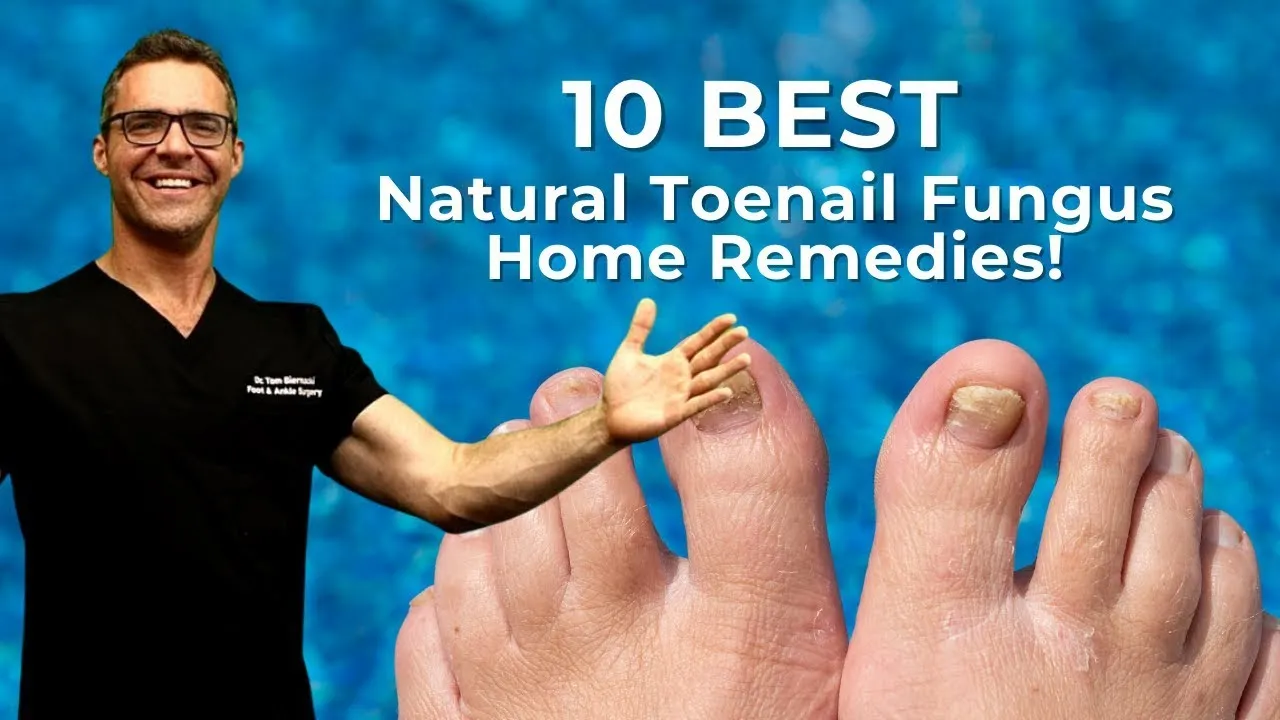
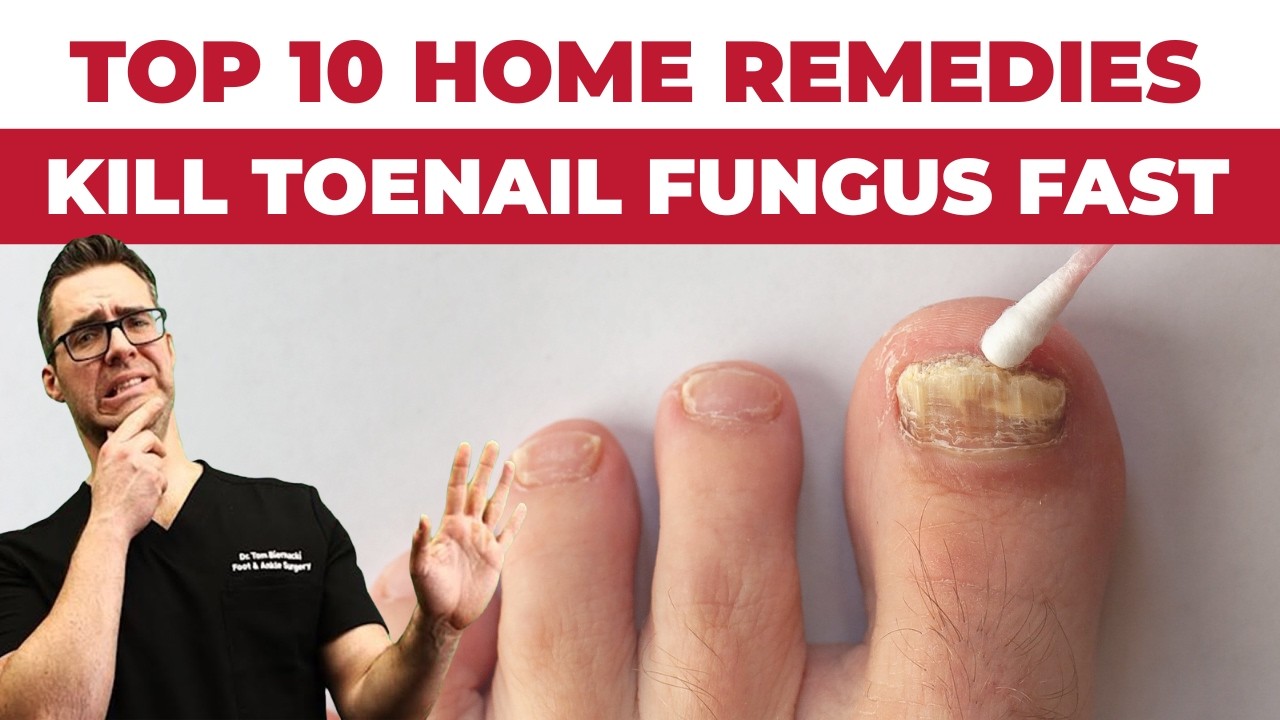
This is Dr Tom Biernacki Toenail fungus is something I see every day. A lot of people don't understand exactly what it is, and they're not doing the proper treatment. We're going to go over the best home remedies and the three big secrets that are probably stopping you from healing your toenail fungus.
And we're starting now. Toenail fungus is something we see all the time in clinic. I'm talking thousands of times.
I feel that virtually 99% of the time you can get this better. There are some big secrets stopping people from getting it better. We're going to go over exactly what it is.
We're going to count down the top ten remedies from 10 to 1. And the ones you should be doing, the ones I think are effective and I see working all the time. There are six types of toenail fungus.
Number one, this is called onychomycosis, and it usually gets underneath the toenail. So it's under the toenail, not on top. In most cases.
The most common is distal sublingual. So it just gets under the front of the tip. Number three is superficial.
So this is the one that's on top. This is the more rare common type. Number four, New Endonyx.
This is new. It's just white patches on top. Fairly rare.
Five is proximal sublingual onychomycosis. That means it gets jammed and some type of pus or fungus gets underneath. And six is really bad.
Total onychomycosis. That's basically if you have diabetes, that's under control. But almost all of it.
I'd say 90% plus is the distal sublingual. What causes toenail fungus? The number one dermatology sites.
These are the most common fungi that cause toenail fungus. They thrive in warm, moist environments like sweaty shoes or public showers. So when you have sweat athlete's foot, it kind of goes from your socks, from your dry skin underneath your toenail.
And they love sitting there because sweat builds up there. It's moist. You get good blood flow.
I have great videos on athlete's foot, but essentially athlete's foot is thick, flaky skin. It can sometimes look like chalky powder that is ripe for fungus, for bacteria, and even viruses that can cause warts. So here's some different pictures of athlete's foot.
it's only a matter of time until that athlete's foot fungus bacteria starts to crawl underneath the nail. Then you get develop different types of onychomycosis. The nail gets thick, and that's why it stays permanently.
That's why people can't get rid of this darn fungus. If you're a diabetic, they get more sugar and fungus loves sugar. Next is yeasts and molds.
These can also infect the nails, particularly in people with weakened immune systems, people who are not as healthy. Older people. People who have looser nails that can get under their poor blood flow.
If your blood flows poor, your immune system can't get up there and attack that fungus quite as much. And at the same time, diabetes, a fungus, a love blood sugar. If you're eating a process, diet sugar, cupcakes, that kind of stuff, it's going to be for those fungi.
This is the microscope slide again. But take a look at this. Blood sugar.
If you are a diabetic, your blood sugar makes it into that skin periphery so that blood sugar makes its way into that callus where fungus love to eat it. But guess what? The blood vessels do not penetrate into that callus.
So sugar can diffuse there, but your immune cells don't circulate there. So look who moves in. Friendly mushroom right there.
That's your fungus. That looks like a toad from the new Mario Brothers movie. I went to go see that with my kids.
It's actually the first movie they've seen. I've got four kids, so they're. They're very young, but they love that Mario movie.
Environmental factors walking barefoot in damp areas, swimming pools, gyms, showers. This can increase the risk of fungal nail infection. But the reality is a lot of people that I see are fairly clean.
It's not like you have poor hygiene. It's not your fault. I think this one is overrated.
And that brings me to another one. Poor hygiene is listed as one of the most common ones. I don't think that's a problem for most people, and I'm going to go over that in my big secret.
You are unfairly blamed as having poor hygiene. I see wives blaming their husbands for giving them fungus in the shower. Don't blame your poor husband or husbands.
Don't blame your wives. Another one. And I think this is more common.
This will be addressed in the secrets, but tight footwear, shoes that crush. Squeeze your nail, that lift that create calluses, thick, dry skin that your blood vessels can't get to. This creates both a sweaty and friction filled environment that creates lots of excess skin, lots of sweat.
This is ideal for fungal growth, take a look at this microscope. Slide on the bottom. You can see the blood vessels, but on top there's the callus layer where blood vessels do not penetrate.
As a result, you do not have immune system there that gets underneath your toenail. So your toenail lays on top of that. and if you have bad biomechanics, if you're a runner, if you rip your toenails up and down in tight dress shoes, tight heels, if you've put on weight, there's more pressure on your nails.
And that callus develops underneath that big toe. The other toes. And that's where the fungus, bacteria and viruses love to get in.
And because there's no blood vessels, there is no immune system. and the big one is underlying health conditions diabetes, circulation problems, weakened immune systems. As you get older, all of these happen.
There are easy ways to solve this, even if you have all three. That doesn't mean you can't fix your toenail fungus fairly quickly. The symptoms changes in nail color, the nail may turn white yellow.
It's usually lifting. It's usually thick. When you look at it from top to bottom, there's usually stuff underneath it.
Dirt gets stuck in there, horrible, crumbling in texture, distorted nail shapes. Underneath the nail, you can have foul smell, lots of dry skin, lots of callus and discomfort in pain. The most common thing is discomfort and pain that nails coming off.
So let's fix this. You should not have to suffer with these. We're going to start with the top ten home remedies, counting down in least practical and least science to most practical and most science.
Number ten Garlic. There are studies and success rates. Some studies and evidence do suggest that garlic does have antifungal properties.
There's no specific foot and toenail studies. They're limited, but this is something readily available. And we do know that garlic is antifungal.
How practical is this? I don't think this is one that you should focus on. Number nine, I see this listed a lot corn meal studies and success rates.
There are a lot of studies online. This lacks any specific substantial scientific evidence. To me it's a little bit easier than garlic.
That's why I put out number nine. But I think this is a questionable treatment option. I would not go with corn meal number eight, sunflower oil and other overnight oils.
There are studies showing of some people putting sunflower oil. There is studies showing sunflower oil and other oils can help. So I'm referring more sunflower and these cosmetic oils that are sold, they're recommended to be put on the nails.
I wouldn't go with this. It's probably not the best and most proven. Number seven, coconut oil.
Some studies do show that coconut oil has antifungal properties for the toenail fungus. Coconut oil is not the most proven option. I would not recommend coconut oil, but now let's get into some of the ones that are more effective at this point.
Vinegar soaks. So this includes apple cider vinegar, white vinegar. I included Listerine as part of vinegar soaks two.
Listerine is something that you can use as a mouthwash. You could put that in a foot soak as well. There are no specific studies on the soaps.
There is lots of reports about how well they work. And I've seen these work, I've had lots of patients do these and they do have great results. This is mildly effective vinegar and Listerine is not hospitable to fungus.
It creates a harsh environment where it can kill the fungus. There probably are some better options. The way you would do these vinegar and Listerine soaks.
So about 25% of the Listerine or vinegar and make the rest warm water. If you're a diabetic, make sure to check with your elbow or something so you don't burn your feet. 15 to 20 minutes is all you need that gets underneath your nail, soaks in there, softens up your skin.
Number five, hydrogen peroxide studies do show that hydrogen peroxide will kill fungus. It will kill bacteria, but it can burn your skin if left on too long. This is fairly effective.
It's known for its antiseptic properties. It will kill the fungus. It will kill bacteria, but too much can burn the skin.
And it's not very practical. Like realistically do put it in a shot glass and dip one toe in. Or do you buy a couple of big bottles and dump it in a bowl to soak for 15 minutes?
I would say move on to the next options. Hydrogen peroxide is extremely effective at killing toenail fungus. So why isn't it our number one home remedy?
The answer is there's a couple different stages and you could see stage one. It will make that green stuff disappear. But when you look at stage two or stage three, it won't necessarily heal the toenail.
This is where our big secrets at the end come in. It's really easy to kill Toenail fungus and hydrogen peroxide is an easy option, but you really have to get to the root cause for why that toenail fungus is getting there. And it's not just diet.
It's not just losing weight. There are some easy, quick, effective things that are bio, mechanically based that can do the trick. Number four, tea tree oil.
This is something that's well studied. For example, the Australian Journal of Dermatology found 60% success rate in mild to moderate cases treating toenail fungus. This is a well-studied option.
There's a ton of studies. There is a ton of tea tree oil supplements, there's a ton of tea tree oil antifungal medications online that you can purchase. This is moderate to highly successful as an antifungal and antiseptic.
It's natural. It's a pretty good option. There's nothing wrong with going this in the way you do it is you take a dab, you put it on your toenails, you can take a Q-Tip, you can take an applicator, you can leave it on at night, you can wear socks.
I love tea tree oil. It is antifungal. It's widely available, and there's actually good studies that it really does work well.
It's natural and easy to use. You take a Q-Tip, just apply it onto your toenail. You can put a little Band-Aid on there or cover it up with some socks.
The cons are some people are irritated by it. They're allergic to it. And are the results really effective if the nails not trimmed and smoothed down?
It's not the quickest thing in the world. Number three, baking soda. This was actually studied.
It's a little bit higher than I'd recommend. I probably put tea tree oil higher. This was studied in a journal where baking soda was essentially added onto the toenail fungus.
It is toxic. It's something everybody has available in their fridge. Most likely it is moderately effective and it does help prevent fungus from spreading and growing.
It isn't a antifungal it isn't an antibacterial. I saw in TikTok that baking soda mixes are extremely popular now. They do have antifungal properties that are cheap.
They're widely available. They're pretty much at every home and it's a nontoxic, low cost home remedy. But there's limited research.
It may not be the most potent solution, but you can put it in water as a foot soak. So about one quarter baking soda, three quarters water, or you can add a little bit of water like here and make it a paste and apply it onto your toenail directly. Number two lavender or oregano oil.
Lavender and oregano oil are known for its strong antifungal properties. A lot of over-the-counter ones do have a combination of lavender tea, tree oil or egg oil. You can see these in mixtures.
I would probably bring the tea tree oil roughly in this category. I don't really think lavender is better than tea tree. In fact, they're all kind of in the same group, in my opinion.
But that's one you'd put on your toes. Lavender oil is a very popular solution now. It's a natural remedy and it also has aromatherapy benefits.
It's sold and it's more popular, but there's limited research for toenail fungus. It might not be potent enough in some cases, and some people do get skin irritation. What you do is use a Q-Tip to apply it to the toenail, or you can use a light bulb.
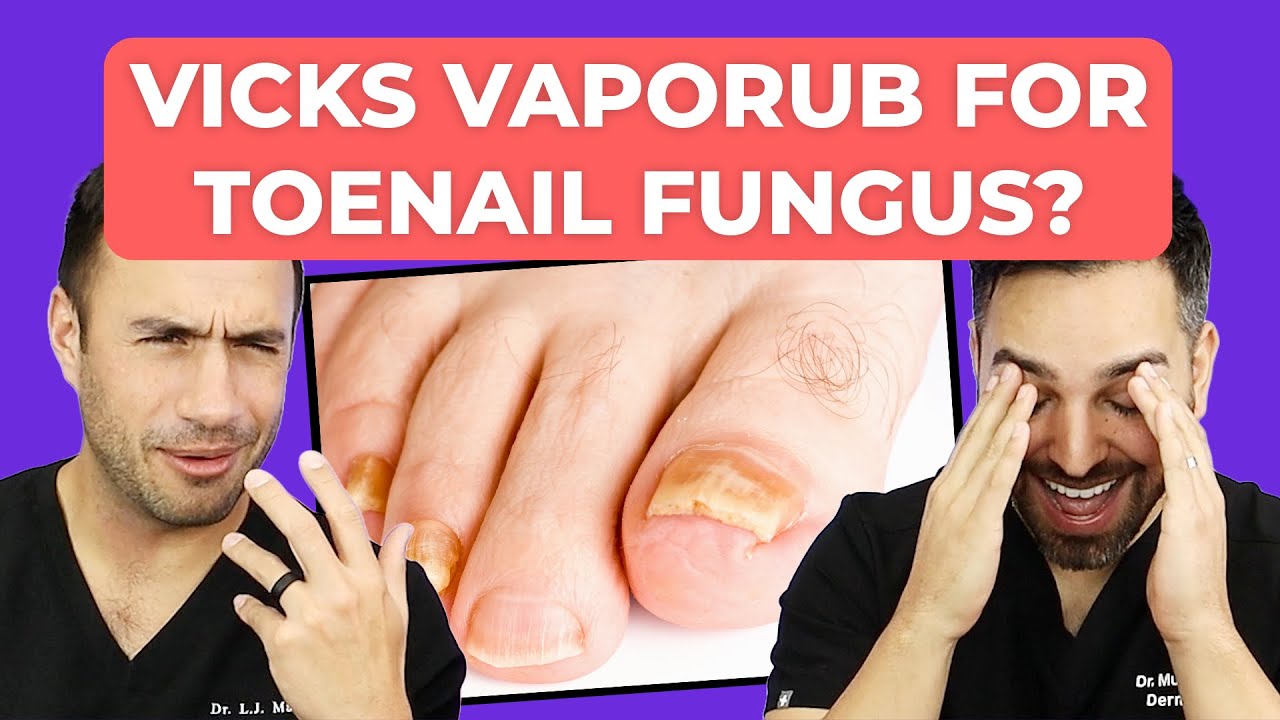
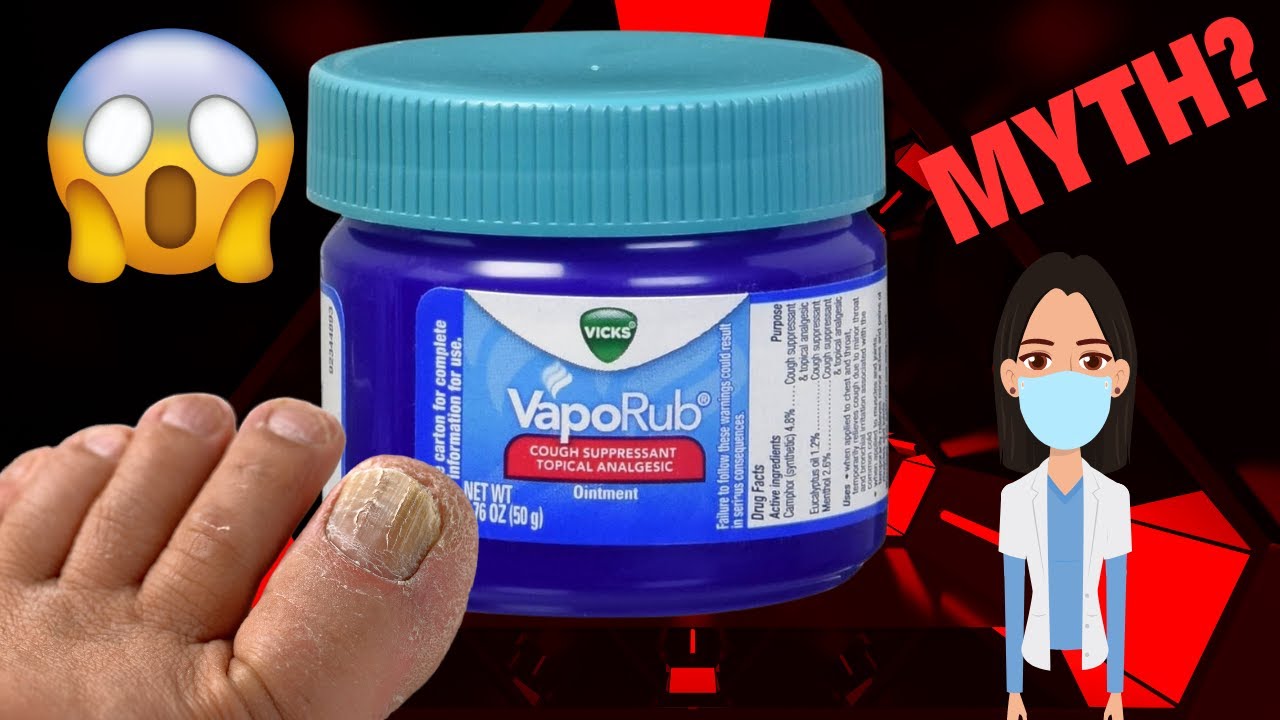
Then you put a Band-Aid, but it's recommended you trim the nails and you clean up the skin and exfoliated as much as possible ahead of time. And number one, this is a popular one. Vicks VapoRub There are studies in the Journal of American Board of Family Medicine showed pretty good results.
It's low cost, it's easy. You don't have to spill it anywhere. Take a dab with your finger, put it on your toenails.
It contains camphor and eucalyptus oil in a high enough concentration or it's antifungal, antibacterial, putting it on there, smearing it on your toes, wearing some sort that can be very effective. You can also take a dab and put it across your athlete's foot. Vicks VapoRub has always been my favorite.
Camphor, eucalyptus, oil and menthol are in high enough concentrations to kill fungus. It's widely available and it is lower cost. It's usually at most people's homes and it's easy to use.
You just apply it to the toenail at nighttime before bed. You put a Band-Aid on or some socks. But there's not huge scientific backing to this.
These can work really well. The reality is with toenail fungus, the creams are not that expensive. There are a lot of good creams that are not that expensive.
That can work extremely well. There's a lot of prescription. So if you come see a foot doctor, there are a lot of prescriptions.
I can tell you here in Michigan, I have a laser device. I use it for people. If I can't get good results, I use the laser.
I won't even charge people for it. The laser gets great results. The creams get great results.
I was always a laser skeptic. I'm like, Who are these foot doctors and dermatologist? Turgeon Thousands of dollars for these lasers.
Do these things work? Well, you know what? I invested in a laser after trying one at my friends offices.
And these things actually work really well. They have the benefits of being painless. They can penetrate through the nail and what they do is they actually use heat to get underneath the toenail and to warm up the fungus.
And it kills the fungus without burning you or the skin. Yes. It's almost too good to be true.
I thought it was a scam before, but it works extremely well. I've had some really good results. Now, the thing is, I have the benefit of on my own practice, so I don't have to charge these outrageous practices.
I don't have to charge these outrageous fees. So if you're in Michigan, I'd love to help you out with your toenail, but it still takes a little while for the nail to grow out for that fungus to be dead. But if you do the three big secrets that I'm going to talk about, that's really the trick.
You don't really need to find the perfect medication. There was basically a scam in the past where some of these medications were like $3,000 and the results were terrible. These medications didn't work.
They were charging 3000 plus dollars for a round of these treatments, and the results were not that good. But I would say start with topical cream. I'm not a big fan of taking the pills.
I always start with the topical creams. I have not prescribed the oral medications in years. Even though they work.
There are side effects with oral ones. Take with these three secrets and you should have some pretty good results. I have a video below where I review all the best creams at the store, the cost points, all the best prescription creams and all the best prescription pills.
I think there's some really good ones. I think there's some really bad ones, especially the more expensive ones through not necessarily better. And I think this is the mistake people make.
They think they by taking these expensive and a lot of times more dangerous and aggressive creams or aggressive pills, they're going to get better results. But that's not the case because they're making critical mistakes, like not having blood flow to deliver it to the site, for example, and not really getting to the root cause of why they have the fungus in the first place. And we're going to do a three secret countdown, three dietary changes.
If you were a diabetic, if you have blood flow issues, the number one thing you can do is get to the root cause of your diabetes. If you have an athlete's foot, if you're having skin tags, if you're having toenail fungus, these are all side effects of high blood sugar. In today's society, we're eating 4000 plus calories for the average person in America.
This is in Europe, too. This is across most of the world. In the 1950s, it used to be like two and a half thousand calories.
Now it's like 4000 plus calories. It's more sugar, more processed foods. If you cut down that sugar, there's less for that fungus, less for that bacteria, less dry skin.
at the obesity rates around the world. It's not just North America and the United States, which is a myth. Europe is actually a little bit higher.
South America's getting up there. The world overall, Asia, Oceania and even Africa is getting up there. So everyone is getting more and more obese.
So look at these statistics. Since just 2000, it's gone up from 30% to 42. 4%.
And even the severe obesity rate has doubled. So it's going up. And what about COVID?
When COVID started, the rates shot up even more rapidly. So this problem is already horrible and it's only getting worse. People are getting higher rates of diabetes.
Everything I'm going to talk about here is more relevant than ever. I have a video that goes over the top 25 skin conditions that high blood sugar causes. Toenail fungus is one of them.
Skin tags, athlete's foot. Check out that guide. If you're struggling with skin problems, wiping out that blood sugar can change your life dramatically.
Number two, big secret You have to get pressure off your toes. Most people that I see their toenails are lifting. So the trick is, if your toes like this in your nails like this, it's essentially ripping up and down every time you take a step.
So if your toes pressed into the ground, if you don't have enough pressure off of it, that toenail is ripping out the blood vessels do not get into the toenail. There's callus under the toenail. There's thick, dry skin under the toenail.
Most people are trying to save a dead toenail where blood vessels don't penetrate. And if blood vessels don't penetrate into that toenail, your immune system can't get there. Heal that toenail.
That's the big secret. And as a result, you have thicker skin, you have calluses, the blood vessels don't penetrate all that. That's what causes athlete's foot and that's what causes bacteria and fungus to live on your thick foot skin.
really combining it all. Get your diabetes down, get your blood sugar down, and your fungus won't have any sugar to eat and your blood flow will be better if your blood flows better. Your immune system, can get into that callus and kill it much easier.
At the same time, you are in good shoes, good orthotics. You won't develop that callus layer, the nail won't lift. And as a result, that harmless little cute fungus right there won't be able to get in there.
I have a video How to prevent thick, dry skin, how to exfoliate, how to get all that down. Check that out below. That's a big secret if you can do that.
Fungus has nowhere to live and it can get underneath your toenails. And big secret number one is if your toenails loose, if it's there, if the scar tissue, there's a build up on it. Not only do you have to trim it shorter, but you have to file it down if you're diabetic, if you have blood flow issues, if you're older, come see a podiatrist.
It's all covered stuff. We can do lasers, we can trim it, we can get it down. If you can't see a podiatrist, you have to shorten down that toenail.
Then you have to use a nail file to get it down. Otherwise, none of these home remedies will be effective. The creams will not be effective, So the real secret here is not only do you have to apply the cream to the correct area, but then the loose nail that's not getting blood flow, that's not getting nutrition, that does not have any blood vessels to it.
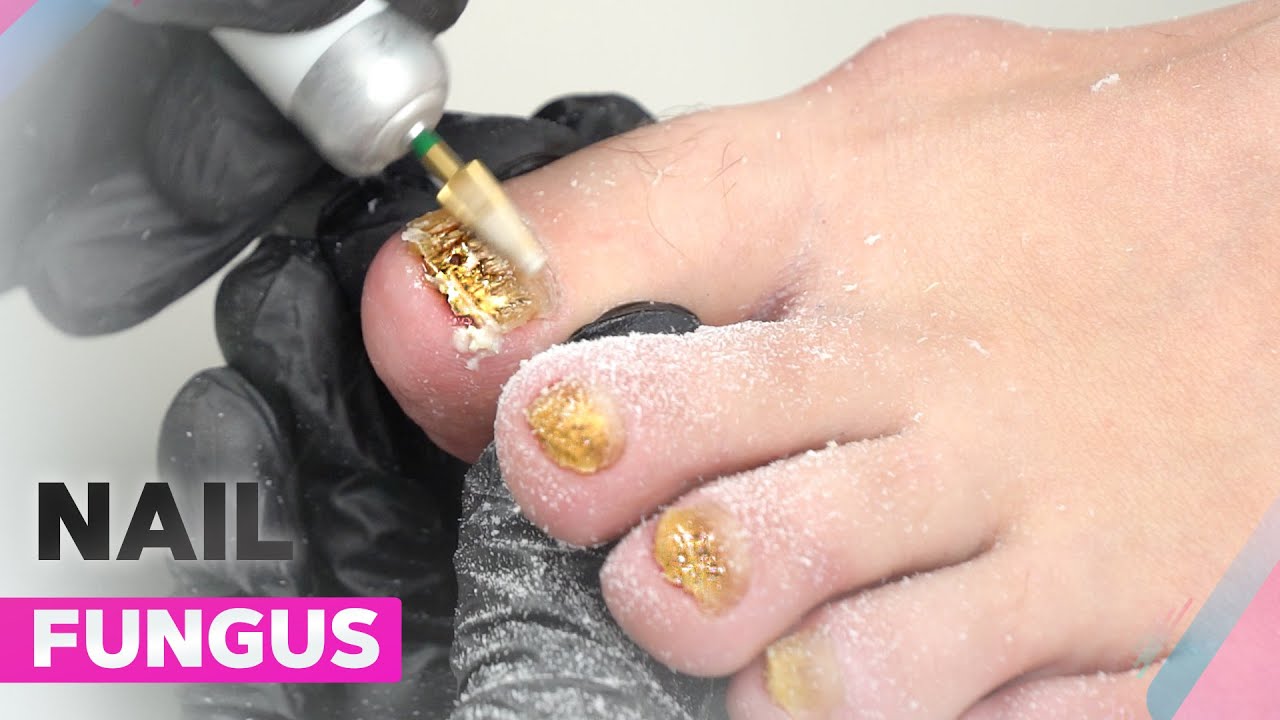
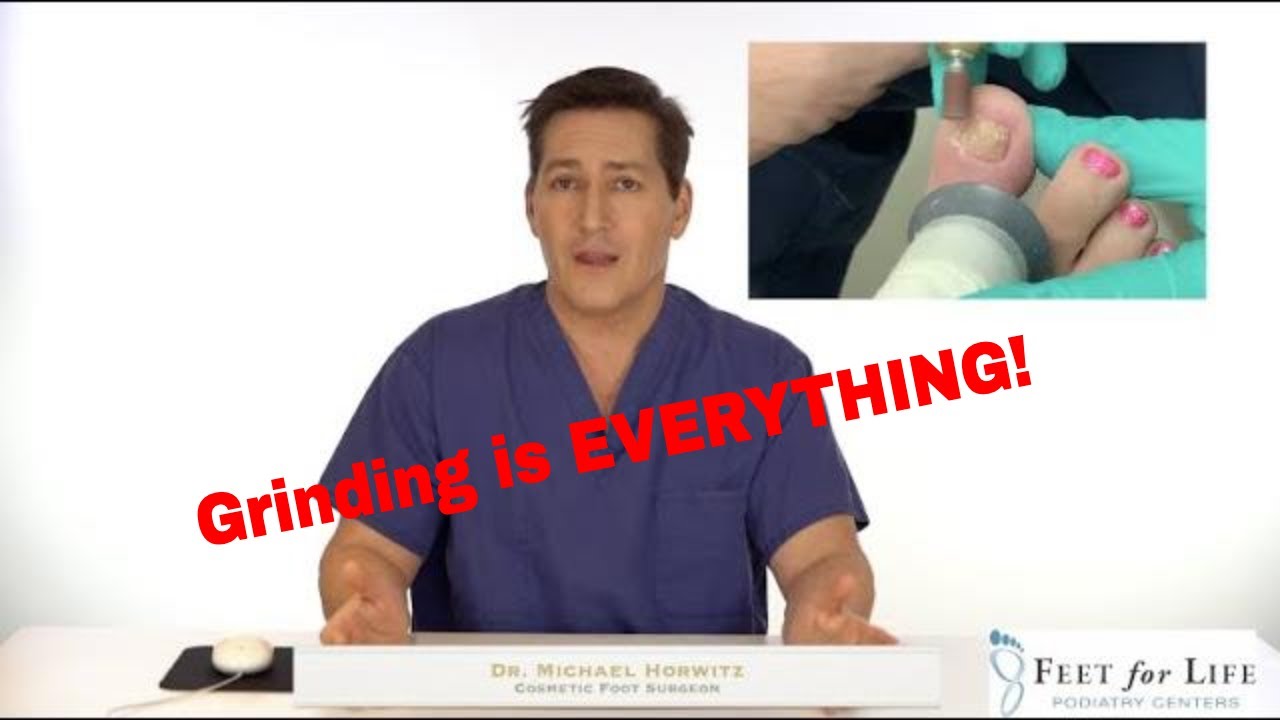
You have to trim. You have to to breed. Here's a picture of somebody using a nail drill to essentially exfoliate the heel skin, the toenail skin.
Getting rid of this is the key. The fungus, the bacteria does not have anywhere to live. Then your blood flow and a good healthy immune system can get there and eliminate the nail fungus.
The athlete's foot the rest of the way. That's the guaranteed way to get rid of your nail fungus, your bacterial skin infections. And then once all of that is gone, it still takes some time to grow a good, healthy toenail.
The secret here is that a nail grows about one millimeter per month. In the summer, it grows 50% faster at about 1. 5 millimeters a month.
So you can move to Florida if you want it, to grow back a little bit healthier. Otherwise, you're going to have to wait about a month. Otherwise, you're going to have to wait about a year to grow back a full, healthy, big toenail.
And it comes from the nail matrix. That's the stem cells that grow that toenail. and you have to get pressure off that toe, get that blood sugar down, get pressure off the toes, proper shoes.
You've got to get your weight down. You've got to fix your biomechanical problems. You've got a hand.
You've got to thin and shorten those toenails. At this point, all of these remedies will work. It will all do great.
And you also have to treat your athlete's foot, your skin. Otherwise that fungus will go from your skin right back into the toenail as soon as you cure it. So you have to get to the root cause.
If that helps, check out your athlete's foot guide or diabetes Skin guides. We go over all this and how to get rid of your thick, dry skin around your toenail, underneath your toenail. That's the true big secret.
That's the big cause. And if you're in Michigan, come see me. We'll do some lasers, we'll do some creams.
We'll get you in great shape.
![BEST 25 Plantar Fasciitis HOME Treatments [Massage, Stretches, Shoes]](https://img.youtube.com/vi/2aXlnFVmIY8/maxresdefault.jpg)



![Best Varicose Vein Home Treatments! [Top 25 Spider Veins Remedies]](https://img.youtube.com/vi/RmdcNI4a9ZU/maxresdefault.jpg)
![Plantar Warts vs Corns vs Calluses [TOP 20 BEST Home Remedies]](https://img.youtube.com/vi/-uCHjVNCElE/maxresdefault.jpg)
![BEST Athlete's Foot Fungus Treatments [HOME Remedies + 3 BIG SECRETS]](https://img.youtube.com/vi/PKT_slq6M54/maxresdefault.jpg)