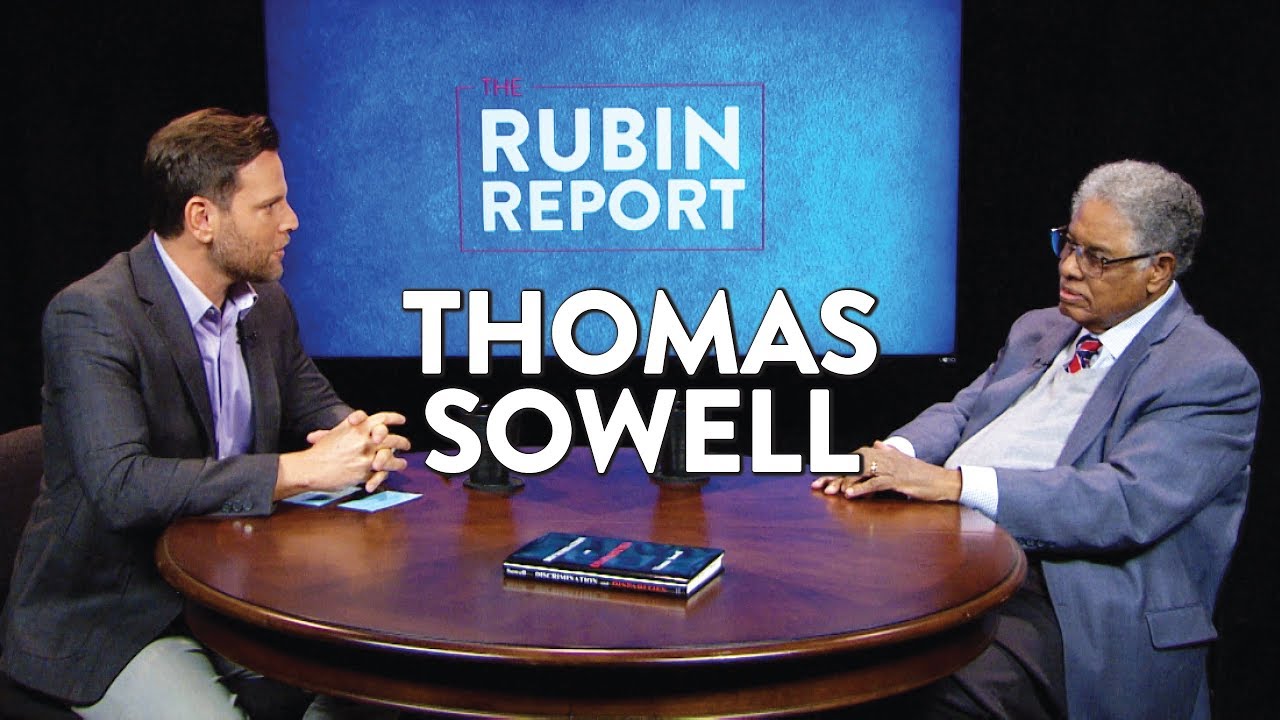
You refer to intellectuals in intellectuals in society. Whom do you mean? I mean people whose end products are ideas.
Uh there are other people people with great intelligence whose end products are things like the sock vaccine. Uh there are a research scientist is not necessarily an intellectual. That's right.
An engineer isn't necessarily an intellectual. That's right. Because the engineer is is judged by uh the end product which is not simply ideas.
If he builds a building that collapses, it doesn't matter how brilliant his idea was, he's ruined. Uh conversely, if an intellectual who's brilliant has an has an idea to for rearranging society and that ends in disaster, he pays no price at all. I see.
Let me quote intellectuals in society. quote, "The fatal misstep of intellectuals is assuming that superior ability within a particular realm can be generalized to superior wisdom or morality overall. Chess grandmasters, musical prodigies, and others who are as remarkable within their respective specialties as intellectuals within theirs seldom make that mistake.
Explain that. Why would a Well, let's take an example. Nam Chosky whom you write about in intellectuals in society whose work in linguistics in the first place I can't understand it but as best I can tell everyone who exactly everyone who understands his technical work within the field within his discipline of linguistics considers him one of the great figures of the 20th century and his work in politics uh uh absurdity the same could be said of Bertrren Russell and his and his uh uh landmark works on on mathematics and other people in other fields uh but they step outside their fields and uh when you step outside your level of uh specialty sometimes that's like stepping off a cliff.
And why is it that intellectuals that is to say people whose end product is ideas should succumb to that temptation more than to use your example a chess grandmaster? Because a a chess grandmaster can be world famous for doing absolutely nothing more than winning chess tournaments and making displays as many of them do of playing uh five chess games simultaneously while blindfolded. Uh so Bobby Fischer had no need to opine on the politics of the day because he was getting rich and famous and making a brilliant career for himself within his narrow profession.
That's right. That's right. But intellectuals what they they they well they they language in obscurity no matter how well the whole question of uh when is someone well known or not came up during the visit of Jim Jim Flynn from uh New Zealand here a few years ago.
He's one of the world's authorities on IQ test. Mhm. Uh people you know in India know about Jim Flynn.
People in England he's going he made world tour. Uh but I doubt if the people in the next block from where he lives knows who he know who he is. I see.
All right. Um it is far easier to concent again I'm quoting from intellectuals in society. It is far easier to concentrate power than to concentrate knowledge.
Yes. What bearing has that got on the influence that intellectuals have over society as a whole? because they they believe that since knowledge is concentrated in people like themselves, what needs to be done is in the quote from from President Obama is to put more power in the hands of of the experts.
So the intellectual temptation is to say, look, we already know everything. That's right. If only we also had the power, all the power, everything would be just fine.
Yes. And what's wrong with that view? Why isn't that a sensible view?
One, they don't know everything. They don't they don't know one/tenth of everything. Uh, in fact, I I I argue that they they probably don't know 1% of the consequential knowledge in a society.
Consequential knowledge is a is a is a a concept that runs through this book. Explain that concept. Knowledge whose presence or absence has consequences, serious consequences.
I mean, I was once in a plane that was coming down for a landing in the Ithaca airport. uh and suddenly the pilot gunned the motor and went up again because someone in the control tower told had reminded him that he hadn't lower lowered his landing gear. So that was consequential knowledge, right?
Yes. Yes. I just delighted that that person had had his eyes open and his mind on his word.
So the notion here is that the kind of knowledge, the kind of consequential knowledge required to prove effective in governing a nation of such as the United States with the biggest economy in the world, 300 million people, you can put together quite a large group of professors and they're still not going to possess the knowledge that would enable them to run General Motors, for example, or to run the nation's health care system, for example. Oh, absolutely. uh in fact one of the one of the things that has happened all around the world in the 20th century was that all sorts of countries have tried central planning.
Now the guys who run the central plan they usually have advanced degrees from uh prestigious institutions. They have mountains of statistics uh uh sitting there and they have all the experts in the country at their beck and call and yet when you take the power out of their hands and return it to the market then all the hundreds of millions of people who don't have any of those things usually end up with a higher rate of growth and a more rapidly uh rapid decline in poverty because consequential knowledge by its nature tends to be diffused widely diffused. Yes.
Yes. Overcoming adversity is one of our great desires and one of our great sources of pride. But it is something that our anointed deep thinkers strive to eliminate from our lives through everything from great inflation to the welfare state.
The anointed want to eliminate stress, challenge, striving, and competition. They want the necessities of life to be supplied as rights, which is to say at the taxpayers's expense without anyone's being forced to work for those necessities except of course the taxpayers. Nothing is to be earned.
Self-esteem is to be dispensed to school children as large as from the teacher. Adults are to have their medical care and other necessities dispensed as large as from the government. People are to be mixed and matched by race and sex and whatever else the anointed want to take into account in order to present whatever kind of picture the anointed think should be presented.
This is a vision of human beings as livestock to be fed by the government and herded and tended by the anointed. All the things that make us human beings are to be removed from our lives and we are to live as denatured creatures controlled and directed by our betters. Those things that help human beings be independent and self-reliant, whether automobiles, guns, the free market, or vouchers, provoke instant hostility from the anointed.
Automobiles enable you to come and go as you wish without so much as a buy your leave to your betters. The very idea that other people will go where they want, live where they want, how they want, and send their children to whatever schools they choose is gling to the anointed, for it denies the very specialness that is at the heart of their picture of themselves. Guns are completely inappropriate for the kind of sheeplike people the anointed envision or the orderly prepackaged world in which they are to live.
When you are in mortal danger, you were supposed to dial 911 so that the police can arrive on the scene sometime later, identify your body, and file reports in triplicate. The free market is a daily assault on the vision of the anointed. Just think of all those millions of people out there buying whatever they want, whenever they want, whether or not the anointed think it is good for them.
Think of those people earning whatever incomes they happen to get from producing goods or services for other people at prices resulting from supply and demand, with the anointed cut out of the loop entirely and standing on the sidelines in helpless frustration, unable to impose their particular vision of social justice. The welfare state is not really about the welfare of the masses. It is about the egos of the elites.
One of the most dangerous things about the welfare state is that it breaks the connection between what people have produced and what they consume. At least in many people's minds. For the society as a whole, that connection remains as fixed as ever.
But the welfare state makes it possible for individuals to think of money or goods as just arbitrary dispensations. Thus, those who have less can feel a grievance against society and are less inhibited about stealing or vandalizing. And the very concept of gratitude or obligation disappears.
Even the obligation of common decency out of respect for other people. The next time you see a bum leaving drug needles in a park where children play or urinating in the street, you are seeing your tax dollars at work and the end result of the vision of the [Music] anointed. At the heart of the social vision prevalent among contemporary intellectuals is the belief that there are problems created by existing institutions and that solutions to these problems can be excaggitated by intellectuals.
This vision is both a vision of society and a vision of the role of intellectuals within society. In short, intellectuals have seen themselves not simply as an elite in the passive sense in which large landowners, rantiers or holders of various synicures might qualify as elites, but as an anointed elite, people with a mission to lead others in one way or another toward better lives. John Stewart Mill, who epitomized the intellectual in many ways, expressed this view explicitly when he said that the present wretched education and wretched social arrangements were the only real hindrance to attaining general happiness among human beings.
Moreover, Mill saw the intelligencia, the most cultivated intellects in the country, the thinking minds, the best and wisest, as guides to a better world, in their role of those who have been in advance of society in thought and feeling. This has been the role of the intelligencia as seen by the intelligencia both before and after Mills time that of intellectual leaders whose broader knowledge and deeper insights can liberate people from the needless restrictions of society. Jean Jacqu Rouso's famous declaration, man was born free and he is everywhere in chains, summarizes the heart of the vision of the anointed, that social contrivances are the root cause of human unhappiness.
This vision seeks to explain the fact that the world we see around us differs so greatly from the world that we would like to see. In this vision, oppression, poverty, injustice, and war are all products of existing institutions. Problems whose solutions require changing those institutions, which in turn requires changing the ideas behind those institutions.
In short, the ills of society have been seen as ultimately an intellectual and moral problem for which intellectuals are especially equipped to provide answers by virtue of their greater knowledge and insight as well as their not having vested economic interests to bias them in favor of the existing order and still the voice of conscience. Large unmmerited differences in the economic and social prospects of people born into different social circumstances have long been a central theme of intellectuals with the vision of the anointed. Contrasts between the grinding poverty of some and the luxurious extravagance of others compounded by similar unmmerited contrasts in social status are among the problems that have long dominated the agenda of those with the vision of the anointed.
More general sources of unhappiness among people across the social spectrum. The psychic problems created by moral stigma as well as the horrors of war, for example, are also things for which intellectual solutions are sought. This vision of society in which there are many problems to be solved by applying the ideas of morally anointed intellectual elites is by no means the only vision.
However much that vision may be prevalent among today's intellectuals.