The following message is made available by Truth for Life. For more information, visit us online at truthforlife. org.
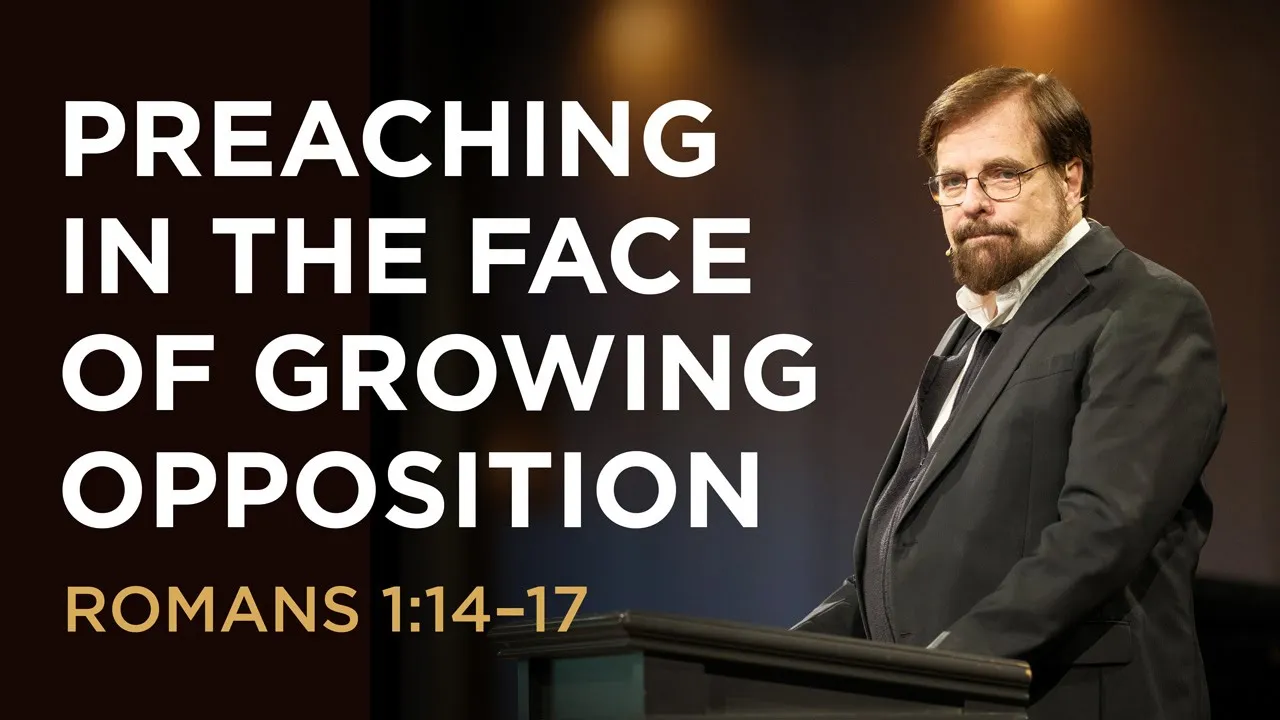
We're going to be looking at a familiar passage, Romans chapter 1. Familiar book, familiar chapter, familiar verses. But for you, for your sake, we're going to be looking at this from the perspective of what can pastors, what can preachers, what can church leaders receive from the experience of the Apostle Paul as he describes it here in these verses.
And we're going to begin in verse 13. And I'm going to read the passage and then we'll pray. Let's read the word of God now.
Hear his word to us. I do not want you to be unaware, brothers, that I have often intended to come to you, but thus far have been prevented, in order that I may reap some harvest among you, as well as among the rest of the Gentiles. I am under obligation both to Greeks and to barbarians, both to the wise and the foolish.
So I am eager to preach the gospel to you also who are in Rome. For I am not ashamed of the gospel. For it is the power of God for salvation to everyone who believes, to the Jew first and also to the Greek.
For in it the righteousness of God is revealed from faith for faith. As it is written, the righteous shall live by faith. May God add his rich blessing to the reading of his word.
Let's pray together. Our Lord Jesus, we bow before you now. We call no one our teacher but you.
We trust no one like we trust you. We long to see no one like we long to see you. But we have now heard words from your apostle written thousands of years ago and we live today.
And so we pray for you please to send Holy Spirit to us. May he come and fill every heart in this room so that we may hear you speak. we may see the truth that you present to us and that by the power that he used to resurrect you from the dead.
May he now cause us to walk in newness of life because of this your word. And as you do it, we will give you the thanks and we'll give you the glory for it all. Amen.
I live in Orlando. I know it's hard. You should go there sometime.
It's a hard place to live. Orlando, Florida. actually is paradise.
What can I say? It's a great place to live. But my calling in ministry takes me in and out of Orlando all the time.
So, I'm always flying in or flying out. And let me just give you a little bit of advice. You really don't want to fly in or out of Orlando on the weekend.
Most people do. And so, it's jammed up. And it's jammed up with lots of children.
So, if you fly into Orlando on a weekend, you're with a lot of children in the plane, standing in line, all the sorts of things that you do to get prepared to go in. And then you're with them in the plane, too. And on the way to Orlando, of course, they are full of eagerness.
They're so excited, they can hardly stand it. Their parents have to hold them down and belt them in with several straps just to get them to sit during takeoff and landing because they're so thrilled. And if they get up to go to the restroom, they're running up and down the aisles like this.
We're going to see Mickey. We're going to see Mickey. And they're just going crazy.
Okay, going crazy. All right, so that's fun in some respects. At least the first hundred times you do it.
But it's quite the opposite when people are flying in out of Orlando on the weekend because they spent the previous week at the theme parks and now they're going home. And so the same children that were running up and down the aisle screaming their heads off in joy and exhilaration are now saying,"I but I don't want to go. I don't want to go.
I don't want to go. " Now I say that to you because I suspect in a room like this, we have people that are on their way to Orlando and on their way home from Orlando. Okay?
And I would think it probably correlates to probably your age to tell you the truth. If you're a younger minister and you're new in a church, then you're on your way. You're so eager to get there.
You're so eager to preach. You're so eager to lead the body of Christ. You're just ready to go every Sunday morning, waking up at 3:00 or 4 in the morning after 2 or three hours of prayer and then rushing to the church.
What? You don't do that? Okay.
Uh rushing to the church. can't wait for the hymns to be done so you can get up and do your job. Amen.
Amen. But if you're old like me, you're probably flying home from Orlando. And sometimes that means there's not a whole lot of eagerness inside of you that you're just trying to hold on until retirement comes.
Now, wherever you are on that spectrum, maybe somewhere in between, this word from the Lord, from the apostle of Jesus is for you because it's a passage that in many respects the apostle opens his heart up on a very emotional level. It's amazing how emotional this passage is. You'll see it in just a few moments.
But as you know, typically people that would come to a conference like this, our eyes venture down to verse 17 because verse 17 is really important to us because of how it played a significant role in the Protestant Reformation. Say yes. Somebody say amen to that one.
Okay. Thank you. For in it, the righteousness of God is revealed from faith for faith.
As it is written, the righteous shall live by faith. It is a very important verse. We don't ever want to forget it.
But our focus is going to be on what led the apostle to write those words that so moved Martin Luther and others and I hope move you as well. That salvation or justification is by faith and by faith alone that unites us. That's something we can all affirm and we can say a hearty amen to the fact that we cannot earn our way into eternal life.
But it's given to us as a precious gift only to be received through the instrumentality of faith from beginning to end. Faith unto faith, faith by faith, faith for faith as it goes and is translated in a variety of ways. Our interest however this morning is going to be on whether you're flying into Orlando or out of Orlando or somewhere in between.
Are you struggling to figure out what kind of attitude can I have or should I have in fact as a minister of the word of God as someone who preaches what we will call the gospel of Jesus? And the apostle opens his heart up to the people of Rome, telling them, "I would like to have come earlier. I'm on my way.
I'm doing my very best. I've been prevented presumably by the providence of God. " Presumably, and this is something I've wanted to do for a long time, but one of these days, I'm going to get there.
Now, he had lots of reasons for doing that because this was the capital, the capital city of the evil empire of the world in his day, the Antichrist's kingdom in his day, the kingdom that persecuted the people of God. And so, he was headed straight for the crown of that kingdom. And that's a motivation he had obviously.
And as you know, the book of Revelation deals with a lot with Rome and the like in its first century context. and something that we have to keep in mind. But that's not quite exactly what the apostle says here.
I want you to look once again. He says this. He says in verse 15, he says, "So I am eager to preach the gospel to you also who are in Rome.
" eager, not by compulsion, not because he won't get a paycheck next on next week on Monday if he doesn't do a good job in the pullpit, not for some assorted reason, not for his own glory, not for his own destiny, but rather eager to preach the good news to them who are in Rome. Now, it may not strike you as particularly strange to say that until you think for just a few moments about what that word gospel in that verse actually meant to the apostle Paul and how it fit within the context of the city of Rome. It might surprise you to know this.
Maybe you know this already. Some of you may be surprised to hear it. However, that gospel was not a uniquely yuangelon is not a uniquely Christian term.
Did you know that? In fact, the Romans used it a lot. A whole lot.
Every time a Caesar would do anything that was spectacular, especially when he conquered enemies, they would announce and proclaim good news about their king, the Caesar. And the good news was that he had victory over his enemies. and which brought prosperity to Rome, brought benefit to the people of Rome and they would celebrate this.
So good news was a familiar term even to pagans in the city of Rome of course associated with Caesar. But the apostle is not a pagan he's a Jew and he knows the Bible and he knows that this word good news actually comes from the Old Testament. Say yes I know it does.
Okay. And there are many passages that you can find, but one that stands out of course is Isaiah 52. How beautiful on the mountains are those who bring good news, who proclaim peace, who say to Zion, "Your God reigns.
" And that's the message that the Apostle Paul was bringing to the city of Rome. Caesar claimed to be the king of the world, but Paul knew something else. He knew who the true king of the world is and his name was Jesus of Nazareth.
Oddly enough, the Caesars were also called saviors. Sotare they were also called saviors. But the apostle Paul being the Christian that he was with his background in the holy scriptures knew that there was a true savior and it was not Caesar.
It was Jesus of Nazareth. And so the apostle Paul understood when he was speaking to these Romans that the message of the good news that he was bringing was distinctive. It was different from that of Rome.
It was the Christian message of what good news is. And it's simply this. The king of the world, our Lord Jesus, has won the victory over sin and death through his death and his resurrection and his ascension into heaven.
And ain't that good news? They lied. He told the truth.
And so he claims then that he's eager to do this in Rome, but it's not going to be a friendly reception that he has. In other words, he's standing against the world in which he lived. They believed there were gods, many gods.
They offered sacrifices to many gods. They worshiped them. Every trade guild had its own god to whom they made sacrifices so they could be prosperous.
Every neighborhood had its own special god so that they could be prosperous in their neighborhood. Every time someone became sick, they would make offerings to this god or that god depending on the the um the disease that the person had. And the reality was that the apostle Paul was saying there is a sacrifice.
There is a sacrifice that brings the favor the favor of the God of heaven and earth. And that sacrifice is none other than Jesus himself. Not the sacrifices given to idols but the one sacrifice of Jesus of Nazareth.
And so you can imagine, can't you, that he walked into that city when he finally got there with some fear, some trepidation because he knew that eventually he was going to be confronted by a very different view of religion, a very different view of life, a very different view of humanity, a very different view of God, a very different view of salvation, a very different view of everything. And I say that to you because whether you're young or old today, if you live or are deeply influenced by Western culture, you know that opposition to the Christian faith is on the rise. Now, I don't know what it's like for you in your home.
My wife and I are both aaholics. I suspect some of you are probably catching the news right now on your phone, as a matter of fact. Okay.
I did before I walked in the room, but then I turned it off. See how good I am. But you know what newsaholics in my family are like?
Um my I get depressed when I watch the news. My wife becomes angry and so we end up having to turn off the TV because I don't want her throwing a shoe into the TV because then I'll have to go buy a new one. Don't want to do that.
But here I am feast with the news every day. every single day seeing my own homeland corrupted and defiled, falling to pieces with world views, with ideas, with beliefs, with religion that is so different than the country I grew up in and the religion that predominated in that world. There it is.
I'm old enough to remember when people didn't mow their grass on Sunday. I'm that old long time ago. I'm old enough to remember when it wasn't just one restaurant that didn't open on Sunday.
I'm old enough to remember those kinds of things. And it's what we have called our Judeo-Christian heritage here in this country and in the West in general. And you know, there's there are good things about that.
There are bad things about it. Hypocrisy, things like that. But let's just face it.
Um, we're challenged today because what was once the civic religion of the West, especially here in this country and in others as well, the civic religion, that sort of commonality that you had with the culture in which you lived, it's disappeared. We now have a new civic religion, a fundamental belief, a fundamental commitment. You can call it all sorts of things, but let's just call it what it is.
pre-Christian European paganism where the only the only and the greatest value is that you fulfill your hedenistic desires as far as you can get away with it for the sake of your own pleasure because of the neilistic philosophies that lie behind it and the heartbreak is everywhere isn't it okay well welcome Welcome to your world. Welcome to the world to which you bring the good news of Jesus, the gospel. This is our world today.
And it was very much like the Apostle Paul's world as he was thinking about going to Rome. Opposition is everywhere and it's rising because they know something. You're not just old-fashioned.
You're not just ignorant. You're not just uneducated and unsophisticated. Oh, no.
You're much worse than that. You are evil. What?
Me? Little me? Evil?
Yes. That's the accusation today. that you are the one standing in front of them obstructing their goals of their faith of their religions and you're doing this in the name of Jesus and that makes you evil in this world and so is easy not to have much eagerness to stand for Christ in that kind of world is e easy to back off I mean do Do you even know how to say thank you to someone in public?
Now, I come from the south. Can you tell that? I haven't said y'all yet, but you can tell I'm from south of the sweet tea line, right?
Okay. So, I'm from south of the sweet tea line. You You may call it the Mason Dixon line.
I'm from the south of that. Okay. And I was raised and taught from the crib that the way you say thank you and to people is you say thank you ma'am.
Thank you sir. Of course. So that's still my habit.
But boy that's a terrible habit to have these days because you don't know when somebody might crawl across the counter and grab you for having called them the wrong thing. And so what does that make you feel like every single day of your life? as a pastor, as a churchman, as a preacher, except hesitant, not eager, hesitant.
See, it used to be that we thought ourselves able to sort of clear the deck, make things smooth, prepare the way for talking about Jesus to people because we had various arguments that people would sort of nod their head and say, "Yeah, that's probably true. " And yes, okay, Christianity is not all that bad. And I respect people that go to church.
And so you have doors open for you. You could go visit someone and you could just be talking casually about faith and life and morality and they would be nodding their heads. Now they don't.
in Orlando where my wife and I live. We live in a gated community and there is no one in our gated community that looks and talks like my wife and me. No one.
So, what do you think that does to us? Do you think we bring our little welcome wagon cookies over to that house? Hey, welcome to the neighborhood.
Where do you go to church? That's normal, isn't it? 50 years ago, but no longer.
And so rather than having eagerness, we withdraw. Let's face it. So, let me bring it home to you.
When was the last time you were at the barber shop? We don't have manly barber shops in Orlando, but I'm sure you do where you live, where only men go. And if there's a sister in the room, it's a very special place for us.
Because we can talk NASCAR, we can talk football, we can talk war, and we can talk politics all that we want to, and nobody's telling us, "Stop talking about that. " We can gr we can moan and groan about all the bad things that are going on in the world. But when was the last time you were sitting in the chair and you said, "You know something?
I know the name of the man that can fix all the problems in the world. " When was the last time you would even venture to imagine yourself saying something like that? I know the man who can fix everything in the world and make it all new.
Now, if you're a Muslim, you would be happy to say it, but you're not Muslim. You're Christian, and so you don't know what to say. You can't bring them the good news of the kingdom of God.
You can't tell them that one person has won the victory already and has guaranteed that the whole world will be turned into the kingdom of God one day and that you know that man's name. Try it out the next time you're in the barber shop. Try it out.
See what the reaction is. Let me know. email me or something.
It's fascinating to see. About 10 years ago, I made a commitment to myself that and to the Lord that when I shared the gospel with someone, I was going to avoid the natural tendency of well of dealing with the individual person and the problems that they had and helping them understand how Jesus can help them with their difficulties in life, how sin has corrupted their lives. I just sort of made a commitment.
And I said, "You know what I'm going to do? I'm going to try this and see how it goes. I'm just going to start talking about the good news of the kingdom of God and tell them what Jesus is going to do and see how that works.
" And so I was in the home in Indonesia, in fact, in Bali, Indonesia, in the home of an American Jew who had converted to Buddhism and had spent his whole adult life in Bali. And I became very sick in his home, near death. He came and saw me on the floor in his home and he walked over to me and shook me.
He said, "Richard, Richard, Richard. Um, I've seen this before. You're not going to make it.
" I was passed out. But when he said those words, I woke up and I and I just sort of naturally, I mean, this was not something I whipped up inside myself. It was very natural.
I just said to him, "That's okay. I'm ready for this. " And then I passed out again.
Well, they got me to the hospital eventually and I'm still alive. But then three weeks later back in the states, he'd call me on the phone. It was the last time I talked with him and I said, "It's okay.
I'm ready for this. " And he calls me on the phone here in the States and he says, "I can't get your words out of my mind. " And I said, "What's that?
" I didn't even remember what I said. Okay. He said, "You said you were ready to die.
" He was about my age and he said,"I not. How are you ready to die? " So rather than dealing with him on a sort of small scale, and there's nothing wrong with this at all of dealing with a person's individual need for Christ.
There's nothing wrong with that. I just started with the big picture. I said, "Well, Charlie, the reason I can say that is because I'm really into Jesus and what Jesus is going to do is going to be amazing.
" And so I just painted the picture of what the new creation's going to be for five or 10 minutes. I just said, "This is what Jesus is going to do to the world. " And at the end of it, I paused and I said, "Charlie, would you like to have a part of that?
" Silence. Yes, I want to be a part of that. Amen.
A new heavens and a new earth where there is no sickness. Where there is no evil, where there is no injustice, where there is no hardship, where there is no more shame, no more shame. Do you want to be a part of a world like that?
And he said, "Yes, I want to be a part of that kind of world. " And then we start talking about faith and repentance and baptism. That man is the most changed man I've ever met in my entire life.
12 years later, we need to become bold as Paul was doing here to stand against the culture around us and say, "We know some really good news, some great gospel that Jesus has come and he's bringing the new creation. Do you want to be a part of that? " Now, how could the Apostle Paul be eager to do this?
Maybe you can understand he would do it out of duty or he do it out reluctantly perhaps or hesitantly. But how could he say, "I'm eager to do this. " Well, he tells us the answer, doesn't he?
Right there in verse 16. These are well-known words, but let's just remind ourselves of what they are. He says in verse 16, "For I am not ashamed of the gospel.
" That's why Jesus is not ashamed to call us his brothers and sisters. And we are not ashamed to be identified with this thing called the good news of the kingdom of God in Christ. We're not ashamed of it.
Well, why not be ashamed of it? And this is where I think it happens so much for pastors. They have to remind themselves of this when they walk into the pulpit.
is what the apostle says here as he explains why he's not ashamed. Remember, he's talking about going to a place like Rome where the opposition is growing, where the opposition is going to be hard, where they actually use Christianized sort of terms for something very pagan. And he's saying, I'm not ashamed of the good news of Jesus.
Why not? Remember what he says? Because the good news is the power of God unto salvation.
There it is. You see, you and I, I know what it's like to go week after week after week into a pulpit looking out at people that you've been dealing with with personal problems and family problems and the hardships and the fights you have in your business meetings and your committees and so on and so forth and then get in that pulpit and try to preach to them. I understand what that's like.
It can be very debilitating and you wonder how in the world can I take a breath and say anything to them. This is how you can do it is when you remind yourself of what the apostle says right here. When you preach the gospel, you're dealing with the power of the one who made everything.
You know, words have power. There's a whole long philosophy of language that reduces language in many respects to acts of power. And you know what that's like when someone praises you or compliments you?
Makes you feel good. Yeah. Oh yeah, man.
I like that. That makes you feel good. And when they scold you or they criticize you in some fashion, what's that make you feel?
Good. No way. It's like, oh, you just emptied me of everything I've got inside of me.
That's power. That's the power of ordinary language. But the apostle is not talking about the power of ordinary language.
He's talking about the power of the preaching of the good news of Jesus which has within it the power of God Almighty. I grew up in Southwest Virginia where having a powerful car was something very important. We didn't care what your car looked like on the outside.
What we cared about was the engine of the car and the four bar four barrel magnum this that and the other and all the special um gear shifts and things that you would put into a car to soup it up, right? And I remember one guy had a really terrible car. It was horrible.
It was like 20 years old or so. And you know the headlight was cockeyed. The back this is now know I know I'm talking about 1922 here but um this windshield was it was so old the windshield was clouded up.
Some of you can remember old windshields used to cloud up after a few years. Okay. And that's the way his car looked and it would shake as it came down the road and things had all kinds of bumps all over it.
Rusted spots on the outside. It wasn't new and shiny. It was old-fashioned.
It was not sleek. It was like a jalapy. Okay.
But he was new in town, so he didn't understand that he was a worthless human being for driving a car like that. But we in our high school, we were going to let him know he was a worthless human being. So we had another custom on Friday night, and you probably engaged in this at one point or another.
Sixlane road down the middle of Rowan Oak, Virginia, if some of you have been there. And we would go out and cruise up and down until you came to a traffic light. and you would do this like that in your car and you waited to see if the other person would respond in the same way.
Now, you didn't look because it might be your mother over there. Okay? But you listened and if he gunned his engine, you had a race.
So, we went out, all of us went out looking for Scott in his hick wreck is what we called it. And we raced him and he beat every single one of us hands down. Hands down.
It wasn't even a contest. Not a single one of us had a chance. Later on that evening, we went to the hamburger place.
I know this is like out of American graffiti, but I promise you this happened. Okay, we went to the hamburger place with the roller skates and all that sort of thing. Okay, we were there and Scott pulled in with his car with his hick wreck.
He didn't say a word. We're hanging out with the girls, so we didn't pay that much attention to him until he walked around to the front of his car and he opened the hood. Um, bonnet.
Okay. The hood. We We'll do Glaswegians always have to translate for me, so we just translate it for them.
Okay. So, Scott opened the hood of his car and all of us walked over and we saw what he had done to his car. He had rebuilt that engine from the ground up.
And now we all stood there understanding why he was not ashamed of his car. because he knew something we didn't know. And what was it?
His car had power under the hood. Brothers, this word of Jesus that you proclaim to your people has the power of God under the hood. It's not power that makes nice people nicer, that gets people into the right club.
Do you remember what the apostle says right there? He says it's the power of God unto salvation, unto eternal salvation to everyone who simply believes it. That's power.
And that's the power that you engage when you preach the gospel. So then, how can you be anything but eager? Yes.
All those people that resist you in the church, all those people that are troubling you, perhaps even troubles in your own family with wavered children and the like. When you preach, you're handling something very powerful and you can proclaim it with boldness, without hesitation, because you know it has the power of God into salvation to everyone who believes. Can you reaffirm that this morning?
Can you say to yourself, you know, I have forgotten about that? It's actually true. Maybe it's been a long time since you've seen the power of God in the gospel.
Maybe it's been a long, long time. But you can remember, can't you? Maybe you heard about Jesus as I did over and over for years and years and years until the age of 17.
And finally, someone else said it to me that I never met before. And the power of the gospel broke through to my heart and he brought me into eternal salvation. Never to lose, never to turn away, never to go back.
Do you remember that day for yourself? That's the day you want to see in other people's lives, too. And that's why we keep on with eagerness announcing and proclaiming the victory of God in Christ Jesus.
Do you want to be a part of that world? I do. Then have faith, repent, and be baptized in the name of Jesus for the remission of your sins, and you will be saved.
Amen. It's very powerful this thing called preaching the gospel. But in a world where there's rampant opposition and the distance between us and unbelievers around us seems to grow and grow and grow.
And I know that some of you are here today. You're facing that kind of distance growing between you say and your children. Or perhaps if you're old like me, you and your grandchildren.
Yes, those sweet little angels become teenagers, too. And you feel the gap. The power is great, but does it have a long enough arm to reach people?
You listen to what the apostle says here. He says, "I am not ashamed of the gospel because it is the power of God unto salvation to everyone who believes to the Jew first and then to the barbarian, to the Greek, to the pagan. " Now, in our day, unless you're in certain parts of this country, you can't really tell the difference between a Jew and a Gentile.
We they don't dress differently except in certain segments of society. But in the Apostle Paul's day, it was fairly evident who was Jewish and who was not. And there was something characteristic about Jews in Paul's day.
They were wellprepared for the gospel. Well prepared. They knew that Moses came before David, for example.
They knew that Messiah had been promised. They were looking for a Messiah. And so when they heard people say Messiah's come, at least they knew what those words meant.
They were wellprepared. They'd be the kind of people you'd want living in your neighborhood. They didn't have wild parties on Saturday night.
They were nice people. You'd want their kids in the youth group. They're well behaved.
They knew when to stand up and when to sit down in church because they've been doing it in a synagogue. You with me on this? They knew what a himnil was.
Most people don't know what that is anymore. So, they knew what a himnil even was. They knew the songs.
They knew the scriptures. Okay? So, they're well prepared.
And some of you were like that. Some of you were raised in Christian homes and you were well prepared for the gospel. and when it came to you, you said, "I recognize that not a long distance between you and the gospel.
" But the apostle goes further than that. He says not simply that it came to the Jew first. There's a little more than a history lesson here, but also then for the barbarian, which is where he was going to Rome, okay?
It's also for them. And those people were very far away. They didn't know Moses came before David.
They didn't know the Bible stories. They had not heard of Messiah. That's a strange word.
They didn't know when to stand up and sit down in church. They didn't know the difference between a polite word and a vulgar word. And their young people, their children, you wouldn't want them in your youth group because they'd be messing up with your kids.
You with me? Let's keep those people away. these pagans, these barbarians, Saturday night, they drive their car into your front yard because they're so intoxicated, they can't tell which house is which, and then they play the music loud all Saturday night, so you can't sleep getting ready for your holy day.
You know, people like that. Some of us have family members that are like that and they are very far away. Maybe you maybe you remember the boxer Mike Tyson.
Do you remember him? He's something of a has been. He's been in the news recently, like a fight in an airplane and a few things like that.
But Mike Tyson was a very powerful boxer. I saw him once hit someone with a slight uppercut and he lifted this huge man off the canvas. I mean, he lifted him off the ground with it just one punch.
He he had enormously strong arms in his youth. It's unbelievable power in those arms. But Mike Tyson had a great disadvantage as a boxer.
This is a manly time. So what was his great disadvantage? Does anyone know?
He has short arms. And so in order to reach his opponent, he had to get in very close. I mean so close sometimes I'm sure he was tempted even to bite his opponent's ear.
If you don't know, he did that once. Okay, it was a very famous fight. Okay, so let's just face it.
To have a strong arm and not to have a very long arm is a great disadvantage in boxing. Well, here's what the Apostle Paul's saying. The gospel has a strong arm.
It's got the power of God in it. Power under the hood. But the gospel also has a long reach.
Yes, it can reach people who are close, who are nice, who are the kinds of people you want to know. But it can also reach your teenage son, your teenage grandson who has turned away from Christ and gone the way of the world with anger and bitterness and hatred toward you and all you represent. Do you hear that?
It can reach a person who has never heard any Bible story whatsoever. It can reach a person who is so captured by the philosophies and the ways of life in our new pagan western culture that they cannot even dream of Jesus as being anything but a myth. It can reach them too.
And aren't you glad because many of us here this morning were just like that. Now, in a group like this, I know we have some that are not professional ministers. So, let me just speak to you for a moment.
I'm sure that there's some in here that are saying to themselves right now, Richard, if you knew what kind of person I've been, and I mean the secrets of my life, you know, the things that my wife doesn't even know and no friend even knows. If you knew those things, you wouldn't be telling me that the good news is for me, too. And if you knew the people in my congregation and what they're consumed by, you would not be telling me that my preaching of the good news of Christ can reach them, too.
But I'm here to tell you that there is no limit. There is no limit to the reach of the good news of Jesus. And I can testify you to you personally that if King Jesus can reach a young man like I was at the age of 17 and can hold on to him for all of these decades as hard sometimes as I have struggled to turn away from him and he holds on to me and brings me back into the fold.
I can tell you there is no one in this room and there is no one in your church that's beyond the reach of the gospel. That's how we can be eager even in a world even in a world like ours where the opposition is rising to be ministers of the good news of Jesus. So who are you?
Are you the children flying into Orlando or are you the children flying out of Orlando? Wherever you are, brothers, this is the word of God for you. For I am not ashamed of the gospel because it is the power of God unto salvation to everyone who believes to the Jew first but also to the barbarian.
Amen. Let's pray together. Our Lord Jesus, how we bless you, how we honor you for the gift of the good news that we preach.
We bow before you humbly and confess to you that sometimes we don't have the eagerness that we should have. And we pray now that Holy Spirit will write these words in our hearts that we may be filled with the newness of life and walk in that newness so that we can proclaim your word and proclaim it with courage and with eagerness to those who will hear. Amen.
This message was brought to you from Truth for Life, where the learning is for living. To learn more about Truth for Life with Aleair Beg, visit us online at truthforlife. org.