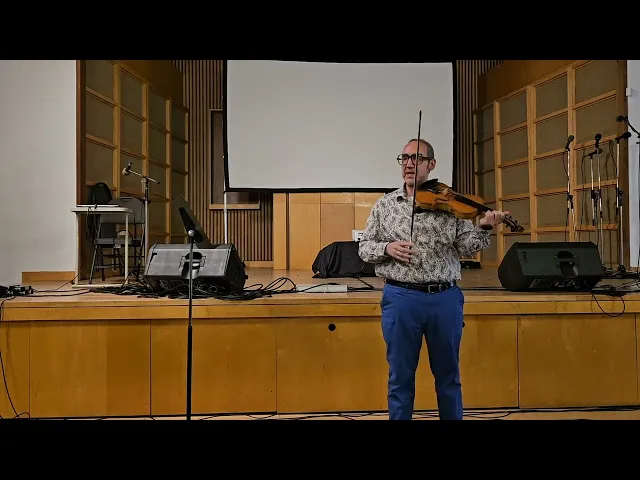
Hi everybody hello I'm Sammy abim um really has been a fantastic conference so far I really appreciate what everyone has presented and said really resonates a lot with my work uh I'm going to do something similar to what we did yesterday we're going to do some participation and singing but I'm going to speak a little bit more uh about the politics of what I'm doing today um I'm going to be presenting an exerpt really from an unpublished paper that I'm calling right now the politics of musical scales and the decolonization of Music studies but it's
like 20,000 words so present the outline of it um I feel like to introduce myself I should contextualize since I'm speaking about decolonizing music studies I should contextualize myself as a Palestinian American who grew up in The states disconnected from my own Heritage studied Western FAL music and who um I decided in my early 20s that I wanted to be reconnected to that cultural heritage so I um traveled to Egypt and Syria and studied music uh there uh and that for me the process of decolonization is very personal because I had to decolonize myself myself
I came in with Western assumptions I studied western music theory I learned music From notation and I went through a whole process by which I learned how to learn music by ear I learned what oral tradition was immersed myself in it and then started to question all the assumptions I had from what do so that's my introduction for myself my context of of who I am um but let's start by singing everyone stand up please so I'm going to review a little bit of what I said yesterday for those of you Who were not here
uh yesterday and uh the first thing to say is that mam comes from the body it's not an abstraction it's a physical skill like dancing or cooking or anything else we do with our bodies so let's start by paying attention to our bodies take a deep breath notice the feeling of your feet on the Ground how does your back feel these were like really intense emotional presentations do you feel the Resonance of what you just experienced do you feel it in your body feel your nose the backs of your knees let's take another deep breath
now let's uh shake it all make crazy sounds come on who's your voice dance around jum around if you want [Music] to and now let's do laughter because again laughter activates the diaphragm ha on your diaphragm experience feel your stomach jiggling [Laughter] and let's now settle down for a minute notice your legs feel the weight on your legs feel your heartbeat feel your Breath and let's start to make sound from that feeling in your body and with your diaphragm uh uh uh [Music] [Laughter] so repeat after me [Music] [Applause] [Music] yeah yeah [Laughter] [Music] [Music]
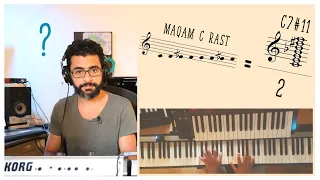
[Applause] [Laughter] [Music] so we've been in this first part of the M what we call Jin bti can everyone say Jin bti jinin to review Jin comes from the Greek word genus the Arab theorists uh adopted that term when they were translating from the ancient Greeks they adopted the Greek Tetra cord Theory like 12200 years ago [Music] and a gin for me is more than just the intervals more than just the notes it is also the melodic vocabulary that we're using as I said yesterday this is like a language class this is like Spanish class
I'm teaching you the words the melodic words of the language when we make larger Melodies we are making them exactly the same way we make work uh Sentences in spoken language we are building sentences from words we're building paragraphs from sentences the Gin also has a particular mood which is somewhat subjective but what is Salient what's important in Arabic music is this contrast among moods so I'm going to change the mood in just a moment and I want you to sort of notice how it feels so here we are in Jin spti [Music] [Music] [Applause]
[Music] feel a very different mood right this is Jin a can say Jin [Music] [Applause] [Music] [Music] [Laughter] [Music] [Applause] You feel that we return to the B yes [Music] [Applause] [Music] [Music] this is [Music] [Applause] [Music] [Applause] [Music] [Applause] N yeah [Music] [Applause] [Music] [Applause] [Music] [Applause] [Music] how each one has a different mood a different feeling from uh each other [Applause] [Music] [Laughter] [Applause] [Laughter] this is Jin rust m do you feel the difference between let me just play for you for a moment here's [Music] rust and here's NOA feel a difference in
the mood anyone want to compare and contrast what does rust feel like what does nan feel like give me nice [Music] adjectives no come on has like a kind of different almost hope feeling in it and the how is a little bluesier maybe I mean rust is kind of losy too in a different way the important thing is that you sense the difference and I'm going through this really fast uh because we spent a lot of time with this yesterday but rust was the main G of the maom we did yesterday Ma 6 that was
the bottom gin now it is the secondary gin we're moving to it as a later part of this m so the as each one has its own identity I gave the example of uh we we identify each like we identify a person or a friend um and in Arabic music it's the drama the contrast among these different ASAS that gives us the story of what a makam is so far we've done four bti aan rust no I'm going to throw one more at you Well let's continue where we were [Applause] [Music] [Applause] [Music] [Applause] [Music]
[Applause] [Music] [Laughter] [Music] [Applause] [Music] [Laughter] [Music] rest rest break that down [Applause] [Music] [Music] yeah hij [Music] [Applause] [Laughter] [Applause] [Music] I'm just going to sing you a quick song that shows you goes through some but not all of these you guys can sit down [Music] [Music] [Music] this is a popular Syrian wedding song Oh beautiful one you who um uh who makes my friendship or I'm Connected to but from oh oh you who with the fire of Love burn me um and then from all of my longing for you I can't sleep so
you hear that [Music] it's going between the and [Music] the we're in the [Music] So we [Music] have so in one simple folk song we are going through four different as I we discussed this in detail yesterday so the the point I want to make here is a couple one is that the structure of mam is not a scale that has a a bottom and a top half um that this description from ancient Greek music theory is not accurate that you just have one Tetra cord and another Tetra cord and that Makes the scale what
we see in actual reparatory is this movement among these eaps frankly you hear the same in Persian music Turkish music Greek music Etc um so this is one way in which the theoretical understandings that we've been given do not match the Repertory I prefer to approach uh Theory by looking at Repertory and the other things that I wanted to say to bring to review what we Said yesterday is that this structure is not a structure that someone just invented on paper for for some reason it is a language spoken by a community so the patterns
of movement that we're seeing from one gin to another are there because of the community because someone decided to do it and other people imitated it and they copied it and they shared it so the structure itself arises from the communal Interaction it is cultural knowledge just as language is for us spoken language is cultural knowledge that individuals contribute to but is not the invention of individuals it is a shared body of knowledge that evolves over time that is changeable um and that is basically Inseparable from the community the community doesn't exist people are not
exchanging this information the makam does not exist so to summarize from Yesterday the mam is in the body and it's in the community it is structured by the physical interactions of people by the physical body by the physical instruments and the constraints of those instruments and it arises from that um so I'm going to get into the topics today and I want to start with sort of what's going to be my little opening statement on this paper why should a painter or fashion designer favor the purest versions of Every color rather than complex Blended colors
doesn't each artist make their own choice of colors from the infinite spectrum of possibilities yes no does everyone have to use only pure red only pure yellow in their visual art or no h no hell no we must think of musical scales and pitch in this way especially when we look at musics from non-european cultures recognizing the influence of instrument and musical system on design on Pitch an Infinite spectrum of possibil with aesthetic choices that don't obey rigid mathematical rules the representation of scales as mathematically determined is inherently political creating hierarchies of correctness and Authority
when applied in a colonial con uh Colonial situation these assertions of authority through mathematics are a tool of white supremacy creating the conditions for exploitation and appropriation denying Agency to musicians and to colonized peoples and enabling cultural eraser one of the accomplices to gde so that is the theme today so I want to start with 1932 in 1932 Egypt Cairo hosted the first International Conference on Arabic music this was sponsored by the Egyptian king of course they were still under British colonial rule but it was an Egyptian effort and musicians from all over the Arab
world came to this conf conference Uh there was a very productive musical exchange from Iraqi musicians coming some of the Egyptians heard Iraqi music for the first time Iraqi music is somewhat different than Egyptian music there's a number of recordings so there's a lot of value that came out of this conference some famous westerners were there the composer Bella BTO was there The Scholar Henry George farmer was there one of the efforts of this Conference was to fix the maam scales so what do they mean by fixing to regularize to systematize the maam scales the
idea was that the maom scales themselves were too messy and needed to be systematized so let's talk for a moment about the messiness of sces so first of all in what we were just doing today we have bti [Music] this note so I'm playing on B this is Roughly a c half sharp can you [Music] sing now if I'm going to sing a different scale rust on [Music] a do you hear that that note is slightly different sharper a little bit sharper right here we have the bti see half sharp and here's rust totally okay
slightly different we're talking about four or five cents But you guys can hear it okay um I have a video you guys can find on YouTube where I demonstrate that between one semitone I have approximately 12 different pitches right so here's like for example a super low C natural if I do B on this [Music] note here this [Music] note but if I do n one on this that would be another C natural if I do [Music] c still another higher note I have multiple Flats I have multiple half Flats I have multiple Naturals right
I [Music] have so are there 144 divisions of the oct no these are not evenly spaced the other part of the messiness is this so I'm talking about within one cultural Tradition within Egyptian music you have these intervals and if I'd sing rust in Egypt we were doing the song [Music] Yesterday sing with me 1 2 3 1 2 I sing a Syrian song [Music] here this third note can everyone [Applause] sing the Egyptian One okay so the same scale is using um different intonations regionally furthermore we saw we have thankfully we have 120 years
of reporting if you listen to mam rust in Egypt from the early 20th century to the late 20th century you will see that the third scale degree of mam rust went down over the course of the 20th century in the early 20th century it's high very closer Closer to Turkish and ottoman music it became it got lower over time so what's happening what we see in actual practice is that the intonation of these notes in the scales varies geographically it varies historically and there are different varieties in different scales in the same tradition so we
have an enormous variety of notes all of which you guys can hear and which anyone can learn by ear so the question of of the Math is kind of stupid because having something match a particular acoustic interval doesn't make it easier to sing it is all muscle memory you are learning just like we learn the vowel signs all of you Canadians speak about or something I can't even say it I don't even know what it is I don't even know why why do you keep saying that about us yeah so you guys can't even hear
your own right but to me it sounds different Right you learn it and I learn my vow differently right we just learn it by ear and this is muscle memory that happens so this is why I reference the whole spectrum of pitch is possible for us and we select music from that spectrum and different people make different cultural choices not based on acoustic phenomena so the idea that there should be a mathematical rationale for pitches which is 25 100 years old infected this Conference and they said okay well we can't there's it's messy so well
the 24 divisions of the octave system that that people thought about to talk about coron isn't quite enough so let's use 54 divisions of the octave and this is this idea has been adopted in Turkish music and Turkish musicians will tell you yes there's 54 divisions of the octave the most brilliant musicians they're wrong cuz how many a are there on the Turkish G 12 17 so they can't be 54 divisions of The octave right theorists don't know what they're talking about but they assert that there there are these numbers of divisions of the octave
and that therefore okay we're going to decide that the Egyptian one is 4 9ths of a semitone of a whole tone andan is going to be F they determined this they decided at the conference but they tuned instruments and they had musicians play they had them try out the 24 equal tone Pon and and the musicians are like no this sounds like that's what happened at the conference so they kind of like prevailed with their effort to regularize it and systematize it but the point here is that attempts to fix scale tuning are precisely parallel
to attempts by colonialists to erase indigenous languages there's this right in the in the North American context we have uh Native children being taken from their families being forced To speak English in in schools right we have a thousands of examples all of you know I don't need to recite all of them but native cultural forms anywhere in the world have been subject to eraser and violence and it its language its cultural forms its means of exchange the scale system of Arabic music is the same this attempt to regularize and fix it comes from the
same place and has the same effect so what is the effect of it as you know from the colonial context if You strip the colonized person of their identity of their own culture you have power over them and the power takes a number of different forms one of them is what I would call legibility in other words the the colonizer doesn't understand these varieties of scale so they have to flatten them regularize them make them legible to to themselves so that they can talk about it so that they can Describe it so that they can
analyze it so there is this sense of power through making it legible to the colonizer and that is essentially this is you know something that is not original to me this is a lot of cultural studies look at this form of colonization and Edward S mentioned earlier talks about how in his book culture and imperialism how the use of the idea of the superiority of the colonizer culture Is a part of imperialism and it helps with the project of imperialism it's part of the political prop of it Edward Z ironically exactly looked down on Arabic
music and thought Western classical music was Superior so anyway sorry it's complicated so let's talk about a second level of this problem and this goes back to ancient Greece so we we have to look at our assumptions about um about music Theory and the first assumption is the neutrality of mathematics there's this belief that math is neutral and that therefore we're discovering mathematical laws and that that is how we're you know we're just discovering something it's out there in nature it's neutral um the question is where does this idea come from um and and it's
tied to this idea of the universality of Western Culture so mathematics the westerners discovered Western culture is universal is the idea of the colonizer and Mathematics is part of that so all we're doing is we're matching the mathematical truth that is the view of western music theory as applied not only to to itself but to the rest of the world I'm going to read some direct quote second level of my critique here is that the practice of making scales legible to the standards of western Music theory is more Insidious and subtle because it adopts the
neutrality of mathematics as a screen the framing is that it is mathematics not European culture that Arab musicians need to conform to the Europeans have simply discovered the mathematical principles and are helping the field of veric music by disseminating that knowledge such a view can also be embraced by the rational by the rationalists in the Arab tradition who Will take it one step further since the Europeans learned the mathematical principles of music from the Arabs themselves the process is simply a continuation of the great tradition of NE Eastern rationality Science and Mathematics which extends from
the ancient Egyptians to the ancient Greeks to the medieval Arabs to the Europeans back to the Contemporary Arab world ancient Egyptians because where did Pythagoras learn about scales from Ancient Egypt and from the Babylonians so there's this mathematical idea that precedes Pythagoras but what is Pythagoras's Innovation Pythagoras's innovation in music theory is not the discovery of harmonic intervals in in in integer ratios that was known by the Egyptians Pythagoras's Innovation is making it into a cult okay there was a cult if you can look this up the Pythagorean cult in Ancient Greece which worshiped mathematical
ratios and believed that the entire universe had a mathematical Harmony and that that is what what had to happen so it was a religious belief that these musical scales must be the true versions are the ones that match this mathematical idea so this gets an addition prop in the in the ideas of Plato and I'll again quote myself Plato explicitly equates mathematical Purity with aesthetic and Political correctness he has so Socrates state in the Republic that certain musical modes scales should be prohibited by the state that the lydian mode expressive of Sorrow should be banished
that ionian Melodies expressive of drunkenness and softness and indolence should be banished that only Dorian and Fran Melody should be permitted he states that quote panharmonicon and virtue and is an important tool of education and of the Regulation of social life um implicit in Plato's writing is a simple fact complex pan harmonic ornamental quote unquote microtonal music did already exist in actual musical practice because if it didn't there would be no reason to prohibit it there would be no reason to force Conformity to the Pythagorean numerical ideals if the music played in ancient Greece and
the ancient near East were already conforming to those ideals so Plainly it didn't so we can see that dating back to the earliest music theory in the Western World the dichotomy between theory and practice already existed and this dichotomy was never neutral it was and is explicitly political carrying an agenda of purification from the messiness and complexity of actual practice M so this is the beginning of the trend to mathematize as a form of Power so we have this platonic ideal what the platonic ideal is that reality is messy and that there are ideals and
we have to find the ideals mathematics is simply one form of it but mathematics is the purest form of it right so we can really make everything pure through mathematics and ironically what happens in the history of music theory in Europe is that this belief that musical scales are based in mathematics remains even When the harmonic ratios change so we have the evolution of equal temperament and different forms of temperament in the west where we're no longer using just intervals based on pure harmonic ratios but still it's based in math logarithmic scales now or different
calculations so there's still this belief that it is mathematic that is guiding the scale rather than what is actually happening think about the evolution of Scales in Europe there were cultural reasons to change the scale from just intonation to different forms of temperament eventually to equal temperament there was a desire a desire to modulate in different ways in those scales there was the construction of keyboard instruments so the physical construction of instruments the shape of the instrument the way that music is made and the desires to Modulate in specific ways guided then a solution was
found in mathematics it's not that the math guided it it's that there's a cultural social Choice that's being made and Mathematics is being used to rationalize it so it's still not math however there is a second effect of this which is the math is difficult the math is misunderstood so math becomes a tool of gatekeeping it creates a mathematical priesthood of Music theorists who know More than actual music practice practitioners this mathematical priesthood it's it's like toic astronomy so as you all know tmy developed an astronomy based on the idea that the Earth was the
center of the universe and everything rotated around the earth he then created a mathematics around that the mathematics is horrendously complicated because the Earth is not the center of the the solar system let alone the the the universe so There's this very complicated math that you have to do to figure out toic astronomy and nobody can understand it except a few Elites and it's wrong it waste your time so that is 2500 years of Music Theory okay is essentially tmic astronomy is this idea that have these things that are mathematically Justified and that very few
people can understand them and they create systems that rationalize Themselves and those who understand the system join the priesthood get academic positions all over the world and those who don't are Den so what we have as a result is the Erasure of differences in multiple cultures so what I describe as happening in Arabic music in the 1930s actually starting from the 19th century to 20th century it happened in America to black musicians the idea of the blue note is the essentially the idea that They they're not really playing that Noe there's something wrong it's off
they're sliding from it it's not really that no so microtonality in black music was erased partly the use of equal tempered guitar instruments erased the the the inherent tality from the blues you can still hear it in recordings if you hear recordings but those musicians who do those recordings like sun house and so on they're Uneducated because they learn by ear they didn't learn through notation I'll talk about that in a moment there are examples of this I learned from a couple years ago I I spoke to some musicians in calibria in Italy who were
like yeah after World War II our micral is a race I've heard it from Greeks I've heard it from you can hear it in all kinds of American music here in Swedish fiddling there's microtonality all over the world and the regularization of it due to like Let's conform to the Western scale let's conform to a mathematically rational scale erases cultural difference and so that is this use of mathematics to say those who get the math are right and everyone else who is uh you know who's a practitioner is ignorant uneducated so I want to propose
another framework and I alluded to this yesterday another framework for thinking about music and how musical scales are constructed and How we determine these things and my framework comes from cure and comparative linguistics so cir Ferdinand cir was the first really linguist to articulate uh the idea of of comparing different cultur uh language forms and before sere Linguistics was very platonic in the sense of finding the correct version of a language after cure we start to recognize that languages there's no one correct Language there's dialects that are no different from the master language Master language
and quotes um and cir created a he didn't come up with the idea of arbitrariness he took it from Charles Sanders Pierce an American theorist but he brought it to Linguistics the idea of the arbitrariness of the sign so arbitrariness is a very important concept here arbitrary in English people colloquially think oh it's just random It's just something that that doesn't have a rationale in linguistics it has a very technical meaning it means selected or Chosen and it means also culturally selected so the idea of the arbitrariness of the sign specifically is that there's nothing
about the word paper that comes from this paper what's the word what in Arabic is what this is um I don't know what this Is in Canadian English but anyway sorry so there's nothing about this that says it has to be paper rather than what so there is an arbitrary connection between the thing signified and the sign which is the word but this arbitrariness extends Beyond simply signs and things signified and this is where I bring in the ideas of information Theory so information theory is a branch of mathematics that was developed in the 1940s
uh to describe communication systems and it was used to analyze Telegraph communication and eventually formed the basis of all of our modern telecommunications so was trying to find out what's the most efficient way to communicate and I referenced this yesterday that we use codes to communicate we use symbols and then we build those symbols into larger words I Illustrated that with you yesterday and Today that with mam we're not talking about single notes we're talking about melodic fragments that are held in vocabulary that are known to speakers of this language um so this is how
communication systems work because of as I referenced yesterday because of the needs for efficiency in communication systems due to energy use the brain is the most uh Expensive iive energy using object in the universe so we have to be economical about how we use energy but the same form of communication we find in DNA meaning that there are four letters in DNA a c GT but that doesn't mean that every combination exists specific words in DNA exist so the combination of smaller units into larger units that are then stored in memory is a feature not
simply of human Communication but is a feature of Life communication and it it's dependent on energy it's dependent on certain things that we won't get into but if you're interested issues of noise and redundancy in communication uh redundancy is very important in uh symbolic communication so what do we learn from comparative linguistics one thing is that there's no master language that all languages each speaker Of their own language is speaking correctly in their own grammar there was a fascinating uh political and I I reference this as political because there was this idea in America that
black Americans spoke bad grammar when linguists actually studied the grammar of black Americans they coin this term be black English vernacular they discovered that black people spoke in better grammar within their dialect than college educated white people spoke In their dialect their grammar is more correct when you recognize the comparative nature that there's no one master language and that people are speaking in different dialects and different versions of the language you then start to see that that something that is a a way of denigrating people politically because they don't speak the master language has no
basis in actual Reality and that's what I'm talking about with music the the challenge here that we have philosophically is a concept also from CER called the mutability and the immutability of the sign the idea here is that our language we inherit we believe it is universal we believe it's given by God because it comes from our forbears and we can't change it I'm using words that you all know that I know I can't make up new words and then You guys suddenly understand what I'm saying so the individual can't change the language so it
seems immutable it seems Eternal however language changes over time it is in fact mutable but it is hidden from the speakers of it that feature of language is what led people obviously there's political reasons right there's desires to colonize there's belief in the inferiority of the other but there is a An inherent psychological and philosophical basis in the way that we cognitively experience language that makes us believe that our language is true and is handed down and only when you do comparative linguistics do you start to see that that oh no there's differences and that
people do things differently um the problem then with music Academia is that music is not truly comparative in Academia in the way that Linguistics is music Still Remains Essentially locked into a platonic view because we have musicology and music theory and music composition and then the rest of the world all in ethn musicology right so there's no real comparison that's happening in Academia so music theory is still 100 years behind Linguistics philosophical perhaps more um um this creates this is another prop for power for institutional Power so another level of this uh that I encounter
a lot um is over the years that I've been kind of putting educational materials on Eric music on the internet people reach out to me and like can you tell me the rules for Arabic music can you tell me the rules for mam what's the rule how does it follow [Applause] and the assumption that there are rules I would say is related to this platonic Fallacy that there is some truth and that the role of Music Theory is to discover the rules of Music That's What We believe the idea of Music Theory to discover what's
really what is really going on in music that's what music theory is is for right what is really going on so um let's sing it again stand stand up again [Music] [Music] [Laughter] [Music] [Applause] [Laughter] [Applause] [Music] [Applause] now you should already start to be feeling that you're familiar with some of these melodies already yes we've done them we did them earlier before we were talking that familiarity means that you're starting To learn these Melody words now if instead we had a framework where I said okay in M you're supposed to go from this note
to that note well if I say I'm supposed to go from this note to this note well there's a thousand ways to do that I go I go those don't sound like Arabic music so I say okay we have to go up in scale right I could make any number of rules to try to Define this but the reality is That there's specific vocabulary items that you have to learn and that's what it is it is this vocabulary that is making it up so the idea of rules is an idea of reduction oh if we
can simplify but there's no simplification so again think about spoken language how many words that I used today how many different words that I used in in speaking with you today you can't come in if you're not a speaker of English and say well I Learned the rules of how to generate English words it's ridiculous I generate English words by taking this letter and then moving to that letter no that both creates too many possibilities and too few possibilities the existence of words in language are arbitrary using this word again they are selected and they
are learned this is an important con from information Theory as well that it is a Code that is remembered exactly by the sender and by the receiver so there is no reduction possible um you can sit down again I like making you sit down and stand up you're like a priest in [Music] church so essentially what I'm saying is that there is a large amount of information content in a musical system just like there's a large amount of Information content in a language we're storing this enormous amount of information contact in our in our brains
you all have heard the 10,000 hours idea of Mastery 10,000 hours to learn a skill to learn a language to learn a musical system how many decades uh Mr Dy how many decades did it take you to learn creep music mus how many decades did it take you to learn music well I've been working on it for Six and I'm still studying right there's so many right I'm I'm uh I'm a man in my late 40s I still learn a new word every once in a while in [Music] English right there's there's a huge amount
to learn that can't be determined by saying oh this is the rule that's what generates it no someone came up with the rule someone came up with the word and and that's what it is and so This is essentially this is where you get to the political side of it again if the reality of the musical language is that there's this enormous amount of vocabulary but the Westerner comes in and says well let's find the rules it is an idea of simplifying it to have power over it now this same phenomenon happens internally so what
is happening in the west with westerners describing their Own music is an internal colonization by music theorists of Music practice but in the colonial context you're you're saying essentially oh this mam stuff is really simple anyone can learn mam you don't have to spend 10 years just learn the scales and like you learn a few rules oh you go from Jin bayti to Jin rast and then Jin nand and then you're good so there's this idea of simplifying it to make it easier for westerners to approprate So again simplification defining something in terms of rules
is a form of power it's a form of trying to make something that we can Define it right Define make legible make understandable to whom make legible to someone who doesn't get it because they didn't learn the language right so if you're trying to define something in that way it's automatically coming from this out side context because the language can't be Reduced you want to learn mam you have to learn all the vocabulary of mam that's that's what mam is m is not like I wrote these notes out and I wrote this set of scales
and a set of rules that you can put in the book yes I wrote a book what do I say in the book you need to study poorly that's why we wrote the book because people need books in Academia so we wrote In the book here go stop put down the book and start learning about you that's basically what We wrote In the book um and and this reductionism I would say applies to Western views of their own music theory and even in classical music so the very interesting book came out in 2007 Robert gingan
called music in the Galant style and he's the Galant style is is 18th century music and he's referencing mozark and the contemporaries of mozark and in that time period period there was an Explicit reference to vocabulary harmonic vocabulary what gingan calls schemas these are harmonic sequences that are underlying the music and what gingan talks about in the book is how contemporary listeners to that music at the time could recognize by ear the specific harmonic sequences and they recognized when a composition used it so a composition wasn't just no no no note note or cord cord
cord cord cord it was the romanesca sequence the I'm not Remembering the names of it because I been a while since I WR B but this sequence oh and then that chord sequence and then that Each of which had a name and a vocabulary so this was kind of radical in music theory in 2007 which is ridiculous but essentially he's asserting that and he he couldn't even use the word vocabulary like he did brilliant work but he has to use words like schema he's talking about Words can see I'm angry about this so even this
is not like mainstream in music theory and he's describing something that that that we should know because it's true of music I'm I'm making I'm I'm going assert for you that this is how all music in the world works the brain works this way you acquire music in chunks cuz everything else we're doing cognitively is in chunks and if you you go through and believe that music theory is about Determining the mathematical laws of scales and then based on that then figuring out the mathematical rules for how notes are supposed to move then you're going
to totally miss the vocabulary and if you totally miss the vocabulary you have no way of analyzing your own music which is what western music theory is they have no way of analyzing their own music it is equivalent to us analyzing the words in English by simply making Rules about how the letters there there is you can make uh you know the study of phology but phology is such a small part of language they're basically doing phology of music and calling it music theory they're not recognizing that there is vocabulary and by not recognizing that
there is vocabulary in music then they're not going to look for it in other musics so when western music people have this conception of a music that is rules Based mathematically based they have no idea that there's vocabulary then why would they look for vocabulary in other music why would they assume that uh they have to learn the vocabulary of another musical language they don't so the vocabulary of these other musical languages is missed and western music theory neither describes western music well nor non-western music well the final important point that I want to make
here is about oral versus Written tradition and we know that for the last 100 years or so notation has been the primary means of Music pedagogy in the west and in fact non-western music is often filtered through notation and in in the Arabic context um in the United States I encountered Arabic music first through notation Arabs believe that they had to use music notation in order to uh have their music be disseminated teaching people using pure Notation uh it is used in the Arab world it started more in the late 20th century with people using
notation more and more and more and I had a a fascinating experience with notation because I came to notation as a a western as I said I grew up in Pittsburgh Pennsylvania my father didn't speak Arabic in the home he wanted us to assimilate it was hard being a Palestinian in the 1960s 7s 80s he didn't teach us Arabic so I learned western music I learned Western notation I didn't hear Arabic music so when I first started learning Arabic music by someone giving me a sheet of music I'm playing it as someone with experience reading
music in the west and having oral categories given me by the West trying to interpret Arabic music so I couldn't sound like an Arab if you take someone from Egypt who grew up in the Tradition and they know how to read music and you give them a sheet of Arabic music they can play it and they'll sound like an Arabic what's the difference this goes to something that Trisha was saying yesterday which is that notation does not convey the full context of the music but if you come come in with context already notation is a
shorthand one when I was studying um some Medieval music in graduate school one of the professors Was saying the notation was a pneumonic people learned the songs by ear already and the notation was just to remind them oh you have these four parts we have to work together on this like so the notation is super simple because people are not using it to tell them everything about the music this illustrates a very fundamental point about notation and I again I'm referencing information Theory here and the mathematics of Communication I want you to think for a
moment what is missed in notation so scaler information all of this detail about intonation is missed I I told you about 12 different like notes and Regional differences if we invent a notation that we could invent like the number of cents in this particular practice but then it becomes unreadable you have to have the oral context so so the notation the Intonation is missed the specific rhythmic characteristics of Music are missed because music although it has rhythmic patterns they're not like they're not like a metronome music patterns some beats are heavier than others we have
the same beat as performed in Egypt and Syria and the way that the Doom is how much time is allocated is just slightly different when you do like a uh an analysis of music not through notation but through Just actually the recording and and analyzing it in terms of temporal sequences you notice that these quote unquote equal rhythmic categories are not equal right so notation erases the Nuance of that it erases the the cultural information the specific so when I talk about these differences between Egyptian and Syrian mam rust it's Salient culturally because you can
identify a musician by where they come from just like I can identify you All as Canadians because of the way you speak you can identify me as an America right I can identify someone from Boston someone from Louisiana right you all know that you can identify someone from a different region from Australia from right just by that that happens in music you identify people by exactly where they're from because of those details that's erasa notation the individual qualities of the speaker Of the singer the emotional Contex the blah blah blah blah blah blah blah all
of these things are erased when we use notation and there is literally an informational Gap I want you to compare the file size of a PDF versus the file size of an mp3 for the same musical piece there at least a 10 times difference in terms of file size right that's a rough puristic for how much information is lost when you Transcribe right right you're losing 90% of the information carried by the musical sound when you transcribe music so all of these things that we're talking about finally have another political Dimension if we erase 90%
of the context of music and we're talking about music in journals through notation always notation we have to analyze through Notation we're comparing everything through notation you're erasing 90 90% of what's happening in the music and you can't really do an analysis of the music because you're missing most of the information so when we compare the political side of this is that it's continuing to uphold Western Pony and white supremacy because the use of notation in western music has become so endemic to the music that there's a certain complexity that Arises in western music through
the use of notation right our use of Harmony pipany um the details that are communicated through notation are very precise in western music because there's this desire to communicate about it in this comprehensive way so when you look at the notation of a western piece and the notation of an Arab piece well guess what the aab piece looks deficient the Indian piece looks deficient the whatever piece looks Deficient so when ethn musicologists and Scholars are are going around and they're going and they're trying to notate folk songs like this and then well the folk songs
seem simple the Hungarian folk song seem simple because you're notating it in a system and stripping it of Contex so then this becomes something that furthers the idea that western music is superior to non-western music because the complexity is present in the Western notation system and not present in the notation of the non-western musics so I have described um a number of ways in which the the use of Western tools specifically mathematics um the ideas of rules uh the use of music notation have been essentially tools to for Arabic music and not just Arabic music
for music around the world to basically put it on a lower level to Western Music um so to summarize from the political point of view the colonizer creates Power by creating standards and the power comes from conforming to the Western system everyone else around the world feels that they need to put their music in notation in order to be part of the elite and in Arab in in educational institutions in the Arab world people are taught through notation People are in fact taught in many cases in in conservatories in the Arab world taught western music
before they get to learn Eric music as an elective why because they look down on their own music because the colonizers told them it was inferior and they believe the colonizer so there's this Perpetual system of happening of the westerners are bringing in their systems of thinking about music and the colonized peoples are Adapting to those systems and therefore adapting adopting The View that their own music is inferior and that they have to learn western music to be superior this results in cultural loss because if you people practice the the music and fewer people practice
it in oral tradition right so this description that I gave of music of um 90% of the information being lost in transcription well guess what Transmission even within a culture through notation loses information and so therefore when you lose oral tradition in music practices you're losing the music you're essentially losing what is happening people are not speaking it orally the music is dying and disappearing so much more important for me from my own perspective than say preserving musical tradition specifically is preserving the act of learning music by ear because that's how The full context of
Music gets communicated within communities just like learning language by year so you have this cultural loss from the use of notation and the ideas of rules-based systems and Conformity to rules and then after the cultural loss you have further value judgments of as I said superiority and inferiority because you had the cultural loss so then you can value it as less Superior and then there's an acceptance By the the colonized communities of their own cultural loss of their own inferiority so it's this Perpetual cycle that is just part of this whole process of dehumanizing uh
the col ized people I'm not saying it is at the level of bombing children in hospitals but it is part of this process as is eraser of language as is acial cultural forms um and so when I talk about Decolonization of music theory of Music practice of Music pedagogy [Music] there's an expression I love from um uh from the black left in in America like putting Black Faces in high places doesn't essentially change power structure and most attempts of decolonizing Music uh practice and theory that I've seen over the last Decade have been essentially that
let's get some non-western people to talk about music and there's still they got phds so every I'm sorry for everyone who has a PHD if you have a PhD your mind has been colonized okay so people whove already been mentally colonized are talking about music as the representative of the non-west who are the non-colonized practitioners the people who learn music from oral tradition period those are the People who learn the music as it is rather than a set of reduction reduced rules so for me decolonization looks like basically replacing the entire music faculty of all
Western academics Academia with practitioners of music yeah it's as simple as that that's de colonization anything short of that is a perpetuation of the system that exists um and what I will say is that Essentially to tie what I said yesterday back together to today is that cultural survival requires Community Practice it requires exchange it requires people to be sharing just like and again I think about it in terms of language loss the statistics are that there's something like 7,000 spoken languages and that every two weeks a language dies because the last speaker dies and
by the middle of this Century Half of the languages will be erased we have a lot of indigenous languages that are being erased because the community of speakers is smaller and smaller and smaller thankfully some I know of some indigenous communities in the United States that are making efforts to reinvigorate the youth from it's hard to get young people to speak a language when it doesn't benefit them because they have to speak English to right there's all kinds of trade-offs That we have that we face when we're dealing with cultural loss and and dominant hegemonic
culture but the language doesn't Survive by being put in a dictionary being put in a book or even by being recorded it only survives when people are practicing it together that's the only way for language to survive because as I said yesterday the language itself is the community it is the product of the community it exists in the brains of the Practitioners it exists in the body and in in in the the the exchange among people so let's sing to finish off [Music] [Music] [Applause] [Music] [Music] [Applause] [Music] [Applause] [Music] [Applause] [Applause] [Laughter] [Music] [Applause]
[Music] [Applause] [Music] [Music] yeah yeah [Music] [Applause] [Applause] [Applause] [Music] [Applause] [Applause] [Music] y [Music] [Music] [Music] yeah [Music] Yeah yeah yeah yeah yeah [Applause] [Music] [Applause] beautiful job everybody beautiful you thank you a few questions I mean we should we should kind of stop for dinner but I'll I'll take a couple Questions or you can find me at dinner and ask me more questions but please any questions you guys are hungry huh bu you downstairs no yeah go ahead I have a question but really I don't know how how to say it you know
it's a bit different between Eastern countries and Western countries and about Eastern culture and Western culture and sometimes there's a conflict between you know uh as you told between the university and you know I Mean the practicing at home you know as I know the science comes from Western countries to the Easter countries are we [Music] right and I mean contemporary science does of course yeah I mean but you see the difference between you know the Science and Arts what's the difference between science and art no no no I want to say That the the
science comes from the Western culture or countries Western World I and this and art you know as how can I say you know the most of them or the more attractive kinds of them come from the Eastern countries so how can we you know put a balance between these two because you know there are some of some Masters in Iran that they say that the notation is they disagree with Notation that's that they say that's we have a kind of academic lessons that we just learn You by ear you know like a baby that when
they they are born as you thought but some others are telling that is is not acceptable because you have to know the knowledge of you know the dictation the shift you know this kind of um instrument that you you have to learn to you know speak About your a sense I mean speak about yourself as a musician as a as an artist so I want just to ask you how can we put a balance between this two big items I I don't know how did I did I well let me let me try let me
try to address that um I will say unabashedly that it's my personal opinion that notation gets in the way of any Music trans transmission even in the context when people have an oral understanding because notation is adding an extra cognitive step that isolate that separates you from the to so again this is my bias from my own personal experience I acknowledge that there are modes of analysis and description of the music that rely on notation I still beg To differ from the gentleman at the morning that they are necessary to use notation because there are
ways of doing analysis that don't need notation notation Tri but I acknowledge that there are ways of uh doing analysis that use notation whether those forms of analysis are useful to practitioners is another question that I have again I beg to differ that that analysis has value I don't find that that analysis has Value because it gets in the way of Music practice I do think that there people have argued with me and saying how are you talking about you like say all music theory is is but you're doing music theory right I'm doing I'm
actually doing music theory here right now right I I would say that the mode of thinking about and I have acknowledged I've used two particular paradigms of linguistics and and the mathematics of Information Theory as things that to me are much more consonant with what I see experienced in actual practice than for or for of Music Theory so I acknowledge that I'm involved in theory but most of the time I'm doing this kind of theory because I can't just go and teach people music by ear because people don't think that you're supposed to learn it
that way because people think that that's inferior I'm using Theory to demonstrate that theory is wrong that's Why I'm doing music theory because I have to prove to people that oral knowledge is superior to written knowledge because people don't believe it because people are so so colonized internally that they believe that we have to elevate our culture by using notation by by defining the rules of it that's colonialism it's internal colonization I know you Can all this in black and white and probably you know said I'm going to break the colonizing rules of not actually
disagree but this is a Rel please disagree I totally disagree with you I mean this gentleman here is me but you have to put his Lang his question you in English and you understand it you communicate in an agreed kind of thing notation sometimes is just an agreement in order to remember things and you also Criticizing if somebody wants to know more about the music no I'm not criticizing for example but I right now say that I can go back and say you know my country was colonized by by Arabs so I shouldn't listen to
your music because like the colon it's just I have with a lot of things you know I just want to have very black and white and if you um I'm sorry it's just it's going on and on I just find that uh you know the fact that you somebody want find out how Music Works the brain is colonized the word that you just used is an insult because you know I started yes as a musician that just learned to play and I was I was curious to know what music is about and I wanted to
find out and I new the that well but I do enough to satisfy my curiosity so I can't just say that my brain is colonized I find that as an insult I'm sorry but you are insulting by saying that and I don't think it's right you know it's just accepting there Different ways approaching the same thing and I absolutely respect it or tradition and is absolutely necessary notation doesn't replace it not even Wern our music I go to the symphony and I criticize Theon the notice the same thing that was another but what one one
it the other way so it is notation doesn't replace anything of course it doesn't but you know it could you say that when somebody dies the language that language dies yeah if they had Written it then there's a way of at least trying to reconstruct it's never going to be the same thing but at least we have something to keep it for the future so notation is also for that preservation of something to have some um I just think that there's way of looking things and I appreciate you might want to be very provocative but
I just think that it should be a little bit more that's my op can I say um I mean I acknowledge That you're insulted um I mean you have all rights to be insulted but uh you didn't describe in what ways you're insulted I mean you saying that I'm insulted is one thing but basically describing why is it that you're insulted it's being implied very not in very clearly said anybody who's got a PhD the brain has been colonized that I can you explain why you think that is insult I I'll accept that At face
value I think that that's fair I think that that's fair to take that as an insult I I I respect that and I will say I'm speaking about my own personal experience and this is why I tried to contextualize myself at the beginning which is that I was colonized and my brain was colonized by Western music theory and by Western ways of thinking and when I went to learn music by ear by traveling to Egypt and giving up on music notation and and went To Egypt in Syria I learned how little I knew and I
learned how the categories of describing music were not accurate to the oral tradition so that assertion that I made is based on personal experience I'm insulting my my own self from 25 years ago as well and my 25-year-old self can take it but I I'm going to stick with that assertion because it's not just true in music theory it's true in all the academic disciplines Western Academia is a tool of colonization that has been true in all the humanities because it it is creating Frameworks from a European point of view that is being used to
ensure Western dominance and the dominance of the of the Western University around the world is one of the biggest tools of Western Colonial Hemy so I'll stick to my assertion I don't mean to insult you personally no it's not personal it's just I'm saying it can be a little bit with a little bit More Nuance exactly in the way and I think your own analogy of language I speak quite a few languages and the ones I speak best are the ones that I actually learned by living in that country I Liv in Ukraine at the
time that Ukraine SP Russian actually so I learned Russian really really well but at the same time if I do want to write an email or a letter or something to somebody who is Russian speaker I had to know also how to write that so I also Had to write it to learn the written way the grammar and all of that but it's true that because I was I speak that language a lot more fluently that let's say Ukrainian that I didn't know this and I only learn practic it so it's true that the tradition
or using analogy that hear and ear the best way of learning but I also need thatal thing to be able to communicate and to pass on and to continue and to to improve by reading Other things learning and you know just getting so that's that's exactly you can't say that you shouldent or anything I can and I'll tell you why because I'm using a cell phone and the the the metals from this are coming from slave labor in the Congo I drive a car and the gasoline is dependent on the US military Empire and I'm
Palestinian and so I am Driving on the blood of Palestinian children bro when I drive my car so yes you have to use English that's colonization we all have to adapt to a world in which there's a lot of colonial violence to say that we are we're all colonized here right now because we're speaking in English and and that that's that's it doesn't mean that the individual is uh is wrong for having to to to like you have to earn your living We I have to earn my living I flew on an airplane airplanes are
one of the to get here airplanes are one of the most wasteful things uh in terms of energy usage on the planet so there is a lot of colonial violence that surrounds everything that we're do the food that we get Etc so I stick by my assertion these are still Colonial things we unfortunately in our life have to conform to them but my preference for myself when I'm thinking about music and When I'm thinking about the things is I have to live with that contradiction and and the reason the reason that I present things in
in black and white is because they bomb people in tents and that we've been watching like I'm Palestinian I'm watching thousands of people being erased Colonial violence the the those of you who are black here like how many slaves were how how many people were killed in the Atlantic Crossing how many native peoples have been wiped out this violence is very real and unfortunately everything that we do contributes to it and participates in it so my preference for myself in thinking about it and in teaching music which is what I love and we all here
are here because we love music is to acknowledge the colonial violence that is inherent in the way we think about talk about teach and and transmit music um and to do the best I can so that's That's what I have to sayead two more wanted to make Ross and we have people are soundchecking in a second oh yeah in a second I'll be very briefly yeah I would like to say something about notation which is the following that uh yes indeed I do agree that the theoretical systems which have developed in the last century the
20th century primar in the Arab world in Iran in Turkey in all of the modal musical Traditions they're very much based on Western models and they are they don't really serve the musicians as best they should however notation is not something started there they themselves devise various systems quite a number of systems of not ation actually going back uh to Antiquity it's just that the emphasis was quite different uh nobody ever imagined that we're going to learn a Piece of music from a p piece of paper yeah and so you were learning the music from
a person but you did have this thing as a reference uh either as an age memory primarily as a pneumonic AG um and the emphasis was on writing it not with as much detail as possible but with as little detail as possible for the reason that what they valued was the freedom and the uh ability of the musician to take this basic material and to work it into his own way need it sort Of into his own way need in the sense of bread yes not in the sense of necessity um so there there is
a place for notation in this music but it just has a totally different role the Western World stressed accuracy in notation because of the orchestra when you have 100 people playing together and if you don't have a good system of notation it's not going to sound very nice yes so it's I think that what we have to look at is actually the the difference in emphasis on on the Usage of notation what you want to do with it if what you want to do is to standardize something then it is of course it's it's a
hindrance if just you want it as an assistance to your memory for example we have the old hotan system theum not which was from the 17th century no sorry 18th early 18th century which was invented by an Armenian and what you had was the thing called UL this was extremely important uh which were Rhythmic patterns and you would even it's even reported for example that a composer like Abdul Kadir maragi of the 14th century his new composition was just a rythmic pattern it didn't even say anything about the notes but what they would do is
they would they would give you this rythmic pattern said here are all the notes spread them out over this rhythic pattern as you wish basically and so there would be actually many many different Renditions of the Same composition and uh so so basically the notation was was for that purpose was to to give you some material to work with but they would leave you to work with it in your own way which uh I think is perhaps the basic difference yeah I agree with you 100% And I I referenced that in the medieval context and
even in the Arab context absolutely 100% And so yeah to be clear what I'm talking about is the use of Notation as the primary means of dissemination is the problem specific way of of having it be the dominant form rather than when it's a pneumonic Aid when it's just something that helping out then it can be very useful yes absolutely thank you all so much for coming